Financial Consolidation for Manufacturing Groups: Clean Group Accounts Across Factories, Subsidiaries and Distribution Entities
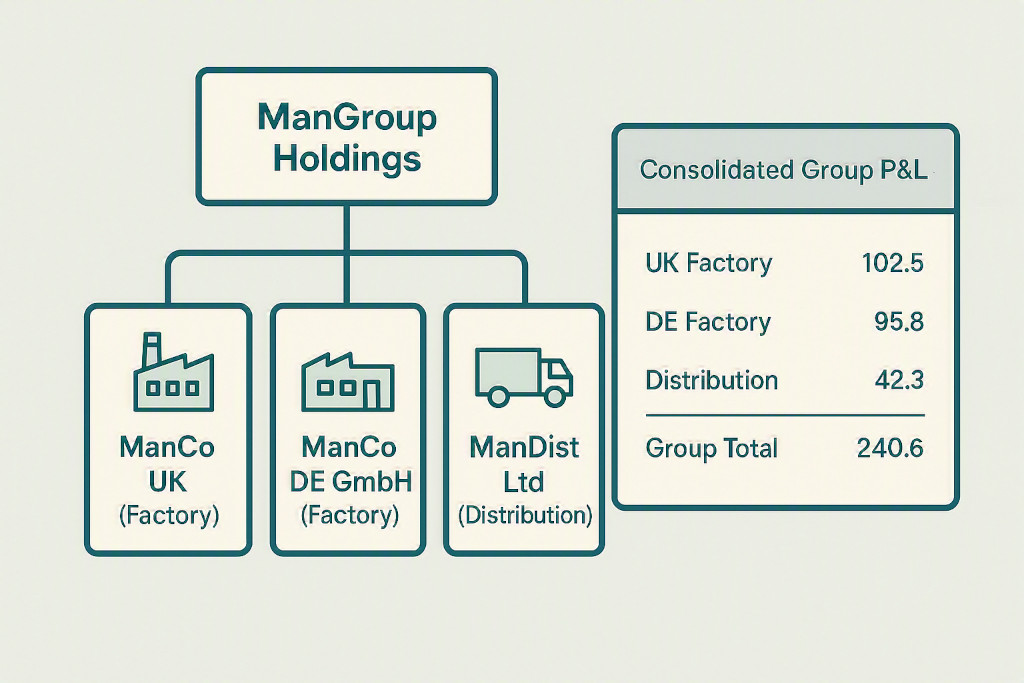
The group financial controller of a mid-sized UK manufacturer laid out the problem simply. His group had four legal entities — a UK holding company, two manufacturing subsidiaries (one in the UK, one in Germany), and a UK distribution company. The factories sold finished goods to the distribution entity at transfer prices, and the distribution entity sold to customers. Every month, he spent three days building the group consolidation in Excel: adjusting the intercompany sales, eliminating the unrealised profit on stock that sat in the distribution company’s warehouse at month-end, translating the German entity’s euro financials into sterling, and reconciling the whole thing back to a consolidated P&L that the board could rely on.
Manufacturing groups create some of the more demanding consolidation scenarios in practice. The combination of intercompany goods transfers, transfer pricing, multi-currency overseas factories, and often misaligned chart of accounts between sites means that financial consolidation for manufacturing groups demands a more systematic approach than a spreadsheet can reliably provide.
This guide explains why, works through a realistic example, and covers what to look for in group reporting software built to handle it.
Automate NCI calculations across all your entities.
BrizoConsol handles non-controlling interest automatically — no manual adjustments required.
What Makes Manufacturing Consolidation Harder Than Most Sectors
| Challenge | Why it’s manufacturing-specific |
|---|---|
| Intercompany goods transfers and unrealised profit | Factories sell to distribution entities at a margin — the profit embedded in unsold closing stock must be eliminated every period, and the amount changes with inventory levels |
| Transfer pricing consistency | Intercompany margins have both accounting and tax implications — inconsistent pricing between periods complicates elimination calculations |
| Fixed asset transfers between entities | Plant and tooling moved between entities at a gain creates unrealised profit that must be eliminated, with depreciation adjustments going forward |
| Mixed accounting systems across sites | UK factory on Xero, European subsidiary on a local platform, distribution entity on MYOB — trial balances must be exported, reformatted, and mapped before consolidation can begin |
| Multi-currency international subsidiaries | Overseas factories introduce IAS 21 translation requirements and a CTA that compounds over time |
Why Manufacturing Group Structures Create Consolidation Complexity
A single manufacturing entity is straightforward. The consolidation challenge grows in proportion to the number of entities, currencies, and intercompany flows. Manufacturing groups typically include:
- A parent or holding company that may hold IP, provide financing, or act purely as a treasury and governance entity
- One or more manufacturing subsidiaries — often in different jurisdictions, with different functional currencies, running on accounting systems chosen locally
- A distribution or sales entity that purchases finished goods from the factories and sells to end customers
- Potentially an IP holding entity that licences brand, patent, or process IP to the manufacturing subsidiaries
Each of these creates intercompany transactions that are real within individual entity accounts but must be eliminated at group level. The more entities, the more flows — and the more opportunities for errors to compound across months.
The Four Biggest Consolidation Headaches in Manufacturing
1. Intercompany Goods Transfers and Unrealised Profit
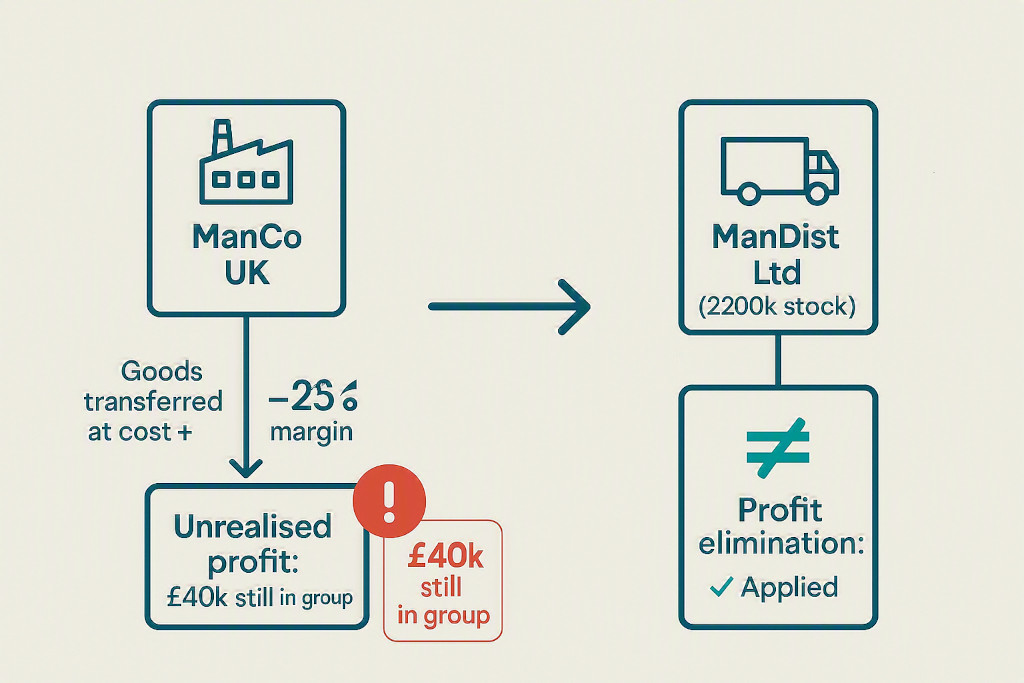
When one entity within a manufacturing group sells goods to another — the factory sells to the distribution company, for example — those goods are recorded as revenue in the factory’s accounts and as a cost (and eventually inventory) in the distribution company’s accounts. At the group level, neither the revenue nor the cost should exist: it is an internal transaction.
The complication arises when the selling entity has added a margin to the transfer price. If ManCo UK transfers goods to ManDist Ltd at cost plus 25%, and ManDist still holds some of those goods in inventory at the month-end reporting date, the group balance sheet includes inventory valued at the inflated transfer price rather than the group’s actual cost. The margin embedded in the unsold stock — the unrealised profit — must be eliminated from both inventory and group profit. This is one of the most commonly missed adjustments in manual consolidations.
For a broader grounding in how intercompany eliminations work across different transaction types, the guide on intercompany eliminations for multi-entity groups covers the underlying principles and journal entries in detail.
2. Transfer Pricing Consistency
The price at which one entity within the group sells to another has both accounting and tax implications. For consolidation purposes, any margin included in the transfer price creates an intercompany profit that must be tracked and eliminated. When transfer prices are set inconsistently — or change between periods — the elimination calculation becomes considerably more complicated.
3. Fixed Asset Transfers Between Entities
Manufacturing groups occasionally move plant, equipment, or tooling between entities. When one entity sells an asset to another at a gain, that gain is unrealised from the group’s perspective and must be eliminated, with depreciation adjustments applied going forward. This is another adjustment that is straightforward in principle but easy to overlook in a busy month-end close.
4. Mixed Accounting Systems Across Sites
Manufacturing subsidiaries often run on accounting platforms chosen for their local market or historical preference. A UK factory might use Xero or QuickBooks. A continental European subsidiary is more likely to run on a locally preferred platform. The UK distribution entity might use MYOB or Zoho Books. Consolidating across platforms without a dedicated tool means exporting trial balances from each, reformatting them, and mapping across different charts of accounts before the consolidation even begins. The guide on designing a common chart of accounts for multi-entity groups covers the practical approach to standardising account structures across disparate entities.
A Practical Example: Consolidating a Four-Entity Manufacturing Group
Consider ManGroup Holdings Ltd, a UK-based manufacturing group with the following structure:
| Entity | Country | Functional Currency | Role | Annual Revenue |
|---|---|---|---|---|
| ManGroup Holdings Ltd | UK | GBP | Holding company | — |
| ManCo UK Ltd | UK | GBP | UK manufacturing | £6.4m (to group) |
| ManCo DE GmbH | Germany | EUR | European manufacturing | €3.2m (to group) |
| ManDist Ltd | UK | GBP | UK distribution & sales | £11.8m (to customers) |
The group’s key intercompany flows each month are:
| From | To | Flow type | Monthly amount | Annual amount |
|---|---|---|---|---|
| ManCo UK Ltd | ManDist Ltd | Finished goods at cost +25% | ~£533k | £6.4m |
| ManCo DE GmbH | ManDist Ltd | Components at cost +20% (invoiced EUR, translated GBP) | ~€267k | €3.2m |
| ManGroup Holdings Ltd | ManCo UK Ltd | Management services fee | £15k | £180k |
At the April month-end close, ManDist Ltd holds £800,000 of inventory purchased from ManCo UK during the month. Of that, the intercompany margin element is £160,000 (£800k × 25% ÷ 125%). That £160,000 of unrealised profit must be eliminated from both the group P&L and the group inventory balance on the consolidated balance sheet.
Eliminating Unrealised Profit on Intercompany Inventory
The elimination journal for the ManCo UK / ManDist scenario looks like this at group level:
Elimination — Unrealised profit in ManDist inventory (April)
| Dr £ | Cr £ | |
|---|---|---|
| Cost of Sales | 160,000 | |
| Inventory (ManDist balance sheet) | 160,000 | |
| Total | 160,000 | 160,000 |
Being: elimination of unrealised profit on intercompany goods held in ManDist inventory at period end.
This journal reverses next month (since the opening stock position is unwound) and is recalculated based on the closing stock balance each period. When tracked manually in a spreadsheet, a missed update or incorrect stock figure can flow silently into the consolidated accounts for months before someone notices.
The broader challenge of staying on top of intercompany reconciliations at month-end is covered in detail in the post on why multi-entity groups lose days to manual reconciliation — and what the alternative looks like.
Currency Translation for International Manufacturing Entities
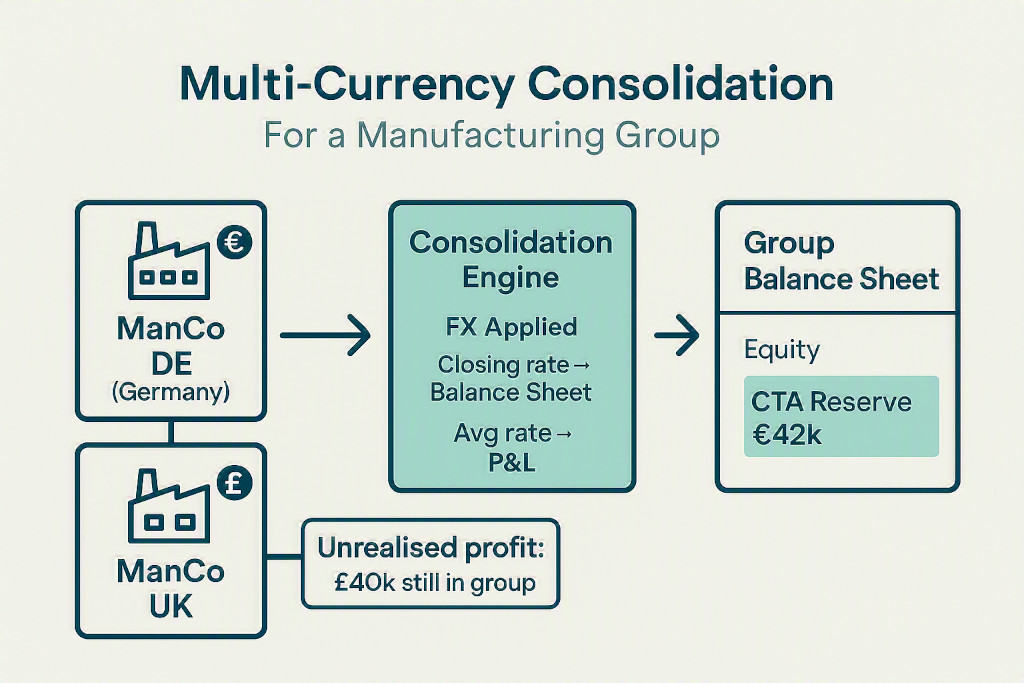
ManCo DE GmbH presents the group with a EUR functional currency entity whose financials must be translated into GBP for group consolidation. The rules under IAS 21 (or ASC 830 for US GAAP groups) are straightforward in principle:
- Balance sheet items translate at the closing rate on the last day of the reporting period
- P&L items translate at the average exchange rate for the period
- The difference between translating assets and liabilities at the closing rate versus the rate at which equity was originally recorded accumulates as the cumulative translation adjustment (CTA) in group equity
For ManGroup, with a EUR/GBP closing rate of 0.856 and an average rate of 0.851 for April, the translation difference on ManCo DE’s net assets produces a CTA movement of approximately £42,000 for the month. That figure grows or shrinks with exchange rate movements and must be tracked cumulatively. If the group later disposes of ManCo DE, the cumulative CTA is recycled through the group P&L at that point — which makes accuracy over time particularly important.
In a spreadsheet, applying the correct rates consistently every month, adjusting for prior-period corrections, and ensuring the CTA reconciles to the group equity section is a significant manual burden. In a consolidation tool with built-in FX handling, it runs automatically once the rates are entered for the period.
How BrizoConsol Handles Financial Consolidation for Manufacturing Groups
BrizoConsol connects directly to Xero, QuickBooks, MYOB and Zoho Books via API — no CSV exports, no manual data re-entry. For a group like ManGroup Holdings, live trial balance data flows from all entities into a single consolidation environment, updated as the books are maintained.
Key capabilities for manufacturing groups:
- Automatic intercompany eliminations. Define the intercompany relationships once — the ManCo UK to ManDist goods flow, the management fee from the holding company — and BrizoConsol eliminates them at every close. For unrealised profit on inventory, the elimination is driven by the intercompany margin rate and the closing stock balance.
- Multi-currency with automatic CTA. Set the closing and average FX rates for each period, and BrizoConsol applies the correct translation to ManCo DE GmbH’s accounts, producing the CTA reserve in group equity without a separate manual step.
- Consolidated P&L, Balance Sheet and Cash Flow on demand. The group controller can pull a consolidated view at any point in the close, not just at the end — enabling early visibility of where the numbers are heading.
- Virtual Groups for segment reporting. A manufacturing group that wants to report UK production versus European production separately, or to see the distribution entity’s contribution in isolation, can create virtual reporting groups without additional legal entity structures.
- AI Auto-Map for chart of accounts differences. When ManCo DE GmbH uses a German chart of accounts (SKR03, for example), BrizoConsol’s AI Auto-Map normalises account mappings to the group’s standard structure automatically.
- Full audit trail on all consolidation adjustments. Every elimination, currency adjustment, and journal entry is logged, making the group close defensible to auditors and straightforward to review internally.
What to Look for in Consolidation Software for a Manufacturing Group
Manufacturing groups evaluating multi-entity accounting software should prioritise the following:
| Capability | Why it matters for manufacturing |
|---|---|
| Native API connections | Manufacturing subsidiaries often run on different systems — a tool requiring manual CSV exports introduces data lag and human error at the most critical stage of the close |
| Unrealised profit on intercompany inventory | Not all consolidation tools support this elimination — non-negotiable for any manufacturing group where entities sell goods to each other |
| Multi-currency with automated CTA | Any group with an overseas entity needs correct translation methodology and cumulative CTA tracking under IAS 21 or ASC 830 |
| Flexible chart of accounts mapping | Manufacturing subsidiaries in different countries use locally preferred structures — intelligent mapping normalises these to the group standard without requiring local entities to change their setup |
| Segment reporting by factory, product line, or geography | Manufacturing groups typically need more granular visibility than a single group P&L — virtual group functionality enables this without changing legal entity structure |
| IFRS, US GAAP, and UK GAAP support | Groups with both UK and overseas statutory reporting requirements may need to tag accounts against different standards for local versus group purposes |
Financial consolidation for manufacturing groups is not inherently more difficult than consolidation in any other multi-entity structure — but the specific combination of intercompany goods flows, unrealised profit on inventory, multi-currency overseas subsidiaries, and mixed accounting platforms means that a spreadsheet-based approach carries compounding risk at every close. A purpose-built group consolidation tool handles each of these automatically, and turns a multi-day month-end exercise into something the finance team can run — and trust — in hours.
Conclusion: The Compounding Risk of Manual Manufacturing Consolidation
Financial consolidation for manufacturing groups is not inherently more difficult than consolidation in any other multi-entity structure. The underlying accounting is the same. What differs is the specific combination of intercompany goods flows, unrealised profit on inventory, multi-currency overseas subsidiaries, and mixed accounting platforms — and the way errors in each of these compound across months when the process is managed manually.
A missed unrealised profit adjustment in March flows into April’s opening position. An incorrect exchange rate applied in February distorts the CTA balance for the rest of the year. An unmapped account in the German subsidiary silently drops revenue from the group P&L until someone runs a reconciliation. Each of these is a manageable problem in isolation. Together, they make the group controller’s job significantly harder than it needs to be.
A purpose-built group consolidation tool handles each of these automatically, and turns a multi-day month-end exercise into something the finance team can run — and trust — in hours.
See How BrizoConsol Handles Manufacturing Group Consolidation
Connect your entities across Xero, QuickBooks, MYOB and Zoho Books, set up intercompany eliminations including unrealised inventory profit, and produce a consolidated group P&L — without the spreadsheet. Start Free Trial