BrizoConsol vs Quick Consols (2026): Which Group Consolidation Software Is Right for Your Team?
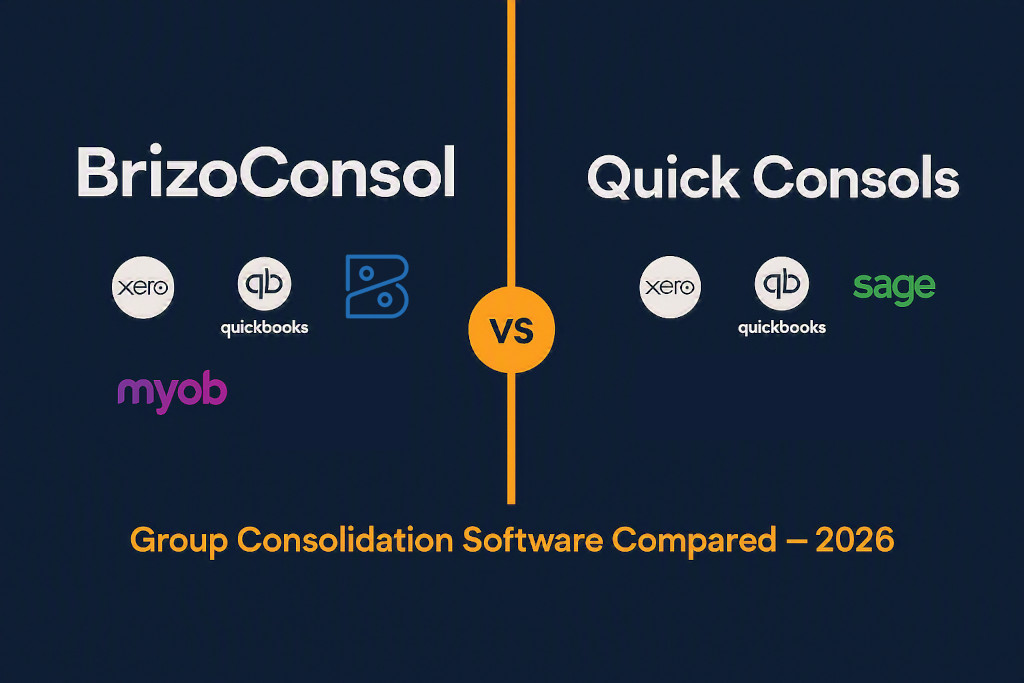
If you’ve been searching for dedicated group consolidation software, you’ve likely encountered both BrizoConsol and Quick Consols. Both are cloud-based platforms built specifically for multi-entity finance teams — both automate intercompany eliminations, handle multi-currency translation, and integrate with popular accounting systems. But they take meaningfully different approaches, and depending on your accounting stack, your group’s size, and what you need beyond a consolidated P&L, one will suit you significantly better than the other.
This comparison is based on information drawn directly from each product’s website in June 2026. We’ve aimed to be factual and specific — if you’re evaluating financial consolidation software for your group, the differences below are the ones that will actually matter to your decision.
Quick Overview
BrizoConsol
BrizoConsol is a financial consolidation platform built for SME groups and accounting firms managing multi-entity clients. It connects natively to Xero, QuickBooks, MYOB, and Zoho Books, and is focused squarely on producing accurate consolidated financial statements — with automation features including AI-powered chart of accounts mapping, auto intercompany eliminations, multi-currency CTA, and NCI. It supports IFRS, US GAAP, UK GAAP, and SFRS — each entity assigned its own accounting standard — and offers a free trial.
Stop building consolidations in spreadsheets.
BrizoConsol automates multi-entity consolidation — setup in minutes, reports the same day.
Quick Consols
Quick Consols is a South African-origin consolidation platform with offices in Johannesburg and Tallinn. It serves mid-to-large groups and offers three distinct modules: Consolidation, Annual Financial Statements (AFS), and Analytics. It integrates with Xero, QuickBooks, Sage, and other ERPs via open API. Pricing starts from $575/month (ZAR 9,950) and is customised based on group size and complexity. There is no free trial — instead, Quick Consols offers a proof-of-concept engagement for prospective customers.
Feature Comparison at a Glance
| Feature | BrizoConsol | Quick Consols |
|---|---|---|
| Auto intercompany eliminations | ✓ | ✓ |
| Multi-currency CTA / FCTR | ✓ | ✓ |
| Non-controlling interest (NCI) | ✓ | ✓ |
| Xero integration | ✓ | ✓ |
| QuickBooks integration | ✓ | ✓ |
| MYOB integration | ✓ | ✗ |
| Zoho Books integration | ✓ | ✗ |
| Sage integration | ✗ | ✓ Sage 200 |
| IFRS support | ✓ | ✓ |
| US GAAP support | ✓ | ✓ |
| UK GAAP / FRS 102 support | ✓ | ◑ FRS 102 in AFS module only |
| AI chart of accounts mapping | ✓ AI Auto-Map | ✗ |
| Virtual Groups (sub-consolidations) | ✓ | ✓ Partial/sub consolidations |
| Segmental / cost-centre reporting | ✓ | ✓ |
| Custom reports | ✓ | ✓ |
| Drill-down to trial balance | ✓ | ✓ |
| Budgets & forecasts reporting | ◑ | ✓ |
| Non-financial / operational metrics | ✗ | ✓ |
| Annual Financial Statements (AFS) module | ✗ | ✓ IFRS, IFRS for SMEs, US GAAP, FRS 102, IPSAS, GRAP |
| Built-in analytics / BI dashboards | ◑ Dashboards included | ✓ Dedicated Analytics module |
| Audit trail | ✓ | ✓ |
| Role-based access control | ✓ | ✓ |
| Recurring journals | ✓ | ◑ Not confirmed |
| Free trial | ✓ Self-serve | ✗ Proof of concept only |
| Pricing model | From $15/entity/month (Standard) · $35/entity/month (Pro) | From $575/month; custom quote; unlimited users |
| Implementation support | In-app guided tours & contextual help | Dedicated implementation consultant |
| Support | In-app support portal | Same-day ticket resolution |
✓ = Available | ✗ = Not available | ◑ = Partial or not confirmed
Where the Products Differ Most
Accounting Software Integrations – BrizoConsol advantage
This is one of the clearest differentiators. If your group runs on MYOB or Zoho Books — common in Australia, New Zealand, and across Asia — BrizoConsol is the only option here that connects natively. Quick Consols does not offer MYOB or Zoho Books integrations.
Conversely, if your group uses Sage 200 (common in the UK and South Africa), Quick Consols has a prebuilt integration while BrizoConsol does not. For Xero and QuickBooks groups, both tools work equally well.
Annual Financial Statements (AFS) – Quick Consols advantage
Quick Consols offers a full AFS preparation module — an entirely separate product line that lets finance teams draft IFRS, IFRS for SMEs, US GAAP, FRS 102, IPSAS, and GRAP-compliant financial statements in-house. The module supports standalone and consolidated financial statements, produces output in Word or PDF, includes note templates and disclosure policies, and allows roll-forward from one period to the next.
BrizoConsol does not offer an AFS module. If producing audit-ready statutory financial statements directly from your consolidation platform is a requirement, Quick Consols has a meaningful capability that BrizoConsol does not replicate.
AI-Powered Chart of Accounts Mapping – BrizoConsol advantage
A recurring challenge in group consolidation is mapping different entities’ charts of accounts to a single group structure — particularly for groups where subsidiaries use different accounting systems or have been set up with varying account naming conventions. BrizoConsol addresses this with its AI Auto-Map feature, which intelligently suggests mappings rather than requiring manual line-by-line account matching.
Quick Consols handles the same problem through its standard chart of accounts management tools but does not appear to offer AI-assisted mapping. For groups with heterogeneous account structures — or accounting firms managing multiple client groups — BrizoConsol’s AI Auto-Map can meaningfully reduce setup time.
Accounting Standards Coverage
Both platforms support IFRS and US GAAP in their consolidation modules. BrizoConsol supports UK GAAP (FRS 102) across the full consolidation workflow — each entity is assigned its accounting standard, so the correct treatment is applied at the entity level throughout the consolidation run.
Quick Consols supports FRS 102 within its AFS module, which covers statement preparation rather than the consolidation workflow itself. Groups with UK entities reporting under FRS 102 who need the standard applied at entity level — not just at the statement output stage — should consider this distinction carefully.
If you’re weighing the differences across IFRS, US GAAP, and UK GAAP more broadly, our guide on intercompany eliminations covers how those standard differences affect elimination treatment.
Pricing and Getting Started – BrizoConsol advantage
Quick Consols publishes a starting price of $575/month (ZAR 9,950), with the final fee customised based on group size and complexity. It does not offer a free trial — interested teams must either engage for a proof-of-concept or book a demo. Implementation is handled by a dedicated consultant, which is valuable for complex groups but adds lead time.
BrizoConsol offers a self-serve free trial, meaning finance teams can get hands-on with the platform before committing. This makes BrizoConsol more accessible for smaller groups and accounting firms who want to evaluate the tool quickly without a sales process. Pricing is not listed publicly and requires contact, but the free trial lowers the barrier to first evaluation significantly.
Analytics and Reporting Depth – Quick Consols advantage
Quick Consols offers a dedicated Analytics module as a separate product alongside its Consolidation module — supporting custom dashboards, key metric tracking, account-level drill-through, and the ability to connect an external BI application. It also supports reporting on non-financial/operational metrics, which is useful for boards that want non-financial KPIs alongside financial data.
BrizoConsol includes dashboards and custom reports within the consolidation workflow, but does not position a standalone analytics module. Groups with significant board reporting or BI requirements may find Quick Consols’ analytics depth more suited to their needs.
Which Platform Should You Choose?
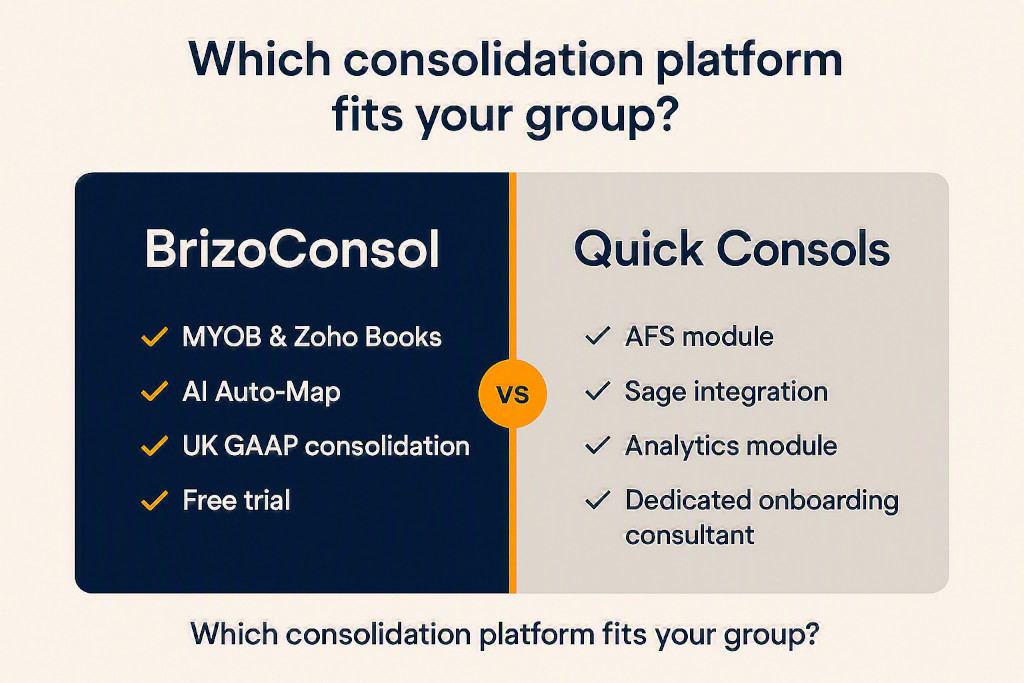
Choose BrizoConsol if…
- Your group uses MYOB or Zoho Books (BrizoConsol is the only platform here that connects to these)
- You want to start with a free trial and evaluate the product hands-on before committing
- Your group includes UK entities reporting under FRS 102 / UK GAAP
- You’re an accounting firm managing multiple consolidation clients and want AI-assisted account mapping to reduce per-client setup time
- You want a consolidation-focused platform that handles eliminations, CTA, NCI, and group journals without paying for AFS or analytics modules you don’t need
Choose Quick Consols if…
- You need to produce full statutory Annual Financial Statements (IFRS, FRS 102, IPSAS, GRAP) directly from your consolidation platform
- Your group runs on Sage 200 and needs a prebuilt integration
- You need a dedicated analytics/BI module with non-financial metrics for board reporting
- Your group is large or complex enough to warrant a dedicated implementation consultant and bespoke pricing
- You require budget vs. actual vs. forecast reporting within the consolidation system
Bottom line: For most SME groups and accounting firms using Xero, QuickBooks, MYOB, or Zoho Books who want to produce accurate consolidated financials without producing formal statutory statements, BrizoConsol is the better-fit starting point — and you can verify that with a free trial. Quick Consols is the stronger choice for larger groups that specifically need in-platform AFS preparation or Sage connectivity. If you want to see how BrizoConsol compares to reporting tools more broadly, see our BrizoConsol vs Fathom comparison as well.
See BrizoConsol for Yourself
Try BrizoConsol free — connect your Xero, QuickBooks, MYOB, or Zoho Books data and run your first consolidated report without speaking to a salesperson first. Start Free Trial