Financial Consolidation for SaaS & Technology Groups: How Multi-Entity Tech Companies Get Clean Group Accounts
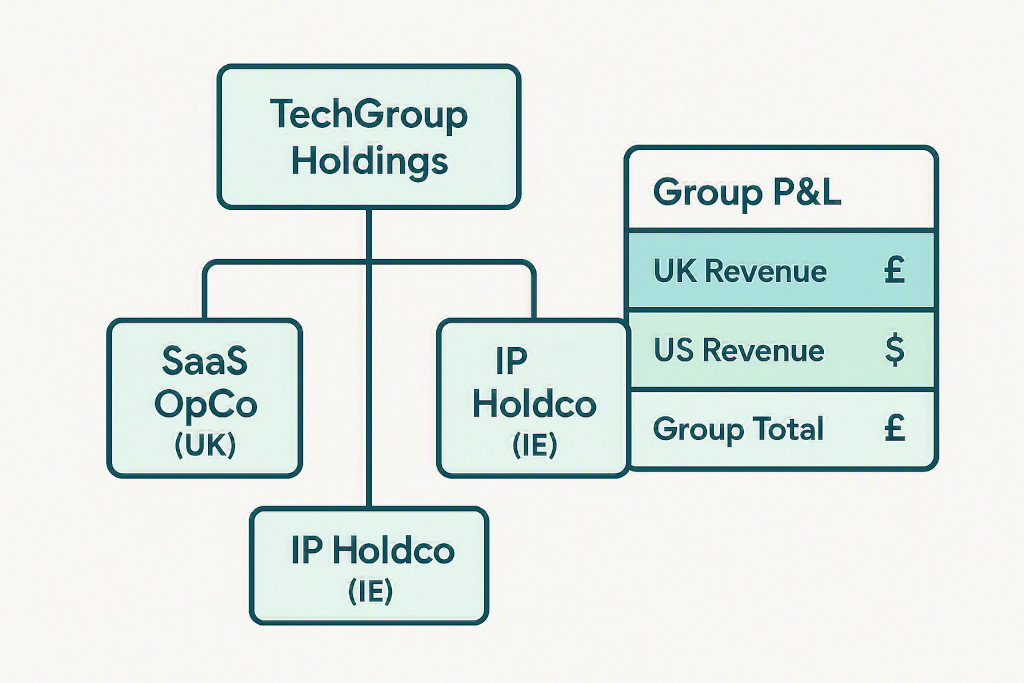
The finance director of a mid-sized SaaS business once described her month-end close as doing three different jobs at once. Her group had a UK holding company, a US operating entity, and an Irish IP holding company set up to hold the software licence. Each ran on a different accounting platform. Each produced its own P&L. And every month, she spent four days pulling them together in a spreadsheet — adjusting for intercompany licence fees, translating USD and EUR balances to GBP, and eliminating transactions that existed in two entities simultaneously but nowhere in the real world.
She is not unusual. As SaaS and technology companies grow, they almost inevitably expand into multi-entity structures: offshore holding companies for IP, regional subsidiaries for sales and support, employee benefit trusts for share schemes, and acquired businesses that bring their own charts of accounts. The need for financial consolidation for SaaS companies scales quickly — and spreadsheets stop being sufficient well before most finance teams expect.
This guide explains why SaaS group consolidation presents specific challenges, works through a practical example, and covers what to look for in multi-entity accounting software built to handle them.
Automate NCI calculations across all your entities.
BrizoConsol handles non-controlling interest automatically — no manual adjustments required.
What Makes SaaS & Technology Group Consolidation Harder Than Most Sectors
| Challenge | Why it’s SaaS-specific |
|---|---|
| Intercompany licence fees and royalties | IP holding structures generate monthly royalty flows between the IP entity and the trading entities — high-value, recurring, and must be eliminated cleanly every period |
| Revenue recognition across entities | SaaS revenue is deferred under IFRS 15 or ASC 606 — ensuring consistent recognition policy across all entities before consolidating adds a layer of complexity absent in most other sectors |
| Multi-currency translation | US and international subsidiaries introduce IAS 21 or ASC 830 translation requirements — the CTA compounds quickly and is frequently missed or mishandled in spreadsheet consolidations |
| Mixed accounting platforms | Acquisitions and regional expansions result in Xero, QuickBooks, MYOB, and Zoho Books coexisting in the same group — manual export and reformat before every consolidation run |
Why SaaS Group Structures Create Consolidation Complexity
A single-entity SaaS business is straightforward to account for. The complexity begins the moment you introduce a second legal entity — and technology companies tend to create them faster than most.
Common drivers include:
- IP holding structures. Many SaaS groups create a separate entity — often in Ireland, Singapore, or another jurisdiction — to hold the software IP and licence it back to the trading entity. This introduces an intercompany royalty or licence fee that must be eliminated at consolidation.
- International expansion. A UK-founded SaaS business opening a US sales office will typically incorporate a Delaware subsidiary. Immediately, the group has a USD functional currency entity whose financials must be translated to GBP for group reporting.
- Acquisition roll-ups. Technology companies frequently acquire complementary software products, each arriving with its own legal entity, its own chart of accounts, and quite possibly its own accounting platform.
- Employee benefit trusts and holding vehicles. Share schemes for staff often require a separate trust entity, adding another point to the consolidation.
Each of these is individually manageable. Together, they create a consolidation process that a spreadsheet cannot sustain at scale — particularly when the entities run on different accounting systems.
The Four Consolidation Challenges Specific to SaaS Groups
1. Intercompany Licence Fees and Royalties
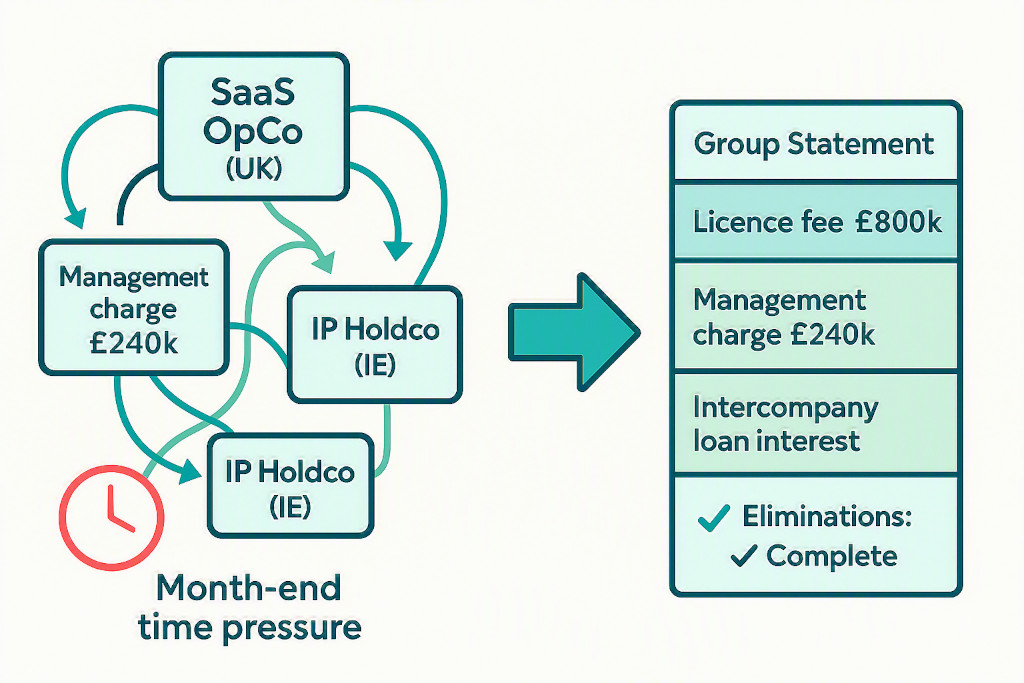
Unlike a manufacturing group, where intercompany transactions are often straightforward sales of goods, a SaaS group’s intercompany flows tend to involve IP licensing, software development recharges, and management service agreements. Each of these is a real cost to one entity and real income to another — but from the group’s perspective, they cancel out entirely and must be eliminated from the consolidated P&L. For a detailed walkthrough of how eliminations work in practice, the guide on intercompany eliminations for multi-entity groups covers the journal entries step by step.
2. Revenue Recognition Across Entities
SaaS revenue is typically deferred — customers pay annually upfront, and the revenue is recognised monthly over the subscription period. When multiple entities recognise subscription revenue under IFRS 15 or ASC 606, ensuring consistent recognition policy across the group adds a further layer of complexity to the SaaS group consolidation process.
3. Multi-Currency Translation
A UK-headquartered SaaS group with a US subsidiary must translate the subsidiary’s USD balance sheet and P&L into GBP. Balance sheet items translate at the closing rate; P&L items translate at the average rate for the period. The difference between the two rates accumulates in equity as the cumulative translation adjustment (CTA). Most finance teams using spreadsheets either calculate this manually each month or, more dangerously, omit it altogether. The post on calculating the cumulative translation adjustment in group consolidation explains the full mechanics.
4. Mixed Accounting Platforms
When a SaaS group has grown through acquisition, or simply made pragmatic choices for different markets, it is common to find Xero in the UK entity, QuickBooks in the US, and perhaps MYOB or Zoho Books in another region. Consolidating across platforms without dedicated group reporting software means exporting trial balances from each, reformatting into a common structure, mapping disparate charts of accounts, and building the consolidation in a spreadsheet — slowly, and with every step introducing error risk.
A Practical Example: Consolidating a Three-Entity SaaS Group
Consider TechGroup Holdings Ltd, a UK-based SaaS group with the following structure:
| Entity | Country | Functional Currency | Accounting Platform | ARR |
|---|---|---|---|---|
| TechGroup Holdings Ltd | UK | GBP | Xero | — |
| SaaS OpCo Ltd | UK | GBP | Xero | £3.2m |
| SaaS US Inc | USA | USD | QuickBooks | $1.8m |
| IP Holdco Ltd | Ireland | EUR | Zoho Books | — |
The group has the following recurring intercompany flows each month:
- IP Holdco Ltd charges SaaS OpCo Ltd a software licence fee of £67,000 per month (£800k per annum)
- IP Holdco Ltd charges SaaS US Inc a licence fee of $50,000 per month ($600k per annum)
- TechGroup Holdings Ltd charges a management services fee of £20,000 per month to SaaS OpCo Ltd
At consolidation, all three flows must be eliminated. That is three separate elimination journal entries every single month — before even considering the USD and EUR foreign currency translation.
At consolidation, all three flows must be eliminated. That is three separate elimination journal entries every single month — before even considering the USD and EUR foreign currency translation. The consolidation is not complex in theory. The challenge is that it involves three accounting platforms, three currencies, and six intercompany balances that need to reconcile and eliminate perfectly every month — while the team is simultaneously trying to close the books.
With a USD closing rate of 1.27 and average rate of 1.25, the USD P&L of SaaS US Inc translates to approximately £1.44m ARR equivalent in GBP. The difference between translating at the closing rate versus the average rate produces a CTA balance that sits in group equity on the consolidated balance sheet — a figure that is often missed entirely when consolidation is handled in a spreadsheet.
Currency Translation for SaaS Groups with International Entities
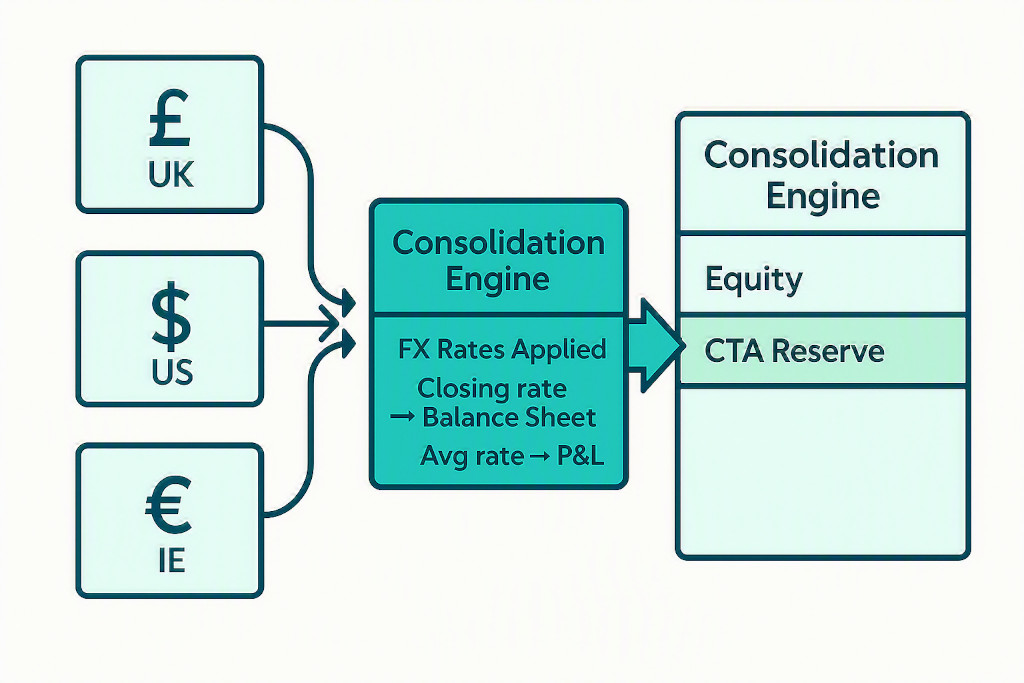
Currency translation is one of the most frequently mishandled aspects of financial consolidation for SaaS companies. The rules are clear under IAS 21 and ASC 830, but applying them consistently across multiple entities, currencies, and periods in a spreadsheet is laborious and fragile.
The standard approach requires:
- Translating all balance sheet items at the closing rate on the last day of the reporting period
- Translating all P&L items at the average exchange rate for the period
- Recognising the difference between these two rates as the CTA, which accumulates in equity and grows (or contracts) with each reporting period
For a SaaS group with monthly reporting and multiple foreign currency entities, this means updating FX rates each month, recalculating the CTA movement, and ensuring the equity section of the consolidated balance sheet agrees. When the group has several foreign currency entities, each with its own historical rate stack, the calculation becomes genuinely complicated without purpose-built group reporting software.
How BrizoConsol Handles Financial Consolidation for SaaS Companies
BrizoConsol connects directly to Xero, QuickBooks, MYOB and Zoho Books via API — no CSV exports, no manual data re-entry. For a group like TechGroup Holdings, that means live trial balance data flows automatically from all four entities into a single consolidation environment every time the books are updated.
Once the group structure is configured:
- Intercompany eliminations run automatically. Define the intercompany relationship once — licence fees between IP Holdco and the operating entities, management charges from the holding company — and BrizoConsol eliminates them at every close without additional manual journals.
- CTA is calculated automatically. Set the closing and average FX rates for each period, and BrizoConsol applies the correct translation method to each entity, producing the CTA reserve in the consolidated equity section without a separate calculation step.
- Consolidated P&L, Balance Sheet, and Cash Flow are available on demand. Finance teams can pull a consolidated view by entity, region, or the full group at any point during the close — not just at the end.
- Virtual Groups allow reporting by product line or geography. A SaaS group that wants to see UK versus US performance separately, or product A versus product B, can create virtual reporting groups without needing additional legal entities.
- AI Auto-Map handles chart of accounts differences. When acquired businesses use a different account structure, BrizoConsol’s AI Auto-Map normalises account mappings automatically, reducing the manual effort of onboarding new entities.
- Every consolidation adjustment carries a full audit trail. All eliminations, journal entries, and currency adjustments are logged, simplifying internal sign-off and external audit.
For finance teams currently managing consolidation in spreadsheets, understanding what financial consolidation software actually does — and where spreadsheets stop being adequate — is a useful starting point before evaluating tools.
What to Look for in Consolidation Software for a SaaS or Technology Group
When evaluating multi-entity accounting software for a SaaS group, the requirements differ in a few important ways from a traditional business:
| Requirement | Why it matters for SaaS and technology groups |
|---|---|
| Native API connections | Technology groups run mixed stacks — Xero in the UK, QuickBooks in the US, Zoho Books in Asia. A tool requiring CSV exports introduces a manual step that undermines automation and creates a data integrity gap |
| Automatic intercompany elimination | Licence fees, development recharges, and management service agreements are common in tech groups. The software should handle these at every close without monthly journal entry work |
| Multi-currency with automated CTA | Any group with an international entity needs a tool that applies the correct translation method and produces the CTA automatically under IAS 21 or ASC 830 — not a separate manual calculation |
| Flexible chart of accounts mapping | Acquired businesses rarely share your account structure. AI-assisted mapping tools that normalise different structures into a common group chart of accounts reduce onboarding effort significantly |
| Drill-down from group to entity level | When the board asks why group gross margin moved by 1.5 percentage points, you need to reach the entity and account level in seconds — not after another round of spreadsheet analysis |
| Multi-standard support | Technology groups with UK and US entities often need to report under different standards for local statutory accounts while consolidating under one group policy — the software should support accounting standard tagging at the account level |
Financial consolidation for SaaS companies is not inherently more complicated than consolidation for any other multi-entity group. What makes it feel harder is the combination of mixed accounting platforms, intercompany IP flows, and multi-currency translation that almost always coexist in the same group. The right consolidation software handles all three automatically — and turns a four-day month-end exercise into something that runs in the background while the finance team focuses on analysis.
Conclusion: SaaS Consolidation Is a Process Problem, Not an Accounting Problem
Financial consolidation for SaaS companies is not inherently more complicated than consolidation for any other multi-entity group. The underlying accounting is the same. What makes it feel harder is the specific combination that almost always coexists in the same group: mixed accounting platforms from organic growth and acquisition, intercompany IP flows that generate high-value recurring eliminations, and multi-currency translation that compounds silently across periods when it is not tracked correctly.
The finance director at the start of this guide spent four days a month on consolidation — not because the work was technically demanding, but because the tools were wrong for the job. A spreadsheet built for one person, one entity, and one currency cannot sustain a group with three platforms, three currencies, and six monthly intercompany balances without becoming fragile, slow, and person-dependent.
The right consolidation software makes those four days into four hours. The intercompany eliminations run automatically. The CTA calculates without a separate worksheet. The consolidated P&L is available on demand. And the finance team spends the close reviewing numbers rather than assembling them.
See How BrizoConsol Handles SaaS Group Consolidation
Connect your entities across Xero, QuickBooks, MYOB and Zoho Books, set up intercompany eliminations, and produce a consolidated group P&L — without the spreadsheet. Start Free Trial