Virtual Groups in BrizoConsol: How Finance Teams Report by Division Without Restructuring Your Entities
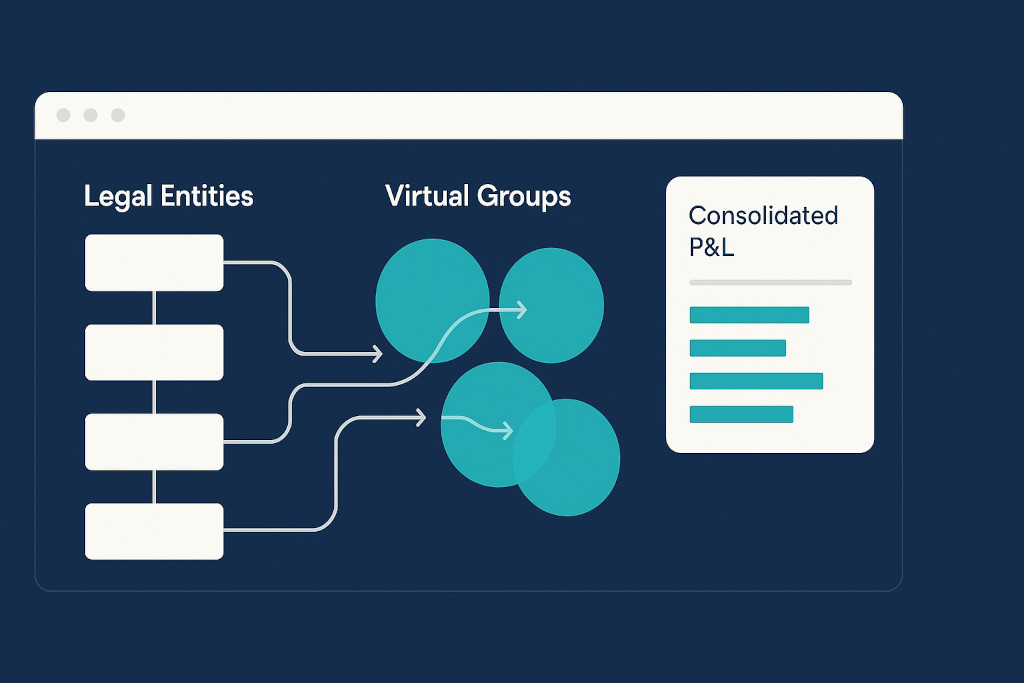
When managing a multi-entity group, finance teams often discover that the legal structure of the organisation bears little resemblance to the way management wants to view performance. A group may operate through multiple legal entities across different countries, yet business performance is managed according to product lines, geographic regions, service offerings, or operating divisions. Legal entities exist for ownership, tax, and regulatory purposes, while management reporting structures are designed to support operational decision-making. As a result, the two frameworks rarely align naturally.
Attempting to force alignment between legal and management reporting structures can create significant challenges. Finance teams may try to restructure entity hierarchies, redesign the chart of accounts, or introduce complex allocations simply to produce the reports required by management. These approaches are often time-consuming, difficult to maintain, and can introduce additional reconciliation complexities into the reporting process.
BrizoConsol addresses this challenge through its Virtual Groups feature, which enables organisations to create flexible reporting structures on top of their existing entity framework. Without changing legal entities, modifying ownership structures, or reclassifying accounts, finance teams can create alternative reporting views that reflect how the business is actually managed. This article explains how Virtual Groups work, why they are valuable, and how organisations use them to produce meaningful management reporting alongside their statutory consolidated accounts.
BrizoConsolStop building consolidations in spreadsheets.
BrizoConsol automates multi-entity consolidation — setup in minutes, reports the same day.
The Gap Between Legal Structure and Management Reporting
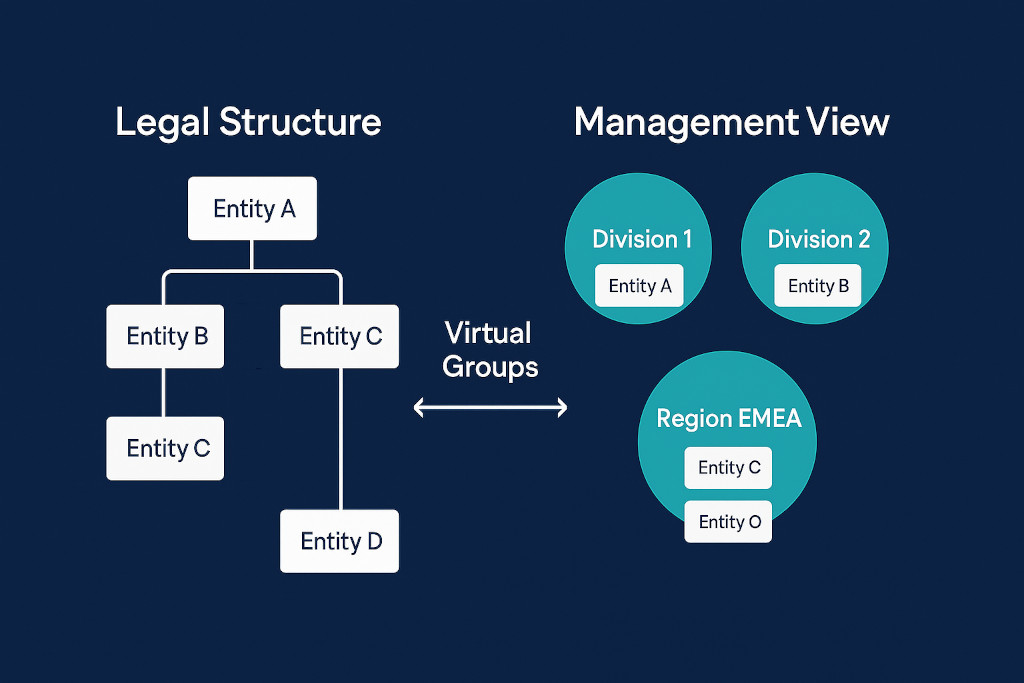
Almost every group finance function operates with two distinct reporting requirements. On one side are statutory and regulatory reporting obligations, including consolidated financial statements prepared under IFRS, UK GAAP, US GAAP, or local accounting standards. These reports follow the legal entity structure of the group, incorporate intercompany eliminations, and reflect the ownership relationships that govern the consolidation process. This is the reporting environment used for audits, board reporting, regulatory compliance, and external stakeholders.
On the other side is management reporting, which is designed to help the business make operational decisions. Unlike statutory reporting, management reporting often cuts across legal entity boundaries. A marketing services group may operate through entities in multiple countries, while management wants to analyse results by client segment. A property group may own assets through numerous special purpose vehicles, yet investment managers need performance measured by asset class, project stage, or region. Because legal and operational structures rarely align, many organisations rely on spreadsheet exports, manual reclassifications, and offline reporting models to create these alternative views.
BrizoConsol’s Virtual Groups feature provides a structured and repeatable way to bridge this gap. Rather than creating separate reporting processes for statutory and management purposes, finance teams can build alternative reporting structures directly within the consolidation platform. Both statutory and management reporting views draw from the same underlying financial data, ensuring consistency across reports while eliminating much of the manual effort and reconciliation work traditionally required to produce management-focused reporting.
What Virtual Groups Are and How They Work
A Virtual Group in BrizoConsol is a user-defined reporting structure that enables finance teams to group entities together for a specific management, operational, or analytical purpose, independently of the statutory entity hierarchy. Users create a Virtual Group by selecting the entities to be included and then generating reports against that group in the same way they would for a statutory consolidation. This allows organisations to create reporting views that reflect how the business is managed rather than how it is legally structured.
Once a Virtual Group has been defined, BrizoConsol applies the same consolidation logic used for statutory reporting. Intercompany transactions are eliminated, foreign currency balances are translated where required, and the resulting financial statements are presented as a consolidated view of the selected entities. As a result, finance teams can produce consistent and reliable management reporting without maintaining separate reporting models or manually combining data outside the platform.
The key advantage of Virtual Groups is that they operate independently of the underlying legal structure. There is no need to modify entity hierarchies, restructure ownership relationships, or redesign the chart of accounts. Virtual Groups simply provide an additional reporting lens over existing data. Organisations can create multiple Virtual Groups to support different reporting requirements and update them as the business evolves. New acquisitions can be added quickly, organisational changes can be reflected easily, and historical reporting remains available for trend analysis and period-to-period comparison.
Use Cases That Finance Teams Rely On
The most common use case for Virtual Groups is divisional or segment reporting. Many organisations have legal entity structures that reflect historical acquisitions, tax considerations, or ownership arrangements rather than current operating divisions. Virtual Groups allow finance teams to create reporting structures that reflect how the business is actually managed. For example, a “Retail Division” Virtual Group can combine entities from multiple jurisdictions and produce consolidated profit and loss, balance sheet, and cash flow reports without making any changes to the underlying legal structure.
A second common use case is geographic reporting. Groups operating across multiple countries often need both a full consolidated view and separate regional reporting views for management oversight, performance measurement, and local governance requirements. Virtual Groups make it possible to create reporting structures such as EMEA, APAC, or North America, with each group producing its own consolidated financial reporting while remaining fully aligned to the overall group consolidation.
Virtual Groups are also valuable for accountancy practices and advisory firms managing multiple client groups. Each client can be maintained as a separate Virtual Group within BrizoConsol, allowing reporting, consolidation, and analysis to be performed within a single platform while preserving clear separation between clients. This simplifies administration and ensures that reports and financial data remain isolated to the appropriate client engagement.
Another use case is budget and forecast reporting. Finance teams can create Virtual Groups that mirror their budgeting structure, allowing actual results to be compared directly against approved budgets at a divisional, regional, or business-unit level. This eliminates much of the manual mapping and reconciliation that often occurs when budget structures do not align with the legal entity hierarchy.
In each of these scenarios, Virtual Groups provide a flexible reporting framework without requiring changes to entities, ownership structures, or charts of accounts. Finance teams can create reporting views that match the way management evaluates performance while continuing to maintain statutory reporting through the standard consolidation process. The result is greater reporting flexibility, reduced manual effort, and a single source of financial data that supports both statutory and management reporting requirements.
Virtual Groups Versus Restructuring Your Chart of Accounts
When finance teams first encounter the need for divisional reporting, the natural response is often to build the reporting structure into the chart of accounts through cost centres, department codes, or other transaction-level classifications. In theory, this approach allows financial data to be analysed by division because every transaction carries a management reporting identifier from the point of entry. While logical in concept, it can become increasingly difficult to manage as organisations grow in size, complexity, and geographic reach.
Maintaining this approach requires consistent coding practices across multiple entities, finance teams, and source accounting systems. The chart of accounts must support both statutory accounting requirements and management reporting needs simultaneously, often resulting in a structure that is more complex than either objective requires on its own. Organisational changes can create additional challenges, as divisional restructures may require historical transactions to be recoded or supported through increasingly complex mapping rules and reporting adjustments.
BrizoConsol’s Virtual Groups provide a more flexible alternative by separating management reporting structures from the underlying accounting framework. Legal entities can continue to use a standardised chart of accounts designed for statutory reporting, while divisional and operational reporting structures are maintained independently within the consolidation platform. As the organisation evolves, Virtual Groups can be updated quickly without requiring changes to source systems or historical accounting records. This separation enables finance teams to support both statutory and management reporting requirements efficiently, while reducing complexity and improving the long-term maintainability of the reporting environment.
How Virtual Groups Interact With Intercompany Eliminations
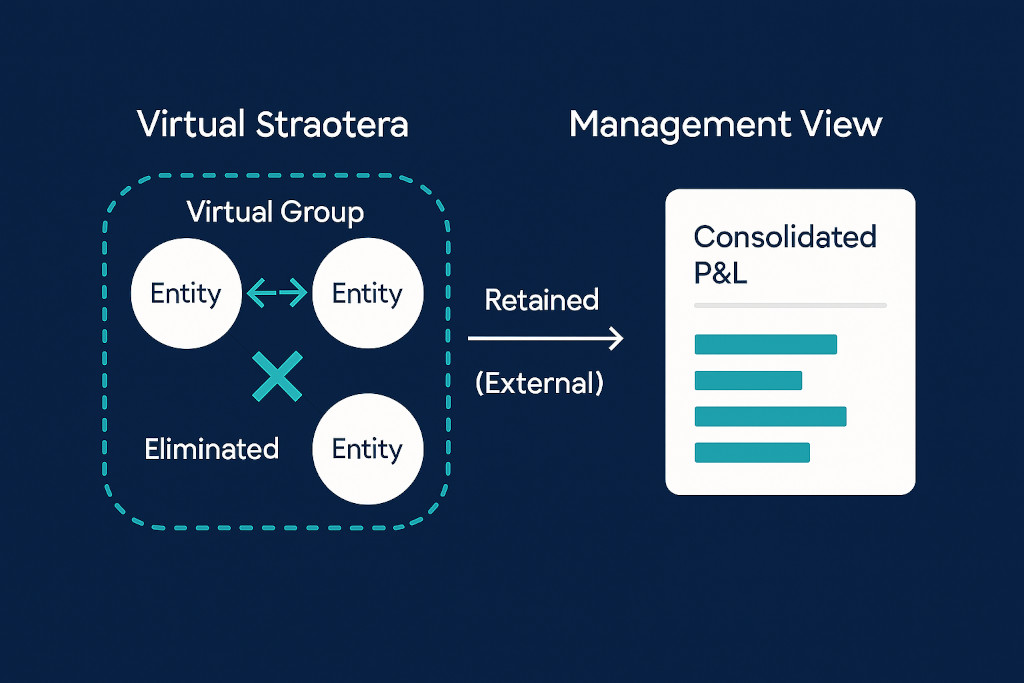
One of the most important aspects of Virtual Groups is the way they handle intercompany transactions during consolidation. When a Virtual Group includes only a subset of the entities within the wider group, BrizoConsol applies intercompany eliminations only to transactions between entities that are members of that Virtual Group. This ensures that the consolidation reflects the reporting scope that has been defined rather than the structure of the wider group.
Transactions between an entity inside a Virtual Group and an entity outside that Virtual Group are treated as external transactions from the perspective of the reporting scope. This is the correct treatment for management reporting because the objective is to present the financial position and performance of the selected group of entities as a standalone operating segment.
For example, a “UK Operations” Virtual Group may contain three operating entities while the group treasury entity remains outside that reporting structure. If one of the UK entities has an intercompany loan from the treasury entity, that balance should continue to appear in the Virtual Group’s balance sheet because it represents an external funding arrangement from the division’s perspective. BrizoConsol applies this logic automatically, ensuring that eliminations reflect the reporting scope being analysed.
This level of precision is difficult to achieve consistently using spreadsheet-based consolidation models, where scope-specific elimination rules often require complex manual calculations and cross-referencing. In BrizoConsol, elimination rules are applied automatically based on the entities included within each consolidation scope, while maintaining a complete audit trail of all elimination entries. Finance teams can therefore generate management reporting views with confidence, knowing that intercompany treatment remains accurate, consistent, and fully traceable.
Multi-Currency Handling Within Virtual Groups
For groups with entities operating in different functional currencies, Virtual Groups in BrizoConsol apply the same multi-currency consolidation methodology used for statutory group reporting. When a Virtual Group includes entities across multiple currency jurisdictions, each entity’s financial results are translated into the reporting currency using the appropriate exchange rates and translation rules defined within the platform. This ensures that management reporting remains consistent with the group’s broader consolidation framework, regardless of the currencies used by individual entities.
BrizoConsol applies the relevant closing rates to balance sheet balances and the applicable average rates to income statement items in accordance with the configured translation methodology. Currency translation differences are calculated automatically and presented separately, allowing finance teams to distinguish between operational performance and foreign exchange movements. This provides management with a clearer understanding of the factors driving divisional or regional results.
This capability is particularly valuable for organisations that manage business units or regions as currency-neutral performance centres and require reporting in a common presentation currency. In spreadsheet-based environments, finance teams often maintain separate currency conversion models for management reporting, creating additional work and increasing the risk of using inconsistent exchange rates. By using the same translation engine, exchange rates, and methodology for both statutory consolidations and Virtual Groups, BrizoConsol ensures that management reporting remains fully reconcilable to the statutory consolidation while significantly reducing manual effort and control risk.
Getting Started With Virtual Groups in BrizoConsol
Setting up Virtual Groups in BrizoConsol does not require any changes to your existing entity structure or chart of accounts. For organisations already running their statutory consolidation in the platform, the underlying data foundation is already in place. As a result, Virtual Groups can be introduced without modifying source accounting systems, ownership structures, or established consolidation processes.
The setup process begins by defining which entities belong to each Virtual Group. Using the group management interface, finance teams can create named reporting groups and assign the relevant entities to them. Where applicable, ownership relationships within the Virtual Group can also be configured to ensure that consolidation and elimination calculations are performed correctly. Once created, Virtual Groups sit alongside the statutory group structure and can be accessed through the same consolidation environment.
Finance teams can run the full suite of BrizoConsol reports against a Virtual Group, including consolidated profit and loss statements, balance sheets, cash flow statements, and custom management reports. Reports can be generated for any reporting period, presented with prior-period comparatives, and exported in the formats required for board reporting, management reviews, and performance analysis.
For organisations transitioning from spreadsheet-based divisional reporting, BrizoConsol’s implementation support team can assist with mapping existing reporting structures into Virtual Groups and validating results against current reporting outputs. Because Virtual Groups leverage the existing consolidation framework, implementation is typically straightforward. The primary benefits are not changes to the underlying accounting logic, but improvements in efficiency, consistency, and control. By automating the consolidation and reporting process within a single platform, organisations can reduce manual effort, improve reporting reliability, and maintain a complete audit trail for every reporting view.
Why This Matters for CFOs and Group Finance Teams
The ability to produce reliable, reconcilable divisional reporting from the same platform that manages statutory consolidation can fundamentally improve the efficiency of the month-end close process. Rather than completing the statutory consolidation and then rebuilding divisional reporting separately in spreadsheets, finance teams can generate both statutory and management reporting views from a single consolidation process. The result is a more streamlined workflow, reduced manual effort, and greater confidence in the accuracy of reported information.
Because both statutory and divisional reports are derived from the same underlying data, they use the same exchange rates, apply the same consolidation principles, and reflect intercompany eliminations according to the relevant reporting scope. This removes one of the most common challenges in group reporting: explaining why management reports do not reconcile to the statutory consolidated accounts. When both views are produced within the same platform using the same consolidation engine, the relationship between them becomes transparent, traceable, and easily verifiable.
For CFOs, this means being able to discuss divisional performance in the context of overall group results with confidence that all reporting views are internally consistent. For finance teams, it means spending less time reconciling spreadsheets and more time analysing performance and supporting decision-making. BrizoConsol’s Virtual Groups feature demonstrates how a purpose-built consolidation platform can simplify complex reporting requirements, enabling organisations to deliver both statutory and management reporting from a single source of truth while reducing manual complexity and strengthening reporting governance.