BrizoConsol vs Excel: Why Accounting Firms Are Making the Switch for Multi-Entity Consolidation
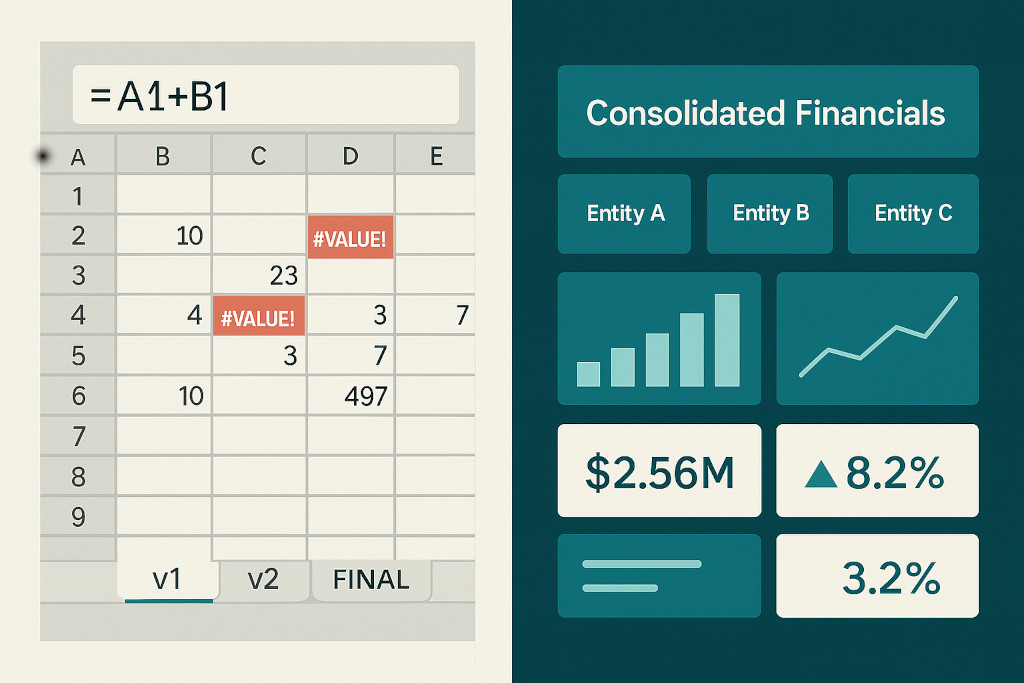
Excel is impressive. For a tool built in the 1980s, it has survived every wave of software disruption and remained the default workspace for accountants worldwide. But there is a point — and most multi-entity accounting teams have crossed it — where Excel stops being a tool and starts being a liability.
This post breaks down the honest comparison: what Excel does well, where it falls apart for group consolidation, and what BrizoConsol does differently.
Why Accounting Firms Still Use Excel for Consolidation
Let us be fair. Excel earns its place for a reason.
Replace your Excel consolidation — for good.
BrizoConsol automates what you've been doing in Excel, faster and without the errors.
It is flexible, familiar, and available on every laptop without a new licence conversation. For a single-entity client or a straightforward two-company group, a well-built Excel model works. Partners and managers know how to build them. Clients trust them. Auditors can follow them.
The problem is not Excel itself. The problem is what happens when the group grows — more entities, more currencies, more intercompany transactions, more reporting periods, more people touching the same files. At that point, Excel is no longer the tool doing the job. It is the team doing the job despite the tool.
Where Excel Breaks Down for Multi-Entity Consolidation
1. Manual intercompany eliminations
Every accountant who has done group consolidation in Excel knows the elimination sheet. It starts clean. By the third reporting period it has grown into something no one fully trusts. Intercompany receivables, payables, revenue, and costs need to be matched and eliminated — and in Excel, that matching is manual, version-sensitive, and error-prone.
Miss one leg of an elimination and the consolidated P&L is wrong. The problem is you may not catch it until the review, or worse, after the pack goes out.
2. Version control is not version control
“Final_consol_v3_FINAL_USE THIS ONE.xlsx” is a joke until it is not.
When multiple people — managers, partners, offshore teams, clients — are feeding into a consolidation workbook, version control collapses. Emailed files create forks. Shared drives create overwrites. There is no audit trail. There is no rollback. If a formula breaks or a number gets hardcoded over, finding it can take hours.
3. Multi-currency is a manual rebuild every period
A group with entities reporting in SGD, USD, AUD, and GBP requires foreign currency translation at the correct rates — closing rate for balance sheet, average rate for P&L, with the resulting FX translation reserve flowing through equity. In Excel, this is a rebuild exercise every period. Rates have to be manually updated, formulas checked, and the translation reserve reconciliation done from scratch.
4. Non-controlling interests require a specialist
IFRS-compliant NCI accounting — particularly for partial acquisitions, step acquisitions, or disposals with loss of control — is complex. In Excel, getting NCI right requires a senior person who knows exactly what they are building. There is no guardrail. A formula that works for 60% ownership may silently break at 75% or when a second tranche is acquired.
5. Reporting takes as long as the consolidation itself
Once the numbers are consolidated in Excel, building the actual reports — board packs, investor summaries, entity-level comparisons — is another project. Charts have to be rebuilt or refreshed. Formatting breaks. Commentary is typed in separately and may not reconcile with the numbers it references.
BrizoConsol vs Excel: Feature by Feature
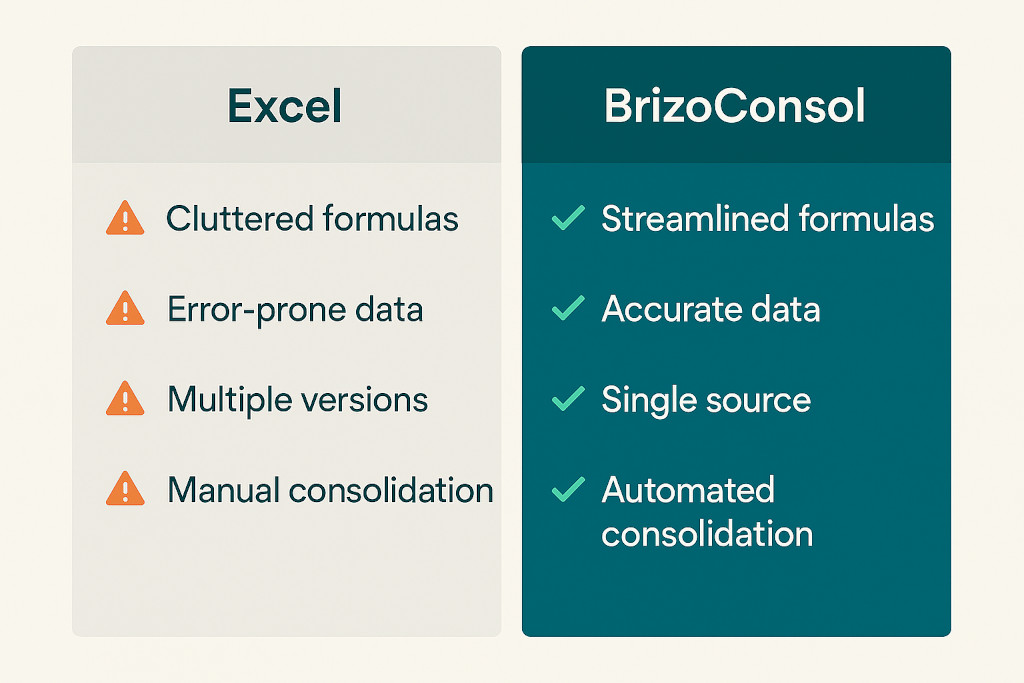
| Capability | Excel | BrizoConsol |
|---|---|---|
| Multi-entity consolidation | Manual, formula-based | Automated, rules-based |
| Intercompany eliminations | Manual matching | Auto-eliminated via BrizoElim |
| NCI calculation (IFRS) | Manual, error-prone | Built-in, IFRS-compliant logic |
| Multi-currency translation | Manual rate input per period | Automated with FX reserve calculation |
| AI account mapping | Not available | AI-powered mapping across chart of accounts |
| Audit trail | None | Full transaction-level audit log |
| Version control | File-based, fragile | Cloud-based, single source of truth |
| Real-time dashboards | Static, manual refresh | Live KPI dashboards with drill-down |
| Pulse health scores | Not available | Automated across all entities |
| Data import | Manual copy-paste | Excel/CSV upload + Xero, QuickBooks, MYOB, Zoho Books |
| Reporting output | Manual formatting | Structured, exportable consolidation packs |
| Multi-user access | Overwrite risk | Role-based, concurrent access |
What Excel Simply Cannot Do
There are capabilities that are not just difficult in Excel — they are architecturally impossible.
AI-powered account mapping. When a client has twelve entities with twelve different charts of accounts, mapping them to a unified group chart is a significant piece of manual work. BrizoConsol uses AI to map accounts automatically, learning the structure and flagging anomalies — cutting setup time from days to hours.
BrizoElim. BrizoConsol’s elimination engine identifies and eliminates intercompany transactions automatically. When an intercompany sale is recorded in one entity and the corresponding cost is in another, BrizoElim matches and eliminates both sides — without a formula, without a spreadsheet, and with a complete audit record.
Pulse health scores. BrizoConsol generates automated health scores across entities, surfacing early signals — margin compression, cash flow stress, covenant proximity — before they become reporting problems. Excel can show you what happened. Pulse tells you what to watch.
A single source of truth across your team. With BrizoConsol, there is one consolidation, live, accessible to everyone with the right permissions. Not twelve emailed copies at different stages of review.
The Real Cost of Excel for Consolidation
The cost of an Excel-based consolidation workflow is not just the time spent building it. It is the time spent checking it, the errors that get through anyway, and the talent cost of putting senior people on work that could be automated.
For accounting firms managing multiple group clients, the compounding effect is significant. Every additional entity added to a group increases the Excel overhead non-linearly. Every new reporting period means another rebuild cycle. Every staff member who touches the file is a version risk.
BrizoConsol is built specifically for this workflow — not adapted from a general-purpose tool, but designed from the ground up for multi-entity consolidation in accounting practices.
Who Should Make the Switch
BrizoConsol is the right fit if:
- You manage three or more entities in a group consolidation
- You are spending significant senior hours on eliminations, NCI, or FX translation each period
- Your consolidation pack has been wrong before and you are not entirely sure why
- You are scaling your practice and need consolidation to be repeatable without adding headcount
- You need IFRS-compliant output your clients and their auditors can rely on
If you are still running consolidation in Excel, the question is not whether to move — it is how much longer the current approach holds before it breaks under its own weight.
See BrizoConsol in Action
The best way to understand the difference is to see a live consolidation run — eliminations, NCI, FX translation, dashboards — in a single workflow.
Start your free trial or book a demo at brizoconsol.com →
No spreadsheets required.