How Financial Consolidation Software Cuts Your Month-End Close
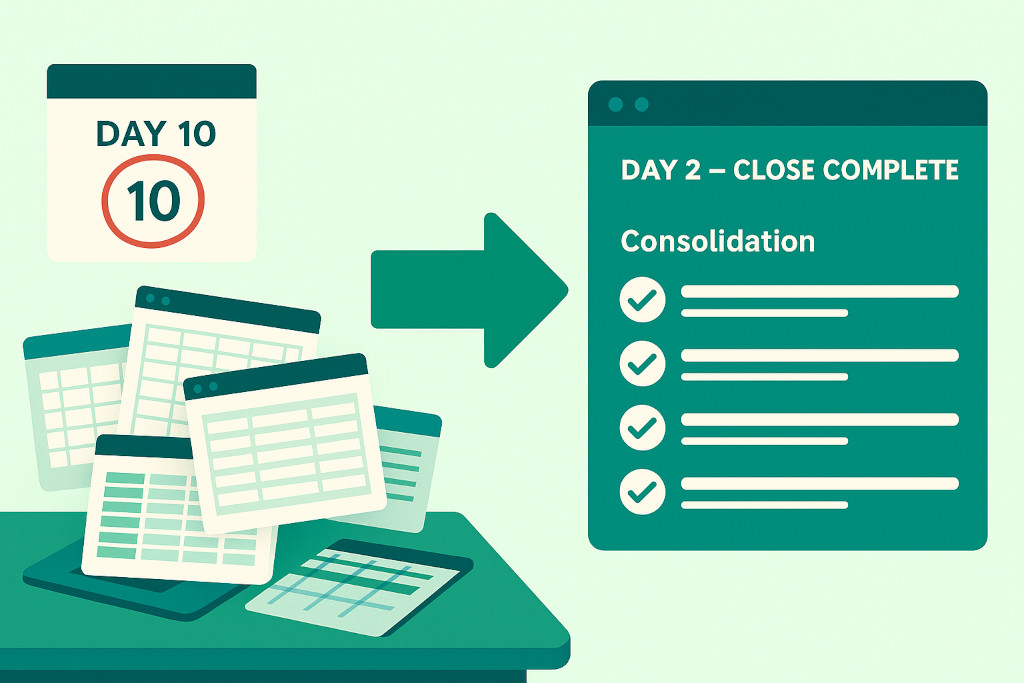
The average multi-entity finance team takes between eight and twelve working days to complete its month-end consolidated close. That figure — drawn from conversations with group CFOs and financial controllers across a range of industries — has barely moved in a decade, even as the underlying accounting software has improved substantially. The reason is straightforward: the bottlenecks in a consolidated close are almost never inside the accounting system. They live in the layer between entities, in the spreadsheets used to stitch individual ledgers together into a group view.
Financial consolidation software targets exactly that layer. This article examines where the delays actually occur, what a well-designed close process looks like when automation handles the consolidation mechanics, and how groups using platforms like Xero, QuickBooks, MYOB, or Zoho Books can compress a ten-day close into two.
The Five Bottlenecks That Slow Every Multi-Entity Close

Before examining solutions, it is worth being precise about where time actually goes. Most close delays trace back to one or more of the following five areas.
Automate NCI calculations across all your entities.
BrizoConsol handles non-controlling interest automatically — no manual adjustments required.
1. Waiting on entity submissions
In groups where each subsidiary uses a different accounting system — or even a different Xero organisation — the consolidation team cannot begin until each entity has finalised its own books and submitted trial balance data. If even one entity is late, the entire consolidated close stalls. Without a centralised view of submission status, the finance team spends time chasing rather than consolidating.
2. Manual chart of accounts mapping
Each entity’s chart of accounts reflects its own operational history, often built by different accountants at different times. The mapping from subsidiary account codes to group reporting codes must be maintained manually in most organisations — and reviewed again whenever any entity restructures its chart of accounts or adds new codes mid-year.
3. Intercompany reconciliation
Intercompany balances — loans between entities, management fees, intragroup sales, cost recharges — must net to zero in the consolidated statements. Identifying the transactions, confirming both sides of each entry are posted correctly, resolving discrepancies, and then eliminating the balances in the consolidation workbook is routinely the single most time-consuming step in the entire close. In groups with six or more entities, this can absorb three full days of senior finance staff time each month.
4. Currency translation
For groups with foreign currency entities, each entity’s financials must be translated to the group reporting currency before consolidation. The correct methodology — closing rate for balance sheet items, average rate for P&L, with the difference posted to equity as a Currency Translation Adjustment — is straightforward in principle but error-prone at scale, particularly when average rates need to be computed for each period across multiple currencies.
5. Iterative correction cycles
Because each of the steps above is typically performed manually, errors are common and discovered late. A mismatched intercompany balance only becomes visible when the consolidated Balance Sheet fails to balance. A missed account mapping shows up as an unexplained variance in the group P&L. Each error triggers a correction cycle that costs another day — and because corrections often cascade, a single mistake in the consolidation workbook can require rebuilding large sections from scratch.
“We were spending the first two weeks of every month closing the previous month. By the time we had reliable group numbers, they were already three weeks old.” — Group Financial Controller, professional services firm, six entities across four countries.
What Financial Consolidation Software Actually Automates
The term financial consolidation software covers a wide spectrum of capability. At one end, simple report aggregators sum entity P&Ls together and present the result as a “consolidated” view — without performing any consolidation accounting. At the other end, purpose-built group reporting software automates every mechanical step of the close: data collection, account mapping, intercompany elimination, currency translation, and financial statement production.
The distinction matters because only the latter category actually removes days from the close. Here is what genuine automation looks like at each stage:
- Data collection: Direct API connections to each entity’s accounting system (Xero, QuickBooks, MYOB, Zoho Books) pull trial balance data automatically. There are no submission deadlines, no CSV exports, no manual imports. The consolidation platform holds a live view of each entity’s books and refreshes continuously.
- Account mapping: AI-assisted mapping tools match subsidiary account codes to group codes on initial setup, flagging ambiguous cases for human review. Mappings are stored and applied automatically on every subsequent close — and when an entity adds a new account code, the platform flags it as unmapped rather than silently omitting it.
- Intercompany elimination: Elimination rules are configured once per entity pair. On each close run, the platform applies the rules, matches intercompany positions, and posts elimination entries automatically. Discrepancies are surfaced immediately, with drill-through to the underlying transactions on both sides — so resolving them takes minutes rather than days.
- Currency translation: The platform maintains a rate table, applies the correct translation methodology to each account class, and calculates the CTA automatically. No manual rate input per entity per month; no risk of applying the wrong rate to the wrong account type.
- Financial statements: A consolidated P&L, Balance Sheet, and Cash Flow Statement are produced on demand as soon as the data and adjustments are complete — not at the end of a manual compilation process.
Building a Repeatable Consolidated Close Checklist
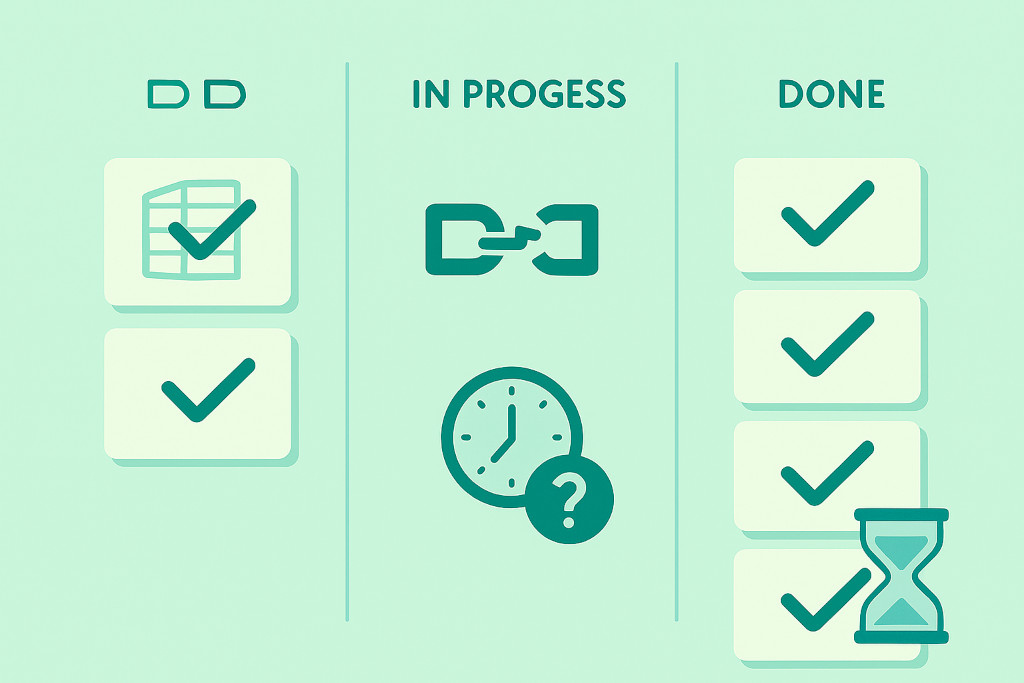
Automation changes the structure of the close, not just its speed. With manual processes, the consolidated close is sequential — each step must wait for the previous one to complete. With financial consolidation software handling the mechanics, the process becomes parallel and continuous. The following checklist reflects what a well-designed automated close looks like:
| Day | Task | Who | Enabled by automation |
|---|---|---|---|
| D+0 (last day of month) | Entity books locked; consolidation platform pulls live trial balances | System | Direct API — no action needed |
| D+1 morning | Review unmapped account flags; resolve any new codes | Group controller | AI mapping flags only changed items |
| D+1 afternoon | Review intercompany discrepancy report; resolve mismatches with entity finance leads | Group controller + entity FDs | Discrepancies isolated automatically; drill-through to source transactions |
| D+2 morning | Review CTA calculations; approve consolidation adjustments | Group controller | CTA calculated automatically; adjustments carry full audit trail |
| D+2 afternoon | Run consolidated financial statements; prepare board pack | CFO / group controller | Statements generated on demand; drill-down available for variance queries |
The shift is not just from ten days to two — it is from a high-stress, error-prone sprint to a manageable, documented process with clear ownership at each step. The finance team’s time moves from mechanical data processing to analysis, commentary, and decision support.
How BrizoConsol Supports the Consolidated Close
BrizoConsol is purpose-built multi-entity accounting software for the consolidation layer. Its close process support is designed around three principles: live data, automated mechanics, and a complete audit trail.
Live data from all connected systems
BrizoConsol connects directly to Xero, QuickBooks, MYOB, and Zoho Books via their official APIs. Every entity’s trial balance is available in the consolidation ledger continuously — there is no month-end data submission step and no risk of a stale import. Groups with a mixed-system landscape (some entities on Xero, others on QuickBooks, for example) are fully supported without requiring migration to a single platform.
Automated eliminations with instant discrepancy reporting
Intercompany elimination rules are configured once and applied on every close run. When the two sides of an intercompany position do not match — a common occurrence when one entity processes a recharge a day later than expected — BrizoConsol reports the discrepancy immediately, shows the exact amount and account, and links to the originating transactions in both entities. Resolving a discrepancy that previously took a day now takes minutes.
Audit trail on every consolidation adjustment
Every elimination entry, consolidation journal, and currency translation adjustment posted by BrizoConsol carries a timestamped audit trail: what was posted, when, and why. This is not just good practice — it is the documentation your external auditors will ask for, and having it built into the process rather than reconstructed afterwards saves significant effort at year-end.
Virtual Groups for segment reporting
Beyond the statutory consolidated close, BrizoConsol’s Virtual Groups feature lets you define reporting groups by region, brand, or any other dimension — and produce a consolidated P&L and Balance Sheet for each group on demand. Management reporting that previously required a separate spreadsheet model is produced directly from the same consolidation run as the statutory close.
Measuring Your Close: Benchmarks and What Good Looks Like
Knowing that your close is slow is one thing; knowing how slow, and where the time goes, is what enables improvement. Before implementing financial consolidation software, it is worth baselining three metrics:
- Days to close: The number of calendar days from the last day of the month to the date the consolidated financial statements are approved and available to management. Industry benchmarks suggest best-in-class multi-entity groups close in two to three days; the average is eight to twelve.
- Rework rate: The percentage of close cycles that require a material restatement or correction after the initial statements are issued. A high rework rate points to systemic process problems, typically in intercompany reconciliation or account mapping.
- Time allocation: The breakdown of total close hours spent on data collection and processing versus analysis and commentary. In manual close processes, data processing often consumes 70–80% of total close hours. In automated processes, the ratio should be reversed.
Tracking these metrics before and after implementing a consolidation platform gives you a concrete picture of the return on investment — and provides the CFO with the data to justify the change to the broader business.
Getting Started: What to Expect in the First Month
The most common objection to implementing new close process infrastructure is the fear of disruption to an already-pressured function. In practice, BrizoConsol’s implementation follows a sequence designed to minimise that risk.
In the first week, each entity’s accounting system is connected via API and the initial account mappings are generated by the AI Auto-Map tool. Typical mapping review for a four-to-six entity group takes four to six hours of the group controller’s time. Intercompany elimination rules are configured in the second week — again, a one-time exercise that applies to every subsequent close.
By the end of the first month, most groups run a parallel close: the legacy spreadsheet process and BrizoConsol simultaneously, comparing outputs to build confidence. After that parallel run confirms the numbers agree, the spreadsheet is retired and the platform becomes the close of record.
The first fully automated close — where the consolidated P&L, Balance Sheet, and Cash Flow are available by Day 2 — typically produces a visible reaction in the finance team. The hours reclaimed from mechanical processing are hours that can go back into analysis, planning, and supporting the business.