Financial Consolidation for Agencies: A Finance Leader’s Guide to Clean Group Reporting
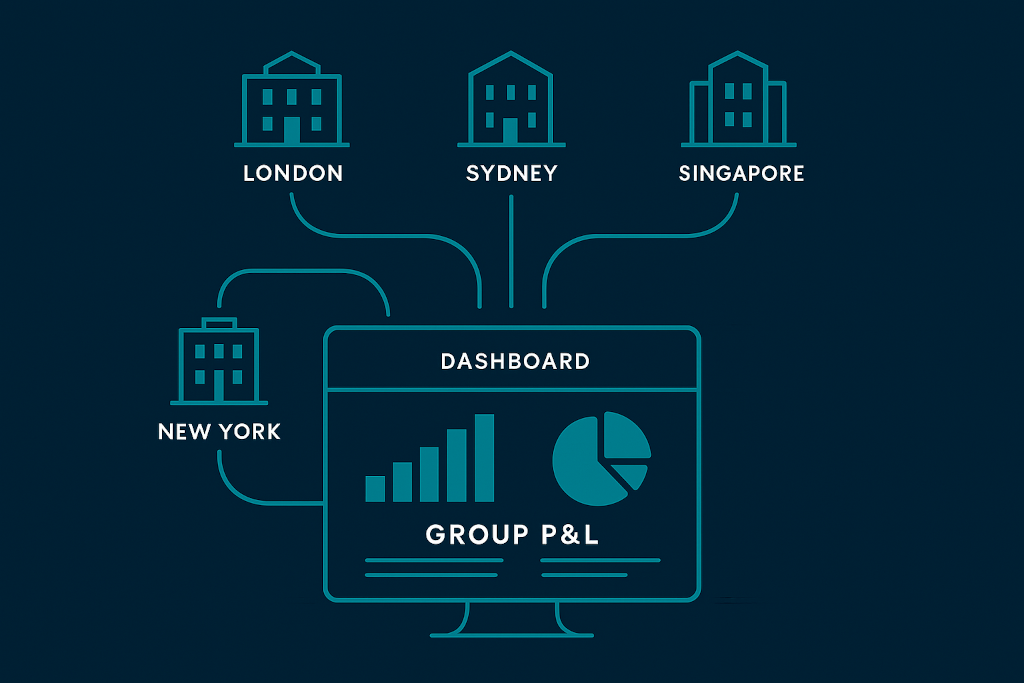
If you run or finance a multi-entity agency group — whether that is a marketing network, a creative holding company, a PR group, or a digital services conglomerate — you already know that the standard advice about financial consolidation rarely fits your world. Most of the literature on group reporting focuses on manufacturers with subsidiaries, holding companies with passive investments, or franchise networks with identical business models.
Agencies are different in almost every meaningful structural dimension. Your entities share staff, pitch jointly for business, charge each other for services rendered, operate in multiple currencies across different jurisdictions, and often have overlapping client relationships that make clean entity-level P&L genuinely difficult to produce.
The finance team at an agency group faces a set of consolidation challenges that are as complex as any large corporate structure — but with far fewer resources, far tighter monthly deadlines, and boards that want client-level and entity-level visibility simultaneously.
Automate NCI calculations across all your entities.
BrizoConsol handles non-controlling interest automatically — no manual adjustments required.
This post is written specifically for CFOs, finance directors, and finance managers at agency groups who are trying to move beyond spreadsheet-driven month-end consolidation. We cover the structural challenges unique to agency groups, the specific intercompany and multi-currency traps to watch for, the chart of accounts issues that cause the most pain, and the practical steps to achieve consolidated financials your whole leadership team can trust.
The Agency Group Structure — and Why It Makes Consolidation Hard
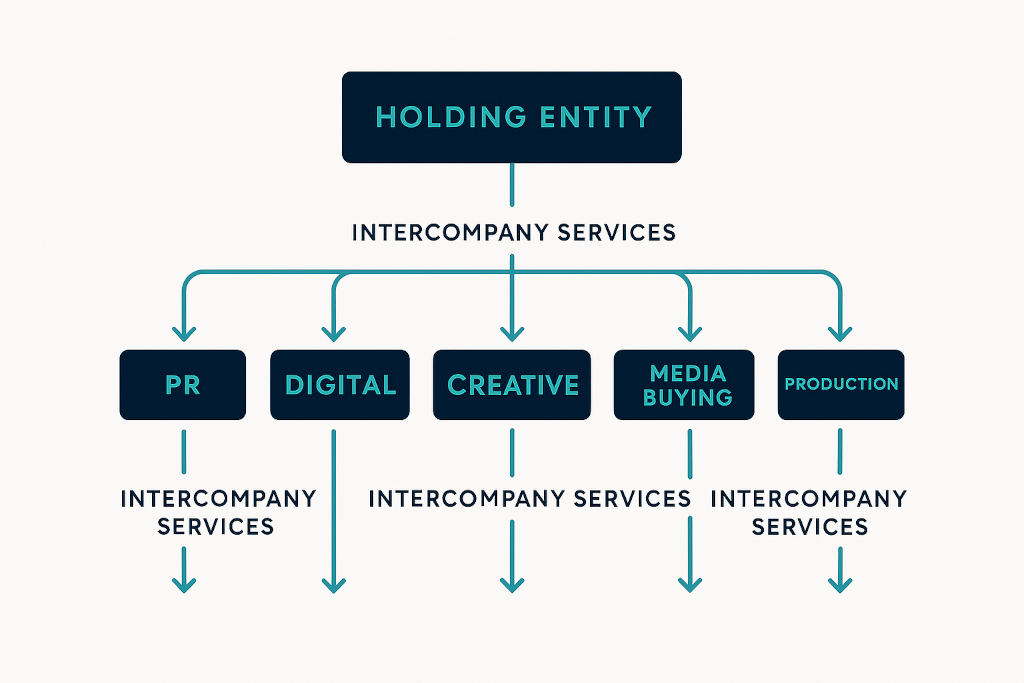
Most agency groups did not start as neatly planned corporate structures. They grew organically — a founder started a creative studio, acquired a PR boutique, spun up a digital arm to serve existing clients, and perhaps merged with a regional media buyer. Each entity carries its own accounting history, its own software stack, and its own chart of accounts built around the way that particular business evolved.
This organic growth model is completely normal in the agency world, and it produces consolidated reporting challenges that are simultaneously structural, technical, and cultural.
The consolidation challenges this creates fall into three categories:
| Challenge | What it looks like in practice |
|---|---|
| Structural | Mixed ownership configurations — 100% subsidiaries, 75/25 joint ventures, equity-method associates — each requiring a different consolidation treatment |
| Technical | Mismatched accounting software and charts of accounts across entities, requiring manual remapping every reporting period |
| Cultural | Lean finance teams managing enterprise-level consolidation complexity without enterprise-level resources or time |
Structural: Agency groups rarely have clean ownership arrangements. One entity might be 100% owned, another 75% owned with a key creative partner retaining a 25% stake, and a third held as a joint venture with a media network partner. Each configuration requires a different consolidation treatment — full consolidation, NCI-adjusted consolidation, or equity method accounting — and getting those treatments right manually is one of the most error-prone tasks a finance team can attempt.
Technical: Mismatched software and chart of accounts mean that before any consolidation can happen, someone has to map revenue lines from multiple trial balances into a common structure — and then do it again next month, because agency P&Ls are highly variable.
Cultural: Agency finance teams are often lean and under-resourced relative to the complexity of what they manage. The month-end close is already stretched, and adding a manual consolidation process on top of it is a recipe for late reports, quiet errors, and board packs that nobody fully trusts.
Intercompany Billings in Agency Groups — The Elimination Challenge
No aspect of agency consolidation causes more problems than intercompany billings, and no consolidation topic is more frequently misunderstood. In a typical agency group, entities charge each other constantly. The production studio charges the PR firm for video content. The media buying entity charges the creative agency for campaign placements. The parent holding company charges all subsidiaries a management fee. The digital arm seconds staff to other entities and invoices them for the time.
Each of these transactions is entirely legitimate from an operational and commercial perspective — but from a consolidation standpoint, every single one of them is noise that must be eliminated before the group’s true financial performance can be seen.
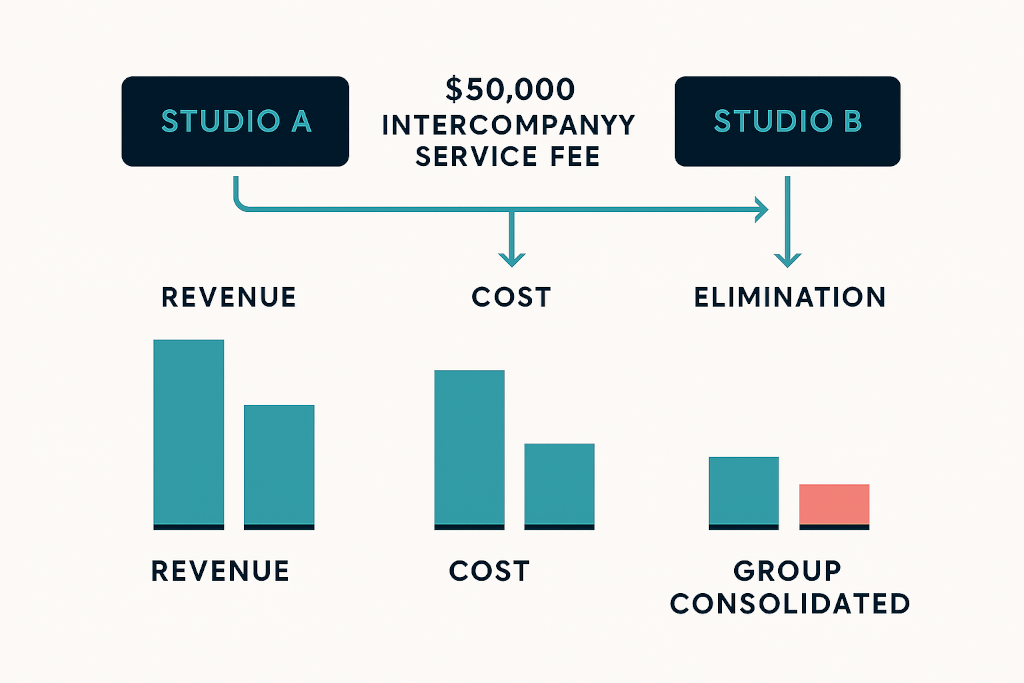
The problem is not just identifying which transactions are intercompany. The deeper problem is eliminating them correctly. If Studio A charges Studio B $50,000 for services, then from a group perspective, neither the $50,000 revenue in Studio A’s books nor the $50,000 cost in Studio B’s books should appear in the consolidated P&L. Both must be eliminated.
What the elimination looks like for a simple intercompany service charge:
| Studio A (seller) | Studio B (buyer) | Group consolidated | |
|---|---|---|---|
| Before elimination | Revenue: $50,000 | Cost: $50,000 | Revenue overstated $50k; costs overstated $50k |
| After elimination | Revenue: $0 | Cost: $0 | Neither appears — internal transaction removed |
| Group profit impact | — | — | Nil — profit is unchanged; gross figures are correct |
When Studio A and Studio B operate in different currencies, the elimination must also capture the FX difference between the transaction rate and the reporting date rate — an additional step that manual spreadsheet eliminations frequently miss.
If the agencies operate in different currencies — say, Studio A bills in USD and Studio B books the cost in AUD — the elimination must also account for the exchange rate difference at the time of the transaction versus the rate at the reporting date.
Doing this manually, month after month, across five or six entities and dozens of intercompany relationships, is where agency finance teams lose the most time and where the most errors accumulate. Automated intercompany elimination — with FX-aware matching and a full audit log — is not a luxury for agency groups. It is a fundamental requirement for reliable consolidated reporting.
Multi-Currency Complexity in International Agency Groups
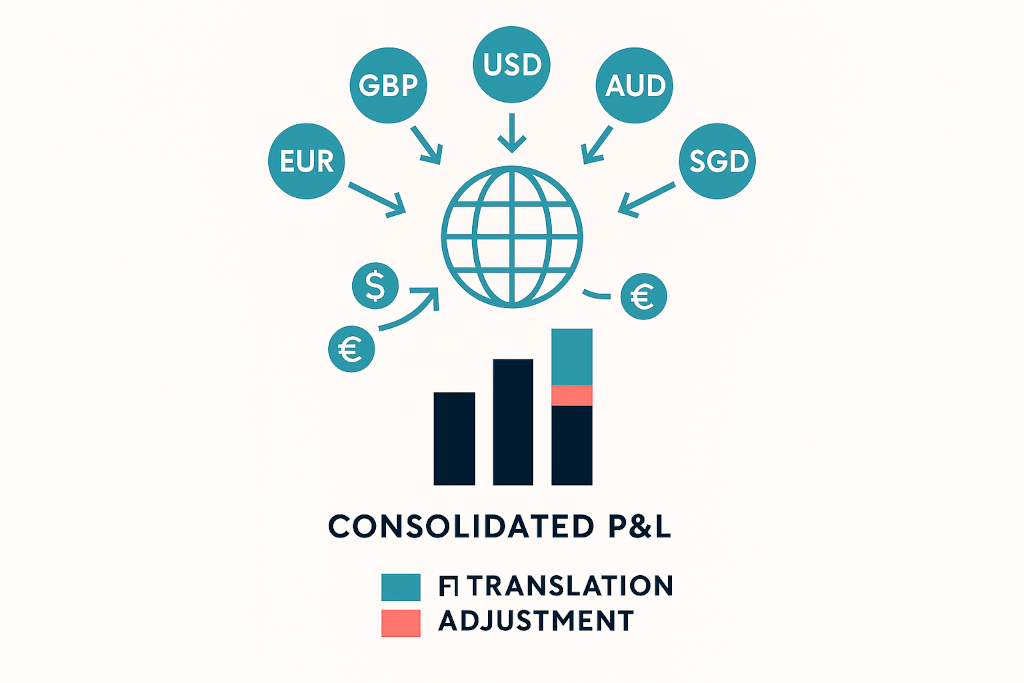
International agency groups face a consolidation challenge that purely domestic businesses do not encounter: every entity reports in its local currency, but the group needs to produce consolidated financials in a single presentation currency.
Under IFRS (IAS 21) and equivalent frameworks, three different rates apply to three different parts of a foreign entity’s financial statements:
| Rate | Applied to | Why |
|---|---|---|
| Closing rate (spot rate at period-end) | All balance sheet items | Reflects the current value of assets and liabilities at the reporting date |
| Average rate (average for the period) | All income statement items | Approximates the rate in effect when transactions actually occurred |
| Historical rate (rate at original recognition) | Equity items — share capital, retained earnings b/f | Equity carries forward at the rate in use when it was originally recognised |
| CTA / FCTR | Balancing figure in equity | Absorbs the difference between closing, average, and historical rates |
The difference between these three rates is what creates the Currency Translation Adjustment — an equity movement that has nothing to do with trading performance but can produce material swings in consolidated results when exchange rates move significantly.
The standard approach under IFRS and most GAAP frameworks requires translating each foreign entity’s financial statements using the closing rate for balance sheet items and the average rate for income statement items, with any difference between the two landing in a separate equity reserve — the Foreign Currency Translation Reserve or Cumulative Translation Adjustment. This means that even if every entity performs exactly as budgeted in local currency terms, consolidated results in the presentation currency will move — sometimes materially — based purely on exchange rate movements.
For agency CFOs presenting results to private equity owners, investor boards, or bank debt providers, unexplained swings in consolidated revenue or EBITDA driven by FX are a credibility problem. Stakeholders who do not understand currency translation adjustments will ask why the numbers changed, and the finance team must be prepared to explain it clearly and consistently every month.
Beyond the translation challenge, there is the intercompany FX elimination challenge and the practical challenge of sourcing accurate exchange rates for every entity pair, applying them consistently, and ensuring that the rates used in consolidation match the rates used in the individual entity trial balances. Manual FX consolidation in a spreadsheet is not just time-consuming — it is a source of compounding error that tends to be discovered late, usually during an audit or investor data room exercise.
Chart of Accounts Mapping — The Foundation That Determines Everything
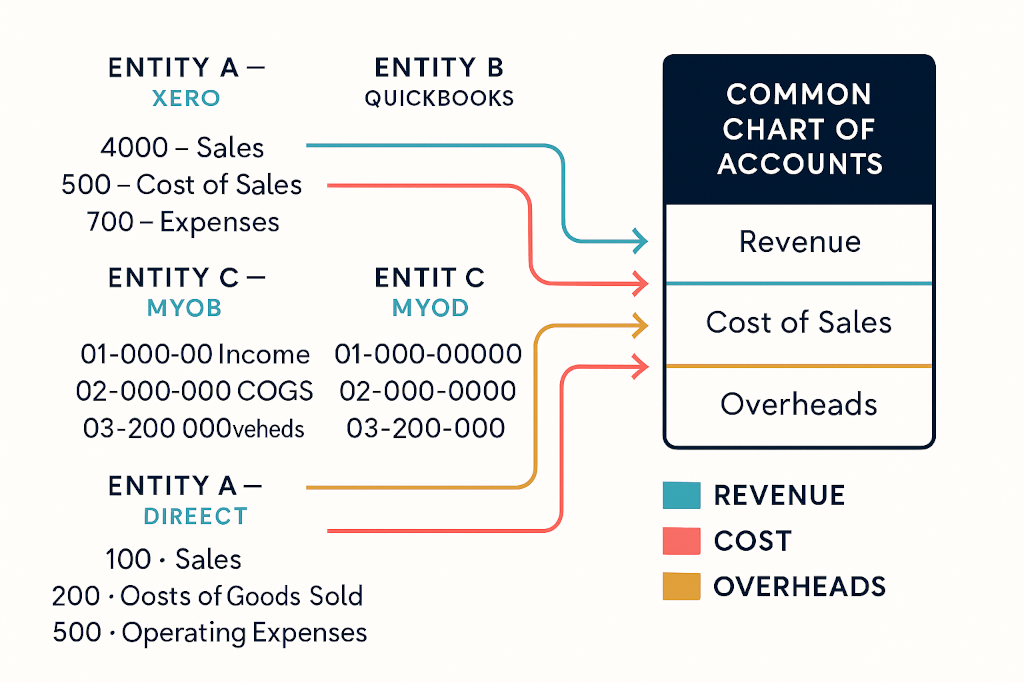
If intercompany elimination is the most error-prone part of agency consolidation at month-end, chart of accounts mapping is the most underestimated part at setup. Every entity in an agency group has its own chart of accounts, built by whoever set up the accounting software at the time and reflecting whatever mattered to that entity’s business model.
A common example of what the mapping problem looks like in practice:
| Local account | Entity | Maps to CCOA account |
|---|---|---|
| Retainer Revenue | PR entity | Client Revenue |
| Project Fees | Creative studio | Client Revenue |
| Campaign Billings | Media buyer | Client Revenue |
| Staff Salaries | All entities | Employee Costs |
| Freelance Costs | Production studio | Employee Costs |
| Contractor Invoices | Digital arm | Employee Costs |
| Management Recharge | All subsidiaries | Intercompany — Management Fee |
This sounds like a one-time setup task, but in practice it is an ongoing maintenance challenge. New accounts are added in entity books every month as the business evolves. Account descriptions change. A new service line launches and creates revenue categories that did not exist in the original mapping. Each change has the potential to break the consolidation if the mapping is not kept current.
The most dangerous scenario is a mapping gap — an account in an entity’s trial balance that has not been mapped to any CCOA category. In a manual spreadsheet consolidation, mapping gaps result in silent omissions: the numbers simply do not appear in the consolidated output, and the discrepancy is only discovered when a detailed reconciliation is done — often not until quarter-end or audit, by which point several months of management reporting have been produced on incomplete data.
How BrizoConsol Addresses the Agency Consolidation Challenge
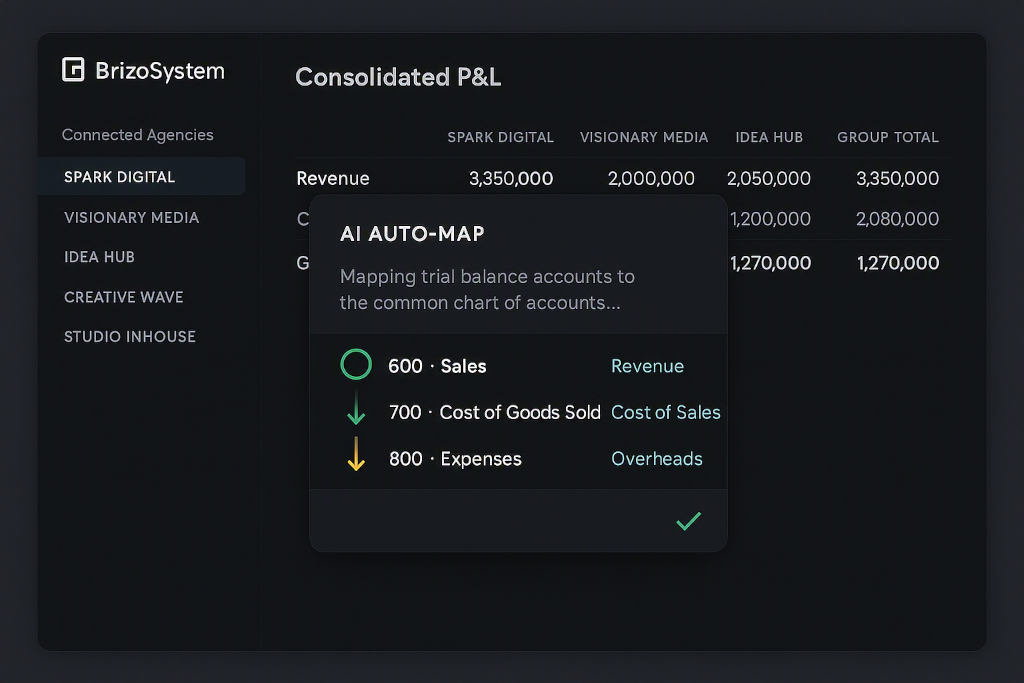
BrizoConsol was built with exactly this kind of complex, multi-entity, multi-currency structure in mind. Rather than requiring a finance team to manually manage chart of accounts mappings in a spreadsheet and chase intercompany mismatches across email threads, BrizoConsol automates the most labour-intensive parts of the agency consolidation workflow from the moment the trial balance data is connected.
| Feature | What it does | Agency-specific benefit |
|---|---|---|
| AI Auto-Map | Analyses entity account names and codes; suggests mappings to group CCOA | Reduces days of manual mapping to a review-and-confirm workflow |
| BrizoElim | Identifies intercompany relationships; posts elimination entries automatically | FX-aware — handles currency mismatches between billing and reporting currency |
| NCI Automation | Calculates non-controlling interest share of equity and profit based on ownership % | Handles the mixed ownership structures common in agency groups |
| Virtual Groups | Defines reporting segments by geography, service line, or client type | Divisional reporting without restructuring the legal entity architecture |
| Insight Package | Pre-configured board and investor reports delivered automatically | Eliminates manual PDF assembly at month-end |
The AI Auto-Map feature is particularly valuable for agency groups dealing with the chart of accounts challenge. When a new entity is onboarded or when a trial balance includes unmapped accounts, BrizoConsol’s AI engine analyses the account names, codes, and transaction patterns and suggests the most appropriate mapping to the group’s Common Chart of Accounts — reducing what used to be hours of manual mapping work to a review-and-confirm workflow that takes minutes.
For intercompany eliminations, BrizoConsol’s BrizoElim feature identifies intercompany relationships, suggests elimination entries, and maintains a full audit log of every entry applied. The FX-aware elimination engine handles the currency mismatch scenario that causes so many problems for international agency groups — automatically calculating and applying the exchange rate difference as part of the elimination rather than leaving it as an unexplained variance.
For ownership structures with partial stakes — the 75% owned creative studio, the 60% held media buyer — BrizoConsol’s NCI automation calculates the non-controlling interest portion of equity and profit automatically, based on the ownership percentages defined in the system.
For Virtual Groups, the feature allows agency finance teams to define custom reporting segments — by geography, by service line, by client type — that cut across legal entity boundaries, enabling divisional reporting without requiring any restructuring of the underlying corporate or accounting architecture.
Reporting for Agency Leadership — What Good Looks Like
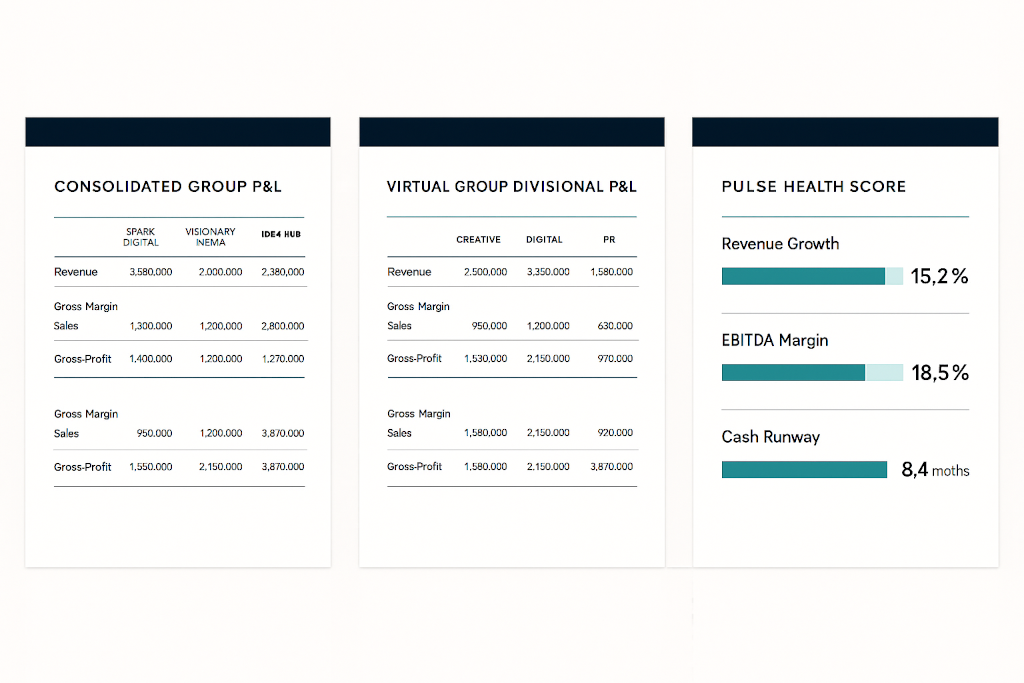
The ultimate measure of a successful agency consolidation process is not whether the numbers close correctly — although that is table stakes — but whether the output actually helps leadership make better decisions.
Agency boards and investors have a specific set of questions they want consolidated financials to answer every month:
- How is each entity performing against budget?
- Which service lines are growing and which are contracting?
- Are intercompany charges distorting individual entity margins, or do those margins reflect genuine commercial performance?
- What is the group’s EBITDA margin on a like-for-like basis, stripping out one-off items and FX noise?
- What is the group’s cash position and how does it compare to prior periods?
- Which entities are generating cash and which are consuming it?
And increasingly, they want that information delivered without requiring a finance team member to spend three days assembling a PDF in PowerPoint.
The Insight Package feature in BrizoConsol allows agency finance teams to pre-configure exactly the reports the board and investor need each month — the consolidated P&L, the entity-level breakdown, the cash summary, the KPI dashboard — and deliver them automatically to the right people at the right time without manual intervention. Combined with Virtual Groups for divisional views and Pulse health scores for real-time KPI monitoring, BrizoConsol gives agency leadership the kind of financial visibility that was previously only available to much larger organisations with dedicated group reporting teams.
Getting Started — A Practical Roadmap for Agency Finance Teams
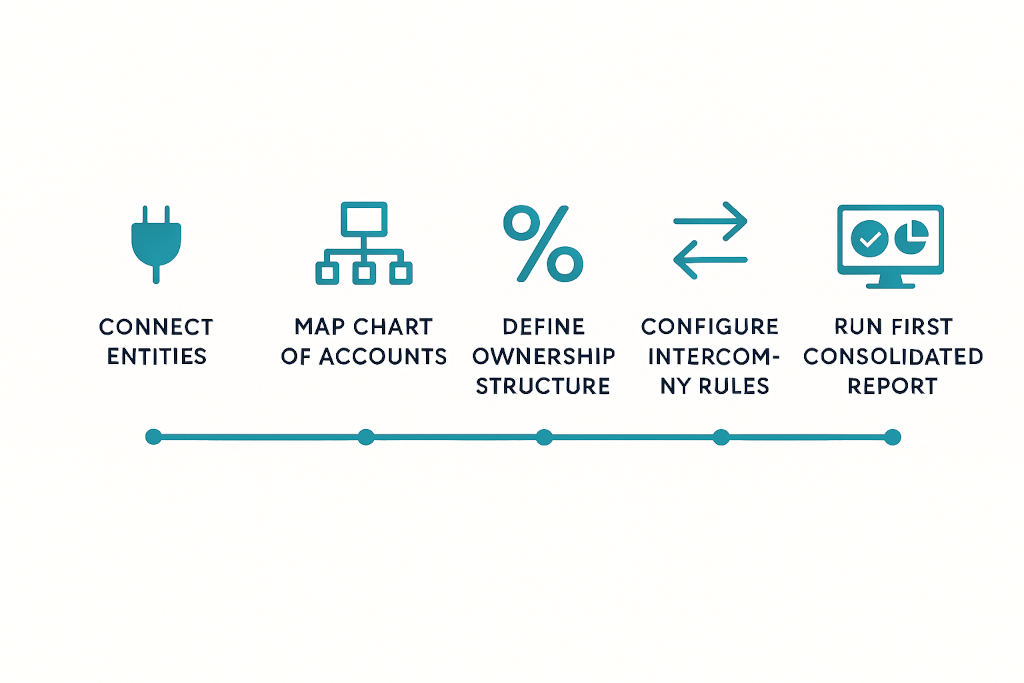
Making the transition from manual consolidation to an automated process does not have to be a lengthy or disruptive project. The biggest barrier most agency finance teams face is the internal preparation work, not the software itself.
Three things to have in place before you start:
- A clear picture of your entity structure — ownership percentages, functional currencies, and which entities trade with each other
- Trial balance data in a consistent export format from each entity’s accounting software
- A first-pass Common Chart of Accounts — the reporting categories your board and investors need to see at group level
The CCOA is worth some investment of time upfront. It is the reporting framework your entire group will use going forward, so design it from the perspective of what leadership needs to see — not just what makes sense to each entity’s bookkeeper.
Once those foundations are in place, onboarding in BrizoConsol follows five steps:
- Connect each entity’s accounting software via direct API integration
- Review and confirm AI Auto-Map’s suggested account mappings
- Define ownership percentages and entity relationships
- Configure intercompany elimination rules per entity pair
- Run your first consolidated report
For most agency groups with five or fewer entities, the first consolidated output is achievable within a day or two of setup. The ongoing maintenance — keeping mappings current, adding new entities, updating ownership percentages — is a fraction of the effort of a manual process.
Conclusion: The Agency CFO’s Competitive Advantage
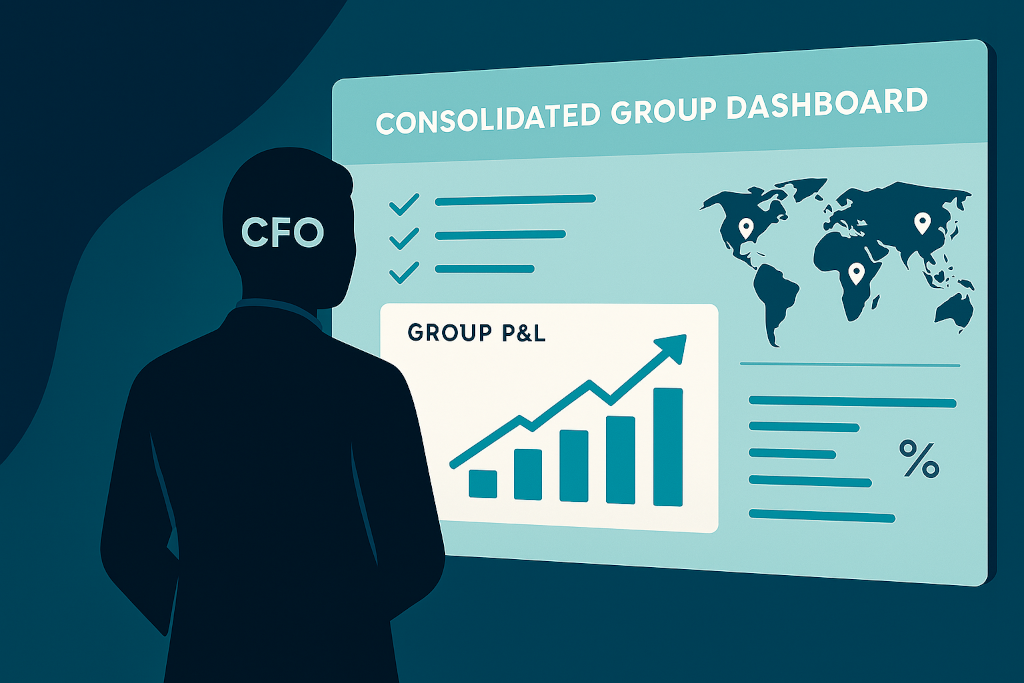
Agency groups have historically been under-served by financial consolidation technology. The enterprise-grade tools were too expensive and too complex for mid-sized agency networks. The small-business tools were too limited for groups with intercompany transactions, multiple currencies, and partial ownership structures. That gap is one of the main reasons why so many agency CFOs and finance directors are still running month-end consolidations in spreadsheets — accepting the risk and the inefficiency because no better option felt accessible.
BrizoConsol was built to close that gap. By combining automated intercompany elimination, AI-driven chart of accounts mapping, NCI automation, multi-currency consolidation, and flexible virtual group reporting in a single platform, BrizoConsol gives agency finance teams the infrastructure they need to consolidate accurately, report confidently, and spend their time on insight rather than assembly.
If your agency group is still spending days each month chasing intercompany mismatches, re-mapping trial balances, and manually translating foreign currency financials in a spreadsheet, this is the right moment to evaluate a better approach. The finance leaders at the fastest-growing agency networks are already using automated consolidation as a competitive advantage — moving faster, reporting cleaner, and giving their boards the transparency they need to make acquisition, investment, and operational decisions with confidence.