Insight Packages in BrizoConsol: How Finance Teams Automate Report Delivery to Every Stakeholder
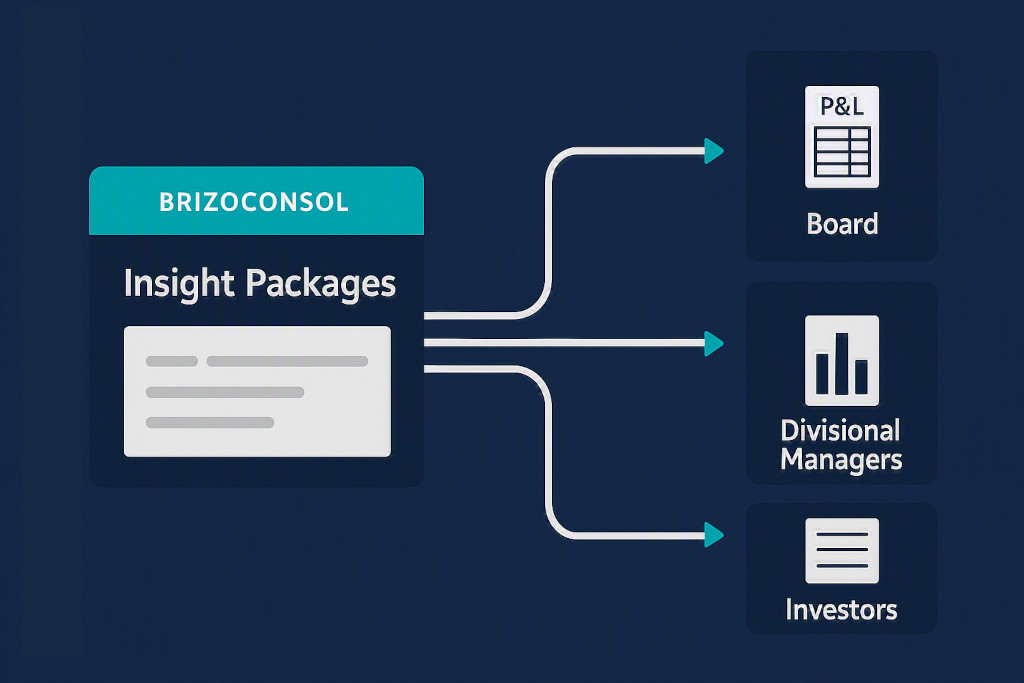
Running the month-end close is one challenge. Getting the right reports to the right people afterwards is another, and for many group finance teams it consumes almost as much time as the close itself. The CFO needs the consolidated group pack, divisional heads need entity-level performance summaries, the board requires a high-level view with commentary, and external investors or lenders may request specific financial schedules. While these audiences rely on the same underlying data, each requires information presented in a format that is appropriate to their responsibilities.
Traditionally, finance teams manage this distribution process manually by generating reports, exporting them to spreadsheets or PDFs, compiling email distributions, and sending files to individual stakeholder groups. This approach is time-consuming, creates opportunities for error, and makes it difficult to maintain a clear audit trail of what was distributed, to whom, and when.
BrizoConsol’s Insight Packages feature replaces this manual workflow with a structured and automated report distribution process embedded directly within the consolidation platform. The same trusted data used to complete the close can be packaged and delivered to the appropriate stakeholders automatically, eliminating manual report assembly, reducing administrative effort, and ensuring that recipients receive consistent, up-to-date information from a single source of truth.
Stop building consolidations in spreadsheets.
BrizoConsol automates multi-entity consolidation — setup in minutes, reports the same day.
What Insight Packages Are
An Insight Package in BrizoConsol is a configurable bundle of financial reports that can be defined once and then generated and delivered automatically to a designated group of recipients. Users can specify which reports to include, the entities or groups to be covered, the financial periods to be presented, and the recipients who should receive the package.
Once configured, BrizoConsol assembles the reports directly from the live consolidation data and makes them available through a secure, role-based view. Reports are generated using the latest approved consolidation figures, ensuring that stakeholders receive consistent and reliable information from a single source of truth.
The key principle behind Insight Packages is the separation of report distribution from data preparation. Finance teams can complete the close and confirm the consolidation process as normal, while Insight Packages automatically draw on those approved figures to create stakeholder-specific reports. There is no need to re-export data, manually rebuild reports, or manage individual distribution lists. As a result, report delivery becomes a natural outcome of completing the close rather than a separate administrative task, ensuring that information is distributed consistently, efficiently, and on time.
Building an Insight Package in BrizoConsol
Creating an Insight Package begins with defining the report set required by each stakeholder group. BrizoConsol allows users to include any combination of the standard financial reports available within the platform, including consolidated profit and loss statements, balance sheets, cash flow statements, trial balance views, and custom reports designed for specific analytical or management purposes.
For each report, users can configure the reporting scope, including the entity or group to be covered, the financial periods to be presented, and whether comparative information such as prior-period results, variance analysis, or commentary should be included. This flexibility enables organisations to tailor reporting packages to the specific information needs of different audiences while maintaining consistency across the reporting process.
Once the report set has been defined, the package can be assigned to a designated group of recipients. Recipients are selected from the users and contacts maintained within BrizoConsol, and access to reports is controlled through the platform’s role-based security model. A board member with access to the consolidated group may receive the full group reporting pack, while a regional manager may be limited to reports relating only to the entities within their area of responsibility. This approach helps ensure that recipients can view only the information they are authorised to access.
Insight Packages can also be configured as recurring distributions linked to specific reporting periods. As each month-end or quarter-end close is completed, BrizoConsol automatically generates the latest version of the package and makes it available to the relevant recipients. This eliminates the need for manual distribution activities and helps ensure that stakeholders receive timely, consistent, and up-to-date reporting.
Tailoring Reports for Different Stakeholder Audiences
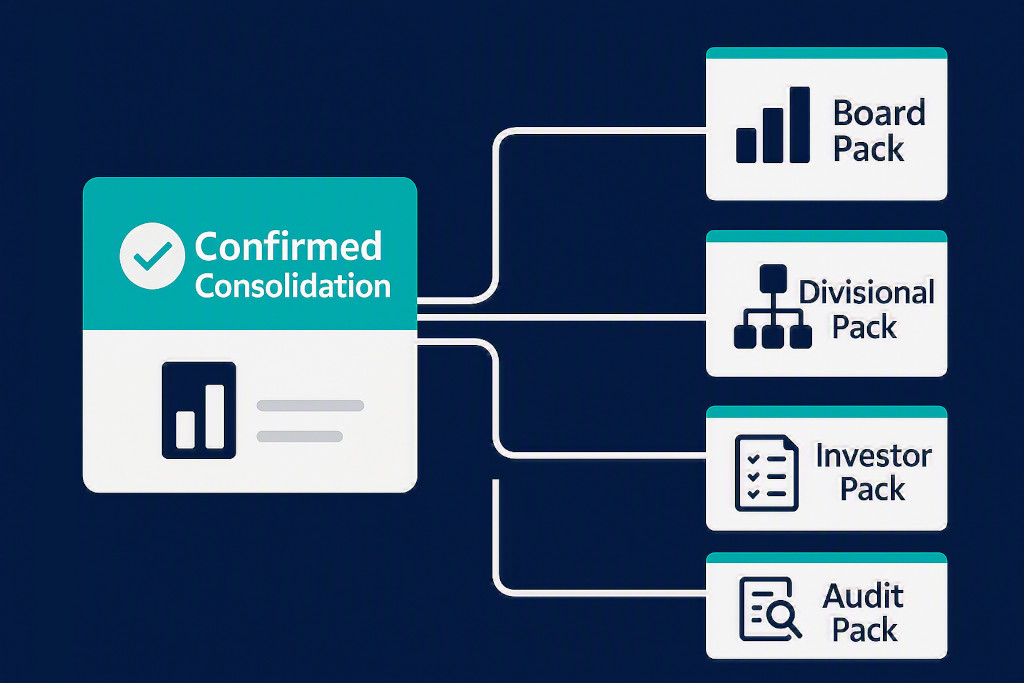
One of the most useful features of Insight Packages is the ability to maintain multiple reporting packages for different audiences while drawing on the same underlying consolidation data. A group finance team may create several packages, each tailored to the requirements of a specific stakeholder group. Because the packages are configured independently, each audience receives the reports and level of detail most relevant to its responsibilities without requiring separate reporting processes.
For example, a board reporting package may contain the consolidated group profit and loss statement, balance sheet, cash flow summary, and a selection of high-level KPIs for the current period. A divisional management package may include entity-level profit and loss statements, prior-year comparisons, and budget-versus-actual variance reporting for the entities within a particular business unit. An investor or lender package may present financial schedules in the format required under financing arrangements, including covenant compliance measures and liquidity reporting. Similarly, a package prepared for accountants or auditors may contain trial balances, intercompany reconciliation schedules, and detailed consolidation adjustment reports.
Despite serving different audiences, all Insight Packages are generated from the same approved consolidation data. This eliminates the duplication of effort associated with producing multiple versions of reports and helps ensure consistency across all stakeholder communications. Because every package is derived from a single authoritative source, there is no risk of different audiences receiving conflicting figures as a result of manual exports, spreadsheet manipulation, or report reformatting. This becomes particularly valuable during reporting periods involving adjustments, corrections, or restatements, when maintaining a single version of the truth is essential.
Insight Packages and the Month-End Timeline
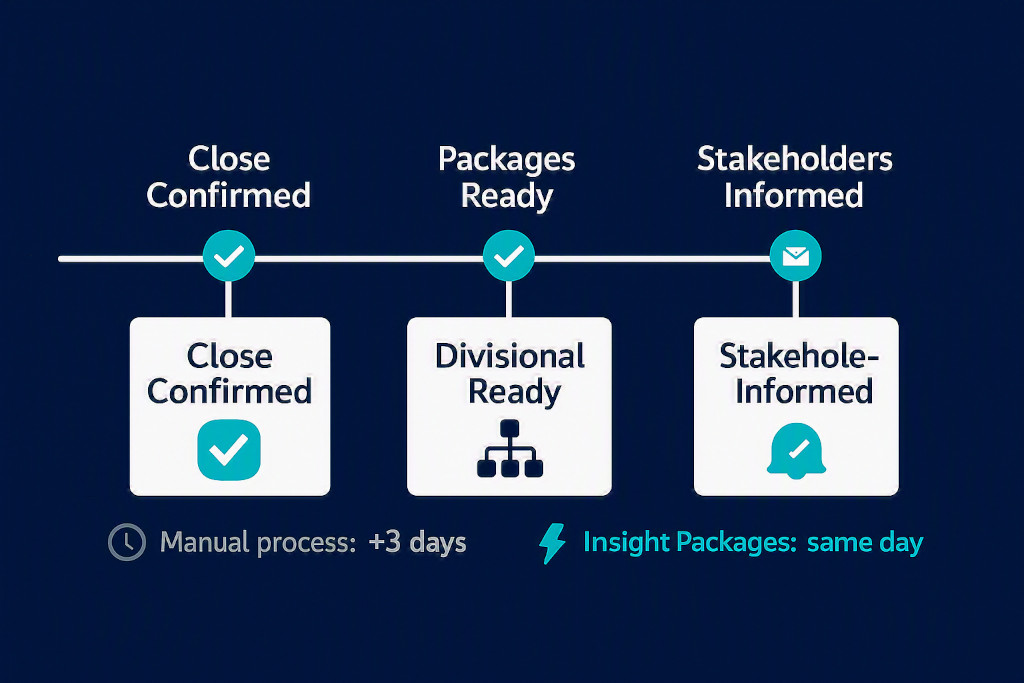
For finance teams seeking to accelerate the month-end close process, report distribution is often an overlooked source of delay. While the consolidation itself may be completed by the third or fourth working day of the month, the preparation and distribution of stakeholder reporting packs can add several additional days to the reporting cycle. During this period, decision-makers may still be relying on outdated information despite the latest figures already being available within the consolidation system. Board members may be reviewing prior-period reports, while divisional managers wait for performance updates that have been prepared but not yet distributed because the reporting process remains dependent on manual assembly and sequential delivery.
BrizoConsol’s Insight Packages eliminate this bottleneck by making report distribution a natural extension of the close process. Once the consolidation has been reviewed and approved, the relevant reporting packages are automatically generated from the confirmed data and made available to their intended recipients. Stakeholders can access reports through their BrizoConsol portal or receive notifications when new packages are available, without requiring any additional intervention from the finance team.
The result is a significantly shorter reporting cycle and faster access to trusted financial information. For organisations operating against demanding board, lender, or investor reporting deadlines, reducing the time between consolidation and distribution can be critical to meeting reporting obligations. Equally important, finance teams are relieved of one of the most repetitive and error-prone aspects of the close process. By automating report assembly and delivery, BrizoConsol enables finance professionals to focus on analysis and decision support rather than administrative report distribution activities.
Insight Packages Versus Manual Report Distribution
The differences between a manual report distribution process and an Insight Packages workflow become most apparent when reporting deadlines are tight or financial results need to be updated. In a traditional process, any correction or restatement requires the finance team to identify which stakeholders received the original reports, regenerate the relevant reporting packs, and redistribute the updated versions. This creates additional administrative effort and increases the risk that some recipients may continue working from outdated information.
Insight Packages simplify this process by linking report delivery directly to the underlying consolidation data. When approved figures are updated, the latest consolidation results automatically flow through to the relevant reporting packages. Rather than recreating and redistributing multiple versions of reports manually, finance teams can rely on a controlled process in which stakeholders always have access to the most current approved information.
The approach also strengthens governance and auditability. BrizoConsol maintains a record of when reporting packages were generated and the consolidation status on which they were based. This provides a clear and defensible audit trail, helping organisations demonstrate control over their financial reporting process and supporting the governance requirements of auditors, regulators, investors, and other stakeholders.
A further benefit is reporting consistency. In manual processes, different stakeholder packs are often prepared from separate data exports taken at different points in time, which can result in small but confusing differences between reports. For example, figures presented in a CFO’s board reporting pack may not exactly match those shown in a divisional management report if the underlying data was refreshed between exports. With Insight Packages, all reports are generated from the same confirmed consolidation data, ensuring consistency across every level of reporting. Any differences between entity, divisional, and group views can be clearly explained through the consolidation adjustments applied within BrizoConsol, giving stakeholders greater confidence in the accuracy and integrity of the reported numbers.
How Accountancy Practices Use Insight Packages
For accountancy practices and advisory firms that manage group consolidations on behalf of multiple clients, Insight Packages provide a structured way to deliver completed reporting outputs. Rather than distributing reports to internal stakeholders, practices can use Insight Packages to present consolidated accounts, financial statements, and supporting schedules to clients in a consistent and professional format. Each client can have a dedicated package configuration tailored to the specific reporting requirements of the engagement.
Once configured, the package becomes part of the normal close workflow. When a client’s consolidation process is complete, the relevant reports are automatically assembled and made available without requiring the practice team to manually create a separate client deliverable. This can be particularly valuable for firms managing multiple consolidation engagements simultaneously, where manually generating and distributing reports for each client can create significant administrative overhead and increase the risk of errors or inconsistencies.
Insight Packages can also be used to provide clients with secure, read-only access to their reports directly within BrizoConsol. Instead of receiving report packs as email attachments, clients can log in to a dedicated view containing only the information relevant to their organisation. This approach ensures that clients always have access to the latest approved reports, while allowing them to review supporting detail within the platform as needed. The result is a more efficient, controlled, and professional reporting experience for both the practice and its clients.
Getting Started With Insight Packages in BrizoConsol
Setting up Insight Packages in BrizoConsol is straightforward for organisations that already perform their group consolidation within the platform. Because each package draws on the same reports and consolidation data used during the close process, there is no need to create a separate reporting infrastructure. The process typically begins by identifying the stakeholder groups that require reporting and defining the specific reports, schedules, and levels of detail that each audience needs.
This exercise often delivers value beyond the technical configuration itself. Many finance teams rely on undocumented knowledge when distributing reports, with report requirements and recipient lists being maintained informally by experienced team members. Insight Packages formalise this process by creating a documented stakeholder-to-report mapping within BrizoConsol. As a result, reporting requirements become transparent, repeatable, and easier to maintain as responsibilities change or new stakeholders are introduced. Once the packages and recipient permissions have been configured, the finance team can validate the output during a reporting cycle and make any necessary refinements to report scope, content, or access settings.
BrizoConsol’s support team can assist with the initial setup and help organisations align existing reporting formats with the Insight Packages framework. For many groups, the transition from a manual distribution process can be completed within a single reporting cycle. The long-term benefit is a reporting process that becomes more efficient and scalable over time. Rather than increasing administrative effort as the organisation grows and stakeholder requirements expand, report distribution remains controlled, consistent, and largely automated.
Why This Matters for Finance Leaders
The quality of a group’s financial reporting is measured not only by the accuracy of its numbers but also by the speed, consistency, and reliability with which those numbers are delivered to stakeholders. A consolidation may be technically correct, but if reports are delayed, distributed inconsistently, or require significant manual effort to produce each reporting period, the organisation incurs a real operational cost. Stakeholders lose confidence in the reporting process, finance teams spend valuable time on administrative activities instead of analysis, and decision-makers receive critical information later than they should.
BrizoConsol’s Insight Packages are designed to address these challenges by making report distribution an integrated part of the consolidation process. Rather than treating distribution as a separate activity that begins after the close has been completed, Insight Packages enable reports to be configured once and delivered automatically using the same consolidated data, access controls, and audit framework that support the close itself. This ensures that stakeholders receive consistent, up-to-date information from a controlled and auditable source.
For CFOs managing multi-entity organisations and for accounting professionals delivering consolidation services to clients, this approach provides significant benefits in both operational efficiency and reporting governance. By automating the distribution of financial information, BrizoConsol enables finance teams to support a growing stakeholder base without increasing administrative workload. The result is a reporting process that scales effectively, maintains consistency across audiences, and ensures that the delivery of high-quality financial information becomes a natural outcome of completing the close rather than a separate project that follows it.