MYOB Consolidation Software for Accounting Firms: Delivering Group Accounts for Multi-Entity Clients
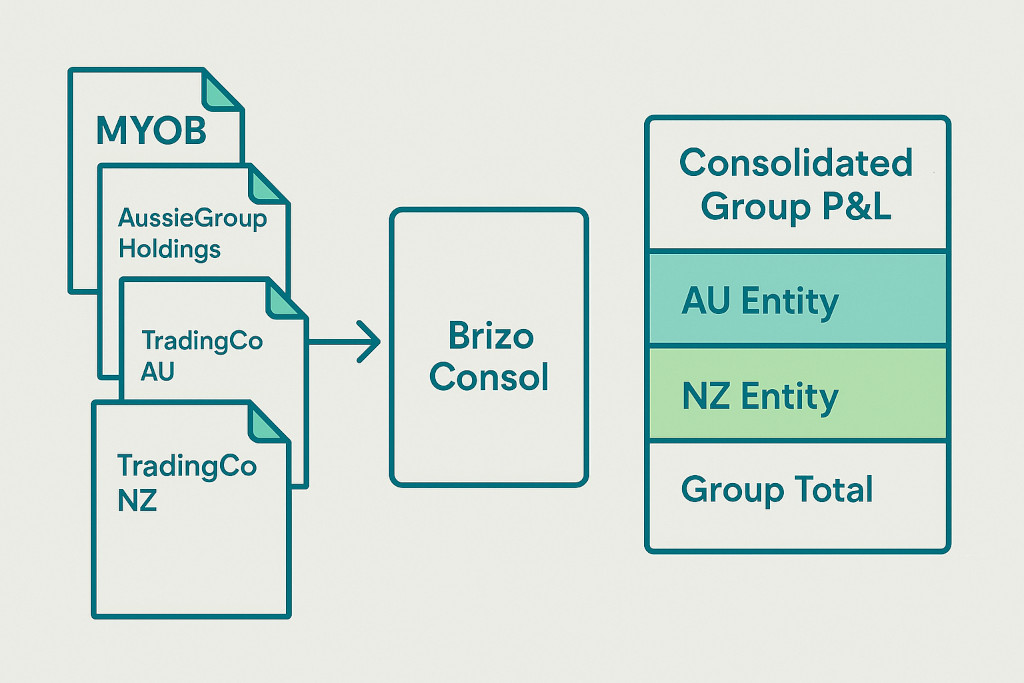
Most accounting firms with a MYOB client base have at least a handful of clients running multiple entities — a holding company, two or three trading subsidiaries, perhaps a property trust or a New Zealand operation. Each entity has its own MYOB file. Each produces its own trial balance. And every month-end, the firm’s team consolidates those files manually: exporting reports, mapping account codes, adjusting for intercompany transactions, and building a group P&L in a spreadsheet that the client’s directors can review.
It works — until it does not. When a firm has five group clients, the manual consolidation process is a significant time cost. When it has fifteen, it becomes a capacity constraint that limits growth and increases the risk of errors reaching client deliverables.
This is the problem that MYOB consolidation software for accounting firms is designed to solve. This post explains where MYOB stops and what dedicated consolidation software adds — with a practical example of how a typical MYOB group consolidation works in BrizoConsol.
Consolidate your MYOB entities in minutes.
BrizoConsol connects to MYOB and automates your group financial statements.
Why MYOB Does Not Handle Group Consolidation
MYOB is a capable single-entity accounting platform. It manages transactions, produces entity-level P&Ls and balance sheets, and handles payroll and tax obligations for Australian and New Zealand businesses effectively. What it does not do is consolidate across multiple MYOB files.
There is no native mechanism in MYOB AccountRight or MYOB Business to:
- Combine the trial balances of two or more separate entities into a single consolidated view
- Eliminate intercompany transactions — management fees, loans, intercompany sales — that appear in both entities’ books
- Translate a New Zealand or international subsidiary’s financials into AUD for group reporting
- Present a consolidated P&L, balance sheet, and cash flow for the group as a whole
For a detailed look at the specific group reporting outputs that MYOB cannot produce, the post on group financials MYOB cannot produce covers the gaps in full. The short answer is: anything that requires combining data across two or more entities falls outside what MYOB was designed to do.
The Scale Problem for Accounting Firms Managing MYOB Group Clients
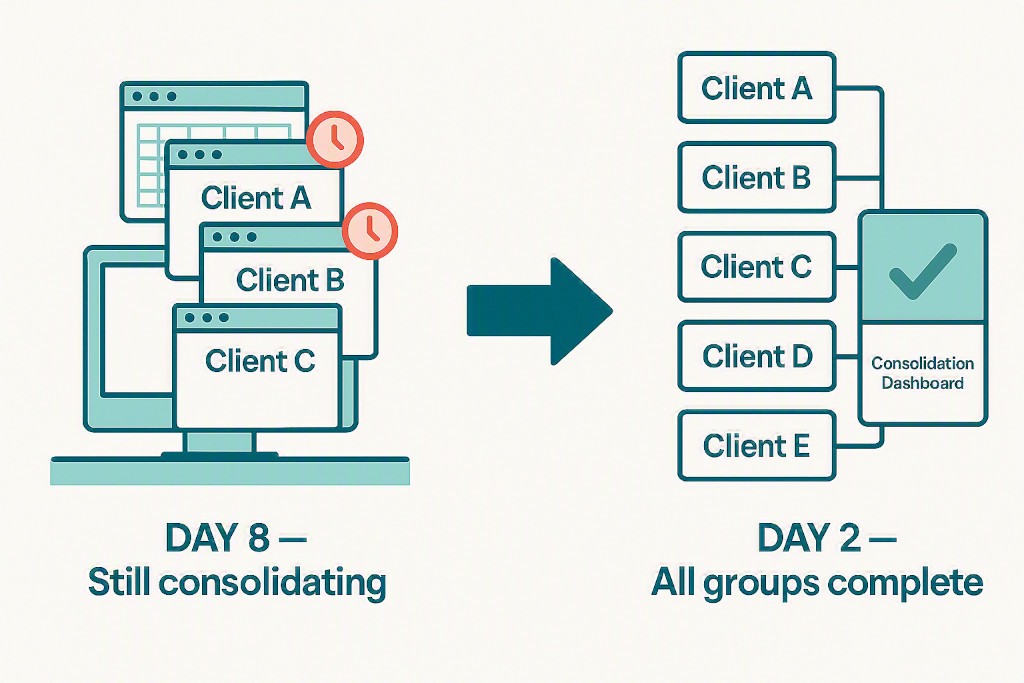
For an individual group client, a manual MYOB consolidation might consume six to ten hours of senior staff time each month. The process typically involves exporting trial balances from each MYOB file, reformatting the data into a common structure, mapping account codes that differ between entities, posting intercompany eliminations, and producing a consolidated output the client can use.
Multiply that across a firm’s full portfolio of group clients and the numbers become significant. A practice with ten group clients on monthly reporting cycles is committing up to 100 hours per month — roughly two and a half FTE weeks — to a process that adds no analytical value and is entirely reproducible with the right software.
“The consolidation itself is not difficult. It is the same steps every month. The problem is that it is ten hours of steps that a senior accountant has to perform manually — and that is ten hours they cannot spend on advisory work, on client relationships, or on anything that grows the practice.”
The accounting firms that have moved this workflow to a dedicated tool consistently report the same outcome: consolidation time drops from days to hours, delivery to clients accelerates, and the senior team shifts from data assembly to analysis. For a broader view of how this plays out in practice, the post on how accountants deliver consolidated financials without the manual work covers the full workflow.
What MYOB Group Clients Typically Need
Before selecting MYOB consolidation software, it helps to be clear about what the typical MYOB group client actually requires from their consolidated reporting:
- A consolidated P&L and balance sheet. The directors of a holding company need to see the group’s financial performance as a whole — not four separate entity reports stapled together.
- Intercompany elimination. Management fees charged by the holding company to subsidiaries, intercompany loans, and intercompany sales all need to be removed from the consolidated view. If they are not, both revenue and costs are overstated.
- Entity-by-entity breakdown. Whilst the board sees the group totals, management typically needs to drill into each entity’s contribution — which subsidiary is profitable, which is underperforming, where the cash is sitting.
- Multi-currency translation. Many MYOB groups have a New Zealand subsidiary, an offshore holding entity, or an international trading company. Those entities’ AUD or NZD or other currency financials need to be translated consistently into the group’s presentation currency.
- Audit-ready workpapers. The consolidation adjustments need to be documented, traceable, and defensible — particularly for groups with statutory audit requirements.
A Practical Example: Consolidating a Three-Entity MYOB Group
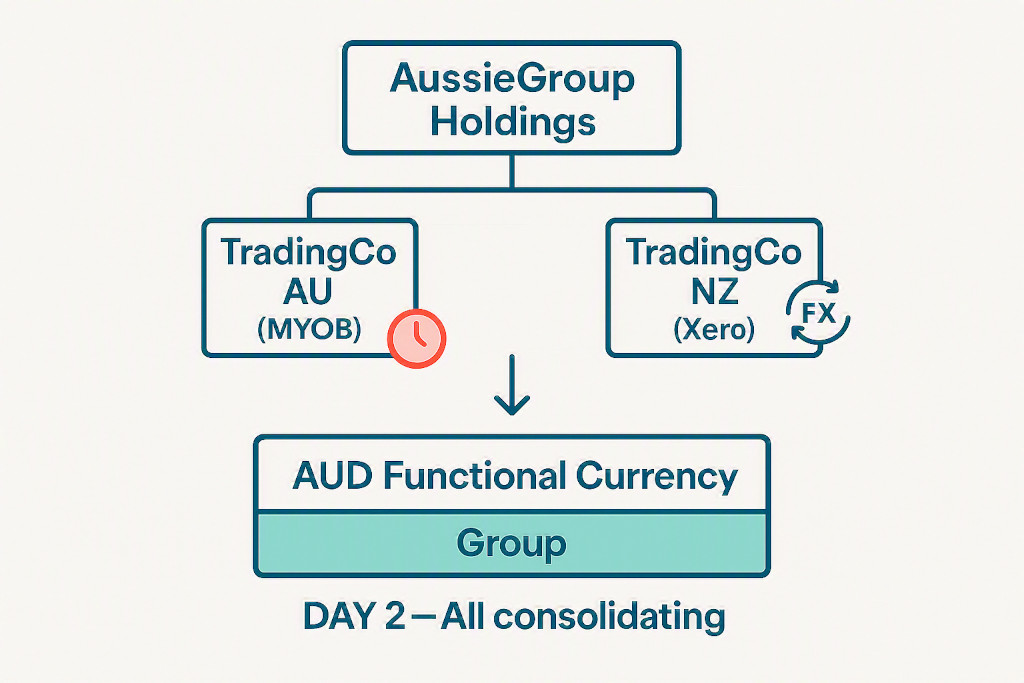
Consider AussieGroup Holdings Pty Ltd, a typical multi-entity MYOB group structure:
| Entity | Country | Currency | Platform | Annual Revenue |
|---|---|---|---|---|
| AussieGroup Holdings Pty Ltd | Australia | AUD | MYOB AccountRight | — |
| TradingCo AU Pty Ltd | Australia | AUD | MYOB AccountRight | A$4.8m |
| TradingCo NZ Ltd | New Zealand | NZD | Xero | NZ$1.6m |
The group has the following intercompany flows each month:
- AussieGroup Holdings charges a management services fee of A$20,000 per month to TradingCo AU
- AussieGroup Holdings charges a management services fee of NZ$8,000 per month to TradingCo NZ
- TradingCo AU provides fulfilment services to TradingCo NZ at a monthly charge of A$15,000 (invoiced in AUD, reimbursed via intercompany account)
At consolidation, all three flows are eliminated. The NZD entity’s financials are translated to AUD using the closing rate for the balance sheet and the average rate for the P&L. The difference produces a cumulative translation adjustment in group equity.
In BrizoConsol, this group connects via direct API to both MYOB AccountRight (for the two Australian entities) and Xero (for the New Zealand entity). Trial balances flow live into a single consolidation environment. The intercompany relationships are defined once; eliminations run automatically at every close. The AUD/NZD translation applies the rates entered for the period without a separate calculation step.
How BrizoConsol Connects to MYOB
BrizoConsol connects to MYOB AccountRight and MYOB Business via direct API — the same approach it uses for Xero, QuickBooks, and Zoho Books. There are no CSV exports, no manual trial balance reformatting, and no risk of importing a stale or incorrectly formatted file.
For accounting firms, this matters for two reasons. First, it means the consolidation reflects the live state of each entity’s books at any point during the month — not just the position at the time someone remembered to export a report. Second, it means the process is genuinely repeatable: the same steps run at the same quality for every client, every month, without variation driven by which team member happens to be performing the work.
Key capabilities relevant to MYOB group clients:
- Mixed platform support. Many MYOB groups include at least one entity on Xero, QuickBooks, or another platform. BrizoConsol consolidates across all of them simultaneously, handling the mixed-system reality of most genuine group structures.
- Automatic intercompany eliminations. Management fees, intercompany loans, and intercompany sales are eliminated at each close once the relationships are defined. No recurring manual journals.
- Multi-currency with AUD/NZD and other currency pairs. Enter the closing and average FX rates for the period, and BrizoConsol applies IAS 21-compliant translation automatically, producing the CTA in group equity.
- Virtual Groups for segment reporting. For clients who want to see performance by business unit, brand, or region independently of legal entity structure, virtual groups provide that view without additional consolidation steps.
- Full audit trail on all consolidation adjustments. Every elimination, currency adjustment, and consolidation journal is logged — providing the documentation trail that underpins a clean audit file.
Why Accounting Firms Choose BrizoConsol for MYOB Group Clients
The practical argument for MYOB consolidation software is straightforward: time. But the less visible benefit is consistency. When consolidation is performed manually, the quality of the output depends on the individual performing the work — their familiarity with the client, their attention to intercompany flows, their discipline with FX rates. When it runs through a structured tool, the methodology is the same for every client and every month.
For firms building a consolidation service line — or looking to move existing clients from ad hoc spreadsheet work to a repeatable monthly product — BrizoConsol provides the infrastructure to do that at scale. The firm configures each group client once, and the system handles the rest.
Firms also benefit from having a single tool that covers MYOB clients and Xero or QuickBooks clients simultaneously, rather than maintaining separate workflows by platform. Whether a group runs entirely on MYOB, entirely on Xero, or mixes both, the consolidation process in BrizoConsol is identical.
Consolidate Your MYOB Group Clients in BrizoConsol
Connect directly to MYOB AccountRight and MYOB Business via API. Eliminate intercompany transactions, handle multi-currency, and deliver consolidated group accounts — without the monthly spreadsheet. Start Free Trial