Group Reporting for Multi-Entity Businesses: What It Is and How to Get It Right
The owner of a four-entity services group had been running each business profitably for five years. He had a clear view of each company individually: the revenues, the costs, the profit margins. What he did not have — what his bank was now asking for in connection with a refinancing — was a consolidated set of accounts showing the group as a single economic entity. His accountant produced something workable after three weeks of manual spreadsheet work. The bank asked a few questions that exposed some intercompany balances that had not been properly eliminated. The refinancing was delayed. The group was profitable and fundable. The reporting process let it down.
This situation is more common than it should be. Multi-entity businesses regularly reach the point where stakeholders — banks, investors, auditors, directors — need a group view, and the finance team discovers that producing one accurately is considerably harder than running each entity’s own books. Group reporting is a discipline in its own right. Understanding what it requires, why it goes wrong, and how to do it properly is the starting point for any multi-entity business that needs to produce reliable consolidated accounts.
What Group Reporting Actually Means
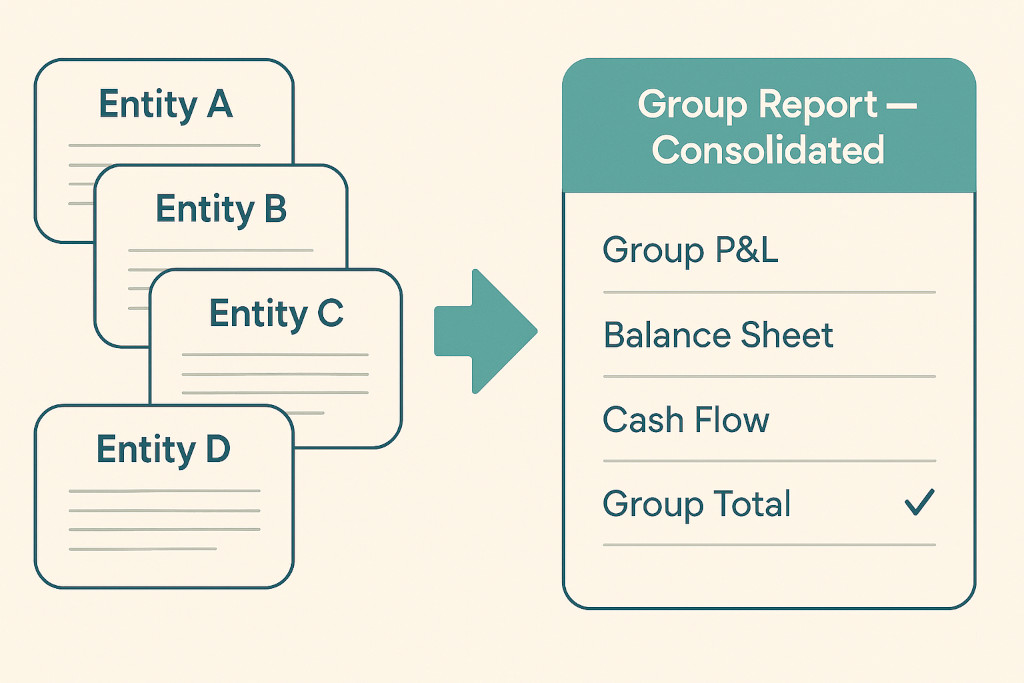
Group reporting is the process of producing financial statements that represent two or more legal entities as a single economic unit. Rather than showing the finances of each company individually, group reporting produces a consolidated picture: a combined profit and loss statement, a consolidated balance sheet, and typically a consolidated cash flow statement, all prepared as if the entities were one business.
Stop building consolidations in spreadsheets.
BrizoConsol automates multi-entity consolidation — setup in minutes, reports the same day.
The key word is consolidated. A group of four companies does not simply add their revenues together to get group revenue. Intercompany transactions — any sale, charge, loan, or transfer from one group entity to another — must be eliminated before the consolidated figures are calculated. A management fee that the holding company charges to its subsidiaries shows up as income in the holding company and as an expense in the subsidiaries. At the group level, both entries must be removed, because from the outside world’s perspective, no economic transaction has taken place. Money has moved between pockets within the same jacket.
Group reporting also involves combining entities that may use different charts of accounts, operate in different currencies, and be owned in different proportions. All of these factors have to be addressed before the consolidated numbers can be considered accurate. Getting each one right is a specific technical task, not just a matter of running a sum.
Which Businesses Need Group Reporting
Group reporting applies to any organisation that controls or significantly influences more than one legal entity. The structures vary widely, but the reporting challenge is consistent.
| Business type | Why group reporting applies |
|---|---|
| Holding companies | Parent entities controlling more than 50% of subsidiary voting rights are typically required by law to consolidate — whether listed or private |
| Private equity and investment groups | Portfolio ownership triggers consolidation, with additional complexity from acquisition accounting — goodwill, fair value adjustments, and deferred tax |
| Family-owned multi-entity businesses | Multiple trading entities under common ownership require a consolidated view for management, banking, and succession planning |
| Professional practices | Entities structured across multiple trading vehicles — common in law, accountancy, and advisory — require consolidation for partner reporting and lender requirements |
| Property investment groups | Assets held through separate SPVs each require their own accounts, with consolidation needed at the fund or group level |
| Franchise groups | Franchisors with company-owned locations alongside franchisee structures require group reporting to separate entity-level and group-level performance |
| Joint ventures | JV arrangements where one party has control or significant influence trigger either full consolidation or equity method accounting |
Even groups not legally required to consolidate typically need group reporting to run the business. A CFO managing four operating companies cannot give the board meaningful performance data from entity-level P&Ls alone — and that internal group view requires the same consolidation work, whether or not a statutory obligation is attached.
What Group Reporting Must Produce
| Statement | What it shows | Key consolidation requirement |
|---|---|---|
| Consolidated income statement | Combined revenues and costs after eliminating all intercompany transactions | Intercompany revenue and expense eliminated; only third-party transactions remain |
| Consolidated balance sheet | Combined assets and liabilities after eliminating intercompany balances | Intercompany loans, receivables, and payables removed; goodwill from acquisitions recognised |
| Consolidated cash flow statement | Group cash movements for the period | Indirect method applied to consolidated movements; intercompany cash flows eliminated |
| Non-controlling interest | Minority shareholders’ share of equity and earnings | Calculated from subsidiary net assets and NCI ownership percentage; presented separately in equity |
The sections below cover each statement and its specific consolidation requirements.
The output of a group reporting process is a set of consolidated financial statements. In their full form, these include three primary statements and a set of supporting notes and schedules.
The consolidated income statement — also called the consolidated profit and loss account — shows the group’s combined revenues and costs after eliminating all intercompany transactions. This is the statement that tells the board whether the group as a whole is profitable and gives investors a view of operating performance.
The consolidated balance sheet shows the combined assets and liabilities of the group, again after eliminating intercompany balances. Intercompany loans, receivables, and payables that exist between group entities must all be removed before this statement can be presented. Any goodwill arising from acquisitions — where the group paid more than the book value of the acquired entity’s net assets — appears as an asset on the consolidated balance sheet and must be subject to impairment testing in each subsequent period.
The consolidated cash flow statement reconstructs the group’s actual cash movements for the period. Building this statement from a set of individual entity P&Ls and balance sheets is one of the more technically demanding parts of group reporting, because it requires the indirect method to be applied to consolidated — not entity-level — movements, with intercompany cash flows also eliminated.
For groups that own subsidiaries partially rather than in full, the consolidated balance sheet must also show non-controlling interest — the portion of the subsidiary’s equity that belongs to minority shareholders rather than the parent. This line appears in equity on the balance sheet and requires a specific calculation based on the subsidiary’s net assets and the non-controlling ownership percentage.
The Five Things Group Reporting Requires to Be Done Correctly
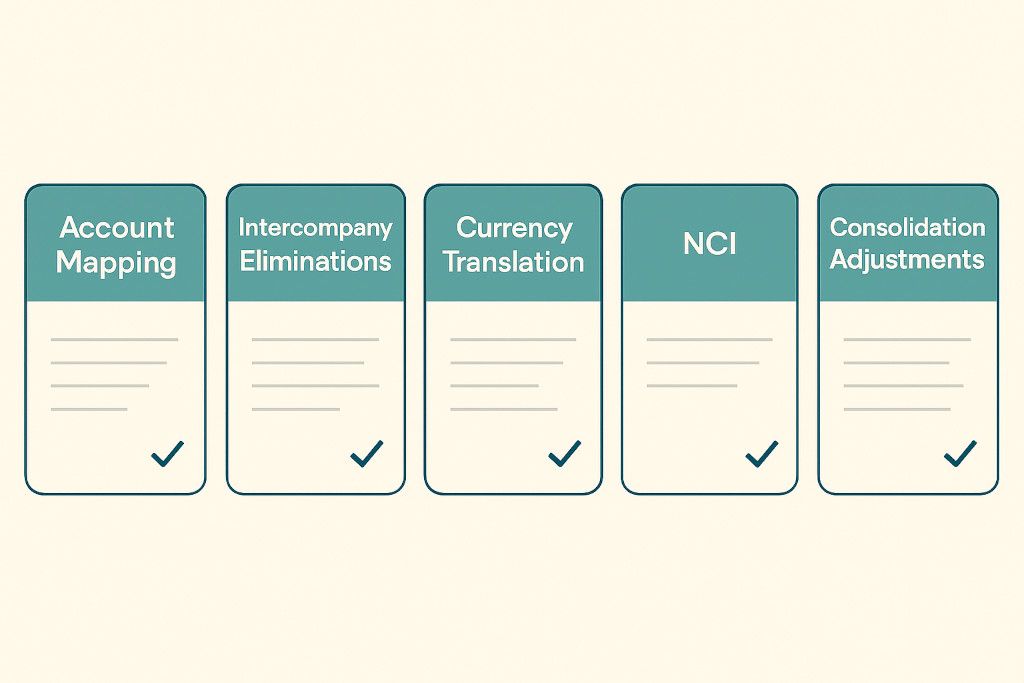
Most errors in group reporting trace back to one or more of five specific technical requirements not being handled properly. Understanding each of them is essential to understanding why the process is harder than it looks and where investment in the right tools pays off.
Account Mapping Across Entities
Every entity in the group has its own chart of accounts. These charts reflect the history of each business — how it was set up, which accounting software it uses, which accountant configured it, and which industry it operates in. A property holding entity’s chart looks nothing like a professional services firm’s. A company acquired from a third party arrives with a chart designed for its previous owner’s purposes, not the group’s.
Before consolidation can run, every account in every entity must be mapped to a shared group chart of accounts. Revenue from Entity A and Entity B need to land in the same group line before they can be combined. A group with five entities and two hundred accounts per entity has up to a thousand mapping decisions to make — and those mappings must be maintained, updated, and applied consistently every period. Any inconsistency produces errors in the consolidated output that are difficult to trace once the figures have been assembled.
Intercompany Elimination
Intercompany transactions are the most technically important and the most frequently mishandled element of group reporting. Every time one group entity transacts with another — charges a management fee, lends money, sells goods, provides a service — both sides of that transaction appear in the individual entity accounts. At the group level, both sides must be eliminated before the consolidated statements are produced.
The elimination covers income statement items — intercompany revenues and expenses — and balance sheet items, including intercompany receivables and payables and intercompany loan balances. Where an intercompany transaction has generated an unrealised profit — for example, where one entity has sold inventory to another entity in the group and that inventory has not yet been sold to a third party — the unrealised element must also be eliminated from consolidated profits.
The complication in practice is that intercompany balances frequently disagree between entities. Entity A records a receivable of $50,000 from Entity B. Entity B records a payable of $48,500 to Entity A. The difference of $1,500 may reflect timing — a payment in transit — or it may reflect an error. Either way, the mismatch must be investigated and resolved before the consolidation can close. In a group with ten or fifteen entities and significant intercompany activity, reconciling these differences each period is a substantial task. For a more detailed walkthrough of how intercompany eliminations work mechanically, see our guide to intercompany journal automation.
Foreign Currency Translation
Groups with entities operating in more than one currency face an additional layer of complexity. The financial statements of each foreign entity must be translated into the group’s presentation currency before they can be included in the consolidated accounts. Under IFRS and most other frameworks, the balance sheet is translated at the closing rate as of the reporting date, while the income statement is translated at the average rate for the period. The difference between what these two rates produce — the currency translation adjustment — is not recognised in profit or loss but taken directly to other comprehensive income and accumulated in a separate component of equity.
Getting this right requires maintaining both the closing rate and average rate for each currency for each reporting period, applying them correctly to the right categories of items, and calculating the translation adjustment accurately. The cumulative translation adjustment that sits in equity also needs to be reversed when a foreign subsidiary is disposed of — adding a further complication at the point of any group restructuring. For a detailed treatment of how currency translation works, see our currency translation adjustment guide.
Non-Controlling Interest
When a parent company owns less than 100% of a subsidiary, the portion of that subsidiary’s equity and earnings belonging to outside shareholders must be separately identified in the consolidated accounts. This is the non-controlling interest. It appears as a separate component of equity in the consolidated balance sheet, and the NCI share of the subsidiary’s profit or loss is separately presented in the consolidated income statement, below the group’s profit for the period.
The NCI calculation flows through from the subsidiary’s net assets at each reporting date and must be updated for the subsidiary’s profits or losses for the period, any dividends paid, and any changes in ownership percentage arising from share transactions.
For groups that have acquired subsidiaries through business combinations, the NCI figure at acquisition also depends on whether the group uses the proportionate method or the full goodwill method — a choice that affects both the NCI balance and the goodwill recognised on acquisition. Our NCI feature overview covers how BrizoConsol handles these calculations automatically.
Consolidation Adjustments
Beyond the four standard steps above, group reporting frequently requires additional adjustments. Acquisition accounting adjustments — the fair value adjustments made to the acquired entity’s assets and liabilities at the date of acquisition, and the amortisation of those adjustments in subsequent periods — must be maintained and applied each time the consolidation runs. Goodwill impairment testing is an annual requirement. Deferred tax adjustments arising from the difference between the accounting and tax base of assets create further complexity. Groups that have made acquisitions at different points in time carry a layered set of adjustments that must all be tracked and maintained correctly.
Why Group Reporting Goes Wrong
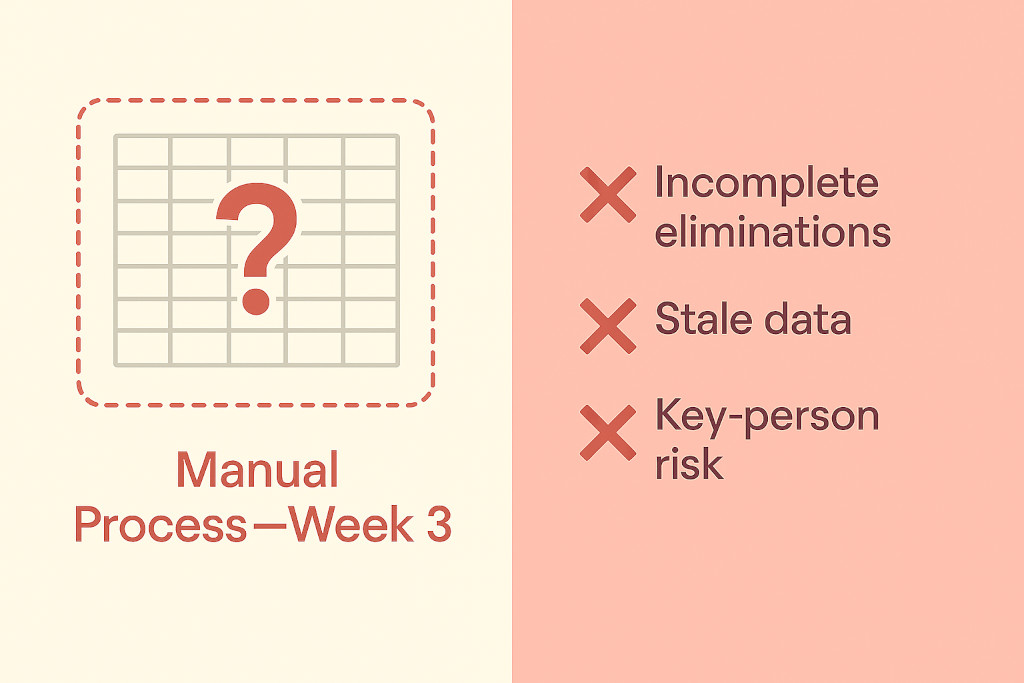
The most common group reporting failure modes are predictable and consistent across industries. Understanding them explains why the process is harder than it looks and where the risk sits.
The wrong tool — Excel
The overwhelming majority of group reporting failures trace back to a consolidation workbook in Microsoft Excel. Excel is a powerful modelling tool. It is not designed to be a consolidation engine. A consolidation workbook grows in complexity with every entity added, every acquisition completed, and every period that passes without proper documentation. Over time it becomes infrastructure that one person understands and nobody else can maintain. When that person leaves, the workbook is rebuilt from scratch — or partially rebuilt. Manual data entry introduces errors that take hours to trace. Version control is informal. The result: a consolidation that takes far longer than it should, produces results that are difficult to audit, and consumes finance team capacity right when it is most scarce.
Incomplete elimination
Intercompany balances that do not reconcile are written off as rounding, carried forward in the hope they will self-correct, or simply overlooked under time pressure. Any of these outcomes produces consolidated accounts that overstate or understate assets, liabilities, revenues, or costs — often by amounts small enough to be ignored individually but material in aggregate. The balance sheet may not balance. The P&L may overstate revenue. Neither is obvious until someone looks closely.
Timing
When the manual consolidation process takes three weeks, the figures reported to the board reflect the position as of the end of last month, two and a half weeks ago. In businesses where conditions change quickly, that information is of limited value for decision-making. The board is navigating by a map drawn three weeks ago. A finance team closing month-end consolidation in week three of the following month is a finance team that cannot provide timely information.
What Good Group Reporting Looks Like in Practice
A well-functioning group reporting process has three defining characteristics. It is fast, producing consolidated accounts within a few days of period end rather than weeks. It is accurate, with intercompany balances fully reconciled, eliminations correctly applied, and currency translation handled consistently. And it is auditable, meaning that every consolidated figure can be traced back to a source — the entity-level trial balance that produced it, the elimination journal that removed an intercompany balance, the exchange rate applied to translate a foreign entity’s results.
Speed matters because timely information is more valuable than retrospective information. A CFO reviewing consolidated results for May on the fifth of June can intervene in June if something looks wrong. A CFO reviewing May’s results on the twenty-eighth of June is reviewing history at that point. The business has already moved on.
Accuracy matters because errors in consolidated accounts have consequences. Banks and investors make funding decisions based on these figures. Auditors test them against source records. Errors that are discovered after the accounts have been shared externally damage credibility and may require restatement, which is both costly and reputationally damaging.
Auditability matters because the ability to explain and defend the consolidated figures is what separates a professional finance function from one that produces numbers it cannot fully account for. When a lender asks why group revenue this quarter is different from the same period last year, the finance team needs to be able to answer that question at the group level, not just at the entity level.
Achieving all three — speed, accuracy, and auditability — in a manual Excel-based process becomes increasingly difficult as the group grows. The complexity compounds faster than the finance team’s capacity to manage it manually.
How BrizoConsol Handles Group Reporting for Multi-Entity Businesses
BrizoConsol is purpose-built for multi-entity group reporting. It connects directly to the accounting software each entity uses — Xero, QuickBooks, MYOB, Zoho Books, or any platform via Excel import — and pulls trial balance data automatically at each reporting period. There is no manual data extraction, no copy-pasting of figures, and no risk of importing the wrong version of an entity’s numbers.
| Capability | How BrizoConsol handles it |
|---|---|
| Account mapping | Configured once per entity; maintained in the platform; changes to entity charts of accounts flagged automatically |
| Intercompany elimination | Runs automatically based on configured relationships; mismatches flagged for review; elimination journals posted without manual intervention |
| Currency translation | Closing and average rates applied correctly to balance sheet and income statement; CTA calculated and posted to OCI automatically |
| Non-controlling interest | Calculated from ownership structure configured for each subsidiary; NCI share of equity, profit, and OCI presented correctly |
| Consolidated statements | Group P&L, balance sheet, and cash flow available on demand — not at the end of a weeks-long manual process |
The finance team’s role shifts from calculating and posting eliminations to reviewing and approving them — a much faster and more reliable process than building elimination schedules manually each period.
For accounting firms managing consolidations on behalf of clients, or for CFOs managing multi-entity structures in-house, this change in the time required to close each period has a direct impact on the quality and timeliness of reporting available to the business.
For a more detailed look at specific structural scenarios, the holding company consolidation guide and the property group consolidation guide cover the specific requirements those structures present.
Getting Group Reporting Right From the Start
The finance teams that handle group reporting well share a common characteristic: they treat it as a process to be designed and maintained, not a task to be repeated from scratch each period. That means defining a group chart of accounts and maintaining account mappings consistently. It means setting clear rules about how intercompany transactions are recorded so that both sides of each transaction are entered in a way that makes reconciliation straightforward. It means establishing a close timetable that each entity follows so trial balances are available at the same point in time across the group.
And it means choosing tools built for the job rather than adapting general-purpose tools to a problem they were not designed to solve.
Multi-entity businesses managing group reporting through spreadsheets typically reach a point — a new entity acquired, a lender requesting audited consolidated accounts, a CFO who wants monthly board packs without a three-week close cycle — where the manual process stops being viable. That inflection point is the right moment to build the process on a foundation that will scale with the group rather than against it.
If you are at that point, or if you want to see what group reporting looks like when the process is properly automated, see BrizoConsol in action.