Why Do We Eliminate Intercompany Transactions in Financial Consolidation?
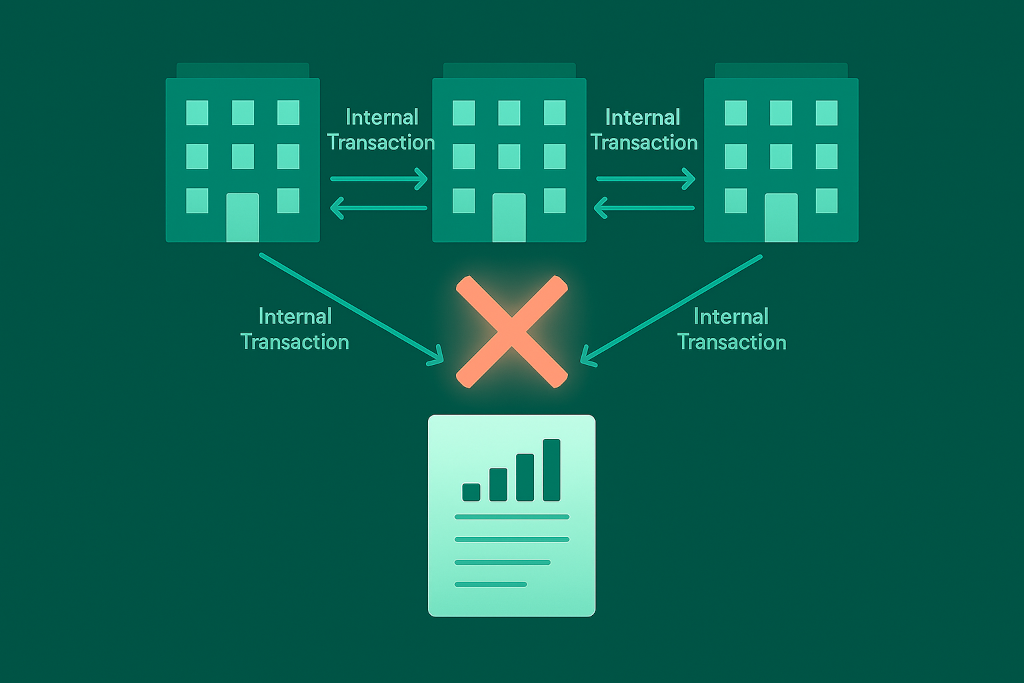
When a group of companies is under common control—such as a parent company with several subsidiaries—the goal of financial consolidation is to present their financials as if they were one single economic entity. This means transactions between the entities in the group are internal, not external, and do not represent real income, expense, asset, or liability from an outsider’s perspective.
That’s where intercompany elimination comes in. It ensures the group’s consolidated financial statements reflect only dealings with parties outside the group and provide a true and fair view of financial health.
Let’s explore why this is necessary, how it works in practice, and what can happen if it’s not done properly.
Automate NCI calculations across all your entities.
BrizoConsol handles non-controlling interest automatically — no manual adjustments required.
What Are Intercompany Transactions?
Intercompany transactions occur between companies that are part of the same group. These can include:
- Sales and purchases of goods or services
- Loans, advances, or interest income/expense
- Dividends declared and received
- Management fees or royalty payments
- Transfers of assets between group companies
Each individual company records these transactions in its own books, often treating them just like any other third-party transaction. But in a consolidated view, these do not add value to the group as a whole—they’re simply internal movements.
| Transaction Type | What Gets Eliminated | Statement Affected |
|---|---|---|
| Intercompany sales / purchases | Revenue (seller) + Cost of goods (buyer) + unrealised profit in inventory | Income Statement + Balance Sheet |
| Intercompany loans | Loan receivable (lender) + Loan payable (borrower) | Balance Sheet |
| Intercompany interest | Interest income (lender) + Interest expense (borrower) | Income Statement |
| Intercompany dividends | Dividend income (recipient) + Dividend payable/receivable | Income Statement + Balance Sheet |
| Management fees / royalties | Fee income (charger) + Fee expense (recipient) | Income Statement |
| Asset transfers | Gain on sale (seller) + inflated asset value (buyer) | Income Statement + Balance Sheet |
Note: Where partial ownership exists, eliminations apply only to the group’s proportionate share — the non-controlling interest portion is retained.
Why Eliminate?
1. To Avoid Double Counting
Imagine Subsidiary A sells $100,000 of goods to Subsidiary B. If you consolidate both companies without eliminating the intercompany sale:
- The group’s revenue would be overstated by $100,000.
- The group’s cost of goods sold (COGS) would also be overstated by $100,000.
- If the inventory hasn’t been sold to an external party yet, part of the profit would be unrealised.
The result? A misleading income statement that inflates both revenue and expenses, distorting profitability.
2. To Prevent Overstated Assets and Liabilities
Suppose Subsidiary X lends $1 million to Subsidiary Y. At the entity level:
- Subsidiary X has a loan receivable of $1 million.
- Subsidiary Y has a loan payable of $1 million.
If these aren’t eliminated, the consolidated balance sheet will wrongly show $1 million more in both assets and liabilities than what the group truly owns or owes externally.
3. To Reflect External Reality
Investors, auditors, regulators, and decision-makers rely on consolidated statements to understand a group’s actual performance. Internal transactions give an inflated view of income, obligations, and financial activity. Intercompany eliminations ensure the reported results represent only what’s relevant from the outside world’s perspective.
4. To Ensure Compliance with Accounting Standards
Accounting frameworks such as IFRS 10 – Consolidated Financial Statements and ASC 810 (US GAAP) require the elimination of intercompany balances and transactions. It’s not optional. If a group fails to do this properly, it risks:
- Audit qualifications
- Regulatory issues
- Loss of investor confidence
Real-World Example
Let’s say BrizoGroup consists of:
- Brizo Holdings (Parent)
- Brizo SG (Subsidiary in Singapore)
- Brizo AU (Subsidiary in Australia)
Brizo AU sells software licenses to Brizo SG for SGD 50,000. Brizo SG capitalises it as an intangible asset and amortises it over 3 years.
Without elimination:
- Brizo AU reports revenue of SGD 50,000.
- Brizo SG reports an increase in assets and depreciation over time.
- The group appears to have grown, even though no money came from outside.
After elimination:
- The software license sale is removed.
- The consolidated revenue does not include internal software sales.
- The group shows only external license sales as part of its top line.
When Elimination Becomes Tricky
While the concept of intercompany elimination is straightforward, the execution can get complicated quickly — especially in larger, more global group structures. Here are the four most common sources of complexity:
Timing Differences
One entity records a transaction in March; the counterparty records it in April. At the March month-end consolidation, you have one side of the elimination but not the other — creating an out-of-balance adjustment that breaks the consolidated balance sheet.
Example: Brizo SG invoices Brizo AU for management fees of $20,000 on 29 March. Brizo AU hasn’t processed the invoice yet and records it in April. At 31 March consolidation, Brizo SG shows fee income of $20,000 but Brizo AU shows no corresponding expense. The elimination can only be done one-sided, leaving a residual variance that must be tracked and resolved in April’s close.
The fix is a clear group-wide cut-off policy — all intercompany transactions must be confirmed and agreed between entities before the consolidation run begins.
Currency Differences
When entities operate in different functional currencies, the same intercompany transaction can generate slightly different amounts on each side due to exchange rate movements between invoice date, payment date, and reporting date.
Example: Brizo Holdings invoices Brizo SG for £50,000 in management fees. Brizo SG records the equivalent in SGD at the rate on invoice date. By payment date, the rate has shifted — leaving a small FX difference that doesn’t cancel out automatically. This residual needs to be treated as a consolidation foreign exchange adjustment, not left as an unexplained variance in the group accounts.
Complex Structures
In tiered groups — where Subsidiary C owns Subsidiary D, which in turn owns Subsidiary E — intercompany eliminations must be applied at the correct level in the hierarchy. Eliminating at the wrong level either misses the adjustment entirely or doubles it.
Example: Subsidiary D pays a management fee to Subsidiary C. If Subsidiary D and C are first consolidated into a sub-group before being rolled into the ultimate parent, the elimination must happen at the sub-group level — not at the top. Getting the sequencing wrong is one of the most common causes of consolidation errors in tiered structures.
Partial Ownership (Non-Controlling Interest)
When a parent owns less than 100% of a subsidiary, intercompany transactions require partial elimination. Only the group’s proportionate share is eliminated — the remainder belongs to the non-controlling interest and must stay in the consolidated accounts.
Example: Brizo Holdings owns 75% of Brizo AU. Brizo AU sells $80,000 of goods to another group entity. At consolidation, only $60,000 (75%) of the intercompany profit is eliminated. The remaining $20,000 is attributable to the minority shareholders and is reflected in the NCI line — not eliminated. Getting this wrong in either direction misstates both group profit and the NCI balance.
How Systems Like BrizoConsol Help
Managing intercompany eliminations manually is time-consuming and error-prone — especially for growing businesses with multiple subsidiaries. That’s where automation matters.
| Capability | What it does |
|---|---|
| Automated identification | Identifies intercompany transactions across entities based on counterparty, date, and amount — so nothing gets missed during the consolidation run |
| Two elimination methods | Teams can input eliminations at group level or by selecting “from” and “to” entities — whichever fits their consolidation structure; method can be set per entity |
| Common Chart of Accounts | Defines a shared CCOA across all group entities, giving every subsidiary a consistent language for intercompany recording and reducing mismatches at source |
| Currency conversion and FX support | Multi-currency groups manage FX differences within the same platform — no switching between tools or manual recalculation of exchange rate variances |
| Full audit trail | Every elimination entry is logged with drill-down capability back to the originating transaction — giving auditors the visibility they need without the finance team reconstructing the story |
Conclusion
Eliminating intercompany transactions isn’t just a technical requirement — it’s the foundation of meaningful consolidated financial reporting. Without it, the group’s income statement overstates revenue, the balance sheet inflates assets and liabilities, and the numbers lose the trust of auditors, investors, and regulators.
Done well, intercompany elimination gives business leaders a clear, accurate view of what the group is genuinely earning, spending, and owning — with no internal noise distorting the picture.
As group structures grow more complex — more entities, more currencies, more tiers of ownership — the manual approach stops being viable. Errors creep in, close timelines stretch, and audit queries multiply.
BrizoConsol is purpose-built for this. It automates intercompany identification, supports multiple elimination methods, handles partial ownership and tiered structures, and gives finance teams full audit-trail visibility into every adjustment made — so consolidation is faster, cleaner, and defensible.