How to Calculate Non-Controlling Interest (NCI) in Financial Consolidation
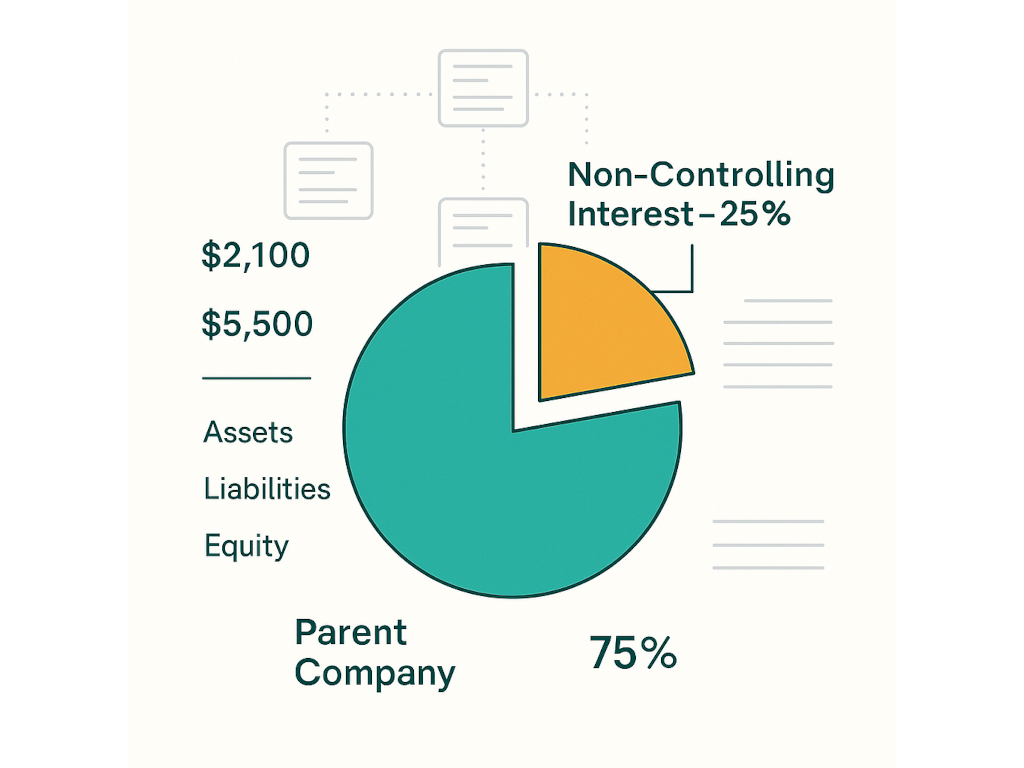
When a parent company acquires a controlling stake in another business but does not own 100% of it, the financial statements of the group become more complex in one very specific way: not all of the subsidiary’s net assets, income, and equity belong to the parent. A portion — the share held by outside investors — must be recognised, measured, and disclosed separately.
This portion is called the Non-Controlling Interest, commonly abbreviated as NCI and also referred to in older accounting standards as Minority Interest.
Understanding how to calculate NCI correctly is one of the most essential technical skills in group financial reporting, and one of the most commonly mishandled. Finance teams that get it wrong end up overstating the equity attributable to the parent, misrepresenting consolidated profit, and producing balance sheets that do not reconcile — all errors that become deeply problematic when external auditors or investors scrutinise the numbers.
Automate NCI calculations across all your entities.
BrizoConsol handles non-controlling interest automatically — no manual adjustments required.
This guide walks through exactly how NCI is calculated, from the acquisition date through to each subsequent reporting period, with worked examples for each step.
What Is Non-Controlling Interest and Why Does It Matter?
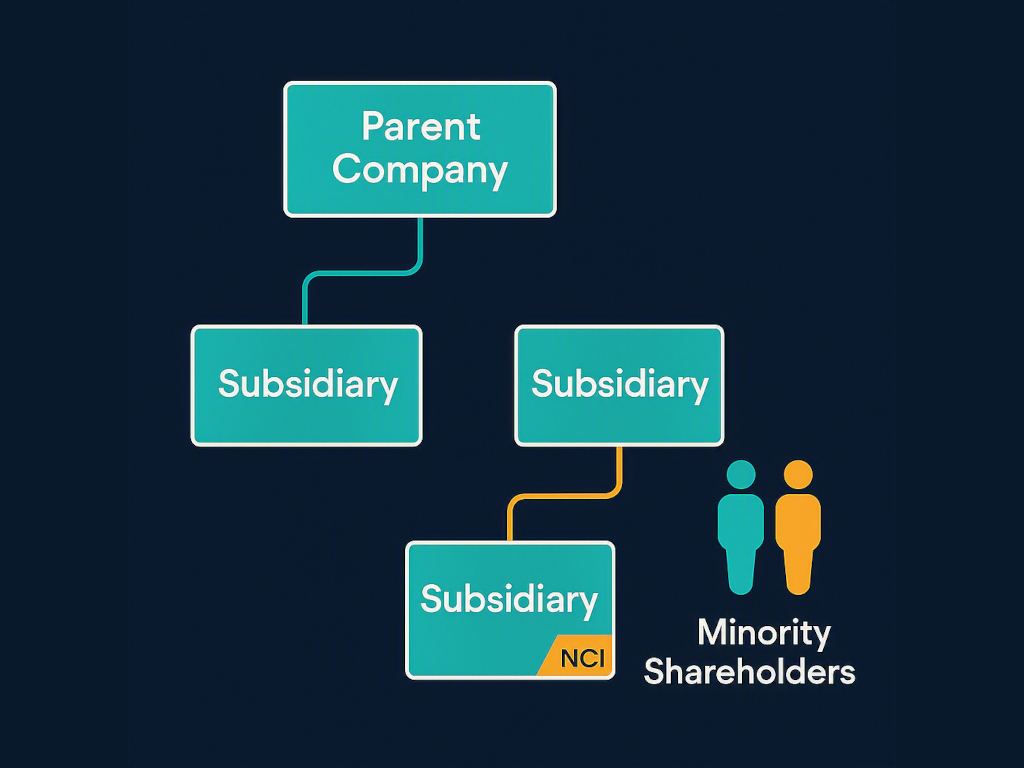
Non-Controlling Interest is the portion of a subsidiary’s equity, net assets, and profit or loss that is attributable to shareholders other than the parent company. It arises whenever a parent acquires a controlling interest in a subsidiary — typically defined as more than 50% of voting rights — but does not acquire the full 100%. The shareholders who hold the remaining percentage are the non-controlling (or minority) shareholders, and their economic interest must be recognised in the consolidated financial statements separately from the interests of the parent’s own shareholders.
This requirement exists because consolidated financial statements present the group as a single economic entity. When you consolidate a subsidiary, you bring 100% of its assets, liabilities, income, and expenses into the group statements — not just your proportionate share. But including 100% of a subsidiary’s net assets while only 75% of them belong to you would overstate the group’s equity attributable to the parent. NCI is the mechanism that corrects this: it represents the percentage that belongs to external shareholders, sits within equity on the consolidated balance sheet, and is disclosed separately from the parent’s equity.
The same logic applies to the income statement — consolidated profit must be split between the amount attributable to the parent’s shareholders and the amount attributable to NCI. Under both IFRS (specifically IFRS 10 and IFRS 3) and US GAAP (ASC 810), this split presentation is mandatory.
Getting it right matters not just for compliance but for the integrity of every key metric that investors and boards rely on — earnings per share, return on equity, net asset value per share, and more.
The NCI Formula
Two formulas drive every NCI calculation:
1. NCI at Acquisition
NCI at Acquisition = Fair Value of Net Assets × NCI %
Where NCI % = 100% − parent’s ownership percentage
2. NCI Balance — Period Roll-Forward
| $000 | |
|---|---|
| Opening NCI balance | X |
| + NCI share of profit (NCI % × profit after tax) | X |
| − NCI share of dividends (NCI % × dividends paid) | (X) |
| + NCI share of OCI (NCI % × OCI items) | X |
| Closing NCI balance | X |
The two formulas work in sequence: the acquisition formula gives you the opening balance on the day control is obtained, and the roll-forward updates it every reporting period after that. The steps below walk through each component in detail with worked examples.
Insert this as a new H2 section immediately after “What Is Non-Controlling Interest and Why Does It Matter?” — before “The Two Methods.”
The Two Methods of Calculating NCI
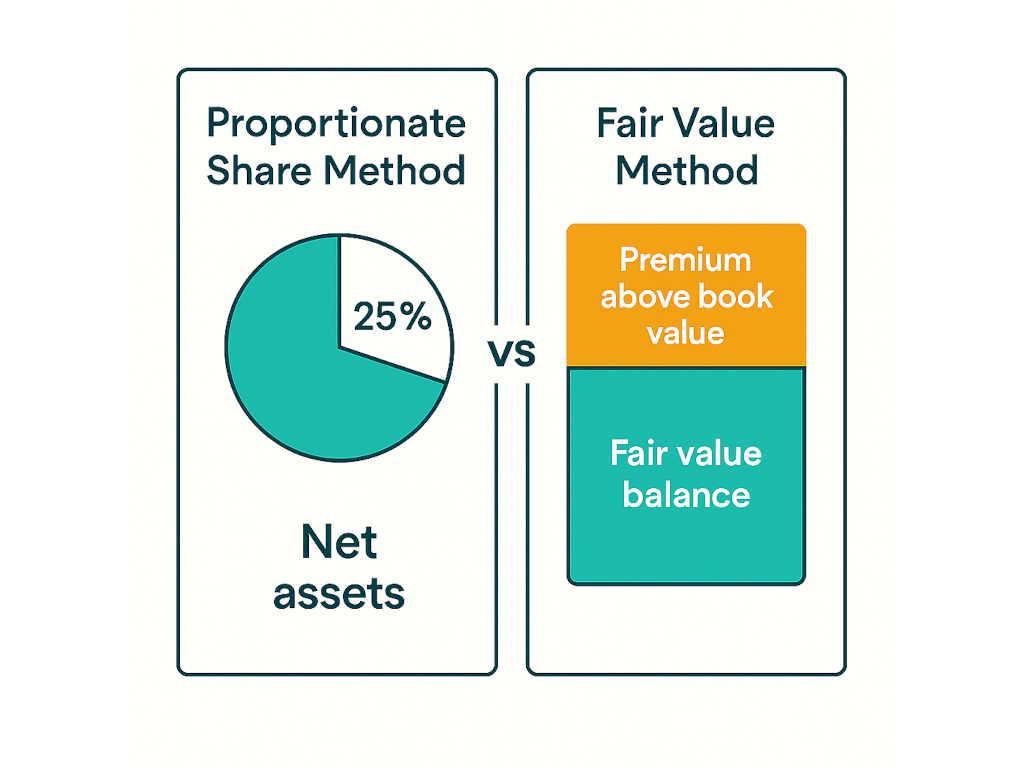
Under IFRS 3, there are two permitted methods for measuring NCI at the acquisition date. The choice affects both the NCI figure and the goodwill recognised on the consolidated balance sheet.
| Proportionate Share Method | Fair Value Method | |
|---|---|---|
| Also called | Partial goodwill method | Full goodwill method |
| NCI measured at | NCI % × fair value of subsidiary’s identifiable net assets | Fair value of the NCI stake itself (market or estimated) |
| Goodwill recognised | Parent’s share only | Full goodwill including NCI’s share |
| NCI figure at acquisition | Lower | Higher |
| More common in practice | ✓ |
The proportionate share method is simpler and more widely used, particularly for private company groups. The fair value method produces a higher NCI and a higher goodwill figure, because it includes the NCI’s notional share of goodwill — something the proportionate method excludes entirely.
Once selected, the method must be applied consistently for that subsidiary going forward.
The worked examples in this guide use the Proportionate Share Method.
Step 1: Identify the Subsidiary’s Net Assets at Acquisition Date
The starting point for any NCI calculation is establishing the fair value of the subsidiary’s identifiable net assets at the date of acquisition. Net assets is total assets minus total liabilities — but the critical word is “fair value.” Under IFRS 3, all identifiable assets and liabilities of the acquired entity must be measured at their fair value on the acquisition date, not at their carrying value in the subsidiary’s own books.
This fair value exercise — often called a purchase price allocation or PPA — is where significant adjustments frequently arise. Property carried at depreciated historical cost may have a current market value well above book value. Customer relationships, brand names, and patents never recognised as assets in the subsidiary’s standalone accounts must be identified and fair-valued. Contingent liabilities not recognised in the subsidiary’s books may need to be recognised at fair value in the consolidated statements.
Once all fair value adjustments are made, the resulting net asset figure is the correct base for calculating both NCI and goodwill. The output is documented in a purchase price allocation schedule, which becomes the opening balance for the subsidiary in the consolidated accounts and the foundation for all subsequent NCI calculations.
Worked Example:
Assume Parent Co acquires 75% of Subsidiary Ltd. At the acquisition date, Subsidiary Ltd’s identifiable net assets at fair value are calculated as:
$000 Property, plant & equipment (at fair value) 4,200 Inventory (at fair value) 800 Trade receivables 600 Cash 400 Total Assets 6,000 Trade payables (500) Borrowings (1,000) Total Liabilities (1,500) Net Assets at Fair Value 4,500
Step 2: Apply the NCI Ownership Percentage
Once the fair value of the subsidiary’s net assets at the acquisition date is established, the NCI at acquisition is simply calculated by multiplying the net assets figure by the non-controlling interest percentage — that is, the percentage of the subsidiary not owned by the parent.
Formula:
NCI at Acquisition = Net Assets at Fair Value × NCI Percentage
This figure represents the non-controlling shareholders’ share of the subsidiary’s net assets on the day the parent took control. It is recognised directly in the equity section of the consolidated balance sheet at the acquisition date and forms the opening NCI balance from which all subsequent movements are tracked.
The calculation itself is arithmetically simple, but the inputs — particularly the fair value of net assets — require significant judgment and expertise to get right. An error in the purchase price allocation flows directly into an error in NCI, which then compounds into every subsequent period’s NCI movement calculation. This is why clean, well-documented acquisition accounting is so important: it is the foundation of accurate group reporting for the entire life of the subsidiary’s membership in the group.
Continuing the Example:
NCI Percentage = 25% (since Parent Co owns 75%)
NCI at Acquisition = $4,500,000 × 25% = $1,125,000
This $1,125,000 is recognised in equity on the consolidated balance sheet as “Non-Controlling Interest” at the acquisition date.
Step 3: Adjust for Post-Acquisition Changes
The acquisition-date NCI figure is just the starting point. In every subsequent reporting period, the NCI balance is updated for the non-controlling shareholders’ share of three categories of movement:
Profit or loss for the period
NCI % × the subsidiary’s profit after tax, after deducting any additional depreciation on fair value uplifts from the purchase price allocation. Added to the NCI equity balance and presented separately in the consolidated income statement.
Dividends paid to minority shareholders
NCI % × dividends declared by the subsidiary. Reduces the NCI balance — these are a return of equity to minority shareholders, not an expense.
Other comprehensive income (OCI)
NCI % × each OCI item — foreign currency translation differences, revaluation surpluses, actuarial gains and losses. Presented in the consolidated statement of OCI and added to or deducted from the NCI equity balance.
The cumulative effect of all these movements, tracked from the acquisition date forward, gives the NCI balance at any reporting date.
The NCI’s share of the subsidiary’s profit for the period is calculated by multiplying post-acquisition profit — after any fair value depreciation adjustments from the purchase price allocation — by the NCI percentage. This amount is added to the NCI balance in equity and presented separately in the consolidated income statement as “Profit attributable to non-controlling interests.”
Dividends paid by the subsidiary to its minority shareholders reduce the NCI balance, because they represent a return of equity to those shareholders. OCI attributable to NCI is similarly calculated as the NCI percentage of each OCI item and presented in the consolidated statement of other comprehensive income.
The cumulative effect of all these movements, tracked from the acquisition date forward, gives the NCI balance at any reporting date.
Continuing the Example:
In Year 1 after acquisition, Subsidiary Ltd earns a post-acquisition profit of $600,000 and pays dividends of $100,000 to all shareholders.
$000 NCI at acquisition 1,125 Add: NCI share of profit (25% × $600k) 150 Less: NCI share of dividends (25% × $100k) (25) NCI at End of Year 1 1,250
NCI in the Consolidated Balance Sheet
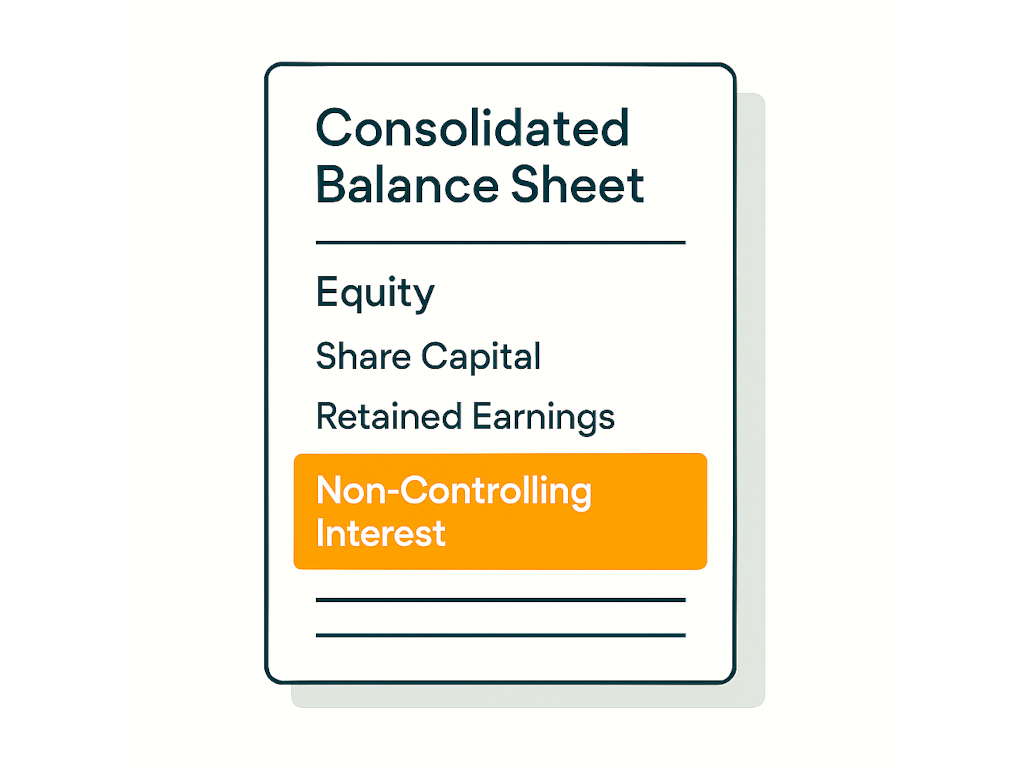
On the consolidated balance sheet, NCI appears within the equity section — but presented separately from the equity attributable to the owners of the parent company. This presentation is mandatory under both IFRS and US GAAP and reflects the fact that while NCI is genuine equity, it belongs to shareholders outside the parent group.
The equity section of the consolidated balance sheet typically presents as follows:
| Equity | $000 |
|---|---|
| Share capital | X |
| Retained earnings | X |
| Other reserves | X |
| Equity attributable to owners of the parent | X |
| Non-Controlling Interests | X |
| Total equity | X |
NCI is not a liability and not part of the parent’s equity — it is a separately disclosed third category within total equity. A common mistake among finance teams new to consolidation is to lump it into retained earnings or, worse, to present it as a liability. Both treatments are incorrect under IFRS and US GAAP.
A common mistake made by finance teams new to consolidation is to lump NCI together with retained earnings or to present it as a liability. NCI is neither — it is a third category, distinctly disclosed, that sits alongside share capital and retained earnings in the equity section.
The NCI balance grows each period by the NCI’s share of the subsidiary’s profit and OCI, and shrinks when dividends are paid to minority shareholders or when the parent increases its ownership stake. If a parent acquires additional shares from minority shareholders, the NCI balance decreases and the difference between the consideration paid and the NCI derecognised is recorded as a movement in the parent’s equity — not as goodwill or a gain or loss in the income statement, under IFRS 10.
NCI in the Consolidated Income Statement
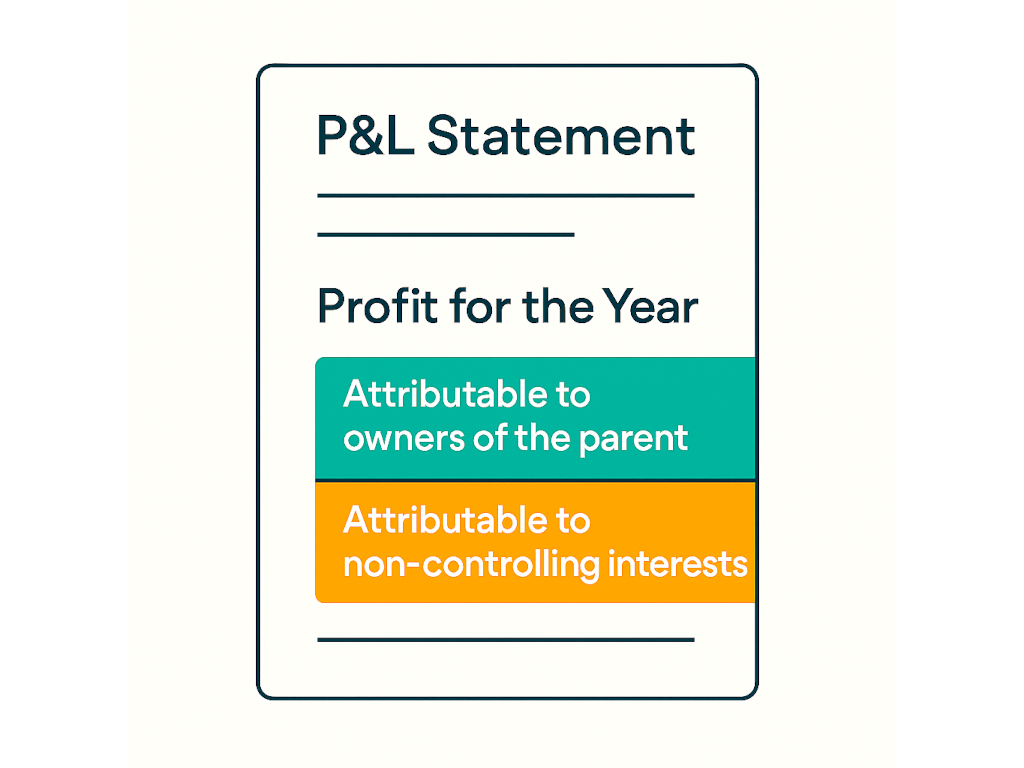
Just as NCI must be disclosed separately in equity on the balance sheet, the consolidated income statement must split total profit between the amount attributable to the parent’s shareholders and the amount attributable to non-controlling interests. This split appears at the bottom of the income statement, after the total “Profit for the period” line, and is a mandatory disclosure.
The NCI’s share of profit is calculated as its percentage of the subsidiary’s profit after tax — but with one important adjustment: any additional depreciation or amortisation arising from the fair value uplift of assets recognised in the purchase price allocation must be charged against the subsidiary’s profit before the NCI split is applied. This is because the fair value adjustments were made at the group level, not in the subsidiary’s own books, and they affect the economic profit being shared between the parent and the minority shareholders.
Forgetting to make these PPA-related adjustments is one of the most common technical errors in NCI calculations. It results in NCI being slightly overstated each period, and the cumulative error can become material over the life of a long-lived acquisition.
In addition to the profit split, the statement of other comprehensive income must similarly split each OCI component between the amounts attributable to the parent and to NCI.
How BrizoConsol Calculates NCI Automatically
If the step-by-step process above looks like a lot of work to maintain across every reporting period — it is, when done manually. The traditional approach involves an NCI workbook in Excel, maintained separately from the main consolidation model, with its own formulas linking to the subsidiary’s trial balance, tracking fair value depreciation adjustments period by period, and rolling forward the NCI equity balance.
It needs to be updated every month-end, checked for broken links every time the trial balance structure changes, and reconciled to the balance sheet and income statement totals manually. A single formula error can cascade into a misstatement across the entire consolidated set.
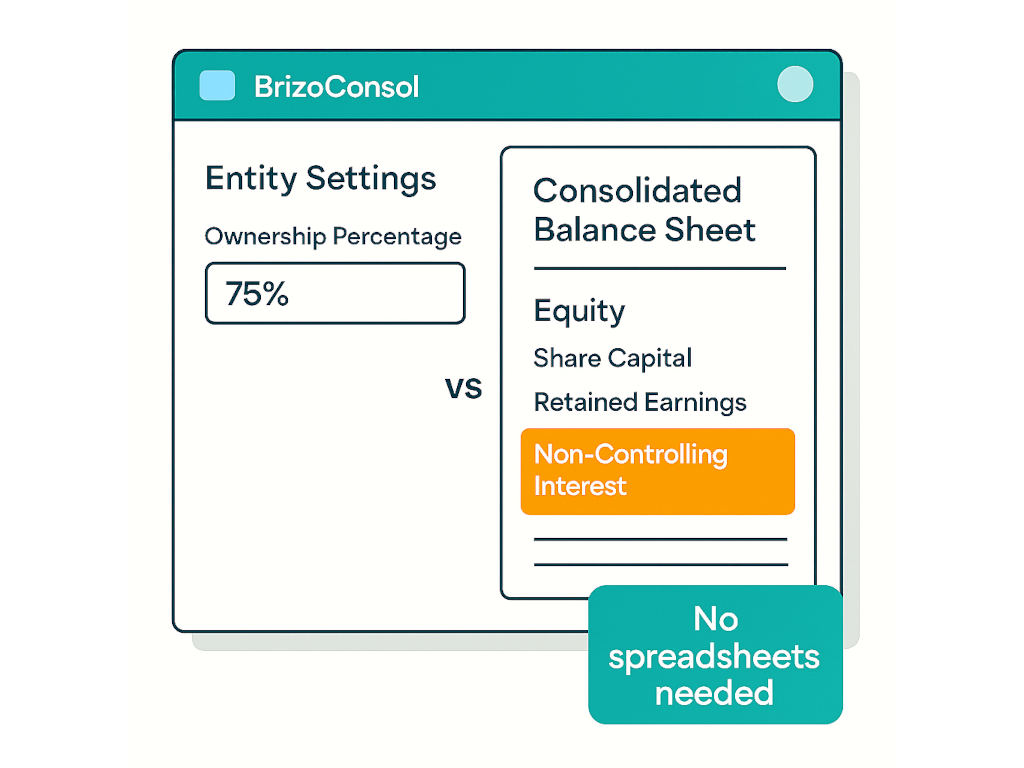
BrizoConsol eliminates all of this. When you set up a subsidiary, you enter the parent’s ownership percentage — say, 75% — and the platform handles every NCI calculation automatically from that point forward. The NCI balance is calculated and updated in real time as the subsidiary’s trial balance data flows in from the connected accounting software. The NCI share of profit is split and presented automatically in the consolidated income statement, and the NCI equity balance rolls forward correctly each period, incorporating profit, dividends, and OCI movements without any manual intervention.
There is no separate NCI workbook to maintain, no risk of formula errors, and no reconciliation step at month-end. If the ownership percentage changes, updating it in BrizoConsol instantly recalculates everything downstream. For groups with multiple subsidiaries at different ownership percentages, BrizoConsol tracks each entity’s NCI independently and aggregates them correctly in the consolidated statements.
Conclusion
Non-Controlling Interest is not a rounding line on the balance sheet — it is a substantive disclosure that reflects the rights of real shareholders with a real economic stake in your subsidiary. Calculating it correctly requires clean acquisition-date fair values, disciplined tracking of post-acquisition profit, dividends, and OCI, and precise presentation in both the balance sheet and the income statement across every reporting period.
The mechanics, as this guide has shown, are logical and systematic — but they require consistent attention and are prone to compounding errors when managed in spreadsheets. For groups beyond a small number of entities, automating this process is not a convenience — it is a control.
BrizoConsol was built to remove that risk entirely. By automating NCI calculation from ownership percentage through to consolidated disclosure, it gives finance teams accurate, audit-ready NCI figures every period without the manual workbook. If your group includes partially owned subsidiaries and you are still calculating NCI by hand, start a free trial at brizoconsol.com.