Financial Consolidation for Holding Companies: How Finance Leaders Consolidate Across Subsidiaries
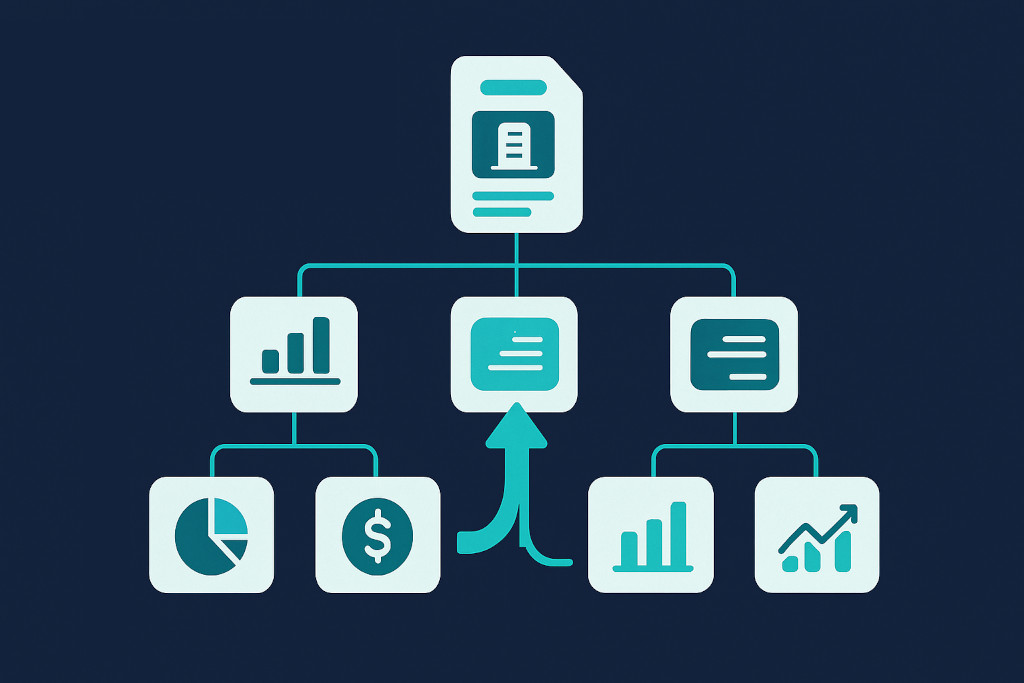
A holding company is an entity that owns a controlling interest in one or more subsidiary businesses. Unlike an operating company that generates revenue from goods or services directly, a holding company derives its value from the ownership stakes it holds. Holding groups can range from relatively simple two or three entity structures to sprawling international networks with dozens of subsidiaries operating across multiple jurisdictions, currencies, and accounting standards.
For finance leaders and CFOs working within holding structures, financial consolidation is not a nice to have activity. It is a legal, regulatory, and strategic necessity. In most jurisdictions, a holding company that controls a group of subsidiaries is required to prepare consolidated financial statements that reflect the group as a single economic entity. This means combining the balance sheets and income statements of every subsidiary, eliminating intercompany balances and transactions, translating foreign currency results, and adjusting for non-controlling interests where the holding company does not own 100% of a subsidiary.
Beyond the regulatory requirement, consolidated financials are the foundation upon which board members, investors, lenders, and auditors form their view of the group. A board that cannot see a clean, timely consolidated picture of the group is making decisions without the full picture. Lenders and investors need consolidated accounts to assess credit risk and returns. Auditors need them to sign off on the group. The finance function that can produce these statements reliably and on time earns strategic influence rather than spending all its energy on month end firefighting.
Automate NCI calculations across all your entities.
BrizoConsol handles non-controlling interest automatically — no manual adjustments required.
The problem for most holding companies is that financial consolidation has traditionally been a laborious, error prone process dominated by spreadsheets, manual journal entries, and enormous amounts of copy and paste work. This guide explains what that process actually involves, where it breaks down, and how purpose built software like BrizoConsol changes the outcome for holding company finance teams.
The Real Challenges Holding Companies Face at Consolidation Time

Most holding companies consolidate using a combination of accounting software at the subsidiary level and spreadsheets at the group level. Each subsidiary runs on whatever accounting platform suits its operations. At period end, a finance manager downloads trial balances from each entity, pastes them into a master workbook, maps accounts, eliminates intercompany items, translates foreign currency, accounts for non-controlling interest, and attempts to produce a coherent group pack. This process produces numbers — but it introduces several categories of risk and inefficiency that compound as the group grows.
| Challenge | What it looks like in practice |
|---|---|
| Account mapping | Each subsidiary runs its own chart of accounts — someone must map these to a common group structure every period. In practice the mapping lives in one person’s head, encoded in spreadsheet formulas nobody else fully understands. When that person leaves, the knowledge leaves with them |
| Intercompany elimination | Parent loans, management charges, shared service recharges, and intercompany sales all exist in two entities simultaneously and must be eliminated. In a group with ten or twenty entities this becomes an enormous reconciliation exercise — and it is easy for balances to remain unreconciled when each entity has recorded the same transaction slightly differently |
| Multi-currency translation | Subsidiaries operating in foreign currencies must have their financials translated using the correct rates for each account type. Getting this wrong produces accounts that will not pass an audit and may need to be restated — a damaging and expensive outcome for any holding group |
| Timeliness | A finance team spending two weeks on manual consolidation cannot provide meaningful insight to the board. By the time the pack is finished the information is stale — leadership is making decisions on data from three weeks ago |
What Holding Company Consolidation Actually Requires
To consolidate a holding group accurately, a finance team must perform several distinct operations — each of which must be done correctly for the overall result to be trustworthy.
1. A common chart of accounts
Every subsidiary trial balance must be mapped to a consistent set of account codes and categories before figures from different entities can be combined. Without this mapping, adding together the revenues of two subsidiaries is meaningless — one might record revenue under one structure and another under a completely different approach. A group chart of accounts, clearly defined and consistently applied, is the foundation of reliable consolidation.
2. Thorough intercompany eliminations
Every transaction between entities within the group must be identified and removed from the consolidated result. Management fees, intercompany loans, shared service recharges — each generates income in one entity and an expense or liability in another. Both sides must be removed. Failure to eliminate correctly results in overstated revenues, expenses, assets, or liabilities — all of which create audit risk and investor concern.
3. Non-controlling interest attribution
When a holding company owns 75% of a subsidiary, the remaining 25% belongs to outside shareholders. The consolidated accounts must present the full results of the subsidiary — because it is controlled by the group — while separately identifying the portion of results and net assets attributable to minority shareholders. This attribution must be correct for both the equity section of the balance sheet and the profit attribution on the income statement.
4. Foreign currency translation
Where subsidiaries operate in foreign currencies, income statement items are translated at the average rate for the period and balance sheet items at the closing rate. The difference arising from applying two different rates is recorded as a currency translation adjustment in equity and must be separately tracked and presented. Getting this wrong produces accounts that will fail audit.
How BrizoConsol Supports Holding Company Consolidation
BrizoConsol is purpose-built for the consolidation work that holding companies need to perform on a recurring basis. Rather than treating each subsidiary as a separate file to be downloaded and stitched together manually, BrizoConsol connects directly to the accounting platforms each subsidiary uses and pulls data automatically each period.
| Capability | How BrizoConsol handles it |
|---|---|
| Multi-source data collection | Direct API connections to Xero, QuickBooks, MYOB, and Zoho Books — no manual trial balance exports, no CSV files, no copy-paste |
| Account mapping | Group chart of accounts defined once; subsidiary accounts mapped within the platform; same mapping applied consistently every period; transparent and auditable — not locked in spreadsheet formulas |
| Intercompany eliminations | Intercompany relationships defined between entities; matching balances identified and eliminated automatically; discrepancies surfaced for investigation before the consolidation is finalised |
| Non-controlling interest | Ownership percentages configured per entity; NCI share of results and net assets calculated automatically; correct attribution to controlling and non-controlling interests in every consolidated output |
| Multi-currency translation | Correct rates applied to income statement and balance sheet items automatically; currency translation adjustment calculated and posted to equity; no manual rate schedule required |
The result is a consolidation process that takes hours rather than days, with a full audit trail of every calculation underpinning the consolidated output.
Multi Currency and Multi Entity Complexity in Holding Groups
The larger a holding group grows, the more complex its consolidation requirements become. A group that starts with two or three entities in a single country will eventually expand — through acquisition or organic growth — into a structure spanning multiple jurisdictions, currencies, and regulatory environments. Each new entity adds more intercompany relationships to track, more currencies to translate, and more potential complications around ownership structure.
Currency translation is one of the most technically demanding aspects of holding company consolidation. Under IFRS and most other major accounting standards, a subsidiary operating in a foreign functional currency must have its financial statements translated into the group presentation currency before being consolidated. The value of a foreign subsidiary in the group accounts will therefore fluctuate with exchange rates even if the subsidiary’s underlying performance is completely stable.
The cumulative translation adjustment that results from this process accumulates in equity and must be tracked and presented as a separate component of group equity — not commingled with retained earnings.
For groups that include partially owned subsidiaries, the interaction between NCI and foreign currency translation adds another layer. The NCI share of the currency translation adjustment must be separately identified and allocated to the NCI balance in equity — not to the portion attributable to the parent. In a spreadsheet, getting this right requires very careful formula construction and is easy to get wrong in ways that are not immediately visible but will be identified during audit.
BrizoConsol handles these complexities as standard features — applying the correct treatment automatically based on the ownership and currency configurations the finance team has defined. The ability to add a new foreign entity to the consolidation perimeter and have it correctly consolidated in the next reporting period, without weeks of manual setup, fundamentally changes what the finance function can deliver during periods of rapid group expansion.
From Fragmented Financials to a Single Group View
For many holding companies, the transition from spreadsheet consolidation to purpose-built software is a significant step change in what the finance function can deliver to the board. When consolidation is automated and reliable, the finance team stops being the bottleneck in the reporting process and starts providing insight rather than just data.
Speed
When BrizoConsol pulls data directly from subsidiary accounting systems and applies a consistent set of rules to produce the consolidated output, the time from period end to group accounts drops dramatically. What previously took two or three weeks of intensive manual work can be completed in hours. The board receives its financial pack while the information is still current and actionable — not three weeks after the period has ended when underlying trading conditions may already have changed.
Confidence in the numbers
When consolidation is done manually in spreadsheets, everyone in the finance team knows the numbers are approximately right rather than definitively right. There is always a nagging uncertainty about whether the intercompany eliminations caught everything, whether the exchange rates were applied correctly, and whether the account mapping is up to date. BrizoConsol removes that uncertainty by applying consistent, documented rules every time the consolidation runs — backed by an audit trail that can be reviewed and challenged, not a set of formulas only one person understands.
Scalability
A holding company growing through acquisition needs a consolidation process that can absorb new entities without proportionally increasing the manual work involved. BrizoConsol is designed to onboard new entities efficiently — connect the accounting platform, map accounts to the group chart, define intercompany relationships and ownership percentages, and the entity is ready to be consolidated in the next reporting period. The group can grow without the finance function becoming a barrier to that growth.
Getting Started With BrizoConsol as a Holding Company
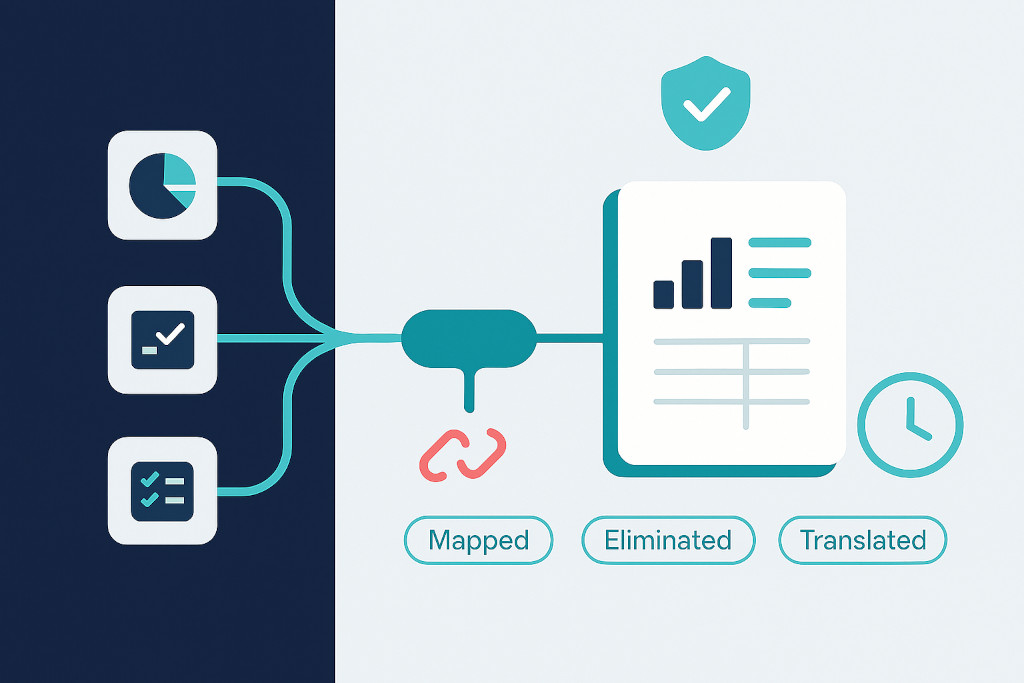
The process of moving from spreadsheet consolidation to BrizoConsol is more straightforward than most finance teams expect.
1. Connect subsidiary accounting platforms
BrizoConsol integrates directly with Xero, QuickBooks, MYOB, Zoho Books, and other common accounting systems, pulling trial balance data automatically once the connection is established. No manual exports, no CSV files, no version control problems.
2. Define the group chart of accounts and map subsidiary accounts
This is typically the step that requires the most thought — it forces the finance team to make explicit the decisions that were previously implicit in the spreadsheet mapping. Done once inside BrizoConsol, it never needs to be rebuilt from scratch. The mapping is maintained and updated within the platform as account structures evolve.
3. Define ownership structure and intercompany relationships
Equity percentages for each entity determine how NCI is calculated. Intercompany relationships between entities determine which balances are identified and eliminated automatically. This configuration is done once and maintained as the group structure changes.
With these foundations in place, the first consolidated run can typically be produced quickly. From that point on, each reporting period requires only the verification of exchange rates and any changes to intercompany positions before the consolidation runs.
Conclusion: Holding Company Finance Teams Deserve a Process That Works
Holding company consolidation is not optional — it is a legal, regulatory, and strategic requirement. The question is not whether to do it. It is whether the process is reliable enough to produce accounts that auditors will sign, lenders will accept, and boards can act on.
A finance team consolidating in spreadsheets is carrying risk that compounds with every new entity added, every new currency introduced, and every new minority interest acquired. The risk is not just that numbers might be wrong — it is that nobody can be certain they are right.
BrizoConsol gives holding company finance teams the infrastructure to close that uncertainty: consistent account mapping applied every period, intercompany eliminations that run automatically, NCI calculated correctly from configured ownership percentages, and currency translation handled without manual worksheets. The result is consolidated financials produced in hours, backed by an audit trail, and delivered while the information is still current enough to drive decisions.