US GAAP vs IFRS: Key Differences in Financial Reporting
For finance professionals working across borders — whether managing a group with subsidiaries in multiple countries, advising clients who report under different frameworks, or preparing for a capital raise that requires reconciliation to a different standard — understanding the differences between US GAAP and IFRS is not academic. It has direct consequences for how revenue is recognised, how assets are measured, how consolidations are prepared, and what the consolidated financial statements ultimately show.
This post sets out the most significant areas of divergence between the two frameworks, with practical implications for multi-entity groups.
The Fundamental Difference in Philosophy
Before examining the specific differences, it helps to understand why they exist. US GAAP and IFRS reflect different regulatory philosophies that shape how each framework approaches accounting questions.
Automate NCI calculations across all your entities.
BrizoConsol handles non-controlling interest automatically — no manual adjustments required.
The two frameworks reflect fundamentally different regulatory philosophies:
| US GAAP | IFRS | |
|---|---|---|
| Approach | Rules-based | Principles-based |
| Guidance style | Detailed rules for specific transactions and industries | Broad principles; preparer applies judgement |
| When rules and substance conflict | Rule applies, even if outcome doesn’t reflect economic substance | Economic substance takes precedence |
| Flexibility | Lower — explicit rules reduce variation | Higher — more scope for judgement and variation |
| Set by | FASB (Financial Accounting Standards Board) | IASB (International Accounting Standards Board) |
In practice, both frameworks have moved closer together over the past two decades through joint convergence projects between the FASB (which sets US GAAP) and the IASB (which sets IFRS). Revenue recognition and lease accounting, for example, are now largely aligned. But meaningful differences remain in several important areas, and for multi-entity groups reporting across jurisdictions, those differences matter.
Where US GAAP and IFRS Diverge Most Significantly
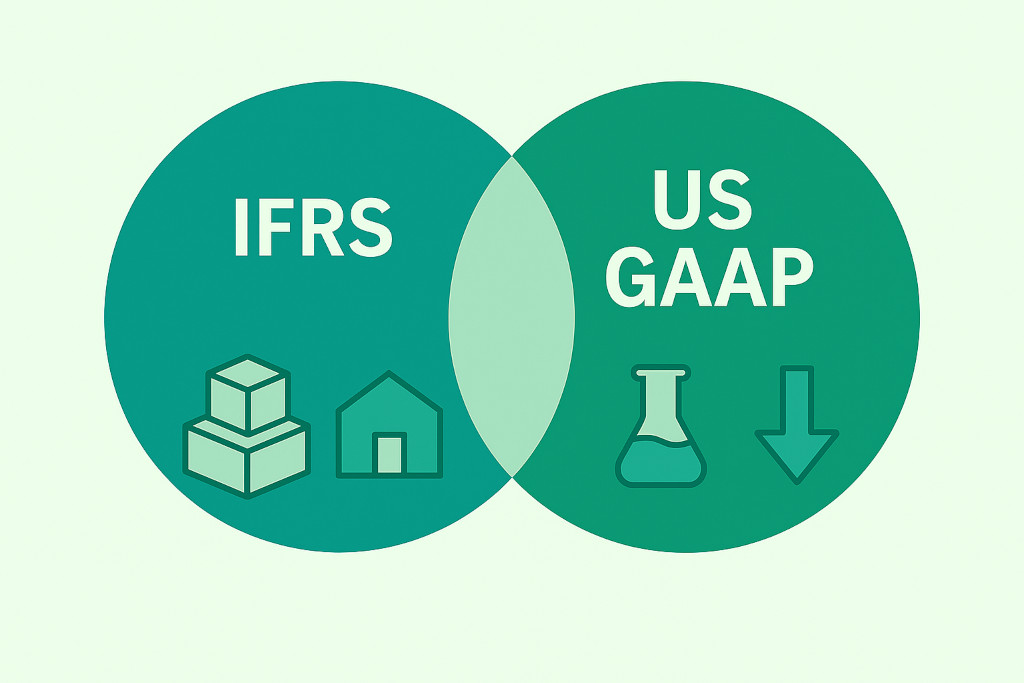
| Area | US GAAP | IFRS |
|---|---|---|
| Inventory valuation | LIFO (last-in, first-out) permitted in addition to FIFO and weighted average cost | LIFO prohibited; only FIFO and weighted average cost permitted (IAS 2) |
| Development costs | Both research and development costs expensed as incurred (ASC 730) | Research costs expensed; development costs capitalised once technical feasibility is established (IAS 38) |
| Impairment testing | Two-step process: first test whether carrying amount exceeds undiscounted future cash flows; if so, measure impairment as excess over fair value (ASC 360) | One-step process: compare carrying amount to recoverable amount (higher of value in use and fair value less costs of disposal). Impairment reversals permitted for non-goodwill assets (IAS 36) |
| Impairment reversals | Reversals of impairment losses on long-lived assets generally prohibited | Reversals of impairment losses on assets other than goodwill required when recoverable amount exceeds carrying amount |
| Lease accounting | Finance leases and operating leases distinguished; operating lease right-of-use assets and liabilities recognised on balance sheet (ASC 842). Short-term lease exemption available. | Single on-balance-sheet model for all leases (IFRS 16); distinction between finance and operating leases eliminated for lessees. Short-term and low-value lease exemptions available. |
| Revenue recognition | ASC 606 — five-step model broadly aligned with IFRS 15, but specific industry guidance and interpretive differences remain in some areas | IFRS 15 — five-step model broadly aligned with ASC 606, with fewer industry-specific carve-outs. More judgement required in certain areas. |
| Revaluation of fixed assets | Revaluation of property, plant and equipment to fair value not permitted; cost model only | Revaluation model permitted as an accounting policy choice alongside cost model (IAS 16) |
| Investment property | No specific standard; investment property measured at cost less depreciation | Fair value model permitted as accounting policy choice; fair value changes recognised in profit or loss (IAS 40) |
| Extraordinary items | Eliminated from US GAAP; previously reported separately, now prohibited (ASC 225) | Also prohibited under IFRS; no separate presentation of extraordinary items |
| Statement of cash flows | Interest paid and received typically classified as operating activities; dividends received as operating, dividends paid as financing | More flexibility: interest paid can be operating or financing; interest received can be operating or investing; dividends received can be operating or investing |
Consolidation: IFRS 10 vs ASC 810
For multi-entity groups, the consolidation standards are among the most practically important areas of difference. Both IFRS 10 and ASC 810 (US GAAP) require the consolidation of subsidiaries that a parent controls, but their definitions of control — and the implications for what must be included in a consolidated group — differ in several respects.
| Area | US GAAP (ASC 810 / ASC 805) | IFRS (IFRS 10 / IFRS 3) |
|---|---|---|
| Consolidation model | Two models: voting interest (VOE) + variable interest entity (VIE) | Single control model — power + variable returns + ability to use power |
| Special purpose entities | Separate VIE model with primary beneficiary assessment | Assessed under IFRS 10 control model |
| NCI measurement at acquisition | Fair value only — full goodwill method mandatory | Choice: fair value (full goodwill) or proportionate share (partial goodwill) |
| Goodwill impairment test | Reporting unit level; optional qualitative step zero | CGU level; one-step quantitative test |
| Impairment reversals | Not permitted | Required when recoverable amount recovers (non-goodwill assets) |
| Potential voting rights | Only currently exercisable rights considered | Substantive potential rights considered even if not yet exercisable |
The sections below cover each of these differences in detail.
The Control Model
Under IFRS 10, control exists when an investor has power over an investee, exposure or rights to variable returns from its involvement, and the ability to use its power to affect those returns. This is a single, unified control model that applies across all entities — including structured entities (formerly called special purpose entities).
Under ASC 810, there are two separate models: the voting interest model (for entities where control is established through voting rights) and the variable interest entity (VIE) model (for entities where control may exist without a majority of voting rights). The VIE model has its own consolidation criteria and applies to a specific set of entities that meet the VIE definition. In practice, the VIE model can require consolidation of entities that would not be consolidated under IFRS 10, or vice versa.
Non-Controlling Interest (NCI) Measurement
Both frameworks require the presentation of non-controlling interests in consolidated equity, but they differ on how NCI is measured at acquisition.
Under IFRS 3, an entity has a choice at each acquisition: measure NCI at fair value (full goodwill method) or at the NCI’s proportionate share of the acquiree’s identifiable net assets (partial goodwill method). The choice is made transaction by transaction.
Under ASC 805 (US GAAP), NCI must be measured at fair value — the full goodwill method is mandatory, with no proportionate share option. This difference affects the amount of goodwill recognised on acquisition and the carrying amount of NCI in consolidated equity.
Goodwill Impairment
Under IFRS, goodwill is tested for impairment at the level of cash-generating units (CGUs) using a one-step test: compare the carrying amount of the CGU to its recoverable amount (the higher of value in use and fair value less costs of disposal). If the carrying amount exceeds the recoverable amount, the difference is recognised as an impairment loss.
Under US GAAP (ASC 350), goodwill is tested at the reporting unit level. An optional qualitative assessment — sometimes called step zero — may allow the entity to conclude that no impairment exists without performing the full quantitative test. Where the quantitative test is required, the impairment loss is the amount by which the carrying value of the reporting unit exceeds its fair value.
In both frameworks, goodwill impairment losses cannot be reversed once recognised.
Implications for Multi-Entity Groups Reporting Across Jurisdictions

For a group with entities in both IFRS and US GAAP jurisdictions — a parent company listed in the US with subsidiaries in Europe, Asia-Pacific, or the Middle East, for example — the consolidation process must reconcile accounts prepared under different frameworks into a single set of group financial statements.
Consistent Accounting Policies
Both IFRS 10 and ASC 810 require that consolidated financial statements be prepared using consistent accounting policies. If the group reports under IFRS, subsidiary accounts prepared under US GAAP must be adjusted to IFRS before consolidation — and vice versa. The most common adjustments are:
| Adjustment | Direction | Detail |
|---|---|---|
| Inventory valuation | US GAAP → IFRS | Convert LIFO to FIFO or weighted average; LIFO is prohibited under IAS 2 |
| Development costs | US GAAP → IFRS | Reclassify expensed development costs to capitalised intangibles where IAS 38 criteria are met |
| Fixed asset revaluation | IFRS → US GAAP | Remove revaluation surplus where IFRS revaluation model has been adopted; US GAAP requires cost model only |
| Investment property | IFRS → US GAAP | Remove fair value gains where IFRS fair value model (IAS 40) has been applied |
| Impairment reversals | IFRS → US GAAP | Remove reversal entries; US GAAP prohibits reversals on long-lived assets |
These adjustments need to be applied consistently each period and documented clearly — both to ensure correct application and to provide an audit trail for external auditors reviewing the consolidated accounts.
Software Support for Multi-Standard Groups
Managing a consolidation that spans IFRS and US GAAP entities requires consolidation software that supports accounting standards tagging at the entity level. BrizoConsol allows each entity in the group to be tagged with its applicable accounting standard — IFRS, US GAAP, UK GAAP, or local GAAP — and applies the appropriate treatment at the consolidation layer. This means the system understands which adjustments are needed when consolidating a US GAAP subsidiary into an IFRS group, rather than requiring the finance team to manage those differences manually through off-system journals.
For groups where the gap between entity-level accounts and group reporting standards is material — most commonly where US entities using LIFO inventory valuation are consolidated into an IFRS group — having that adjustment handled systematically within the consolidation software eliminates a significant source of manual error and reduces the time required to prepare the consolidated accounts.
Which Standard Applies to Your Group?
For most groups, the applicable reporting standard is not a choice — it is determined by regulation, jurisdiction, and the requirements of investors or lenders.
| Entity type | Standard that applies |
|---|---|
| US-listed company | US GAAP — mandatory |
| Listed outside the US | IFRS or local equivalent — mandatory |
| Private company (non-US) | IFRS or local GAAP — typically set by jurisdiction or lender covenant |
| Private company (US) | US GAAP; FASB Private Company Council alternatives available |
| Foreign private issuer filing with SEC | IFRS permitted without US GAAP reconciliation |
The practical question for most finance teams is therefore not which standard to use, but how to handle the adjustments efficiently when entities in the group report under different frameworks.
Conclusion: The Framework Differences Are Manageable — The Process Is Where It Gets Hard
The differences between US GAAP and IFRS are well-documented and, in most areas, predictable. Inventory valuation, development cost treatment, revaluation of fixed assets, and the VIE consolidation model are the areas where the gap is most material and most likely to require adjustment when consolidating across frameworks.
For multi-entity groups, the challenge is not understanding the differences — it is applying them consistently, every period, across entities that may each be maintaining their own accounts under their local standard. The risk of inconsistency, missed adjustments, and manual error grows with the number of entities and the number of framework differences in play.
BrizoConsol handles this at the consolidation layer — tagging each entity with its applicable accounting standard and applying the correct treatment automatically when producing group accounts. For groups spanning IFRS and US GAAP entities, that systematic approach is what makes the difference between a consolidation that closes reliably and one that requires manual reconciliation every time.