IFRS vs UK GAAP: Key Differences in Financial Reporting

Since the UK’s departure from the EU and the decision not to adopt new IFRS standards automatically, the gap between IFRS and UK GAAP has been slowly widening. For finance professionals working with UK-based groups — particularly those with international subsidiaries or plans to raise capital from international investors — understanding where the two frameworks diverge is increasingly important. This post sets out the key differences between IFRS and UK GAAP (primarily FRS 102, the standard applicable to the majority of UK companies), with particular attention to the implications for group consolidation and financial reporting.
Understanding the UK GAAP Framework
UK GAAP is not a single standard but a suite of standards maintained by the Financial Reporting Council (FRC). The framework most relevant for medium and large entities — and for the vast majority of group reporting — is FRS 102, which has applied since 2015 and is based on the IFRS for SMEs standard, though with significant UK-specific modifications.
Within the UK GAAP suite, three standards are most commonly encountered:
Automate NCI calculations across all your entities.
BrizoConsol handles non-controlling interest automatically — no manual adjustments required.
FRS 102 — The Financial Reporting Standard applicable in the UK and Republic of Ireland
Applies to entities that are not required or choosing to apply EU-adopted IFRS. Covers the full range of accounting topics for medium to large companies, including group consolidation. This is the primary point of comparison with IFRS in this post.
FRS 101 — Reduced Disclosure Framework
Allows qualifying entities within a group (typically subsidiaries of a parent that prepares IFRS-compliant consolidated accounts) to use IFRS recognition and measurement but with reduced disclosure requirements. Simplifies subsidiary reporting while maintaining IFRS-aligned numbers.
FRS 105 — The Financial Reporting Standard applicable to the Micro-entities Regime
For very small companies meeting the micro-entity thresholds. Significantly simplified accounting requirements. Rarely relevant for group consolidation purposes.
UK-listed companies and those that choose to do so must prepare their consolidated financial statements under UK-adopted IFRS — which has been maintained separately from IASB-issued IFRS since 2021. For the purposes of this comparison, “IFRS” refers to IASB-issued IFRS as adopted in the UK and internationally, and “UK GAAP” refers to FRS 102.
The Most Significant Differences Between IFRS and FRS 102

| Area | IFRS | UK GAAP (FRS 102) |
|---|---|---|
| Goodwill | Not amortised. Subject to annual impairment test (or more frequently if indicators exist) at cash-generating unit level under IAS 36. | Amortised over its useful economic life. If useful life cannot be reliably estimated, a maximum of 10 years applies. Impairment tested only when indicators exist (not annually). |
| Intangible assets acquired in a business combination | Must be recognised separately from goodwill if they meet the identifiability criteria (IFRS 3). Results in more intangibles on the balance sheet and less goodwill. | Only recognised separately if they can be measured reliably. In practice, fewer intangibles are separated from goodwill under FRS 102, resulting in a larger goodwill balance. |
| Lease accounting | Single on-balance-sheet model under IFRS 16: all leases (other than short-term and low-value exemptions) recognised as right-of-use asset and lease liability. Finance/operating distinction eliminated for lessees. | FRS 102 retains the finance/operating lease distinction (pre-IFRS 16 model). Operating leases remain off-balance-sheet. Note: FRC proposed amendments to align more closely with IFRS 16 — effective date to be confirmed. |
| Financial instruments | IFRS 9: expected credit loss (ECL) model for impairment; classification based on business model and cash flow characteristics; fair value through other comprehensive income (FVOCI) category available. | FRS 102 Section 11/12: simpler classification (basic vs other); incurred loss model for impairment (though ECL amendments under consultation); less granular than IFRS 9 in most areas. |
| Revenue recognition | IFRS 15: five-step model based on transfer of control. Detailed guidance on performance obligations, variable consideration, and contract modifications. | FRS 102 Section 23: simpler principles — revenue recognised when risks and rewards are transferred. Less prescriptive than IFRS 15; fewer explicit rules on complex arrangements. |
| Investment property | IAS 40: fair value model or cost model as accounting policy choice. Fair value changes recognised in profit or loss. | FRS 102 Section 16: investment property measured at fair value through profit or loss (no cost model option for investment property). Broadly similar outcome to IFRS fair value model but no cost model alternative. |
| Development costs | IAS 38: capitalisation required (not optional) once all six recognition criteria are met. | FRS 102 Section 18: capitalisation permitted but not required when criteria are met. Entities may choose to expense development costs even when criteria are satisfied. |
| Revaluation of PP&E | IAS 16: revaluation model permitted as accounting policy; revaluation surplus recognised in OCI. | FRS 102 Section 17: revaluation model also permitted; broadly similar treatment to IAS 16 for most fixed assets. |
| Share-based payments | IFRS 2: full fair value measurement at grant date; complex vesting condition analysis; settlement of equity-settled awards in cash requires reclassification. | FRS 102 Section 26: similar in principle to IFRS 2 but simplified in some areas. Measurement and disclosure requirements less onerous than IFRS 2 for many entity types. |
| Statement of cash flows | IAS 7: indirect or direct method; interest paid may be operating or financing; dividends received may be operating or investing. | FRS 102 Section 7: direct or indirect method; broadly similar classification options to IAS 7. Cash flows from investing and financing activities broadly consistent. |
Consolidation Under IFRS vs FRS 102: What Changes for Groups
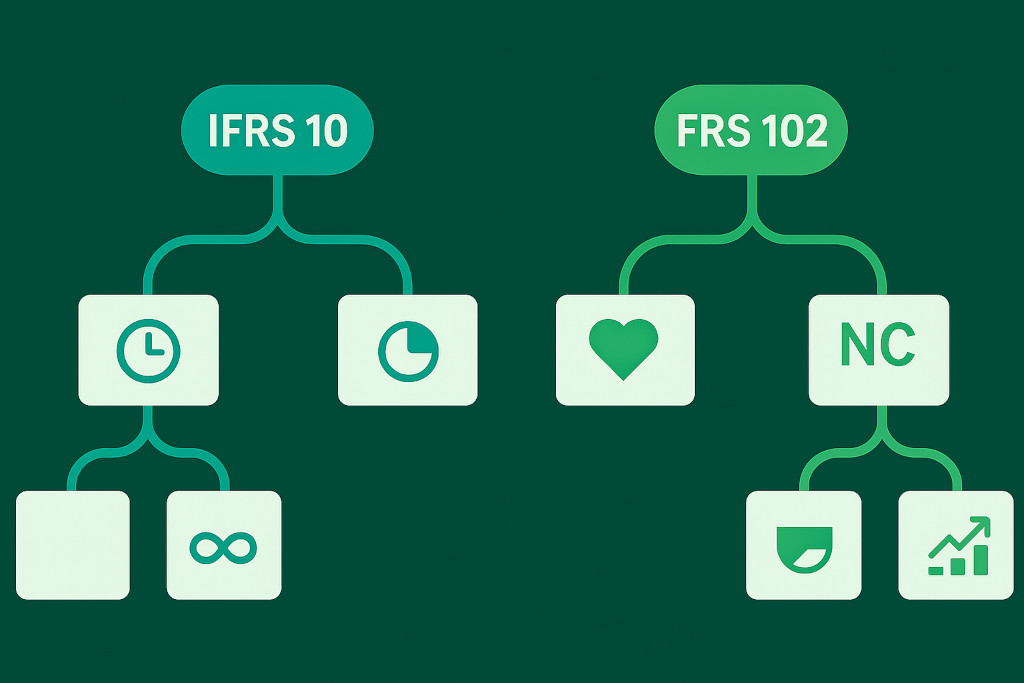
For multi-entity groups, the differences between IFRS and FRS 102 that matter most are those that affect how subsidiaries are measured and how the consolidation is prepared. Three areas stand out.
Goodwill: Amortisation vs Impairment-Only
This is arguably the most practically significant difference between IFRS and UK GAAP for acquiring groups. Under IFRS, goodwill sits on the balance sheet indefinitely — it is tested for impairment annually but not amortised. The balance sheet goodwill figure for an IFRS-reporting group therefore represents the full original acquisition premium, adjusted only for any subsequent impairment charges.
Under FRS 102, goodwill is amortised over its useful economic life — typically between five and twenty years for most acquisitions, subject to a maximum of ten years if a reliable estimate cannot be made. This means the P&L of an FRS 102-reporting group is charged with a goodwill amortisation expense in every period after an acquisition, which reduces reported profit and gradually reduces the goodwill balance on the balance sheet.
For groups considering a transition from UK GAAP to IFRS — often triggered by a stock exchange listing or international investor requirements — the elimination of goodwill amortisation is one of the more attractive features of IFRS, as it typically improves reported EBITDA and post-tax profit relative to the FRS 102 position. Conversely, for groups moving from IFRS to FRS 102 (less common, but relevant for certain post-acquisition restructurings), the introduction of goodwill amortisation represents a recurring P&L charge that needs to be factored into earnings projections.
Lease Accounting: On vs Off Balance Sheet
The treatment of operating leases represents a fundamental balance sheet difference between IFRS and current FRS 102. Under IFRS 16, all material operating leases — office premises, equipment, vehicle fleets — are recognised on the balance sheet as a right-of-use asset and a corresponding lease liability. This increases both total assets and total debt, which can affect gearing ratios, covenant headroom, and certain valuation multiples.
Under current FRS 102, operating leases remain off-balance-sheet. Lease payments are expensed as incurred, and no asset or liability is recognised for future lease commitments. The income statement profile also differs: IFRS 16 front-loads the cost of a lease (higher interest charge in early periods), while FRS 102 charges a straight-line rental expense throughout.
The FRC has been consulting on amendments to FRS 102 that would bring lease accounting substantially into line with IFRS 16. Finance teams should monitor the effective date of these changes, as the transition will require all UK GAAP entities with material operating leases to recognise new balance sheet items and potentially restate comparatives.
Non-Controlling Interest Measurement
Under IFRS 3, an acquirer has a choice at each business combination to measure NCI at fair value (full goodwill method) or at the NCI’s proportionate share of the acquiree’s identifiable net assets (partial goodwill method). FRS 102 only permits the proportionate share method — there is no fair value option for NCI measurement. In practical terms, this means goodwill recognised under IFRS (where the fair value method is chosen) will typically be higher than goodwill recognised under FRS 102 for the same acquisition, as IFRS goodwill includes the NCI’s share of goodwill while FRS 102 goodwill does not.
The goodwill treatment difference is the single most common point of adjustment when reconciling a set of IFRS accounts to FRS 102, or vice versa. For acquisition-active groups, the cumulative impact of amortisation charges under UK GAAP versus the impairment-only model under IFRS can be material after just a few years.
When the Choice Between IFRS and UK GAAP Is Yours to Make
For UK-incorporated companies not listed on a regulated market, the choice between IFRS and FRS 102 is available at group level — the Companies Act permits qualifying entities to prepare consolidated accounts under either framework. The decision depends on several factors.
Groups preparing for an international stock exchange listing, seeking institutional investment from international funds, or requiring accounts that are directly comparable with non-UK peers will typically find IFRS the more appropriate choice. The global comparability of IFRS-based accounts is a genuine advantage in international capital markets contexts.
Groups with a primarily domestic UK focus, simpler structures, and no international capital-raising plans will often find FRS 102 more proportionate. The disclosure burden under IFRS is substantially higher than under FRS 102, and for groups where the incremental cost of full IFRS compliance is not justified by a corresponding benefit, FRS 102 delivers a robust and credible set of financial statements at lower compliance cost.
For groups with a mixture — an FRS 102 parent with IFRS subsidiaries, or an IFRS parent with FRS 102 UK subsidiaries — the consolidation process must adjust subsidiary accounts to the group’s reporting framework before consolidation. The most common adjustments involve goodwill (reinstating amortised goodwill when consolidating FRS 102 subsidiaries into an IFRS group), lease accounting (recognising IFRS 16 right-of-use assets and liabilities for subsidiaries reporting operating leases under FRS 102), and financial instrument classification differences.
Managing IFRS and UK GAAP in a Group Consolidation
For groups that consolidate across both frameworks, the consolidation software needs to handle accounting standards at the entity level — tagging each subsidiary with its applicable standard and applying the appropriate adjustments when rolling up into the consolidated accounts. BrizoConsol supports IFRS, UK GAAP, US GAAP, and local GAAP tagging at the entity level, so the system understands which adjustments are needed when consolidating a UK GAAP subsidiary into an IFRS group.
In practice this means that goodwill amortisation posted in an FRS 102 subsidiary can be reversed at the consolidation layer to comply with the IFRS impairment-only model, and operating lease commitments in FRS 102 entities can be converted to IFRS 16 right-of-use assets and liabilities within the consolidation without requiring restatement of the subsidiary’s own accounts. The audit trail for these consolidation-level adjustments is maintained automatically, providing the documentation that external auditors require to verify the group accounts.
As the FRC’s amendments to FRS 102 progress — and particularly as the lease accounting changes take effect — groups with a mix of IFRS and UK GAAP entities will need to monitor whether their consolidation adjustments remain appropriate. The convergence of FRS 102 with IFRS in certain areas reduces the number of adjustments required, but the goodwill difference — amortisation under FRS 102, impairment-only under IFRS — is unlikely to change in the foreseeable future and will remain a permanent feature of group consolidations spanning the two frameworks.