BrizoConsol vs Fathom: Best for Multi-Entity Consolidation?
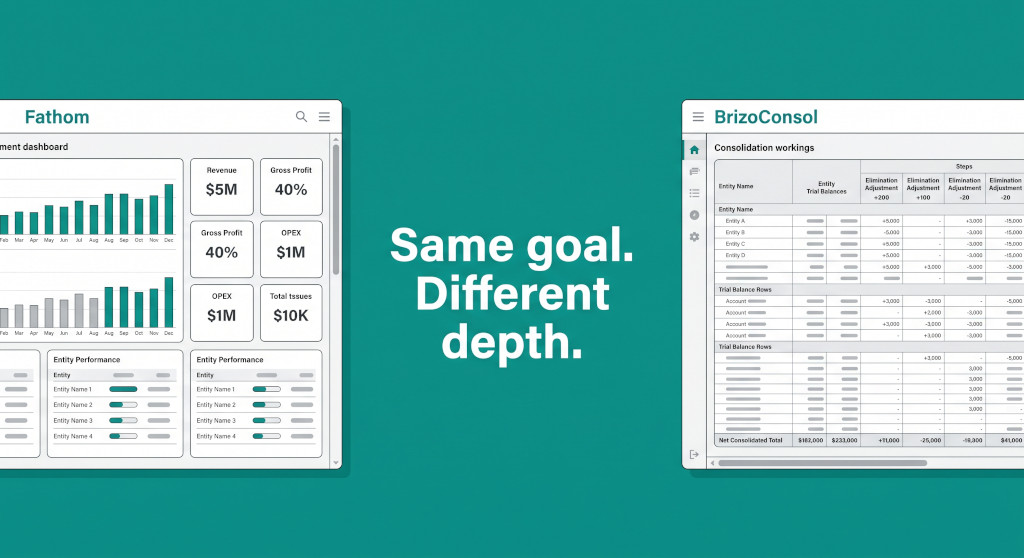
Imagine the finance director of a 12-entity hospitality group who has been using Fathom for two years. Her team loves the dashboards. When the group acquires three companies in New Zealand, she expects the consolidated reporting to remain just as manageable. A few months in, she realises the tool is doing a good job on management reports and entity-level KPIs — but the group’s consolidation workings, particularly the intercompany eliminations and currency translation across the New Zealand entities, are still living in a spreadsheet alongside Fathom. Fathom has not failed her. But it is solving a different problem from the one she now has.
That distinction matters enormously when evaluating software for a growing group. This article sets out a direct BrizoConsol vs Fathom comparison — what each platform does, where they overlap, and where they diverge in design and depth.
What Is Fathom and What Does It Do Well?
Fathom is a management reporting platform with consolidation capabilities, built for accountants, CFOs and business owners who want clear financial reporting, KPI tracking, and group performance analysis. It connects to Xero, QuickBooks and MYOB, and its Consolidated Groups feature supports multi-entity consolidation including intercompany eliminations, multi-currency translation, consolidated P&L, Balance Sheet and Cash Flow statements, group budgets, and group forecasting — covering up to 300 entities for single-currency consolidation and 50 entities for multi-currency groups.
Stop building consolidations in spreadsheets.
BrizoConsol automates multi-entity consolidation — setup in minutes, reports the same day.
Fathom genuinely handles a wide range of consolidation scenarios, and for many groups it does so very well. Its particular strengths are:
- Polished, client-ready management reports and KPI dashboards
- Consolidated group reporting with elimination support
- Multi-currency consolidation and group forecasting
- White-labelling for accounting firms managing multiple clients
- A clean, intuitive interface that non-specialists can navigate confidently
Understanding what Fathom is designed for is the starting point for any honest comparison. It is a management reporting platform that has built consolidation into its feature set. BrizoConsol starts from the other direction: it is a consolidation engine that produces management-ready outputs. The design priorities in each product reflect that difference.
Where the Two Platforms Diverge
Both platforms support multi-entity consolidation. The meaningful differences are in depth of consolidation workflow, accounting framework compliance, group structure flexibility, and which edge cases each platform is equipped to handle.
Elimination depth and audit trail
Fathom supports intercompany eliminations, including automated full-account eliminations and manual full and partial eliminations — covering common scenarios like intercompany loans and management fees. For many groups, this is sufficient.
BrizoConsol’s elimination engine is designed around the full consolidation workflow: every elimination entry is logged in a persistent audit trail, mismatches between entities are flagged automatically, and the elimination workings are directly traceable to the consolidated output. For groups preparing statutory accounts under audit, or running complex intercompany matrices with many entities, the depth of the audit trail is a practical differentiator.
Currency translation and CTA
Fathom supports multi-currency consolidation and cumulative translation adjustment (CTA) across its consolidated group feature. Both platforms support multi-currency consolidation and currency translation using closing and average rates.
The difference is in how the CTA is surfaced and integrated. BrizoConsol calculates the CTA movement as an explicit, named component of equity within the consolidation workings, posted directly from the consolidation engine. For groups reporting under IFRS where OCI presentation of exchange differences is an audit requirement, this integration into the consolidation workflow — rather than as a downstream reporting calculation — matters at year-end.
Non-controlling interest (NCI)
For groups where a parent does not own 100% of a subsidiary, the minority stake must be recognised as a non-controlling interest in the consolidated balance sheet and income statement. BrizoConsol has a dedicated NCI calculation module that automates this. Groups with partial ownership structures should verify the extent of Fathom’s NCI handling against their specific requirements before assuming equivalence.
IFRS, US GAAP and UK GAAP tagging
BrizoConsol supports framework-level tagging — allowing groups that report under multiple frameworks (for example IFRS at group level and UK GAAP for a subsidiary) to tag balances accordingly. This is specifically relevant for groups with statutory obligations under more than one framework. Fathom’s reporting is not framework-specific in this way.
BrizoConsol vs Fathom: Feature Comparison
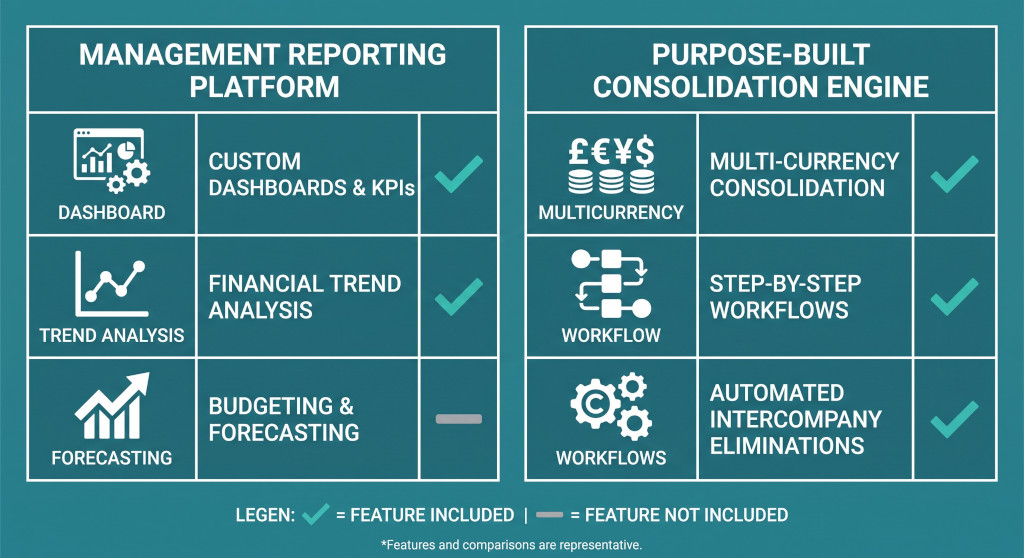
| Feature | BrizoConsol | Fathom |
|---|---|---|
| Xero, QuickBooks, MYOB integration | ✓ Direct API | ✓ Direct API |
| Zoho Books integration | ✓ Supported | ✗ Not supported |
| Intercompany eliminations | ✓ Full automation with persistent audit trail | ⚡ Supported — automated full-account and manual partial options |
| Multi-currency consolidation / CTA | ✓ IAS 21 engine; CTA posted as equity component | ⚡ Supported — up to 50 multi-currency entities |
| Non-controlling interest (NCI) | ✓ Dedicated NCI automation | ⚡ Verify against your group structure |
| Step acquisitions / partial disposals | ✓ Group-level accounting supported | Not documented publicly |
| IFRS / US GAAP / UK GAAP framework tagging | ✓ Framework-level tagging | ✗ Not framework-specific |
| Virtual Groups (region / brand rollups) | ✓ Unlimited Virtual Groups | ⚡ Different approach to group segmentation |
| Consolidated P&L, Balance Sheet, Cash Flow | ✓ On-demand, audit-ready | ✓ Supported within Consolidated Groups |
| Audit trail on consolidation adjustments | ✓ Full adjustment log | ⚡ Reporting-focused; consolidation workings differ |
| AI Auto-Map for chart of accounts | ✓ Automated CoA mapping | ✗ Manual mapping |
| KPI dashboards and performance reports | ⚡ Consolidated metrics reporting | ✓ Core strength — white-label ready |
| Client-facing PDF reports | ⚡ Export available | ✓ Core strength |
| Forecasting, budgeting and group planning | ✗ Not in scope | ✓ Group forecasting and consolidated budgets |
| Maximum entities (single-currency) | Contact BrizoConsol | ✓ Up to 300 entities |
| Free trial available | ✓ brizoconsol.com/register | ✓ Trial available |
⚡ = partial or limited support | ✓ = full support | ✗ = not supported or not documented. Based on publicly available product documentation as at June 2026. Verify current capabilities directly with each vendor before making a purchasing decision.
Purpose-built for group consolidation.
BrizoConsol automates multi-entity consolidation — setup in minutes, audit-ready reports the same day. Start Free Trial See It in Action →
Where BrizoConsol Goes Further for Group Finance
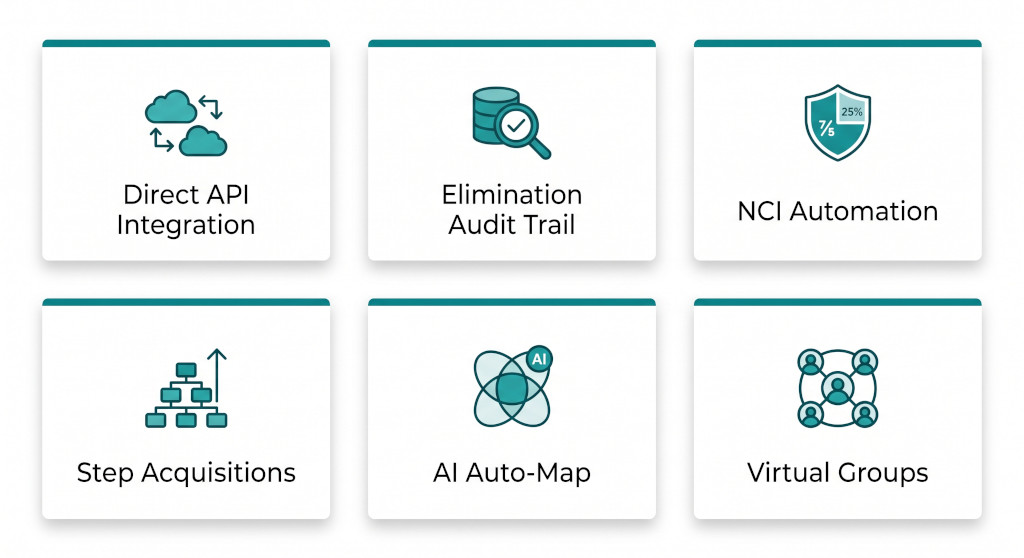
BrizoConsol was built specifically for multi-entity consolidation — not as a feature added to a reporting platform, but as the core product. For groups where the consolidation itself is the hard part, that design priority shows up in several areas:
Direct API integration — no CSV exports
BrizoConsol connects to Xero, QuickBooks, MYOB and Zoho Books via direct API, removing the need for CSV exports or manual file uploads. Financial data is available in the consolidation engine as soon as it is synchronised from the source ledger — with no version-control risk and no manual transfer step. For a group using a mix of accounting platforms across its entities, the Zoho Books connection (not available in Fathom) may also be relevant.
Elimination audit trail at consolidation level
When a group produces statutory accounts, the auditors’ first question about any intercompany elimination is: where is the workings trail? BrizoConsol logs every elimination entry with a persistent audit trail — flagging intercompany mismatches, tracking adjustment history, and linking each elimination directly to the consolidated output. For groups under audit, this is the difference between a clean sign-off and a week of manual reconciliation.
Consolidated cash flow statement
Both BrizoConsol and Fathom produce consolidated cash flow statements. BrizoConsol’s cash flow is generated directly from the consolidation engine — meaning the intercompany eliminations applied to the P&L and balance sheet flow through consistently to the cash flow statement without a separate manual build. This integrated approach reduces the risk of the three statements becoming inconsistent with each other, which can happen when the cash flow is produced as a downstream calculation from consolidated outputs.
Step acquisitions and partial disposals
When a group increases its stake in an associate to gain control, or sells down part of a subsidiary, the group-level accounting adjustments — the remeasurement of previously held interests, the adjustment of NCI, the entries that exist only in the consolidation workings — do not appear in any individual entity’s accounts. BrizoConsol’s step acquisition and partial disposal module handles these consolidation-level entries. This is a capability that sits entirely in the group workings and is not documented in Fathom’s feature set.
AI Auto-Map for chart of accounts alignment
Mapping each subsidiary’s chart of accounts to the group’s common chart of accounts is one of the most time-consuming parts of setting up a consolidation. BrizoConsol’s AI Auto-Map analyses each entity’s account names and suggests mappings to the group chart automatically, turning hours of manual work per entity into a review-and-confirm task. For accounting firms onboarding new group clients, this materially reduces setup time.
Virtual Groups for flexible rollups
Not every reporting view follows the legal entity structure. A property group might want results by geography; a retail chain by brand. BrizoConsol’s Virtual Groups allow finance teams to define rollup structures that cut across entities — combining subsidiaries in any configuration without restructuring the legal group. A single entity can appear in multiple Virtual Groups simultaneously, and each produces its own consolidated P&L and balance sheet.
Which Tool Should You Choose?
Both platforms can produce group-level consolidated accounts. The question is which one is designed around the problems your group actually has.
Choose Fathom if: your priority is management reporting, KPI dashboards, and client-facing performance reports — and your consolidation involves standard intercompany eliminations and currency translation across a relatively clean group structure. Fathom’s management reporting capabilities are genuinely excellent, and its Consolidated Groups feature handles the most common consolidation scenarios well. Its group forecasting and budgeting tools are also a meaningful advantage over BrizoConsol in that dimension.
Choose BrizoConsol if: the consolidation itself is where the complexity lives — intercompany elimination audit trails that need to survive an audit, CTA integration into equity workings, NCI automation for partial ownership structures, group structural changes involving step acquisitions or partial disposals, or IFRS / UK GAAP framework tagging. BrizoConsol is designed around the consolidation workings, not around the reports that come after them.
Some groups use both. Fathom handles client-facing performance reports and KPI dashboards at the entity and group level; BrizoConsol handles the statutory consolidation workings. The two tools are designed for different primary jobs, and for groups that need both polished management reporting and deep consolidation workings, running them alongside each other is a considered approach rather than a compromise.
If you are currently producing consolidation adjustments manually — whether alongside Fathom or in a separate spreadsheet — BrizoConsol’s direct API connections to your existing accounting platforms and its audit-trail-first consolidation engine are built specifically to remove that manual layer.
Ready to see BrizoConsol in action?
Connect your entities, automate your eliminations, and produce a consolidated P&L, balance sheet and cash flow statement — with a full audit trail. Start Free Trial See It in Action →