How to Calculate the Cumulative Translation Adjustment (CTA) in Group Consolidation
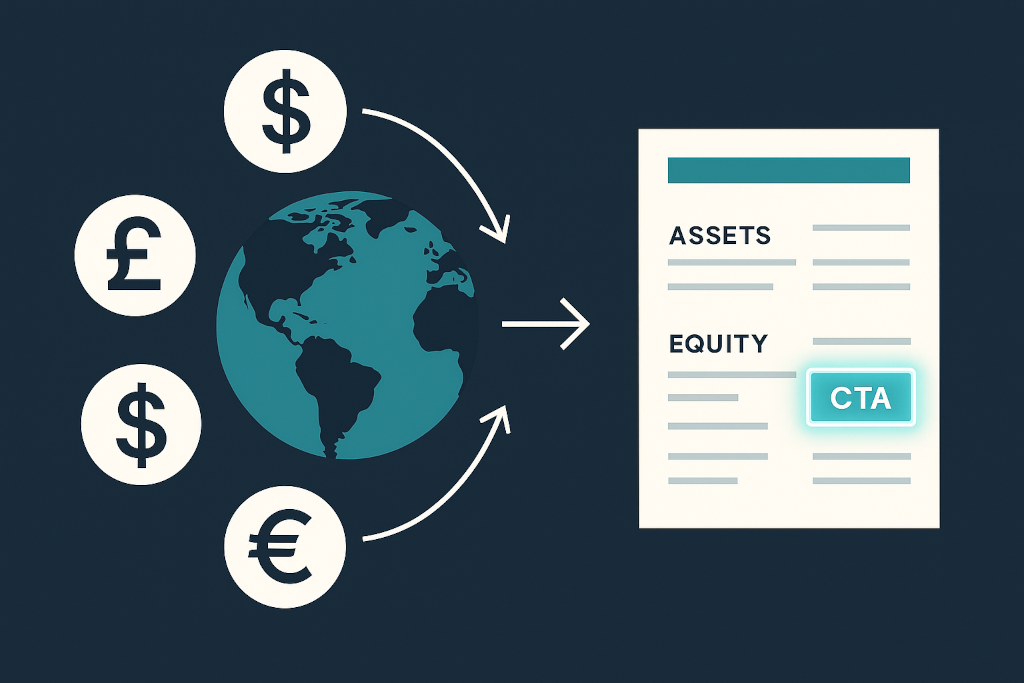
If you have ever prepared or reviewed a consolidated balance sheet and found yourself staring at a line in equity labelled Cumulative Translation Adjustment — or Foreign Currency Translation Reserve, or something similar depending on your reporting framework — and wondered exactly where that number comes from, you are not alone. The CTA is one of the most consistently misunderstood items in group financial reporting. Finance professionals who are entirely comfortable with intercompany eliminations, NCI calculations, and deferred tax treatments will often describe the CTA as something that simply appears at the end of the consolidation process and is reconciled after the fact, rather than something they can calculate from first principles with confidence.
This guide exists to change that. The Cumulative Translation Adjustment is not mysterious once you understand the mechanics behind it — it is a precise and logical consequence of translating foreign currency financial statements using different exchange rates for different parts of the balance sheet and income statement.
Every component of the CTA can be traced back to a specific translation decision, and every movement in the CTA from one period to the next can be explained and reconciled. This post walks through the calculation step by step, with worked examples, the key formula, an explanation of each component, the most common mistakes that cause CTA balances to be wrong, and how modern consolidation tools handle the calculation automatically.
Foreign currency consolidation, handled automatically.
BrizoConsol applies the correct CTA/FCTR treatment across all entities — no spreadsheets needed.
What Is the Cumulative Translation Adjustment?
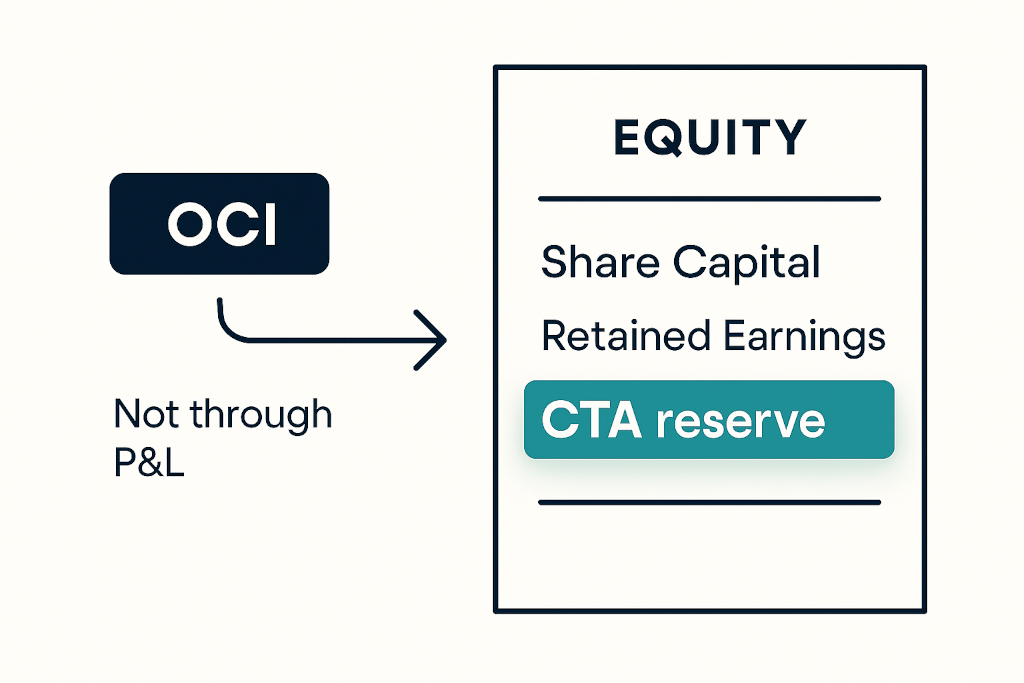
The Cumulative Translation Adjustment is an equity reserve that accumulates the exchange rate differences arising from translating a foreign subsidiary’s financial statements into the parent company’s presentation currency. Under both IFRS (specifically IAS 21) and US GAAP (ASC 830), assets and liabilities are translated at the closing rate, income statement items at the average rate, and equity components at the historical rates in effect when those items were originally recognised.
Because the closing rate, the average rate, and historical rates are almost never the same, the translated balance sheet does not balance automatically. The difference needed to make it balance is the translation adjustment for the period. Over time, as exchange rates move and more periods are consolidated, these period adjustments accumulate in a reserve on the equity side of the consolidated balance sheet — hence the term Cumulative Translation Adjustment.
Critically, the CTA is not a profit or loss item. It sits in Other Comprehensive Income (OCI) and flows into equity rather than through the consolidated income statement. It only gets recycled through the income statement when the foreign subsidiary is partially or fully disposed of — at which point the accumulated CTA related to that entity is released as part of the gain or loss on disposal.
The Translation Rules: Three Rates for Three Things
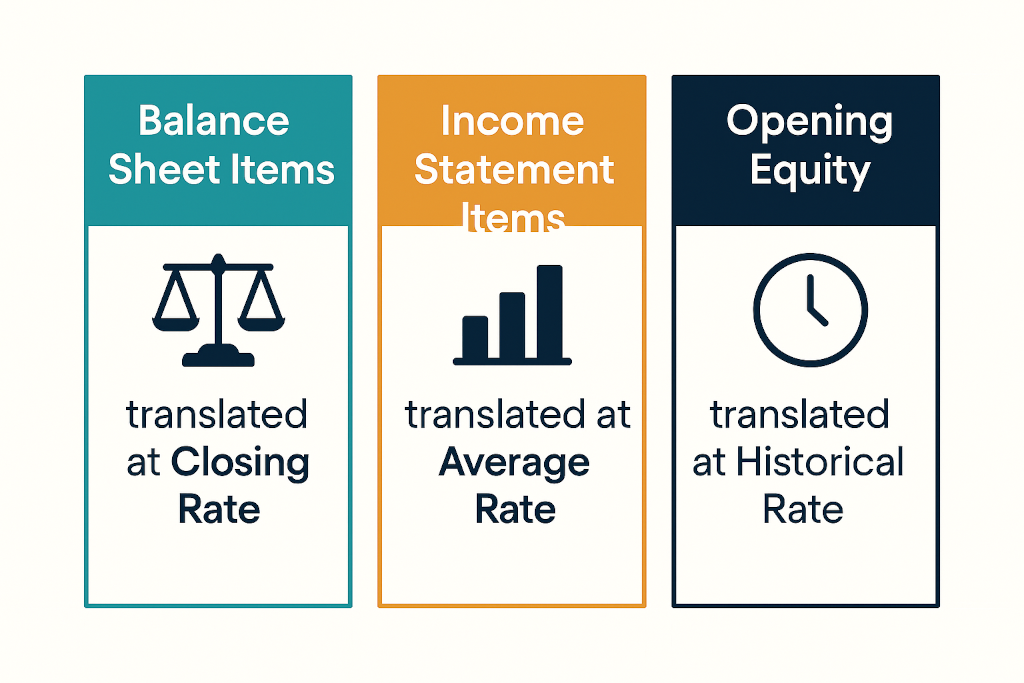
Before working through the CTA calculation, it is essential to understand which exchange rate applies to which component of the foreign entity’s financial statements. Getting this right is the foundation of the entire calculation.
| Component | Rate to use | Notes |
|---|---|---|
| Assets and liabilities (balance sheet) | Closing rate | Spot rate on the reporting date — retranslated every period |
| Revenue, expenses (income statement) | Average rate for the period | Practical approximation of transaction-date rates under IAS 21 / ASC 830 |
| Opening equity (share capital, retained earnings b/f, other reserves) | Historical rate | The closing rate from the period when those balances were first recognised — not retranslated |
| Current period profit | Average rate | Consistent with the income statement translation |
| CTA | Balancing figure | Makes translated equity reconcile to net assets at the closing rate |
Step-by-Step: How to Calculate the CTA
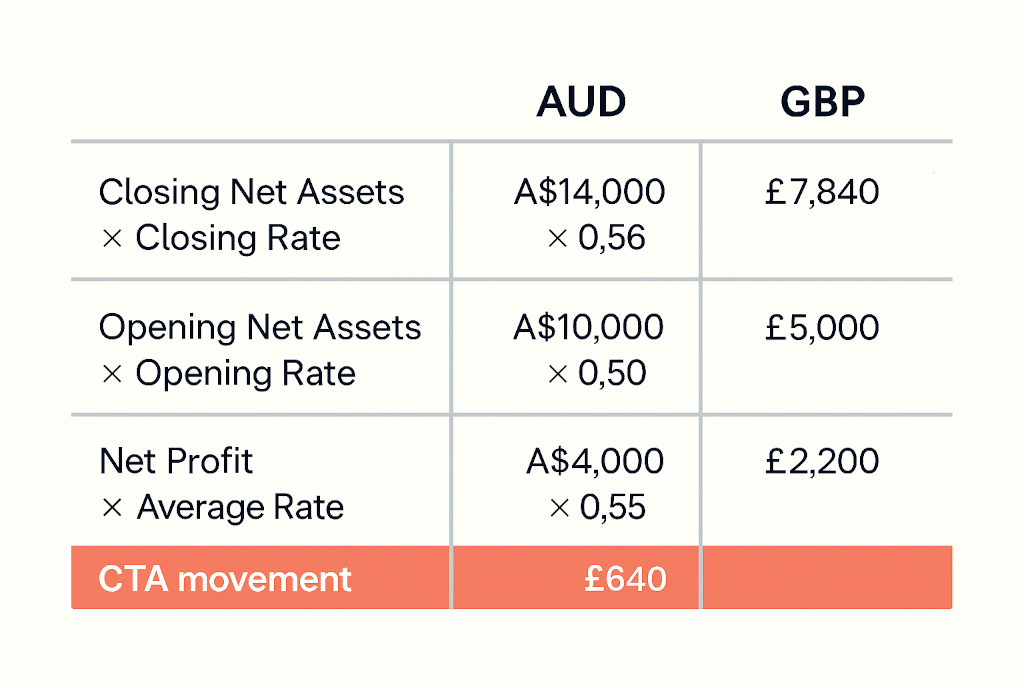
Step 1: Establish your three exchange rates
Every CTA calculation requires exactly three rates:
| Rate | Definition | Example (AUD/GBP) |
|---|---|---|
| Closing rate (CR) | Spot rate on the last day of the reporting period | 0.52 |
| Average rate (AR) | Average rate for the period — used for P&L | 0.50 |
| Opening rate (OR) | The prior period’s closing rate | 0.48 |
Step 2: Translate closing net assets at the closing rate
Take total net assets at period-end in local currency and apply the closing rate.
AUD 4,000,000 × 0.52 = GBP 2,080,000
Step 3: Translate opening net assets at the opening rate
Take total net assets at the start of the period in local currency and apply the opening rate. Do not retranslate at the current closing rate — this is a common mistake.
AUD 3,500,000 × 0.48 = GBP 1,680,000
Step 4: Translate net profit at the average rate
Take net profit from the income statement and apply the average rate.
AUD 1,000,000 × 0.50 = GBP 500,000
Step 5: Translate dividends and capital movements at spot rates
If the subsidiary paid dividends or received capital contributions during the period, translate each at the spot rate on the transaction date — not the average rate and not the closing rate.
Example: No dividends or capital movements this period.
Step 6: Calculate the CTA movement
Apply the formula:
CTA Movement = (Closing NA × CR) − (Opening NA × OR) − (Net Profit × AR) − (Dividends × spot) + (Capital contributions × spot)
GBP 2,080,000 − GBP 1,680,000 − GBP 500,000 = −GBP 100,000
A negative result means the exchange rate movement produced a translation loss for the period. A positive result is a translation gain.
Step 7: Add to the cumulative balance
The CTA line on the consolidated balance sheet at any reporting date is:
Cumulative CTA = Prior period CTA + Current period CTA movement
Each period’s movement stacks. The balance grows or shrinks as rates move, and it only clears through the income statement when the subsidiary is disposed of.
The CTA Formula
The formula is a balancing identity: it captures every movement in the subsidiary’s net assets during the period and explains why the translated closing balance differs from the opening balance. Closing net assets minus opening net assets gives the total change — the formula then strips out the operating result (translated at the average rate) and any equity injections or distributions (translated at spot), leaving the exchange rate effect as the residual. That residual is the CTA movement for the period.
Period CTA Movement:
(Closing Net Assets × Closing Rate)
− (Opening Net Assets × Opening Rate)
− (Net Profit × Average Rate)
− (Dividends × Spot Rate on Payment Date)
- (Capital Contributions × Spot Rate on Contribution Date)
| Component | Rate to use | Why |
|---|---|---|
| Closing net assets | Closing rate | Balance sheet rule — all assets and liabilities at period-end spot |
| Opening net assets | Opening rate (prior period close) | Carried forward at the rate in use when originally recognised |
| Net profit | Average rate | Consistent with how the income statement was translated |
| Dividends paid | Spot rate on payment date | Transaction-date rate — not average, not closing |
| Capital contributions | Spot rate on contribution date | Transaction-date rate |
Cumulative balance: the CTA on the consolidated balance sheet at any date is the sum of all period movements since the subsidiary was first consolidated.
Self-check: the CTA is a balancing figure — it makes translated equity equal to net assets at the closing rate. If your CTA movement doesn’t reconcile, something else in the translation is wrong.
Opening Equity, Retained Earnings, and the Compounding Effect
One of the reasons the CTA confuses finance teams is that it compounds in ways that are not immediately intuitive. Each period’s translation adjustment adds to or subtracts from the cumulative balance, and the opening equity that gets carried forward each period is translated at the rate that was current when those equity items were originally recognised — not at the current closing rate. A subsidiary with a long operating history will therefore carry opening equity translated at a mix of historical rates going back many years, with the CTA serving as the bridge between that historically-translated equity base and the current closing rate.
The retained earnings component of opening equity is particularly important to understand. The retained earnings balance at the start of any period represents the accumulation of all prior year profits, each of which was originally translated at the average rate applicable to its respective year. Those translated retained earnings carry forward at their translated values without being retranslated to the current closing rate. Only the current year’s profit is translated at the current average rate and added to retained earnings.
The result is that the retained earnings balance in the translated financial statements is not simply total profit since incorporation translated at a single rate — it is the sum of each year’s profit translated at that year’s average rate, accumulated over the entity’s entire history. When exchange rates have been volatile, the gap between historically-translated retained earnings and what those retained earnings would be worth at today’s closing rate can be very large, and a significant portion of that gap sits in the CTA.
Common Mistakes When Calculating the CTA
1. Using the wrong rate for dividends
Dividends paid during the period should be translated at the spot rate on the payment date — not the average rate, not the closing rate. Using the average rate is a common shortcut that introduces an error which compounds each year dividends are paid.
2. Wrong opening rate for the first year after an acquisition
When a subsidiary is acquired mid-year, the opening rate is the exchange rate on the acquisition date — not the start of the financial year. Using the year-start rate for the acquisition year introduces an error that flows through to every subsequent period.
3. Rate inconsistency between the income statement and the CTA formula
If the income statement is translated using monthly average rates but the profit figure in the CTA formula uses a full-year average, a reconciling difference will appear. The rate used for net profit in the formula must match the rate used to translate the income statement.
4. Pooling CTA across entities instead of tracking each one separately
Each foreign entity has its own functional currency, exchange rates, and CTA movement. These must be calculated and tracked individually before being aggregated on the consolidated balance sheet. Treating all foreign entities as a single pool produces a CTA that cannot be reconciled or audited at the entity level.
Reconciling the CTA Movement: A Practical Checklist
Run this reconciliation every period — not just at year-end — before the consolidated financials are finalised. It confirms that the CTA movement calculated from first principles agrees with the CTA balance implied by the translated balance sheet.
Starting position
- Opening CTA balance agrees to the closing CTA balance from the prior period
Apply the formula
- Closing net assets translated at the correct closing rate
- Opening net assets translated at the prior period’s closing rate (not the current closing rate)
- Net profit translated at the average rate consistent with the income statement
- Dividends translated at the spot rate on each payment date
- Capital contributions translated at the spot rate on each contribution date
If the CTA doesn’t reconcile, investigate in this order
Any restatements or prior period corrections in the local accounts have been identified — these change the opening balance sheet without flowing through the current period income statement
Closing rate applied to the balance sheet matches the rate used in the formula
Opening rate matches the prior period’s closing rate exactly
Dividends have been identified, correctly dated, and translated at spot
Capital contributions or share issuances during the period have been captured at spot
How BrizoConsol Automates the CTA Calculation
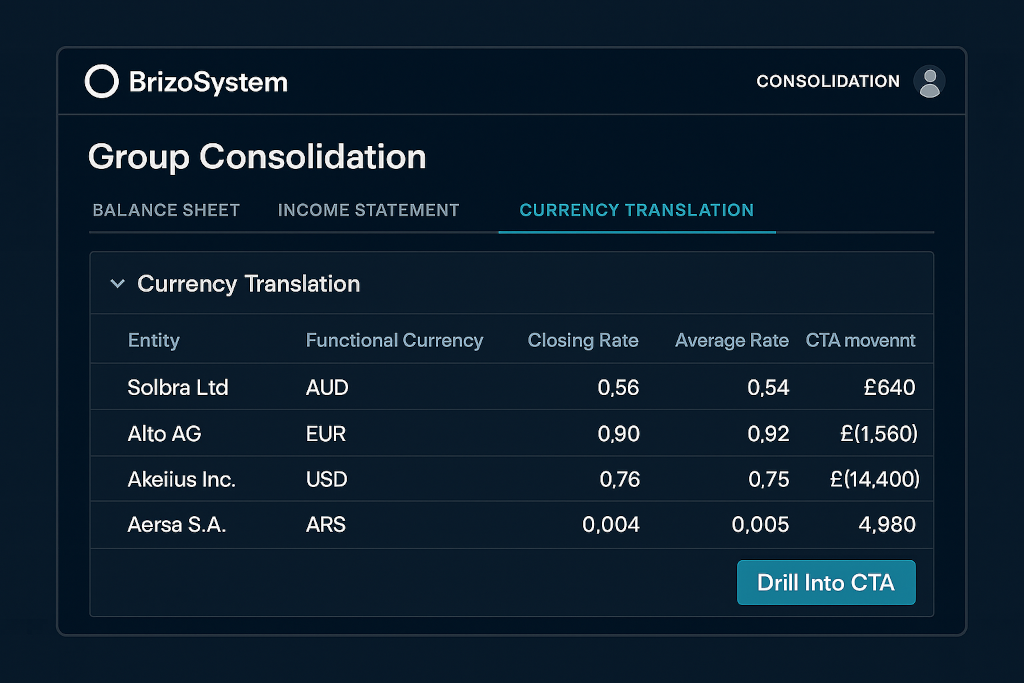
Calculating the CTA correctly across a multi-entity group — with multiple foreign subsidiaries each potentially carrying a different functional currency — is a significant amount of work to do manually in a spreadsheet. The number of exchange rates to track, the entity-level movements to calculate, the need to carry forward historically-translated equity balances accurately, and the requirement to reconcile the CTA every period all add up to a process that is time-consuming, prone to version control errors, and difficult to audit.
BrizoConsol eliminates this manual work by handling the multi-currency translation and CTA calculation automatically as part of the consolidation run. When trial balance data is imported from each entity’s accounting software, BrizoConsol applies the appropriate exchange rates — closing rate for balance sheet items, average rate for income statement items, historical rates for equity — and produces the translated financial statements for each entity. The CTA for each foreign entity is calculated automatically and populated in the correct equity reserve in the consolidated balance sheet, with a period-on-period movement that can be drilled into to show the components of the calculation.
The system stores each period’s exchange rates and translated balances, which means the opening rate and opening equity values for any future period are always available and accurate — eliminating the risk of rate inconsistencies compounding over time. For finance teams that have historically spent hours each month on manual CTA work, BrizoConsol’s automated approach means the CTA is simply correct as part of the standard consolidation output, freeing the team to focus on explaining the movement to stakeholders rather than calculating it from scratch.
Conclusion: Understanding CTA Is a Core Consolidation Skill
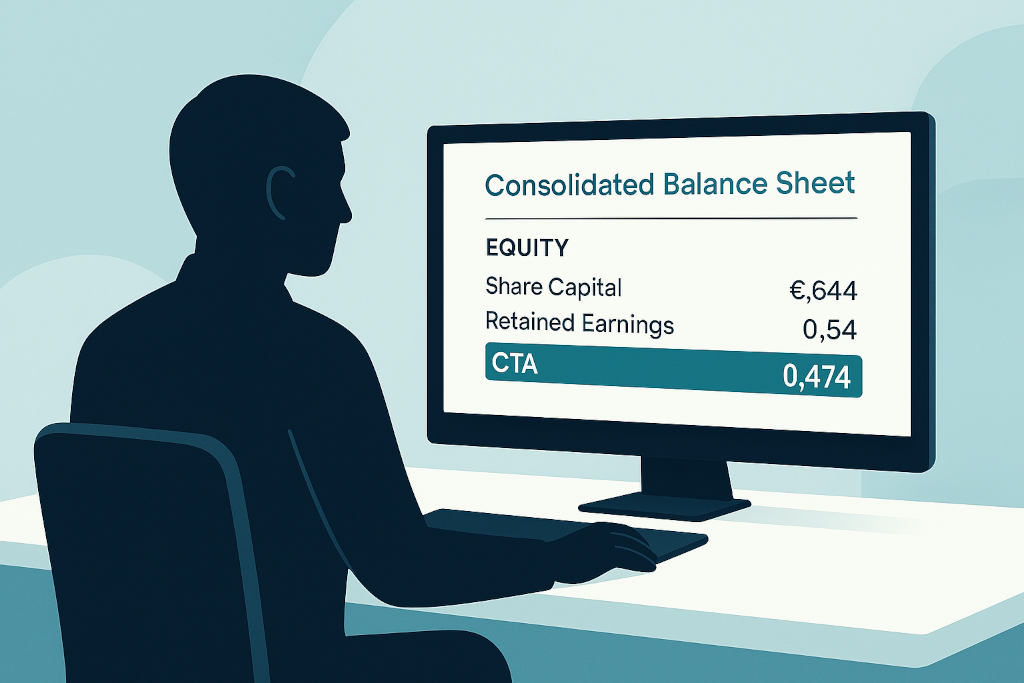
The Cumulative Translation Adjustment is not a residual or an approximation — it is a precise, calculable number that reflects the economic impact of exchange rate movements on the translated value of foreign subsidiaries over time. Finance professionals who understand how to calculate the CTA from first principles, how to reconcile its movement period on period, and how to identify and correct the most common errors are significantly better equipped to manage the complexity of multi-currency group consolidation.
The CTA also serves as one of the most useful diagnostic tools in the consolidation process. A CTA movement that does not reconcile to the expected amount is almost always a signal that something else in the translation or consolidation has gone wrong — and catching that signal early saves considerable time and reduces audit risk.
For groups managing multiple foreign entities, automating the CTA calculation through a purpose-built consolidation platform is the most reliable way to ensure the calculation is correct, consistent, and auditable every period. Understanding the mechanics remains essential, however, because automation cannot replace the finance team’s ability to review, explain, and take ownership of the numbers that appear in the consolidated financial statements.