Multi-Entity Accounting Software: Getting CTA Right at Consolidation
Ask any group financial controller which part of the consolidated close they trust least, and the answer is usually the same: the currency translation. Not because the accounting principle is obscure — IAS 21 has been stable for decades — but because applying it correctly across four or six foreign currency entities, month after month, using a spreadsheet that was built by someone who has since left the business, is genuinely hard. The margin for error is thin, the consequences of getting it wrong are felt in shareholders’ equity, and the methodology is difficult to explain confidently to an auditor.
This is one of the central problems that purpose-built multi-entity accounting software is designed to solve. This article explains exactly how currency translation adjustment (CTA) works, where manual processes typically fail, and what good automation looks like in practice.
What Is the Currency Translation Adjustment (CTA)?
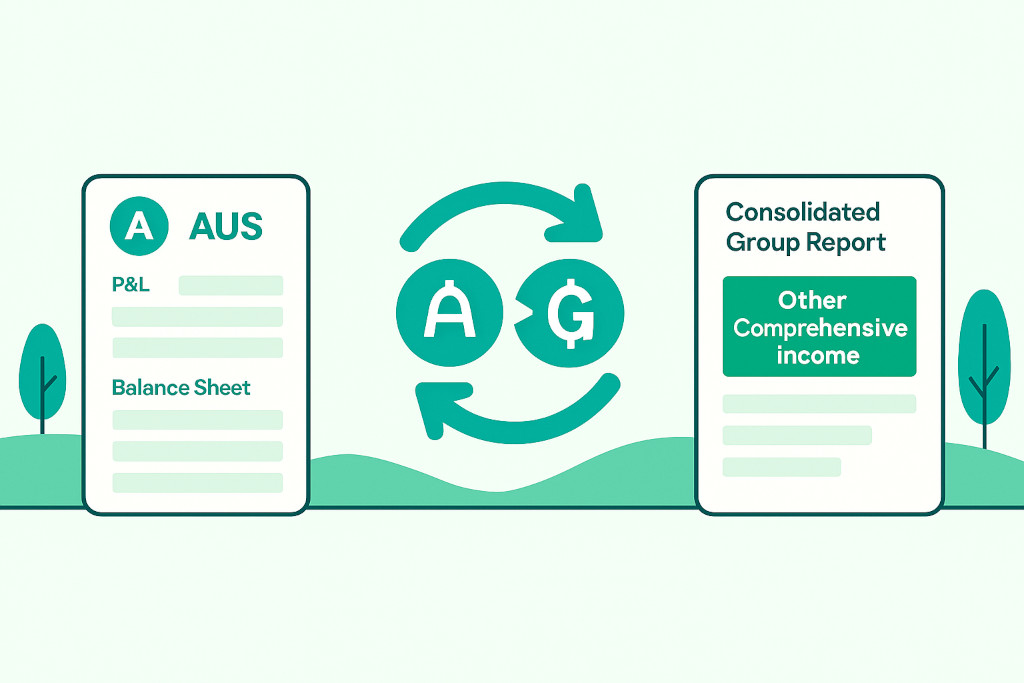
When a group consolidates a foreign subsidiary, it must translate that subsidiary’s financial statements from its functional currency into the group’s presentation currency. The CTA is the balancing figure that arises because different parts of the financial statements are translated at different exchange rates.
Foreign currency consolidation, handled automatically.
BrizoConsol applies the correct CTA/FCTR treatment across all entities — no spreadsheets needed.
Under IAS 21 (and equivalents including ASC 830 for US GAAP groups and FRS 102 Section 30 for UK GAAP), the rules are:
- Balance sheet items — translated at the closing rate (the spot rate at the reporting date).
- Income statement items — translated at the average rate for the period (or the rate at the date of the transaction, where material).
- Equity items — translated at historical rates (the rate at the date the equity was recognised).
Because these three rates are almost always different from each other, the translated Balance Sheet will not balance unless a plug figure is introduced. That plug is the CTA. It accumulates in a separate component of equity — Other Comprehensive Income (OCI) — and is reclassified to the income statement only when the subsidiary is disposed of.
The CTA is not an error. It is not a reconciling item to be explained away. It is a mathematically necessary consequence of translating financial statements prepared in one currency into another using different rates for different account types.
Good financial consolidation software calculates it automatically. Poor processes calculate it as a residual and hope it looks reasonable.
The IAS 21 Framework: Three Rates, One Adjustment
To understand why the CTA arises, it helps to trace through the mechanics at a high level. Consider an Australian subsidiary (functional currency: AUD) being consolidated into a UK group (presentation currency: GBP).
At the start of the year, the opening balance sheet was translated at the closing rate applicable at that date. During the year, the subsidiary generated revenues and costs, which are translated at the average AUD/GBP rate for the year. At year end, the closing balance sheet is translated at the new closing rate.
The AUD/GBP rate has moved during the year. This means:
- The net assets of the subsidiary, when translated at the closing rate, show a different GBP value than the opening net assets translated at the prior closing rate, plus the translated P&L for the year.
- That difference — the effect of the exchange rate movement on the opening net assets, and the difference between average and closing rate on the year’s P&L — cannot go to the income statement, because the underlying trading performance has not changed; only the rate has.
- It therefore accumulates in OCI as the CTA.
IAS 21 Translation Rules — Quick Reference
- Monetary balance sheet items (cash, receivables, payables, debt) → closing rate
- Non-monetary items at historical cost (PP&E, goodwill, intangibles) → historical rate at date of recognition
- Non-monetary items at fair value → rate at date fair value was determined
- Revenue and expenses → average rate for the period (or transaction rate where material)
- Share capital and pre-acquisition reserves → historical rate
- CTA (balancing figure) → recognised in OCI, accumulated in equity until disposal
The practical complexity is not the rule set — it is the volume of calculations. A group with six foreign currency entities must perform this exercise for each entity, for each period, accumulating the CTA balance correctly across months and years. Each period’s CTA depends on the prior period’s closing rate, the current period’s average rate, and the current period’s closing rate. A single rate input error propagates forward into every subsequent period.
Where Manual CTA Calculations Go Wrong
Spreadsheet-based CTA calculation fails in predictable ways. Understanding the failure modes helps in evaluating whether your current process has any of them.
Hard-coded rates that go stale
Closing and average rates are typically entered manually into a rate table each month. When the person responsible is absent, rates are sometimes copied from the prior period “as a placeholder” and never updated. In a volatile currency environment, the resulting CTA error can be material — and because the CTA is a residual, it is not obvious that the rate is wrong until the Balance Sheet is scrutinised in detail.
Mixing historical and closing rates on equity items
Share capital and pre-acquisition reserves must be translated at historical rates — the rate at the date the equity was originally recognised. In practice, many spreadsheet models apply the closing rate to all equity items for simplicity. This systematically misstates the CTA and produces an incorrect equity balance in the consolidated Balance Sheet.
Ignoring intra-year rate movements on P&L
Where revenues or costs are highly seasonal, or where significant transactions occur at exchange rates materially different from the period average, using a single average rate for the whole period introduces error. IAS 21 permits the use of average rates as a practical expedient only where rates do not fluctuate significantly. In volatile rate environments — GBP/USD in 2022, for instance, or AUD/GBP across 2023 — a single period average can be a poor approximation.
Accumulated CTA errors from prior periods
Because the CTA builds up over time, an error made in one period is carried forward into all subsequent periods unless it is corrected at source. A rate input error from eighteen months ago may be silently distorting the current period’s equity balance. This is one of the most difficult errors to detect in a spreadsheet-based model — and one of the most common findings in a consolidation audit.
CTA in Practice: A Worked Example
The following simplified example illustrates how the CTA calculation works for a single foreign currency subsidiary over one reporting period.
Scenario: UK parent (GBP) consolidating an Australian subsidiary (AUD). The subsidiary has net assets of AUD 1,000,000 at the start of the period. During the period, it generates a net profit of AUD 120,000. No dividends are paid.
| Rate | AUD/GBP | Notes |
|---|---|---|
| Opening closing rate (1 Jan) | 0.5400 | Rate at start of period |
| Average rate (full year) | 0.5250 | Used to translate P&L |
| Closing rate (31 Dec) | 0.5100 | Rate at end of period |
Step 1 — Translate the opening net assets at closing rate:
AUD 1,000,000 × 0.5100 = GBP 510,000
Step 2 — Translate the P&L at average rate:
AUD 120,000 × 0.5250 = GBP 63,000
Step 3 — Translated closing net assets (what they should be):
AUD 1,120,000 × 0.5100 = GBP 571,200
Step 4 — What the translated statements produce:
Opening net assets (at closing rate) + P&L (at average rate) = GBP 510,000 + GBP 63,000 = GBP 573,000
Step 5 — CTA (balancing figure):
GBP 571,200 − GBP 573,000 = −GBP 1,800 (adverse CTA, recognised in OCI)
The adverse CTA arises because the AUD weakened during the period (the closing rate fell from 0.5400 to 0.5100). The opening net assets, when retranslated at the lower closing rate, are worth less in GBP than they were at the start — and that value reduction flows into OCI rather than the income statement.
Now multiply this calculation across six subsidiaries, in six currencies, over twelve months, with varying opening balances, intra-period capital injections, and intercompany loan balances that also require translation — and the scale of the spreadsheet problem becomes apparent. Multi-entity accounting software that handles CTA natively performs all of this automatically, using a maintained rate table, with the full calculation available for review and audit.
How BrizoConsol Automates Currency Translation
BrizoConsol handles the complete IAS 21 / ASC 830 / FRS 102 translation workflow within its consolidation engine. The rate table is maintained centrally — closing rates and average rates entered once per period, applied automatically to all entities that use that currency pair.
Historical rates for equity items are captured at the point of entity setup and updated only when a new equity event occurs. This means the rates used for share capital and pre-acquisition reserves are always correct — no manual lookup required each period.
For each foreign currency entity in the consolidation, BrizoConsol:
- Translates monetary balance sheet items at the period closing rate.
- Translates P&L items at the period average rate (with provision for transaction-rate items where configured).
- Translates share capital and pre-acquisition reserves at stored historical rates.
- Calculates the CTA as the mathematical balancing figure and posts it to OCI automatically.
- Accumulates the CTA balance across periods, maintaining a full period-by-period history of CTA movements by entity and currency pair.
The full calculation — rates used, amounts translated, CTA computed — is available in drill-through at the account level. Auditors can verify exactly how any given CTA balance has accumulated, with no need to reconstruct the calculation from a spreadsheet. Every rate input is time-stamped and visible in the audit trail.
For groups using Xero group consolidation alongside other platforms, BrizoConsol pulls functional currency trial balance data directly from each Xero organisation via the API and applies the translation in the consolidation layer — so the source Xero books are never modified, and the translation is applied consistently regardless of which platform each entity uses.
Reporting the CTA to Your Board and Auditors
CTA is frequently misunderstood in board reporting. Non-finance board members often interpret movements in OCI as errors or losses rather than as the mechanical consequence of exchange rate movements.
Finance teams that present CTA well — in a way that is accurate but accessible — build significantly more board confidence in the reliability of the group accounts. The two audiences that matter most are the board and the auditors, and they need different things.
For the board pack
Present the CTA movement for the period alongside the FX variance in the income statement, with a one-paragraph plain-language explanation:
“Our Australian entity’s net assets were worth £X at the start of the year. Because the AUD/GBP rate moved from Y to Z during the year, those same net assets are worth £X-n at year end. The £n difference sits in Other Comprehensive Income as a currency translation adjustment and does not affect our reported profit.”
For the audit
Auditors want three things: the rate table used, the methodology applied, and evidence that the calculation is internally consistent. With BrizoConsol, all three are available in the consolidation audit trail — the rates entered, the accounts translated at each rate, and the CTA figure produced — without any reconstruction work. This typically reduces audit time on CTA from a multi-day exercise to a half-day review.
Conclusion: CTA Is the Foundation of a Trustworthy Consolidated Balance Sheet
Confidence in the CTA calculation is, ultimately, confidence in the consolidated balance sheet. A CTA that cannot be traced back to its component rates and movements is a balance sheet that cannot be fully defended — to auditors, to investors, or to lenders monitoring covenant compliance.
For groups growing through acquisition or operating across multiple currency zones, getting this right is not optional. The mechanics are well established under IAS 21, ASC 830, and FRS 102. The challenge is applying them correctly, consistently, and at speed across multiple entities every reporting period — which is precisely what purpose-built multi-entity accounting software is designed to do.