Acquiring a Property SPV Mid-Year: How to Handle the Purchase Price Allocation, Goodwill, and Your First Consolidation
In August, the board of Hartfield Property Holdings approved the acquisition of Stanmore Yield SPV Ltd, a commercial property holding vehicle that owned a fully let industrial estate in the East Midlands. Completion fell on 1 July — exactly halfway through Hartfield’s December financial year. By October, the group controller, Daniel, had the signed accounts from Stanmore, the completion balance sheet, and instructions from the auditors to produce a consolidated set of group accounts at 31 December that correctly reflected the new acquisition.
The parent company’s work was straightforward: record the investment in Stanmore at cost. But the group consolidation was something different. Daniel needed to establish the fair value of everything Stanmore owned and owed at the exact moment of acquisition, calculate any goodwill arising, include only six months of Stanmore’s income and expenditure in the consolidated P&L, and then deal with a wrinkle he had not anticipated: Stanmore’s investment property was on its own books at a cost-model figure that bore no relation to what the group had just paid to acquire it.
Mid-year SPV acquisitions are how most property groups grow. Getting the first consolidation right — particularly the purchase price allocation and the investment property step-up — determines the accuracy of every consolidated period that follows. Errors made here do not self-correct; they compound.
Stop building consolidations in spreadsheets.
BrizoConsol automates multi-entity consolidation — setup in minutes, reports the same day.
Step One: Establish the Acquisition Date and What It Means for the P&L
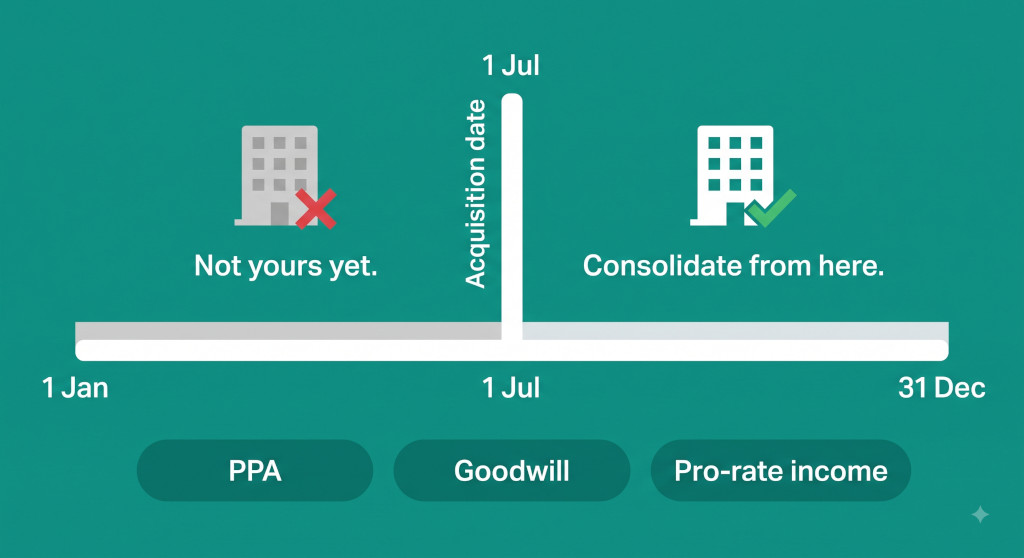
The acquisition date is the date on which the group obtains control of the SPV — in a straightforward share purchase, this is the completion date. From that date and no earlier, the SPV’s income and expenses are included in the consolidated P&L. From before that date, nothing from the SPV appears in the group’s results.
For Hartfield, the acquisition date is 1 July. The consolidated P&L for the year ending 31 December will include exactly six months of Stanmore’s results: rental income, property expenses, finance costs, and any fair value movements — all from 1 July onwards. Stanmore’s January-to-June results do not appear anywhere in the consolidated accounts. They existed, they affected Stanmore’s standalone accounts, but they are pre-acquisition and therefore the group did not earn them.
The most common error in a first consolidation: including the SPV’s full-year income. If Stanmore’s rental income for the full year was £180,000 and Daniel includes all of it in the consolidated P&L, the group’s income is overstated by £90,000 — the pre-acquisition half. Always use the acquisition date as the hard start for all P&L items.
This rule applies to every income and expense line without exception: rental income, property management fees, finance costs on the mortgage, and fair value movements on the investment property. A fair value gain of £120,000 that occurred partly before and partly after the acquisition date must be split, with only the post-acquisition portion included in the group’s results.
Step Two: Perform the Purchase Price Allocation
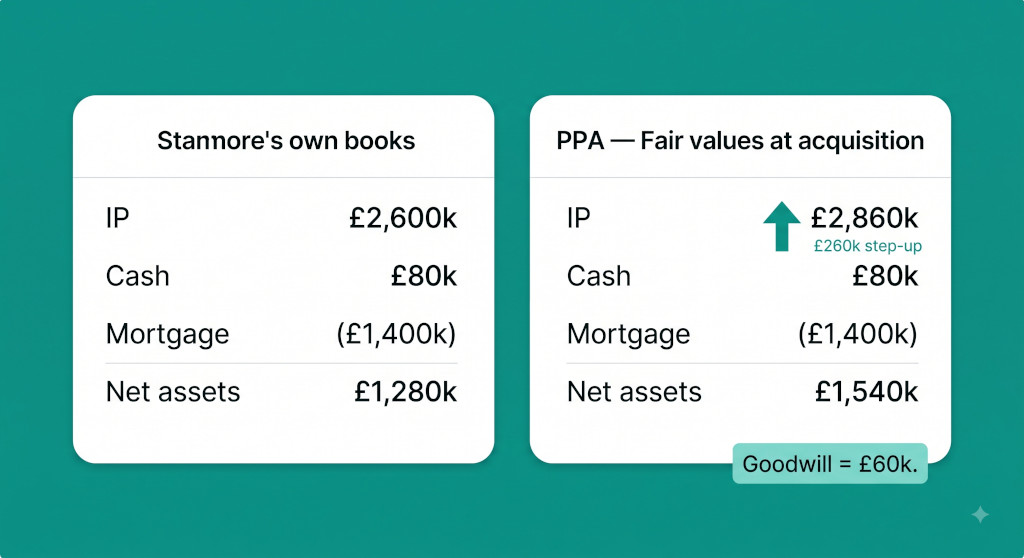
The purchase price allocation (PPA) is the process of identifying the fair value of every identifiable asset and liability in the acquired SPV at the acquisition date. It is the foundation on which the goodwill calculation rests, and it determines the carrying values that will appear in the consolidated balance sheet going forward.
Stanmore’s balance sheet at 1 July, prepared on the basis Stanmore had been using before the acquisition, showed the following book values:
| Asset / Liability | Book value (£) |
|---|---|
| Investment property (cost model) | 2,600,000 |
| Cash and cash equivalents | 80,000 |
| Third-party mortgage | (1,400,000) |
| Net assets at book value | 1,280,000 |
Stanmore had been carrying the investment property at cost since it was acquired several years earlier. The market had moved considerably since then. As part of the acquisition process, Hartfield obtained an independent RICS valuation of the industrial estate at the completion date. That valuation returned a fair value of £2,860,000 — £260,000 above Stanmore’s book value.
The PPA restates the balance sheet using fair values at the acquisition date:
| Asset / Liability | Book value (£) | FV adjustment (£) | Fair value (£) |
|---|---|---|---|
| Investment property | 2,600,000 | 260,000 | 2,860,000 |
| Cash and cash equivalents | 80,000 | — | 80,000 |
| Third-party mortgage | (1,400,000) | — | (1,400,000) |
| Net assets at fair value | 1,280,000 | 260,000 | 1,540,000 |
The mortgage is carried at its face value, which for a standard commercial mortgage is a reasonable approximation of fair value at the acquisition date. If the mortgage had a fixed rate that differed substantially from prevailing rates, a fair value adjustment would be needed — but for most property SPV acquisitions, the assumption that face value approximates fair value for the debt is acceptable and should be documented as an accounting judgement.
Step Three: Calculate Goodwill
With net assets at fair value established at £1,540,000, the goodwill calculation is the difference between what Hartfield paid for the shares and the fair value of what it received:
| Consideration paid (purchase price) | £1,600,000 |
| Less: net identifiable assets at fair value | (£1,540,000) |
| Goodwill arising on acquisition | £60,000 |
This £60,000 represents whatever Hartfield paid above the fair value of Stanmore’s identifiable net assets — perhaps reflecting the quality of the tenant covenant, the location premium, or the value of an established property management relationship that cannot be separately identified and valued. It sits on the consolidated balance sheet as an intangible asset and is subject to annual impairment testing rather than amortisation (under IFRS) or annual impairment review with amortisation over its useful life (under FRS 102).
Using book values instead of fair values inflates goodwill dramatically. If Daniel had skipped the PPA and used Stanmore’s book net assets of £1,280,000, the calculated goodwill would have been £320,000 — more than five times the correct figure. That £260,000 overstatement of goodwill would misrepresent the consolidated balance sheet and might trigger unnecessary impairment discussions in future periods. Always base the goodwill calculation on PPA fair values, not the target’s own carrying amounts.
The Acquisition Journal in the Consolidated Workings
At the point of consolidation for the first time, the group needs an opening journal that brings in all of Stanmore’s assets and liabilities at their acquisition-date fair values, eliminates the investment in subsidiary recorded in the parent’s accounts, and recognises the goodwill arising:
| Account | Dr | Cr |
|---|---|---|
| Investment property (at acquisition-date FV) | £2,860,000 | |
| Cash (Stanmore at acquisition) | £80,000 | |
| Goodwill | £60,000 | |
| Third-party mortgage | £1,400,000 | |
| Investment in subsidiary (parent’s cost) | £1,600,000 |
This journal replaces the parent’s single “investment in subsidiary” line with the full underlying assets and liabilities of Stanmore at their acquisition-date fair values. The investment in subsidiary is eliminated; all of Stanmore’s balance sheet enters the consolidated accounts in its place. From this point, the consolidated balance sheet holds the IP at £2,860,000 — not £2,600,000 (Stanmore’s cost) and not £1,600,000 (the purchase price).
Step Four: Understand the Investment Property FV Step-Up and Its Consequences
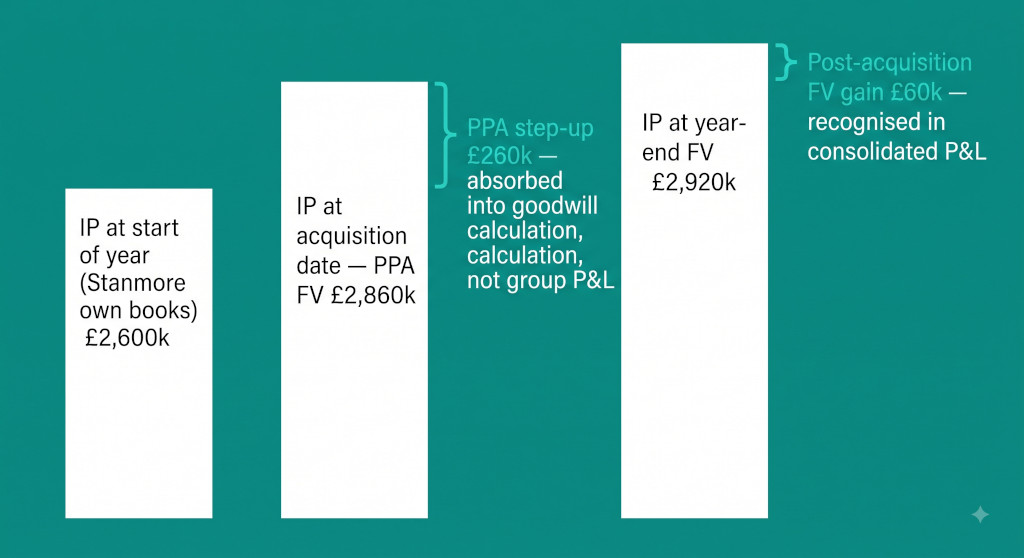
The £260,000 step-up of the investment property from £2,600,000 to £2,860,000 is not a gain. It is simply the recognition that Stanmore’s books were behind the market, and the group’s PPA brings the consolidated carrying value up to date at the acquisition date. That £260,000 is absorbed into the net assets figure that feeds the goodwill calculation — it reduced goodwill from £320,000 (what it would have been on book values) to £60,000 (the correct figure).
What the step-up does affect, however, is the baseline for all future fair value movements in the consolidated accounts. The group’s consolidated accounts now hold the investment property at £2,860,000. Any subsequent movement in fair value — up or down — is measured from that figure, not from Stanmore’s original cost of £2,600,000.
By 31 December, an updated external valuation placed the industrial estate’s fair value at £2,920,000. In the consolidated accounts, the post-acquisition fair value gain is:
| Investment property FV at 31 December | £2,920,000 |
| Less: investment property at acquisition-date FV (PPA) | (£2,860,000) |
| FV gain recognised in consolidated P&L (post-acquisition) | £60,000 |
If Stanmore’s own standalone accounts recorded the property at its original cost of £2,600,000 and showed a year-end FV of £2,920,000, the full-year FV gain in Stanmore’s accounts would be £320,000 — the movement from £2,600,000 to £2,920,000. Only £60,000 of that belongs in the consolidated P&L. The remaining £260,000 is pre-acquisition (or absorbed into the PPA). Failing to separate these two components would overstate the group’s consolidated income for the period.
The acquisition-date fair value from the PPA is not just a balance sheet entry — it is the measurement baseline for every future period. Record it in your consolidation workings with the acquisition date clearly noted, and reference it every time you update the investment property carrying value in subsequent consolidations.
The Consolidated P&L for the Six-Month Period
With the PPA complete and the FV baseline established, the consolidated P&L for the year ending 31 December includes six months of Stanmore’s operating results. Those results, extracted from Stanmore’s management accounts for the period 1 July to 31 December, are:
| P&L item | Full year — Stanmore own accounts (£) | Post-acquisition H2 only — consolidated (£) |
|---|---|---|
| Rental income | 180,000 | 90,000 |
| Property expenses | (40,000) | (20,000) |
| Finance costs (mortgage interest) | (56,000) | (28,000) |
| FV gain on investment property | 320,000 | 60,000 |
| Net profit | 404,000 | 102,000 |
The FV gain in the consolidated P&L (£60,000) is deliberately much smaller than the figure in Stanmore’s own accounts (£320,000), for the reasons explained above. Including the full £320,000 in the group’s consolidated profit would represent a significant overstatement and would be incorrect.
The Consolidated Balance Sheet at 31 December
After the acquisition journal and the six months of post-acquisition activity, the consolidated balance sheet carries the following balances attributable to Stanmore:
| Item | At acquisition (1 Jul) £ | Movement H2 £ | At 31 Dec £ |
|---|---|---|---|
| Investment property (FV) | 2,860,000 | 60,000 | 2,920,000 |
| Cash | 80,000 | (25,000) | 55,000 |
| Third-party mortgage | (1,400,000) | 15,000 | (1,385,000) |
| Goodwill | 60,000 | — | 60,000 |
| Net consolidated carrying amount | 1,600,000 | 50,000 | 1,650,000 |
The opening consolidated carrying amount of £1,600,000 is exactly equal to the purchase price — which is how it should be. At acquisition, the group exchanged £1,600,000 in cash for £1,600,000 of consolidated net assets (including goodwill). The £50,000 movement in H2 reflects the net profit of £102,000 less cash consumed in excess of operating profit during the period.
Goodwill Impairment Testing in the First Year
Even in the year of acquisition, goodwill must be assessed for impairment at the period end. For a property SPV, the cash-generating unit is typically the SPV itself, and the recoverable amount is assessed by reference to the fair value of the underlying investment property (and any other assets) net of liabilities — which is effectively what an external buyer would pay for the equity.
At 31 December, the implied equity value of Stanmore is £2,920,000 (IP) + £55,000 (cash) − £1,385,000 (mortgage) = £1,590,000. Goodwill of £60,000 sits on top of net assets of £1,590,000, implying a recoverable amount of the CGU of £1,590,000. Since the consolidated net assets (ex-goodwill) have increased from £1,540,000 at acquisition to £1,590,000 at year end — driven by the FV gain and net cash retention — the goodwill is supported and no impairment is needed. If the property value had fallen materially, this assessment might reach a different conclusion.
What Happens in the Second Year of Consolidation
In year two, the consolidation is simpler in structure but the same principles apply. The opening balances for Stanmore in the group workings are the closing balances from year one: IP at £2,920,000, cash at £55,000, mortgage at £1,385,000, goodwill at £60,000. The PPA step-up has already been absorbed and no further PPA adjustment is needed. Fair value movements are measured from the opening consolidated carrying value, rental income is included for the full twelve months, and goodwill is tested for impairment again at year end.
The acquisition-date PPA is a one-time exercise. Once it is done correctly, it sets the baseline for all subsequent periods. What matters from year two onwards is that the consolidation workings always open with the correct prior-year consolidated figures — not Stanmore’s standalone figures, which will continue to differ because Stanmore’s own books were not restated as part of the PPA.
Stanmore’s standalone accounts will never match the consolidated figures for its assets. Stanmore’s own books carry the investment property at whatever basis it used before the acquisition (cost model, or FV measured from its original cost). The consolidated accounts carry it at the PPA FV from the acquisition date. These two will not reconcile, and that is correct. The consolidation workings must bridge between Stanmore’s standalone accounts and the consolidated position each period. Document this bridge clearly so it is not treated as an error by a future preparer.
A Checklist for the First Consolidation of a Mid-Year Property SPV Acquisition
- Confirm the acquisition date. Use the legal completion date — the date on which control transferred. Do not use the signing date, the date the board approved the acquisition, or the date you received the keys. The acquisition date determines everything that follows.
- Obtain the completion balance sheet. This is the SPV’s balance sheet at the exact acquisition date, agreed between buyer and seller as part of the completion accounts process. Use this, not the last management accounts or the prior period statutory accounts.
- Commission or obtain independent valuations for all non-cash assets at the acquisition date. For investment property, an independent RICS valuation at or close to the completion date is essential for the PPA. Without it, you cannot demonstrate that the goodwill figure is correct.
- Prepare the PPA table. For each asset and liability, document the carrying value in the SPV’s accounts, the fair value at acquisition, and the adjustment. Note the basis for each fair value assessment and retain the supporting evidence for audit.
- Calculate goodwill. Purchase price minus net assets at fair value. If the result is negative (a bargain purchase), take advice — negative goodwill is recognised immediately in the P&L and is unusual enough to require careful documentation.
- Post the acquisition journal. Bring in all assets and liabilities at fair value, derecognise the parent’s investment in subsidiary, and recognise goodwill. This journal is the foundation of the first consolidated balance sheet.
- Set the PPA fair values as the consolidation opening balances. Record these clearly in your consolidation workings with the acquisition date. They are the reference point for all future periods.
- Include only post-acquisition P&L items. Extract the SPV’s management accounts from acquisition date to period end. Use these figures — not full-year figures — for every income and expense line in the consolidated P&L.
- Calculate the post-acquisition FV movement on investment property. This is year-end FV minus acquisition-date PPA FV. Anything before the acquisition date is pre-acquisition and does not appear in the group’s consolidated P&L.
- Test goodwill for impairment. Even in the acquisition year, perform an impairment assessment. For most property SPVs, this means comparing the implied equity value (net assets at FV) to the consolidated carrying amount including goodwill.
- Document the bridge between the SPV’s standalone accounts and the consolidated position. The two will permanently differ. The bridge should explain the PPA step-up and set out how the consolidated investment property figure relates to the SPV’s own carrying value.
Just acquired a new SPV and need to consolidate it quickly?
BrizoConsol lets you add a new entity, set its acquisition date, and bring it into your group consolidation — no spreadsheet rebuild required. See It In Action