Intercompany Loans in a Restaurant Group: Eliminating the Loan, the Interest, and the Impairment You Didn’t Expect to Reverse
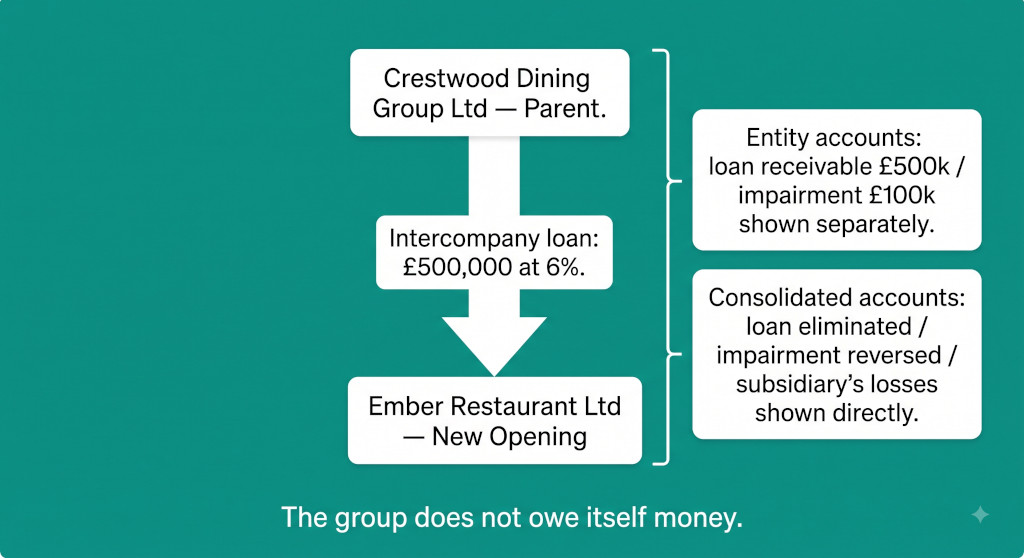
Opening a new restaurant costs money before it makes any. The fit-out, the equipment, the initial stock, the pre-opening wages — typically six to eighteen months of outflows before the site is trading profitably. Most restaurant groups fund new openings from the group’s own resources, channelled to the new restaurant entity via an intercompany loan from the parent. The loan is interest-bearing, documented, and perfectly legitimate at entity level.
At consolidation, it disappears entirely.
The loan principal eliminates. The interest eliminates. And — less obviously — if the parent has recognised an impairment against the loan because the restaurant is loss-making and repayment looks uncertain, that impairment also reverses at consolidation. The consolidated accounts show neither the loan, nor the interest, nor the impairment. They show the restaurant’s actual losses directly, as part of the group’s own trading results.
Intercompany eliminations without the manual work.
BrizoConsol identifies and eliminates intercompany balances automatically at consolidation.
This post works through each of these eliminations using Crestwood Dining Group as the worked example, and explains why the impairment reversal — which often surprises controllers when they encounter it for the first time — is not an error but a fundamental consequence of what consolidation actually does.
The Crestwood Dining Group Structure
Crestwood Dining Group Ltd is the parent entity and the source of group funding. It has provided intercompany loans to two restaurant subsidiaries during the year:
| Borrowing entity | Ownership | Loan principal (£) | Interest rate | Interest for year (£) | Purpose |
|---|---|---|---|---|---|
| Ember Restaurant Ltd | 100% | 500,000 | 6% p.a. | 30,000 | New restaurant opening — fit-out and working capital |
| Saltyard Kitchens Ltd | 80% group / 20% NCI | 200,000 | 5% p.a. | 10,000 | Kitchen refurbishment |
| Total intercompany loans outstanding | 700,000 | 40,000 |
Ember Restaurant is eighteen months old. Trading has been below forecast — the site is in its ramp-up phase and has reported a net loss in both half-years to date. Crestwood’s finance team has reviewed the loan receivable under IFRS 9’s expected credit loss model and concluded that a £100,000 impairment provision is required against the Ember loan in Crestwood’s entity accounts. Saltyard Kitchens is a profitable, established restaurant and the loan is performing normally.
Elimination 1: The Loan Principal
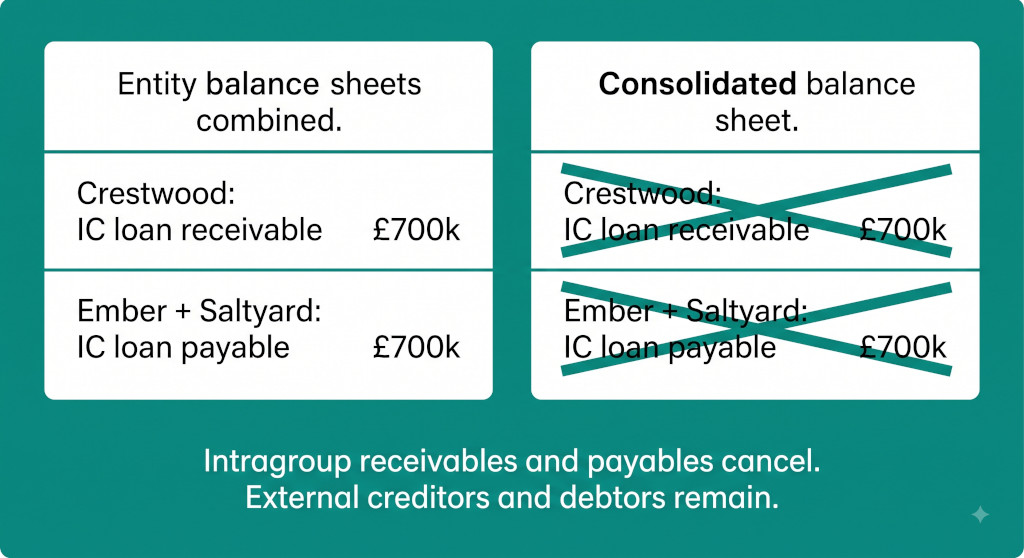
The starting point is the simplest: the loan principal eliminates from the consolidated balance sheet. In Crestwood’s entity accounts, the £700,000 of intercompany loans appears as a financial asset — a loan receivable. In Ember’s and Saltyard’s entity accounts, the same amounts appear as financial liabilities — loans payable. When the group consolidates, these cancel:
| Account | Dr | Cr |
|---|---|---|
| Intercompany loan payable (Ember Restaurant Ltd) | £500,000 | |
| Intercompany loan payable (Saltyard Kitchens Ltd) | £200,000 | |
| Intercompany loan receivable (Crestwood Dining Group Ltd) | £700,000 |
The consolidated balance sheet carries no intercompany loan in either direction. From the group’s perspective, the cash that left Crestwood funded the restaurant operations directly — the loan structure was just the legal mechanism for moving capital between entities. The consolidated balance sheet shows what that capital became: fixed assets, working capital, and accumulated losses in Ember’s case; refurbished kitchen equipment in Saltyard’s case.
Elimination 2: The Interest
During the year, Crestwood recognised £40,000 of interest income on the two intercompany loans. Ember recognised £30,000 of interest expense; Saltyard recognised £10,000. At consolidation, all of it eliminates:
| Account | Dr | Cr |
|---|---|---|
| Interest income (Crestwood Dining Group Ltd) | £40,000 | |
| Interest expense (Ember Restaurant Ltd) | £30,000 | |
| Interest expense (Saltyard Kitchens Ltd) | £10,000 |
The interest elimination applies in full regardless of ownership percentage. Unlike royalties and management fees — where the NCI’s share of a partly-owned subsidiary’s fee represents genuine external income and survives consolidation — interest on a direct loan between the parent and a subsidiary always eliminates completely. The group cannot earn interest from itself. The NCI’s 20% stake in Saltyard reduces their share of the profit allocation (since Saltyard’s P&L includes the interest expense before NCI split), but it does not change what eliminates on the consolidation adjustment.
Interest on an intercompany loan always eliminates in full — 100% — regardless of ownership percentage. This is the key distinction from royalties and management fees where the NCI’s proportionate share survives. A loan is between two specific legal entities; the NCI’s stake in the borrowing entity changes how the interest expense affects NCI profit allocation, but it does not make the interest income external income for the group.
The Impairment — and Why It Reverses at Consolidation
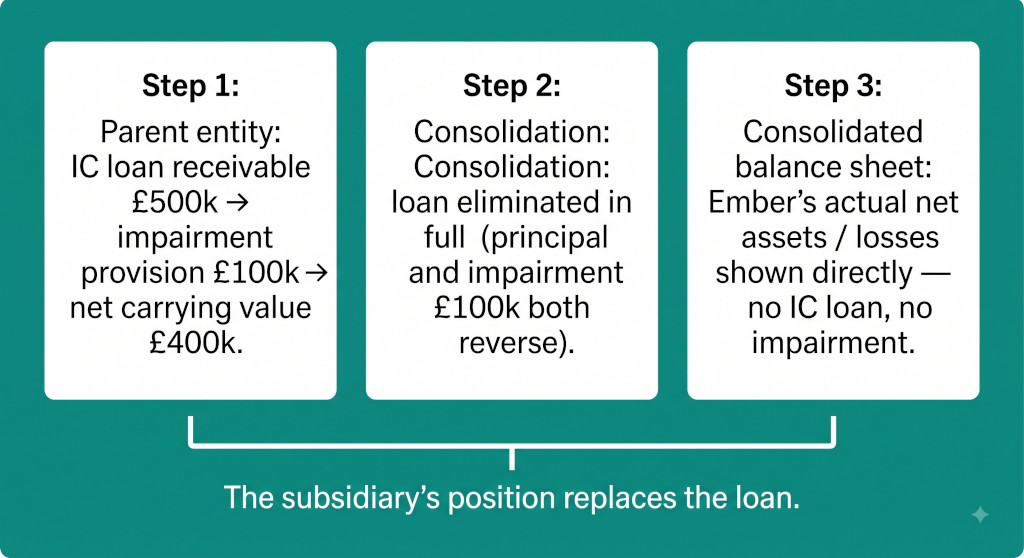
This is the elimination that surprises most controllers the first time they encounter it. Crestwood has recognised a £100,000 impairment provision against the Ember loan in its entity accounts — a prudent, technically correct response to the expected credit loss model under IFRS 9. Ember is loss-making; the loan may not be fully recoverable. The impairment is appropriate at entity level.
At consolidated level, however, the impairment cannot exist. And it must be reversed.
The reason is this: the intercompany loan is not an asset of the consolidated group. The group does not have a receivable from Ember — Ember is part of the group. When Crestwood lent £500,000 to Ember, the group simply moved cash from one pocket to another. What Crestwood now has, at group level, is not a loan receivable but a set of net assets (and losses) that Ember has generated with the funding it received. Those net assets and losses are consolidated directly into the group accounts — the accumulated loss is already sitting in the consolidated P&L and retained earnings.
If Crestwood’s entity-level impairment of the loan were allowed to survive at consolidation, the group would be recognising Ember’s losses twice: once through the impairment of the loan receivable in Crestwood’s accounts, and again through Ember’s own trading losses flowing through the consolidated P&L. The impairment must reverse to prevent this double-counting.
| Account | Dr | Cr |
|---|---|---|
| Impairment provision — intercompany loan receivable (Crestwood) | £100,000 | |
| Impairment charge — finance costs / credit loss expense (Crestwood) | £100,000 |
This reversal removes both the balance sheet provision and the P&L charge that Crestwood recognised at entity level. The consolidated accounts do not carry an impaired IC loan on the balance sheet (the loan principal eliminated entirely in Elimination 1). And the consolidated P&L already carries Ember’s trading losses directly — no further loss recognition is needed or permitted via the impairment mechanism.
After both the principal elimination and the impairment reversal, the consolidated balance sheet position for the Ember loan is clean: no receivable, no provision, no net carrying value. Ember’s actual position — its fixed assets, accumulated trading losses, and working capital — flows directly into the consolidated balance sheet through the normal subsidiary consolidation process.
How Ember’s Losses Appear in the Consolidated Accounts
The impairment reversal sometimes prompts a concern: if we remove the loss that Crestwood recognised against the Ember loan, does the consolidated group look more profitable than it really is?
No — because Ember’s losses appear in a different place. The consolidated P&L includes 100% of Ember’s revenue, costs, and resulting loss for the year. Those trading losses are Crestwood’s losses at group level, flowing directly through the consolidated income statement. The entity-level impairment in Crestwood’s accounts was an attempt to recognise those losses through the lens of the loan receivable — a proxy mechanism that only exists because Crestwood and Ember are separate legal entities. At consolidation, the proxy is removed and the underlying reality is substituted: Ember’s actual trading results, line by line, in the group accounts.
| P&L item | Crestwood entity accounts — Ember-related items (£) | Consolidated accounts — Ember-related items (£) |
|---|---|---|
| Interest income on IC loan | 30,000 | — |
| Impairment of IC loan | (100,000) | — |
| Ember’s restaurant revenue | — | 1,140,000 |
| Ember’s operating costs | — | (1,290,000) |
| Ember’s interest expense (IC loan — eliminated) | — | — |
| Net P&L contribution from Ember | (70,000) | (150,000) |
At entity level, Crestwood’s accounts show only a net £70,000 loss related to Ember — £30,000 interest income offset by the £100,000 impairment. The full picture of Ember’s £150,000 operating loss is invisible in Crestwood’s standalone accounts. At consolidated level, the full £150,000 operating loss is visible (with the interest expense eliminated since it was intragroup). The consolidated accounts are more informative, not less, precisely because the proxy mechanisms are stripped away.
An important distinction: reversing the entity-level impairment at consolidation does not mean the group ignores Ember’s difficult trading position. The consolidated accounts show Ember’s actual losses in full. What the reversal prevents is those losses being counted twice — once via the impairment proxy in the parent and again via the subsidiary’s trading results in the group P&L. The group’s exposure to Ember is real; it just belongs in the consolidated trading results, not in a loan impairment.
Accrued Interest and the Balance Sheet Cross-Check
Where interest is accrued but not yet settled in cash at the year end — as is common when interest is rolled up into the principal or paid annually — there will be a matching intercompany accrual on the balance sheet: an accrued interest receivable in Crestwood’s accounts and an accrued interest payable in the restaurant entities’ accounts. These require a separate balance sheet elimination:
| Account | Dr | Cr |
|---|---|---|
| Accrued interest payable (Ember Restaurant Ltd — year-end accrual) | £30,000 | |
| Accrued interest payable (Saltyard Kitchens Ltd — year-end accrual) | £10,000 | |
| Accrued interest receivable (Crestwood Dining Group Ltd) | £40,000 |
This balance sheet elimination is separate from the P&L interest elimination above. Both are required. A consolidation workbook that correctly eliminates the P&L interest but leaves the accrued interest balances on the consolidated balance sheet will show inflated receivables and payables — a common error in manual workbooks where P&L and balance sheet schedules are not cross-referenced.
A useful discipline: for every intercompany loan in the group, the consolidation workbook should carry four elimination lines — principal (balance sheet), accrued interest (balance sheet), interest income (P&L), and interest expense (P&L). If any of the four is missing, the consolidated accounts will be misstated on at least one financial statement.
The NCI’s Share of Saltyard’s Interest Expense
The £10,000 of interest that Saltyard Kitchens paid on its intercompany loan eliminates fully at consolidation — it does not survive, because there is no external party receiving interest income from the group. But the NCI’s profit allocation from Saltyard is affected: Saltyard’s P&L includes the £10,000 interest expense before the NCI split is calculated. The NCI therefore bears 20% of that £10,000 = £2,000 as a reduction of their share of Saltyard’s profit.
This is not an adjustment the consolidation workbook needs to make separately — it flows automatically from including 100% of Saltyard’s P&L (including the £10,000 interest expense) before allocating 20% to the NCI. But it is worth understanding: the NCI’s profit allocation is lower than it would be if Saltyard had been funded by external bank debt at the same rate. The intercompany loan, while economically equivalent to external debt for the operating entity, has a different consolidated presentation — the interest disappears from the group P&L rather than surviving as an external finance cost, which means the group’s consolidated finance costs are lower, but so is the interest income that would otherwise appear. The net effect on consolidated profit is zero, as always.
Prior Year Eliminations and the Retained Earnings Carry-Forward
Intercompany loans often span multiple financial years. An opening funded in year one will still carry a balance in years two, three, and beyond. At each consolidation, the same elimination applies: the loan principal at the balance sheet date, the interest for the current year, any accrued interest at year end, and any entity-level impairment recognised in the current year.
One nuance for multi-year loans: if the interest was accrued but not settled in a prior year, the prior year accrual will have been eliminated in the prior year consolidation. In the current year, if that accrual is settled in cash, there will be a cash movement in both entities (Crestwood receives cash; the restaurant pays cash) but no P&L entry in either — the settlement of an accrual is a balance sheet movement only. The current year consolidation therefore does not need to eliminate the prior year interest separately; it was handled when it was accrued. The consolidation team should simply confirm that the opening balance of the IC loan receivable/payable agrees to the prior year closing position after eliminations.
At each period end, the IC loan elimination removes the closing principal balance (not the original advance). If the restaurant has been making principal repayments, the elimination amount shrinks accordingly. The interest elimination each year covers only the interest accrued or charged in that specific period — it does not re-eliminate prior year interest that was already removed in the prior consolidation.
Deferred Tax on the Intercompany Interest
Where interest is accrued at year end but is not deductible for tax purposes until it is paid — or where there is a timing difference between the recognition of interest income in Crestwood’s accounts and its inclusion in Crestwood’s tax return — a deferred tax asset or liability may arise at entity level. At consolidated level, the deferred tax position on the intercompany interest also eliminates, because the interest itself does not exist in the consolidated accounts. If Crestwood has a deferred tax liability on interest income that will be taxed on a receipts basis, and Ember has a deferred tax asset on interest expense deductible on payment, both must be assessed for consolidation elimination. The elimination of the timing difference that gave rise to them in the first place is the trigger for removing them.
The deferred tax on the impairment is a separate consideration. If Crestwood has recognised a deferred tax asset on the £100,000 impairment charge (expecting a tax deduction when the loss is ultimately confirmed), that deferred tax asset also reverses at consolidation when the impairment itself is reversed. The group does not have a deferred tax asset on a loss that has been recognised via a different route — Ember’s own trading losses — in the consolidated accounts.
A Practical Checklist for Intercompany Loans in F&B Group Consolidations
- Compile a complete IC loan schedule at each period end. For every intercompany loan in the group, document: lending entity, borrowing entity, principal outstanding, interest rate, interest accrued in the period, interest accrued and unpaid at the balance sheet date, and any impairment provision recognised in the lending entity’s accounts. This schedule drives all four elimination lines.
- Eliminate the loan principal on the consolidated balance sheet. Debit the payable in the borrowing entity’s accounts, credit the receivable in the lending entity’s accounts. Use the closing principal balance, not the original advance amount.
- Eliminate accrued interest on the consolidated balance sheet. Debit the accrued interest payable in the borrowing entity, credit the accrued interest receivable in the lending entity. This is a separate balance sheet adjustment from the principal elimination.
- Eliminate interest income and expense on the consolidated P&L. Debit interest income in the lending entity, credit interest expense in the borrowing entity. Always eliminate 100% regardless of the borrowing entity’s ownership percentage.
- Reverse any entity-level impairment of the IC loan receivable. If the lending entity has recognised an expected credit loss provision under IFRS 9 against an IC loan, reverse both the provision (balance sheet) and the related impairment charge (P&L) at consolidation. The subsidiary’s losses are already captured through the normal trading consolidation — the impairment would double-count them.
- Assess the deferred tax position. Review any deferred tax balances in either entity that arose from timing differences on the intercompany interest or the impairment. Where those balances relate to items that have been eliminated at consolidation, remove the associated deferred tax as well.
- Cross-check opening balances year over year. The closing IC loan balance after eliminations in the prior year consolidation should agree to the opening IC loan balance in the current year consolidation. If there are differences — from settlements, new advances, or renegotiated terms — document and reconcile them before preparing the current year adjustments.
- Brief the board on the consolidated vs. entity-level loss presentation. Where a parent entity shows a relatively modest loss related to a new restaurant (interest income less impairment), the consolidated accounts will show that restaurant’s full trading loss. Prepare the board for this difference to avoid the consolidated accounts appearing to report a more severe loss than expected.
Consolidating a restaurant group with intercompany loans?
BrizoConsol tracks every IC loan balance, calculates the eliminations automatically, and flags impairment reversals before they become audit findings. See It In Action