A Complete Consolidation Worked Example: From Entity Trial Balances to Consolidated Financial Statements
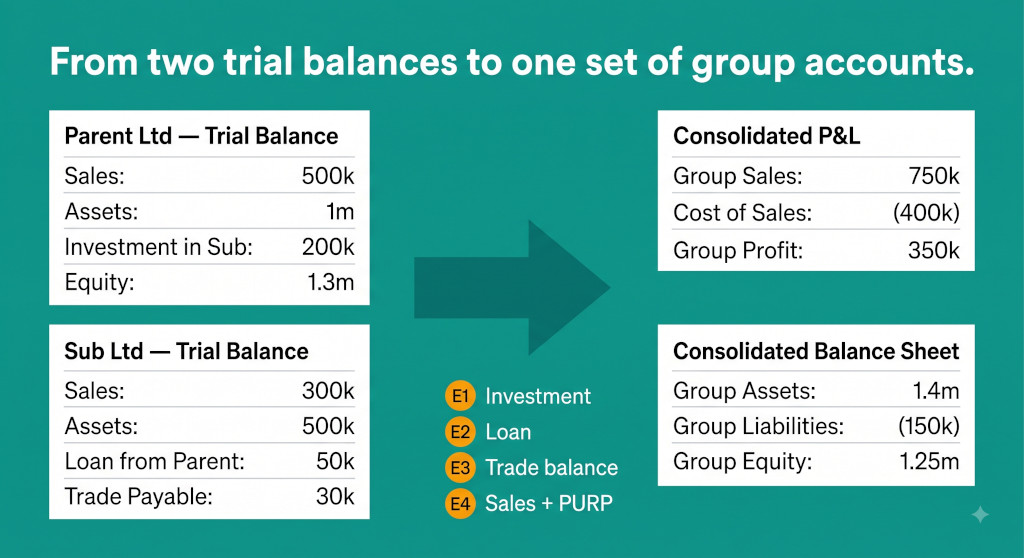
Most consolidation guides explain what an intercompany elimination is. Far fewer show you exactly what happens to the numbers when you do it — starting from two real trial balances and ending with a complete set of group accounts. This post does exactly that. It takes two entity trial balances, applies four elimination journals in sequence, and produces a consolidated profit and loss account and balance sheet that you can trace line by line.
The scenario is deliberately straightforward: a parent company that owns 100% of a single subsidiary. There is no minority interest to complicate the NCI calculation, no foreign currency translation, and no mid-year acquisition. What there is: a goodwill calculation, an intercompany loan with interest, an outstanding trade balance, and intercompany goods sales with unrealised profit sitting in closing stock. These four situations cover the overwhelming majority of what finance teams encounter in a standard period-end group consolidation.
If you have ever produced a consolidation and found that the balance sheet doesn’t balance, or that your consolidated revenue is higher than it should be, or that goodwill has moved when it shouldn’t have, this walkthrough will show you exactly where each number comes from and why.
Automate NCI calculations across all your entities.
BrizoConsol handles non-controlling interest automatically — no manual adjustments required.
The Group Structure and Acquisition Facts
Parent Ltd acquired 100% of Sub Ltd several years ago for £500,000 in cash. At the date of acquisition, Sub Ltd’s net assets had a fair value of £380,000. No fair value adjustments to individual assets were required — the entire excess of purchase price over net assets is goodwill. There has been no goodwill impairment since acquisition.
| Cost of investment in Sub Ltd | £500,000 |
| Fair value of Sub’s net assets at acquisition | £(380,000) |
| Goodwill recognised at acquisition | £120,000 |
Sub Ltd’s net assets at acquisition comprised share capital of £100,000 and retained earnings of £280,000. These figures matter for the investment elimination (Elimination 1) below.
During the current year, two categories of intercompany transactions took place. First, Sub Ltd sold £200,000 of goods to Parent Ltd at a 40% gross margin. At the year end, £50,000 of those goods (at Sub’s transfer price) remain unsold in Parent Ltd’s inventory. Second, Parent Ltd has an outstanding loan of £150,000 to Sub Ltd on which Sub paid £12,000 of interest during the year. A trade balance of £40,000 also remains outstanding between the entities — Sub has a receivable from Parent, and Parent has a matching payable to Sub.
The Entity Trial Balances
The two trial balances below are the starting point for the consolidation. Every figure in the consolidated accounts will be derived from these numbers after the four eliminations are applied.
| Account | Parent Ltd £ | Sub Ltd £ |
|---|---|---|
| Profit & Loss | ||
| Revenue | 3,000,000 | 800,000 |
| Cost of sales | (1,800,000) | (480,000) |
| Admin expenses | (600,000) | (108,000) |
| Interest income / (expense) | 12,000 | (12,000) |
| Profit after tax | 612,000 | 200,000 |
| Balance Sheet — Assets | ||
| Investment in Sub Ltd (at cost) | 500,000 | — |
| Property, plant & equipment | 1,100,000 | 360,000 |
| Trade receivables (external) | 380,000 | 80,000 |
| Intercompany trade receivable (from Parent) | — | 40,000 |
| Intercompany loan receivable (from Sub) | 150,000 | — |
| Inventory | 280,000 | 100,000 |
| Cash | 320,000 | 130,000 |
| Total assets | 2,730,000 | 710,000 |
| Balance Sheet — Liabilities & Equity | ||
| Trade payables (external) | (300,000) | (70,000) |
| Intercompany trade payable (to Sub) | (40,000) | — |
| Intercompany loan payable (to Parent) | — | (150,000) |
| Share capital | (500,000) | (100,000) |
| Retained earnings — brought forward | (1,278,000) | (190,000) |
| Profit for the year | (612,000) | (200,000) |
| Total liabilities & equity | (2,730,000) | (710,000) |
Before applying any elimination, check that each entity’s trial balance is internally balanced. Parent Ltd: total assets £2,730,000 = total liabilities and equity £2,730,000 ✓. Sub Ltd: total assets £710,000 = total liabilities and equity £710,000 ✓. If either entity is out of balance before consolidation begins, find and fix the error before proceeding — a consolidation built on an unbalanced entity trial balance cannot produce a balanced consolidated balance sheet.
The Four Eliminations
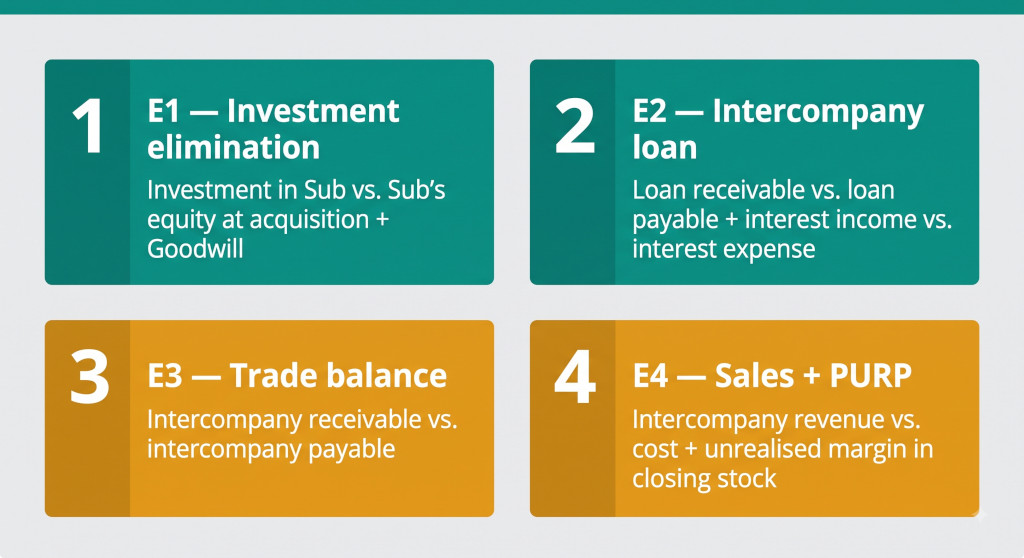
Elimination 1 — Investment in Subsidiary vs. Sub’s Equity at Acquisition
The investment in Sub Ltd sitting on Parent’s balance sheet (£500,000) represents Parent’s ownership of Sub. In the consolidated accounts, we do not show the investment — we show the underlying assets and liabilities of Sub directly. The investment is therefore eliminated against Sub’s equity at the date of acquisition. The difference between the two is goodwill.
| Account | Dr | Cr |
|---|---|---|
| Share capital — Sub Ltd (at acquisition) | £100,000 | |
| Retained earnings — Sub Ltd (at acquisition) | £280,000 | |
| Goodwill | £120,000 | |
| Investment in Sub Ltd — Parent balance sheet | £500,000 |
The investment (£500,000) is eliminated. Sub’s equity at acquisition — share capital (£100,000) and retained earnings at acquisition (£280,000) — is derecognised. The £120,000 excess of cost over net assets is recognised as goodwill on the consolidated balance sheet. Sub’s post-acquisition retained earnings (the profits Sub has earned since acquisition) remain in the consolidated retained earnings and are not eliminated here.
Note that only Sub’s equity at the acquisition date is eliminated — not its current equity. Sub’s retained earnings brought forward are £190,000; the retained earnings at acquisition were £280,000. Sub’s post-acquisition retained earnings = current RE b/f (£190,000) + current year PAT (£200,000) − RE at acquisition (£280,000) = £110,000. This £110,000 belongs to the group and flows into consolidated retained earnings.
Elimination 2 — Intercompany Loan and Interest
Parent Ltd has lent £150,000 to Sub Ltd. This appears as a loan receivable in Parent’s assets and a loan payable in Sub’s liabilities. In the consolidated accounts, a loan from the parent to its own subsidiary is an internal transaction — both sides are eliminated. The same applies to the interest: £12,000 income in Parent and £12,000 expense in Sub cancel each other out at group level.
| Account | Dr | Cr |
|---|---|---|
| Intercompany loan payable — Sub Ltd | £150,000 | |
| Intercompany loan receivable — Parent Ltd | £150,000 |
Balance sheet: the loan receivable and loan payable are eliminated. No cash has left the group.
| Account | Dr | Cr |
|---|---|---|
| Interest income — Parent Ltd P&L | £12,000 | |
| Interest expense — Sub Ltd P&L | £12,000 |
P&L: the interest income and interest expense cancel. Note the net effect on consolidated profit is zero — one entity’s income exactly offsets the other’s expense. The consolidated P&L shows no interest on this loan because from the group’s perspective the loan does not exist.
Elimination 3 — Intercompany Trade Balance
Sub Ltd has a trade receivable of £40,000 from Parent Ltd (for goods sold but not yet settled). Parent Ltd has a matching trade payable of £40,000 to Sub. These are internal balances — from the group’s perspective, the group owes money to itself, which is nonsensical. Both sides are eliminated.
| Account | Dr | Cr |
|---|---|---|
| Intercompany trade payable — Parent Ltd | £40,000 | |
| Intercompany trade receivable — Sub Ltd | £40,000 |
The intercompany trade receivable and payable eliminate. If the two balances do not agree before this step, the difference must be investigated and resolved before the consolidation proceeds. Common causes include cash-in-transit, invoices in transit, or timing differences — all of which require specific treatment. A consolidation that forces-eliminates a mismatched intercompany balance will produce an error somewhere in the consolidated accounts.
Elimination 4 — Intercompany Sales and Provision for Unrealised Profit (PURP)
Sub Ltd sold £200,000 of goods to Parent Ltd during the year. In Sub’s P&L this is revenue; in Parent’s P&L this is part of cost of sales (£200,000 included in Parent’s total COGS of £1,800,000). From the group’s perspective, goods have simply moved from one part of the group to another — no sale to an external customer has occurred. Both the revenue and the matching cost must be eliminated.
| Account | Dr | Cr |
|---|---|---|
| Revenue — Sub Ltd | £200,000 | |
| Cost of sales — Parent Ltd | £200,000 |
The intercompany revenue in Sub and the matching cost in Parent are eliminated. Consolidated revenue reflects only sales to external customers.
This eliminates the revenue and cost — but there is a second problem. At the year end, £50,000 of the goods (at Sub’s transfer price) remain in Parent’s inventory unsold. Sub’s gross margin is 40%, which means the £50,000 of inventory includes £20,000 of profit that Sub recognised when it “sold” the goods to Parent. From the group’s perspective, those goods have not been sold to anyone outside the group. The profit has not been earned. It must be eliminated from the consolidated inventory and from consolidated profit — this is the Provision for Unrealised Profit.
| Closing inventory in Parent from intercompany purchases | £50,000 |
| Sub’s gross margin on intercompany sales | 40% |
| Unrealised profit (PURP) to eliminate | £20,000 |
| Account | Dr | Cr |
|---|---|---|
| Cost of sales — consolidated P&L (increase) | £20,000 | |
| Inventory — consolidated balance sheet (reduce) | £20,000 |
The PURP reduces consolidated inventory by £20,000 (the asset is overstated by the unrealised margin) and increases consolidated cost of sales by £20,000 (reducing consolidated profit). When Parent sells these goods to an external customer in a future period, the elimination reverses — the margin is realised and recognised in consolidated profit at that point.
The PURP margin fraction is 40% of the transfer price — not 40% of the cost. Sub sells at a 40% gross margin on revenue, so for every £1 of selling price, £0.40 is profit. Applied to the £50,000 inventory balance (which is at Sub’s selling price): PURP = 40% × £50,000 = £20,000. If you mistakenly use the cost-based markup (which would be 40/60 = 66.7%), you will over-eliminate and understate inventory.
Building the Consolidated Profit and Loss Account
With all four eliminations applied, the consolidated P&L is built by aggregating both entities’ P&L lines and applying the adjustments:
| Account | Parent £ | Sub £ | Eliminations £ | Consolidated £ |
|---|---|---|---|---|
| Revenue | 3,000,000 | 800,000 | (200,000) E4 | 3,600,000 |
| Cost of sales | (1,800,000) | (480,000) | +200,000 E4 / (20,000) PURP | (2,100,000) |
| Gross profit | 1,200,000 | 320,000 | 1,500,000 | |
| Admin expenses | (600,000) | (108,000) | — | (708,000) |
| Interest income / (expense) | 12,000 | (12,000) | (12,000)/(+12,000) E2 | — |
| Consolidated profit for the year | 612,000 | 200,000 | (20,000) | 792,000 |
Consolidated revenue is £3,600,000 — the £200,000 of intercompany sales has been stripped out, so this represents only sales to external customers. Consolidated profit is £792,000, which is the sum of both entities’ profits (£812,000) less the £20,000 unrealised margin in closing inventory. The interest elimination nets to zero across both P&L lines.
Stop doing this in Excel
BrizoConsol aggregates your entity trial balances, applies intercompany eliminations, and produces a consolidated P&L and balance sheet automatically — every month, without the manual journal-by-journal process described in this post. See It In Action
Building the Consolidated Balance Sheet
The consolidated balance sheet aggregates both entities’ balance sheets and applies the elimination adjustments. The most important things to track are what gets added (goodwill), what gets removed (the investment, the intercompany balances), and what gets reduced (inventory for the PURP).
| Account | Parent £ | Sub £ | Eliminations £ | Consolidated £ |
|---|---|---|---|---|
| Assets | ||||
| Goodwill | — | — | +120,000 E1 | 120,000 |
| Investment in Sub (at cost) | 500,000 | — | (500,000) E1 | — |
| Property, plant & equipment | 1,100,000 | 360,000 | — | 1,460,000 |
| Trade receivables (external) | 380,000 | 80,000 | — | 460,000 |
| IC trade receivable (Sub from Parent) | — | 40,000 | (40,000) E3 | — |
| IC loan receivable (Parent from Sub) | 150,000 | — | (150,000) E2 | — |
| Inventory | 280,000 | 100,000 | (20,000) PURP | 360,000 |
| Cash | 320,000 | 130,000 | — | 450,000 |
| Total assets | 2,730,000 | 710,000 | (590,000) | 2,850,000 |
| Liabilities | ||||
| Trade payables (external) | (300,000) | (70,000) | — | (370,000) |
| IC trade payable (Parent to Sub) | (40,000) | — | +40,000 E3 | — |
| IC loan payable (Sub to Parent) | — | (150,000) | +150,000 E2 | — |
| Total liabilities | (340,000) | (220,000) | 190,000 | (370,000) |
| Equity | ||||
| Share capital | (500,000) | (100,000) | +100,000 E1 | (500,000) |
| Retained earnings — brought forward | (1,278,000) | (190,000) | +280,000 E1 / (110,000) post-acq | (1,278,000) |
| Profit for the year | (612,000) | (200,000) | +20,000 PURP | (792,000) |
| Sub’s post-acquisition retained earnings | — | — | (110,000) | (110,000) |
| Total equity | (2,390,000) | (490,000) | 180,000 | (2,480,000 ← note: negative = equity) |
Consolidated net assets = £2,850,000 (assets) − £370,000 (liabilities) = £2,480,000. Consolidated equity = share capital (£500,000) + consolidated retained earnings (£1,980,000) = £2,480,000. ✓
Reconciling the Consolidated Retained Earnings
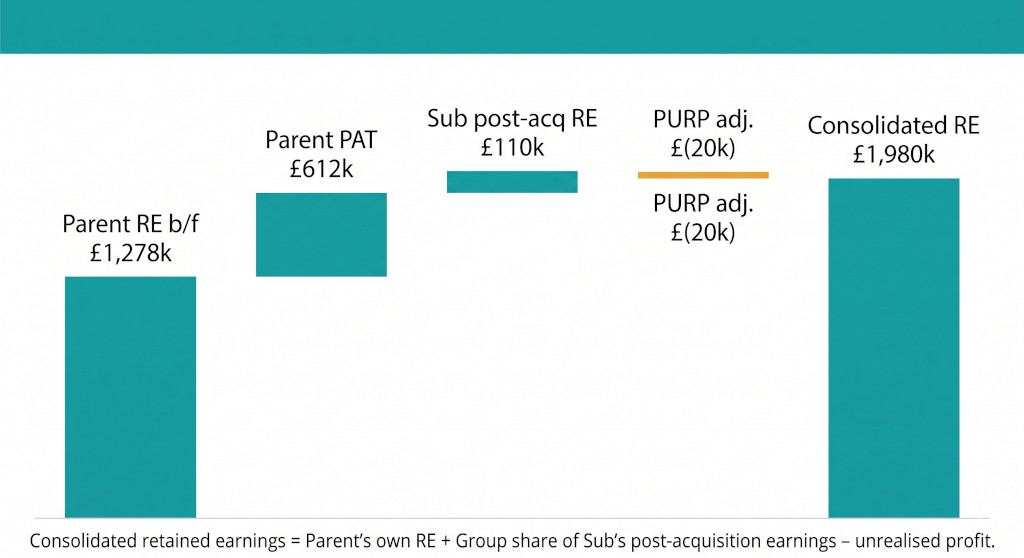
The consolidated retained earnings figure (£1,980,000) is often the most confusing output of the consolidation. It is not simply the sum of both entities’ retained earnings. It is constructed as follows:
| Parent Ltd retained earnings b/f | £1,278,000 |
| Parent Ltd profit for the year | £612,000 |
| Group’s share of Sub’s post-acquisition retained earnings (100% × £110,000) | £110,000 |
| Less: PURP — unrealised profit in closing inventory | £(20,000) |
| Consolidated retained earnings | £1,980,000 |
Sub’s post-acquisition retained earnings of £110,000 represents the profits Sub has generated since the date Parent acquired it — these belong to the group and are included in consolidated retained earnings. Sub’s retained earnings at acquisition (£280,000) were eliminated in Elimination 1 against the investment cost. That portion is already accounted for in the goodwill calculation, not in the retained earnings.
The PURP reduces consolidated retained earnings because the £20,000 of unrealised profit has been eliminated from this year’s consolidated profit — and since it originated in Sub’s P&L in the current year, it reduces the current-year profit contribution flowing into consolidated retained earnings.
The Completed Consolidated Financial Statements
| Consolidated Profit and Loss Account | |
|---|---|
| Revenue | £3,600,000 |
| Cost of sales | £(2,100,000) |
| Gross profit | £1,500,000 |
| Admin expenses | £(708,000) |
| Profit for the year | £792,000 |
| Consolidated Balance Sheet | |
|---|---|
| Goodwill | £120,000 |
| Property, plant & equipment | £1,460,000 |
| Trade receivables | £460,000 |
| Inventory | £360,000 |
| Cash | £450,000 |
| Total assets | £2,850,000 |
| Trade payables | £(370,000) |
| Net assets | £2,480,000 |
| Share capital | £500,000 |
| Retained earnings | £1,980,000 |
| Total equity | £2,480,000 |
What This Example Teaches
Four observations stand out from this walkthrough that matter in every real-world consolidation.
First, the investment in the subsidiary completely disappears. It is replaced by goodwill (£120,000) plus the underlying assets and liabilities of Sub. Any group accountant who can see both the investment and the subsidiary’s assets in the consolidated balance sheet has missed Elimination 1 entirely.
Second, intercompany loans and their interest are completely invisible in the consolidated accounts. The group lent money to itself and earned interest on it — from a group perspective, this simply did not happen. Both the balance sheet positions and the P&L lines net to zero.
Third, consolidated revenue (£3,600,000) is lower than the sum of both entities’ revenue (£3,800,000). This is always the correct outcome when intercompany sales exist — consolidated revenue should never include transactions between group members. If a consolidation produces revenue equal to or higher than the entity sum, the intercompany revenue elimination has not been applied.
Fourth, the PURP affects the balance sheet (inventory) as well as the P&L (cost of sales). It is not enough to eliminate the intercompany revenue and cost — if goods remain unsold at the year end, the unrealised margin must also be stripped from the asset. This is the most commonly missed step in manual consolidations.
For a deeper look at each of these four elimination types — the investment elimination, the intercompany loan treatment, the trade balance reconciliation, and the PURP calculation — the guides on intercompany eliminations and journal entries in group consolidation provide the underlying mechanics in more detail.
Practical Checklist
- Balance each entity trial balance before starting. A consolidation cannot produce a balanced output if any entity input is out of balance.
- Reconcile all intercompany balances before eliminating them. If the receivable and payable don’t match, find out why before proceeding — do not force-eliminate a mismatched balance.
- Identify the retained earnings at acquisition separately from the current retained earnings brought forward. Only the at-acquisition figure is eliminated in E1; the post-acquisition earnings belong to the group.
- Calculate goodwill from the acquisition data, not from current figures. Goodwill is fixed at the acquisition date and does not change unless impaired.
- Apply the PURP to the transfer price, not the cost. The margin fraction is profit ÷ selling price, applied to the closing stock balance at the transfer price.
- Check that interest eliminations net to zero. If they don’t, one entity has recorded a different amount from the other — find the mismatch.
- Verify the consolidated balance sheet balances before distributing. The check is simple: total assets must equal total equity plus total liabilities. If it doesn’t, one elimination journal has an arithmetic error.
- Reconcile consolidated retained earnings using the formula: Parent RE + Group share of Sub post-acquisition RE − PURP. If this reconciliation doesn’t agree to the balance sheet figure, an elimination has been missed or applied twice.
Want this done automatically every month?
BrizoConsol pulls in your entity trial balances, matches intercompany balances, applies eliminations, and produces a consolidated P&L and balance sheet — without a single manual elimination journal. Set it up once, run it every period.Start Free Trial