Acquiring a Retail Chain Mid-Year: Purchase Price Allocation, Goodwill, and Why the First Period of Ownership Looks Less Profitable Than You Expected
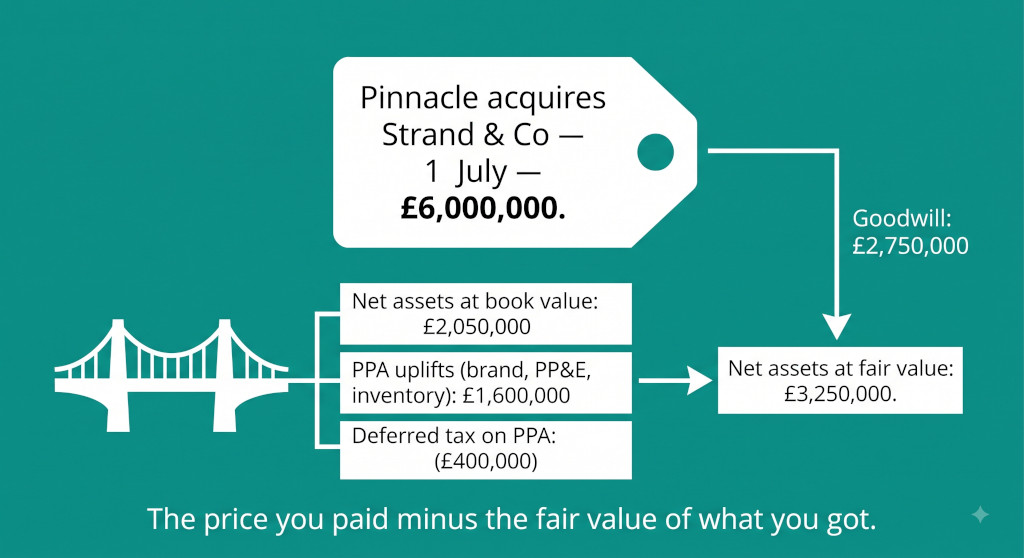
When Pinnacle Retail Group completed its acquisition of Strand & Co, a twelve-store women’s fashion chain, the deal team handed the finance function a spreadsheet showing projected post-acquisition EBITDA contributions and a deal model built from Strand & Co’s own historical management accounts. The first consolidated P&L after completion showed a contribution roughly £220,000 lower than the model.
Nobody had done anything wrong. The shortfall was an accounting consequence of the acquisition itself — the inventory fair value uplift, the brand amortisation, and the PP&E depreciation step-up that arise from purchase price allocation under IFRS 3 and that are invisible in the target company’s own accounts before it joins the group. These charges are real. They are not one-off errors. And in a mid-year acquisition they hit the first consolidated period in concentrated form.
This post works through the Pinnacle acquisition step by step — the PPA, the goodwill calculation, the acquisition journal, and the post-acquisition P&L contribution — and explains each element that creates the margin compression the board will see in the first year of ownership.
Stop building consolidations in spreadsheets.
BrizoConsol automates multi-entity consolidation — setup in minutes, reports the same day.
The Transaction
Pinnacle Retail Group Ltd acquires 100% of the share capital of Strand & Co Ltd on 1 July, six months into Pinnacle’s December financial year end. The acquisition price is £6,000,000 — paid in cash from Pinnacle’s existing facilities. The acquisition gives Pinnacle twelve fashion stores, a recognised brand with an active customer loyalty database, and a lease portfolio of twelve IFRS 16 leases on high-street and shopping centre locations.
Because the acquisition completes on 1 July, only the six months from 1 July to 31 December will appear in Pinnacle’s current year consolidated income statement. Strand & Co’s January to June trading — before Pinnacle owned it — is not included anywhere in the consolidated P&L. What Pinnacle paid for that pre-acquisition period is embedded in the acquisition price; the pre-acquisition earnings belong to the previous owners.
Strand & Co’s Net Assets at Book Value on 1 July
The starting point for purchase price allocation is the acquired entity’s balance sheet at the acquisition date, stated at the carrying values from Strand & Co’s own accounts:
| Asset / liability | Book value at 1 July (£) |
|---|---|
| Property, plant and equipment (store fixtures and fittings) | 800,000 |
| Right-of-use assets (IFRS 16 — twelve store leases) | 3,200,000 |
| Inventory | 1,800,000 |
| Trade receivables | 90,000 |
| Cash and cash equivalents | 160,000 |
| Lease liabilities (IFRS 16) | (3,400,000) |
| Trade payables | (480,000) |
| Accruals and other liabilities | (120,000) |
| Net assets at book value | 2,050,000 |
At book value, Pinnacle appears to have paid £3,950,000 (£6,000,000 − £2,050,000) above net assets. But book value is not the right comparison — IFRS 3 requires that every identifiable asset and liability be measured at fair value at the acquisition date, and several of Strand & Co’s assets are carried significantly below their fair value in the entity’s own accounts.
Purchase Price Allocation: Identifying and Valuing the Retail Assets
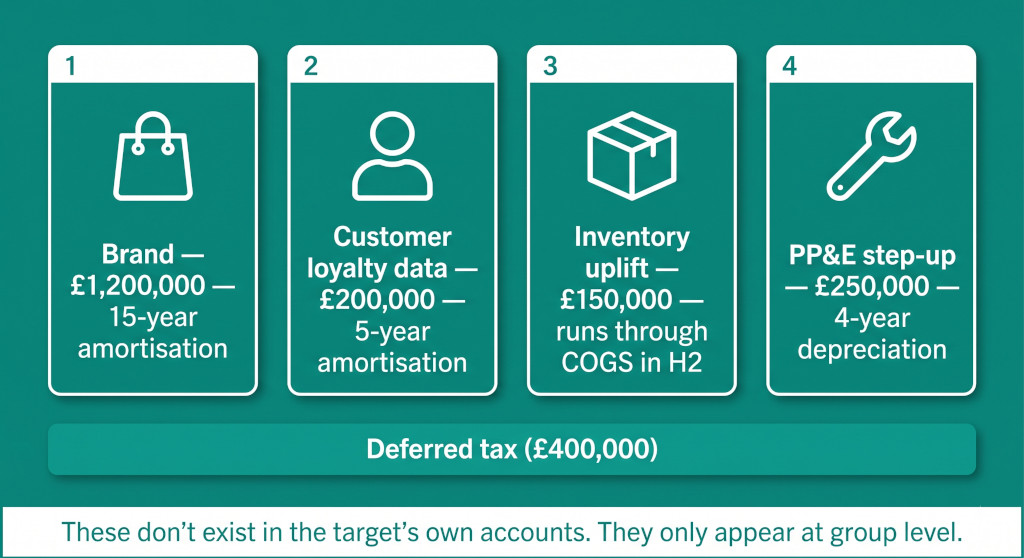
IFRS 3 requires the acquirer to recognise not just the assets and liabilities already on the target’s balance sheet, but also identifiable intangible assets that have never been capitalised in the target’s own accounts — because the target created them internally and IFRS does not permit internally generated intangibles to be recognised. In a retail brand acquisition, these internally generated intangibles are often the most valuable assets in the deal.
1. Brand / Trademark — £1,200,000
The Strand & Co brand has never appeared on Strand & Co’s own balance sheet — it was built organically and the accounting standards prohibit recognition of internally generated brand value. But IFRS 3 requires Pinnacle to identify and separately recognise the brand as an acquired intangible asset because it is separable (it could be licensed or sold independently), it is identifiable, and it arose from contractual rights (registered trademarks).
The brand is valued using a relief-from-royalty approach: the royalty that Strand & Co would need to pay if it licensed the brand from a third party, discounted over the brand’s expected useful economic life. The fair value is £1,200,000. Pinnacle assigns the brand a 15-year useful life and will amortise it on a straight-line basis — £80,000 per year, or £40,000 for the six-month post-acquisition period in the current year.
2. Customer Loyalty Database — £200,000
Strand & Co’s loyalty programme holds data on 180,000 registered customers with purchase histories. The database is separable (it could be sold or licensed) and has economic value — customers acquired through the loyalty channel have significantly higher average order values and retention rates than walk-in customers. It is recognised as a separate intangible at £200,000, amortised over five years (£40,000 per year, £20,000 for H2 of the current year).
3. Inventory Fair Value Uplift — £150,000
Under IFRS 3, inventory is measured at fair value at the acquisition date. For a fashion retailer, the fair value of inventory is its net realisable value — the expected selling price — less the costs required to complete the sale (selling costs, distribution, store overhead) and less a margin that reflects the selling effort still to be applied. This is not the same as the carrying value in Strand & Co’s own accounts, which is the lower of cost and NRV from the entity’s perspective.
For Strand & Co’s mid-season inventory, the uplift from book value to acquisition-date fair value is £150,000. This uplift will run through Pinnacle’s consolidated cost of goods sold in the second half of the year as the acquired stock sells through to customers — depressing post-acquisition gross margins in H2 by the full £150,000.
4. PP&E Fair Value Step-Up — £250,000
Strand & Co’s store fixtures and fittings are carried at £800,000 net book value in the entity accounts. An independent valuation at the acquisition date indicates a fair value of £1,050,000 — the market value of equivalent fittings in their current physical condition, reflecting the investment made in Strand & Co’s stores over their fit-out cycle. The step-up of £250,000 is recognised in the consolidated accounts. The remaining useful life of the fixtures is assessed at four years, adding £62,500 per year (£31,250 for H2) of additional depreciation above what Strand & Co’s own accounts would show.
Deferred Tax on PPA Adjustments — (£400,000)
The fair value uplifts create temporary differences between the consolidated carrying values and the tax bases of the acquired assets — which remain at historical cost for tax purposes. A deferred tax liability of £400,000 arises at the 25% corporation tax rate on the total PPA uplift of £1,600,000 (£1,200,000 brand + £200,000 customer data + £150,000 inventory + £250,000 PP&E). This DTL reduces the fair value of identifiable net assets and therefore increases goodwill.
The PPA Summary and Goodwill Calculation
| Net assets at book value | £2,050,000 |
| Fair value adjustments: | |
| Brand / trademark | £1,200,000 |
| Customer loyalty database | £200,000 |
| Inventory fair value uplift | £150,000 |
| PP&E fair value step-up | £250,000 |
| Deferred tax on PPA adjustments (25%) | (£400,000) |
| Net PPA uplift | £1,400,000 |
| Net assets at fair value (identifiable) | £3,450,000 |
| Acquisition price paid | £6,000,000 |
| Goodwill on acquisition | £2,550,000 |
The £2,550,000 of goodwill represents the premium Pinnacle paid for attributes of Strand & Co that cannot be separately identified and measured — the assembled workforce, the customer relationships embedded in the buying patterns that the loyalty data does not fully capture, the operational know-how of the management team, and Pinnacle’s expectation of synergies from integrating the two businesses. Goodwill is not amortised under IFRS; it is tested for impairment annually.
The Acquisition Journal
At the acquisition date, Pinnacle eliminates its investment in Strand & Co and recognises the fair value of all identified assets and liabilities:
| Account | Dr | Cr |
|---|---|---|
| PP&E (store fixtures — fair value £1,050,000) | £1,050,000 | |
| Right-of-use assets (IFRS 16 leases — book value maintained) | £3,200,000 | |
| Brand intangible asset | £1,200,000 | |
| Customer loyalty database intangible | £200,000 | |
| Inventory (fair value £1,950,000) | £1,950,000 | |
| Trade receivables | £90,000 | |
| Cash | £160,000 | |
| Goodwill | £2,550,000 | |
| Lease liabilities (IFRS 16) | £3,400,000 | |
| Trade payables | £480,000 | |
| Accruals and other liabilities | £120,000 | |
| Deferred tax liability (on PPA) | £400,000 | |
| Cash paid — acquisition consideration | £6,000,000 | |
| Investment in subsidiary (eliminated) | £800,000 |
The £800,000 credit to “Investment in subsidiary” represents the cost of the investment as it would appear in Pinnacle’s parent entity accounts — the intercompany investment balance that is eliminated when the subsidiary is consolidated. The £6,000,000 cash payment is the external consideration; the net effect on Pinnacle’s consolidated cash position is a £5,840,000 outflow (£6,000,000 paid less £160,000 cash acquired in Strand & Co).
What Appears in the Consolidated P&L — And What Does Not
Because the acquisition completed on 1 July, Strand & Co’s January to June trading is excluded from Pinnacle’s consolidated income statement entirely. This is a common source of confusion when boards compare the consolidated results to the deal model: if the deal model was built on a full-year annualised revenue run-rate, the actual consolidated contribution will be half that (plus any seasonal skew in the fashion trading calendar).
The rule under IFRS 3 is straightforward: include the subsidiary’s results from the acquisition date only. Pre-acquisition profits belong to the previous shareholders and are reflected in the acquisition price paid, not in the consolidated P&L.
Why the First Six Months of Ownership Look Less Profitable Than Expected
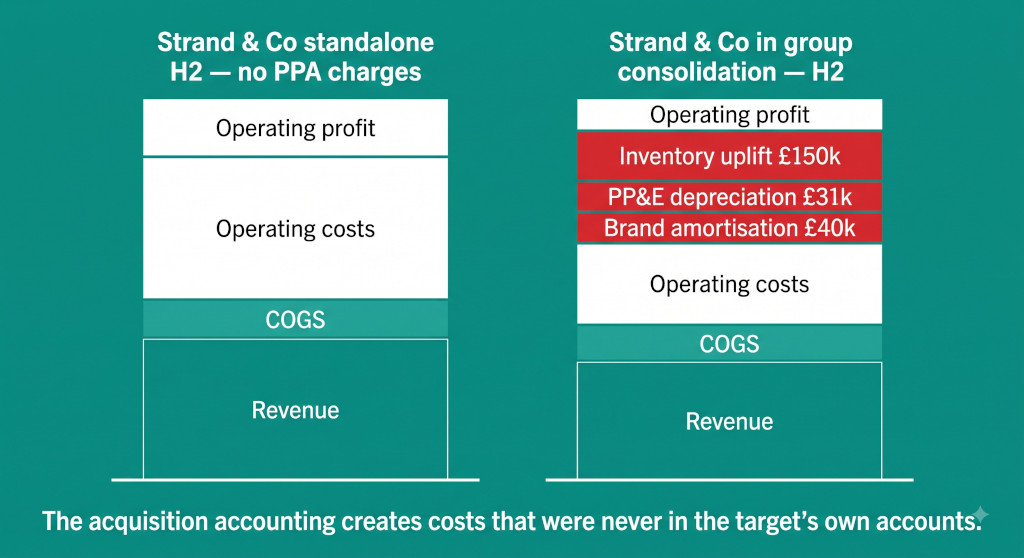
Strand & Co’s own H2 management accounts showed a trading performance broadly consistent with the deal model. But the contribution to Pinnacle’s consolidated accounts is lower — for three distinct, predictable reasons.
Reason 1: The Inventory Fair Value Uplift (£150,000)
The inventory Pinnacle acquired at acquisition was stepped up by £150,000 to fair value. As that inventory sells to customers in H2, Pinnacle’s consolidated cost of goods sold includes the full fair value of the inventory — not its original supplier cost to Strand & Co. The £150,000 uplift effectively runs through consolidated COGS in the post-acquisition period as the acquired stock clears. In a fashion business with relatively fast stock turns, the bulk of this uplift runs through in the first two to three months of ownership.
This charge does not appear in Strand & Co’s own management accounts — Strand & Co never recorded inventory at fair value, because IFRS 3 only applies at the point of acquisition. It is a pure consolidation accounting effect.
Reason 2: Brand Amortisation (£40,000)
The brand intangible of £1,200,000 is amortised over 15 years — £80,000 per year. For the H2 post-acquisition period, Pinnacle’s consolidated accounts carry £40,000 of brand amortisation that does not appear in Strand & Co’s entity accounts and was not in the pre-acquisition deal model. Brand amortisation will continue at £80,000 per year for the full 15-year life of the asset.
Reason 3: Additional PP&E Depreciation on the Step-Up (£31,000)
The £250,000 PP&E step-up is depreciated over the four-year remaining life of the store fixtures — £62,500 per year, or £31,250 for six months. Again, this charge is invisible in Strand & Co’s own accounts, which carry the fixtures at their historical depreciated cost. The additional depreciation will continue for four years until the PPA step-up is fully written off.
The Combined Effect
| H2 P&L line | Strand & Co own accounts H2 (£) | PPA adjustments (£) | Consolidated contribution H2 (£) |
|---|---|---|---|
| Revenue | 7,200,000 | — | 7,200,000 |
| Cost of goods sold | (3,900,000) | (150,000) | (4,050,000) |
| Gross profit | 3,300,000 | (150,000) | 3,150,000 |
| Gross margin | 45.8% | 43.8% | |
| Operating costs | (1,960,000) | — | (1,960,000) |
| Depreciation — PP&E (Strand & Co own) | (100,000) | — | (100,000) |
| Additional depreciation — PP&E PPA step-up | — | (31,000) | (31,000) |
| Brand amortisation (PPA) | — | (40,000) | (40,000) |
| Customer data amortisation (PPA) | — | (20,000) | (20,000) |
| Operating profit | 1,240,000 | (241,000) | 999,000 |
The £241,000 gap between Strand & Co’s own H2 accounts and the consolidated contribution explains the shortfall the deal team observed. Most of this gap — the £150,000 inventory uplift — is a one-time charge that will not recur once the acquired stock has cleared. The amortisation charges of £91,000 per half-year (£182,000 annualised) are permanent recurring charges that will persist throughout the ownership period.
When presenting post-acquisition results to the board, clearly separate PPA charges from trading performance. PPA charges are non-cash accounting consequences of the acquisition methodology — they do not reflect trading deterioration. A bridge from Strand & Co’s standalone H2 management accounts to the consolidated contribution, with each PPA line itemised, prevents the board from drawing incorrect conclusions about store-level performance from the first consolidated results.
Goodwill Impairment Testing
Unlike the PPA intangibles (brand, customer data, PP&E step-up), goodwill is not amortised. Instead it is tested for impairment at least annually, and more frequently if there are indicators that its carrying value may not be recoverable. At the first year end following the acquisition — in this case, six months after completion — Pinnacle must perform at minimum an impairment indicator assessment.
For a retail chain acquisition, the impairment indicators most relevant to watch are: a material deterioration in like-for-like sales at Strand & Co stores; failure to achieve the synergies assumed in the deal case within the expected timeframe; significant market share loss to competitors; or a broader decline in the addressable market for the fashion category. None of these indicators triggers an automatic write-down — they are triggers for a formal value-in-use calculation comparing the recoverable amount of the cash-generating unit (typically the acquired business) to the carrying value of goodwill plus the other net assets attributed to it.
For the first year-end impairment test, the group should use the same cash flow projections that underpinned the acquisition valuation, updated for any material changes since completion. If the business is trading in line with the deal case and no indicators of impairment exist, a formal value-in-use calculation may not be required — a documented indicator review is sufficient. If trading has materially diverged from the deal case, a full calculation is necessary.
Watch point: the PPA charges (brand amortisation, PP&E depreciation, inventory uplift) reduce the acquired business’s reported profits in the consolidation but do not reduce its cash generation or its recoverable amount. Do not use the PPA-adjusted operating profit as the basis for goodwill impairment testing — the impairment test compares the recoverable amount (based on value-in-use or fair value less costs of disposal) to the carrying value of the net assets including goodwill, not to the reported P&L. Using the PPA-depressed P&L as a proxy for recoverable amount will generate false impairment signals.
A Practical Checklist for Retail Chain Acquisitions
- Commission the PPA work promptly. IFRS 3 allows a twelve-month measurement period to finalise PPA, but the acquisition-date fair values must be at least provisionally estimated for the first post-acquisition reporting period. Engage a valuation specialist early — brand valuation using the relief-from-royalty method and customer relationship valuation using multi-period excess earnings require inputs (royalty rate benchmarks, customer attrition data, projected revenues) that take time to assemble.
- Identify all separable intangibles at the acquisition date. The IFRS 3 criteria for separate recognition are: separable (capable of being separated and sold, licensed, or rented) or arising from contractual or legal rights. For a retail brand acquisition, candidates typically include: brand and trademarks, customer lists and loyalty programme data, favourable lease rights (where below-market leases exist in the portfolio), proprietary technology (e-commerce platform, inventory management system), and franchise agreements if applicable.
- Assess and document the inventory fair value uplift by product line. The uplift should reflect the NRV at the acquisition date less costs to complete and sell less a margin representing the selling effort still required. For a mid-season fashion inventory, the uplift will vary significantly by product line — current-season core styles will have a small uplift; end-of-season or carry-over styles may have no uplift or even a write-down. Document the methodology and the line-level inputs.
- Assign useful economic lives to each PPA intangible and step-up. Brand lives in retail acquisitions typically range from 10 to 25 years depending on the brand’s history, competitive position, and the acquirer’s plans. Customer data lives are typically shorter (3 to 7 years) reflecting customer attrition. PP&E step-up lives match the remaining useful life of the underlying assets. These judgements are audited and should be documented.
- Prepare a reconciliation from standalone management accounts to consolidated contribution. For every post-acquisition reporting period, present the board with a bridge showing: standalone trading performance (as the target’s own management accounts would show), then the inventory uplift (one-time), then the PPA amortisation and depreciation charges (recurring), arriving at the consolidated contribution. This prevents misinterpretation of first-period results as trading underperformance.
- Confirm the acquisition date and the pro-ration basis. Revenue, costs, and amortisation should all be included from the acquisition date only — not rounded to the nearest month-end unless the transaction closed on a month boundary. For mid-month acquisitions, pro-rate by actual days.
- Establish the cash-generating unit (CGU) for goodwill impairment testing. Define the CGU at the level at which goodwill is monitored for internal management purposes — typically the acquired brand or chain as a whole. Set up the impairment testing model at this level, using the deal-case cash flows as the starting point and updating for trading actuals at each annual test.
- Review the deferred tax liability on PPA annually. As PPA intangibles amortise and step-up assets depreciate, the temporary differences unwind and the DTL reduces. Ensure the DTL movement is correctly reflected in the consolidated tax charge each period — the unwind reduces the effective tax rate in the years following the acquisition.
Consolidating a newly acquired retail brand for the first time?
BrizoConsol handles the PPA layer, the amortisation schedules, and the post-acquisition pro-ration automatically — so your first consolidated result is clean from day one.See It In Action