How to Consolidate a New Subsidiary Acquired During the Year
The deal closed on 1 May. The group paid £2.4 million for a 75% stake in a profitable manufacturing business, and the integration planning is already underway. But for Diane, the group financial controller, the most immediate problem is the upcoming June year-end. She has never included a brand-new acquisition in the consolidation before. The subsidiary has been operating since January and has a fully populated set of accounts for the year to date. What goes into the group and what doesn’t? How does goodwill get calculated and where does it sit? Can she just add the subsidiary’s January-to-June figures to the group’s? And what happens to the 25% she didn’t buy?
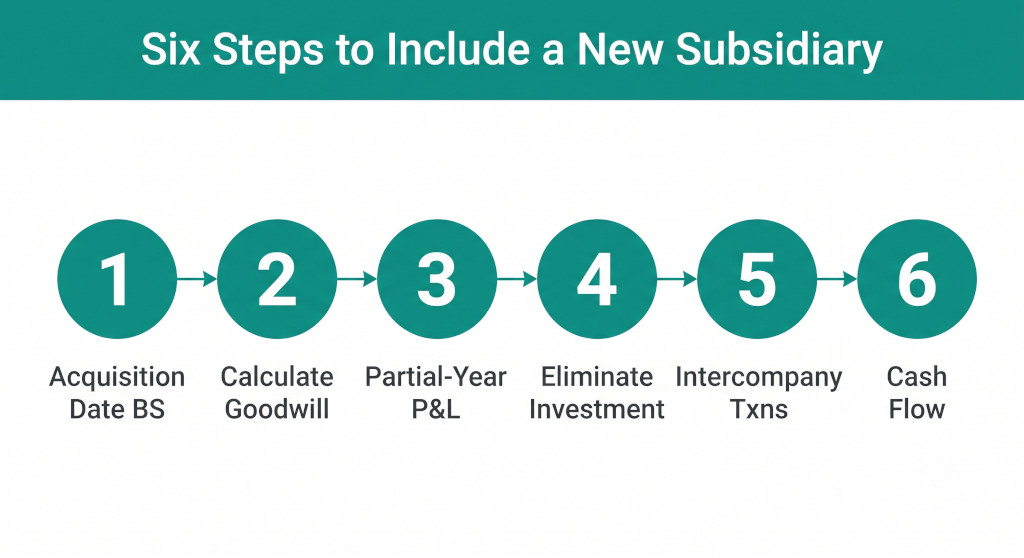
Acquiring a subsidiary mid-year is one of the most common situations that trips up experienced finance teams in consolidation — not because the accounting is fundamentally difficult, but because the rules are specific and unforgiving. Include the wrong period of the subsidiary’s P&L, misstate the goodwill, or miss the NCI opening balance, and the consolidated accounts are wrong in ways that are hard to find and harder to explain to an auditor. This post works through the correct procedure in six steps, with the full journal entries and a worked numerical example throughout.
The Fundamental Rule: Consolidation Starts at Acquisition Date
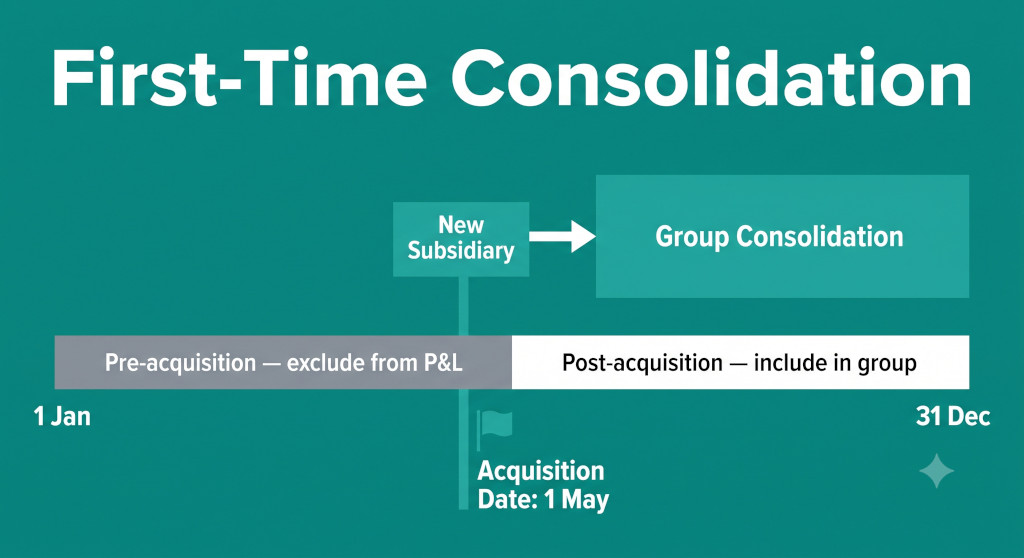
Before anything else, the governing rule needs to be clearly understood: a subsidiary is consolidated from its acquisition date — the date on which the group obtained control — and not before. This applies to every element of the consolidation: the balance sheet, the P&L, the statement of changes in equity, and the cash flow statement.
Stop building consolidations in spreadsheets.
BrizoConsol automates multi-entity consolidation — setup in minutes, reports the same day.
In practice this means three things. First, the subsidiary’s assets and liabilities are brought into the consolidated balance sheet at their fair values as at the acquisition date — not their book values, not their values at year-end, but specifically the values on the date control was obtained. Second, the subsidiary’s revenue, costs, and profit are included in the consolidated P&L only for the period from acquisition date to year-end. Any profit the subsidiary earned before the group bought it belongs to the previous owners, not to the group. Third, goodwill is calculated once, at acquisition date, and is then tested for impairment at each subsequent reporting date but not recalculated.
The acquisition date is not necessarily the date the purchase agreement was signed, the date the funds transferred, or the date the regulatory approval was granted. It is the date on which the acquirer obtained control — typically the date all material conditions were satisfied and the acquirer could direct the subsidiary’s relevant activities. In most transactions these dates coincide, but where they don’t, the accounting date is determinative.
Step 1: Establish the Acquisition Date Balance Sheet at Fair Value
The first task is to prepare — or obtain — a balance sheet for the new subsidiary as at the acquisition date, with each asset and liability measured at its fair value. This is the purchase price allocation (PPA), and it is a requirement under IFRS 3 (and its equivalents under other standards). Book values are used as the starting point but are adjusted for any difference between book value and fair value.
The most common fair value adjustments in a typical acquisition are: property or equipment carried below market value on the subsidiary’s books; intangible assets that the subsidiary has never recognised (customer relationships, brand names, favourable contracts) because they were internally generated; and deferred tax adjustments arising from the fair value uplifts on the tangible and intangible assets.
For Diane’s acquisition, the subsidiary’s balance sheet on 1 May — after fair value adjustments — looks like this:
| Asset / Liability | Book Value £’000 | Fair Value Adj £’000 | Fair Value £’000 |
|---|---|---|---|
| Property, plant and equipment | 820 | 180 | 1,000 |
| Customer relationships (intangible) | — | 350 | 350 |
| Inventories | 290 | 40 | 330 |
| Trade receivables | 410 | — | 410 |
| Cash and cash equivalents | 140 | — | 140 |
| Trade payables | (260) | — | (260) |
| Bank borrowings | (300) | — | (300) |
| Deferred tax liability (on fair value uplifts) | — | (170) | (170) |
| Net identifiable assets | 1,100 | 400 | 1,600 |
The fair value of net identifiable assets is £1,600,000. This is the number that anchors the rest of the acquisition accounting.
Common mistake: Using the subsidiary’s book value of net assets (£1,100,000) instead of the fair value (£1,600,000) to calculate goodwill. This overstates goodwill by £400,000 and understates the recognised identifiable assets — specifically, the intangible and the PP&E uplift never get onto the group balance sheet. Auditors will always check this, and the error is not self-correcting over time.
Step 2: Calculate Goodwill and the NCI at Acquisition
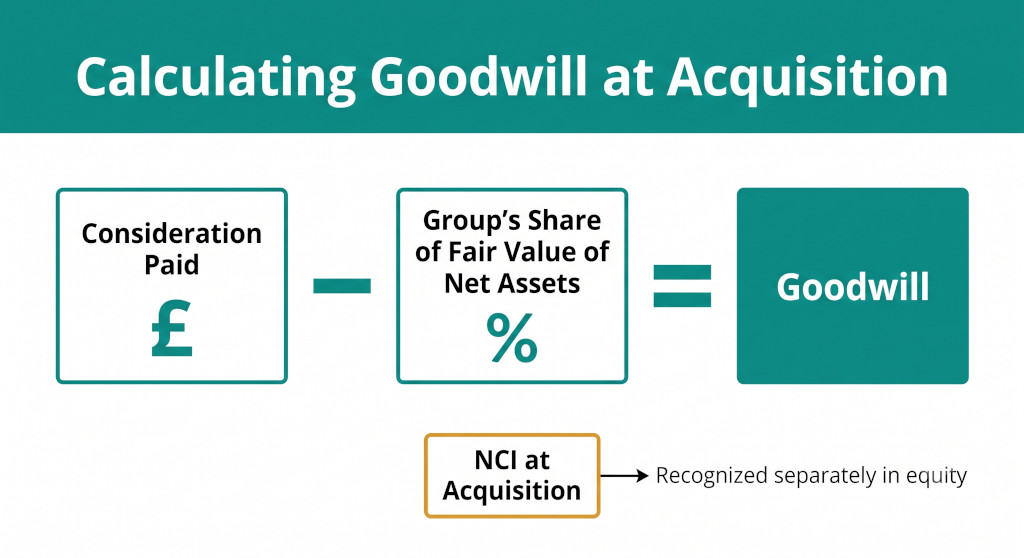
With the fair value of net identifiable assets established, goodwill is calculated as the difference between the consideration paid by the group and the group’s share of those net assets. Under the proportionate share (partial goodwill) method — the simpler of the two methods permitted under IFRS 3 — goodwill represents only the excess attributable to the parent’s ownership percentage.
Goodwill calculation — proportionate share method: Consideration paid £2,400,000 Less: Group’s share of fair value of net assets 75% × £1,600,000 (£1,200,000) ────────────────────────────────────────────────── Goodwill recognised £1,200,000
The NCI at acquisition is measured as the NCI’s share of the fair value of net identifiable assets:
NCI at acquisition date: 25% × £1,600,000 £400,000
Both goodwill (£1,200,000) and the NCI opening balance (£400,000) are recognised in the consolidated balance sheet at acquisition date and carried forward from that point. Goodwill sits as a non-current intangible asset. The NCI sits within equity, below retained earnings but separately from the equity attributable to the parent’s shareholders. For a detailed technical explanation of the goodwill calculation under both the partial and full goodwill methods, see Goodwill in Group Consolidation: How to Calculate and Account for It.
Step 3: Include the Subsidiary’s P&L Only From Acquisition Date
This is the step that most commonly causes errors in the first consolidation of a mid-year acquisition. The subsidiary has been operating since January. Its management accounts show eight months of revenue and costs. Only five of those months — May through December in Diane’s case — belong in the consolidated P&L. The January-to-April figures are pre-acquisition and are the economic history of the previous owners, not of the group.
In practice, this means the subsidiary needs to produce a trial balance as at 30 April (the day before acquisition) and a second trial balance as at 31 December (year-end). The P&L lines included in the consolidation are the movements between those two dates — the subsidiary’s revenue, cost, and profit from 1 May onwards only.
If the subsidiary cannot easily produce a mid-year trial balance — for example, if its accounting software doesn’t support arbitrary period cuts — it may be necessary to estimate the pre-acquisition P&L on a time-proportionate or activity basis and deduct it from the full-year figures. This is permitted under IFRS 3 as a practical expedient but must be disclosed, and the basis of estimation must be reasonable and supportable.
The balance sheet position is different from the P&L. All of the subsidiary’s assets and liabilities are included in the consolidated balance sheet from acquisition date at their acquisition date fair values. There is no partial-year balance sheet — the subsidiary is either in or out. Only the P&L requires the period-from-acquisition restriction.
For the year ending 31 December, Diane’s consolidation will include the following from the new subsidiary:
| Period | Included in consolidated P&L? | Included in consolidated balance sheet? |
|---|---|---|
| 1 January – 30 April (pre-acquisition) | No — belongs to previous owners | No — subsidiary not yet controlled |
| 1 May (acquisition date) | From this date forward | Yes — fair value balance sheet recognised at this date |
| 1 May – 31 December (post-acquisition) | Yes — 8 months included | Yes — year-end balance sheet consolidated in full |
Step 4: Post the Investment Elimination Journal
The investment elimination journal is the central consolidation entry for any acquisition. It removes the parent’s investment in the subsidiary (which appears on the parent’s balance sheet as a cost-of-investment asset) and replaces it with the underlying assets, liabilities, goodwill, and NCI that the investment represents. Without this journal, the group balance sheet would double-count: the parent’s investment and the subsidiary’s net assets would both appear simultaneously.
The journal is posted at acquisition date fair values:
Dr Property, plant and equipment £1,000,000
Dr Customer relationships (intangible) £ 350,000
Dr Inventories £ 330,000
Dr Trade receivables £ 410,000
Dr Cash and cash equivalents £ 140,000
Dr Goodwill £1,200,000
Cr Trade payables £ 260,000
Cr Bank borrowings £ 300,000
Cr Deferred tax liability £ 170,000
Cr Investment in subsidiary (parent) £2,400,000
Cr Non-controlling interest (equity) £ 400,000
Investment elimination at 1 May acquisition date. Assets and liabilities recognised at acquisition date fair values per purchase price allocation. Goodwill £1,200,000 = consideration £2,400,000 less group’s 75% share of net assets £1,600,000. NCI £400,000 = 25% × £1,600,000 (proportionate share method).
This journal is a permanent consolidation adjustment — it is re-posted in every subsequent consolidation because the parent’s balance sheet continues to show the investment at cost, and the group balance sheet must continue to show the underlying assets instead. The goodwill balance and the NCI balance are then updated each period for subsequent movements: goodwill for any impairment, NCI for its share of post-acquisition profits and dividends. For a detailed walkthrough of the IFRS 3 framework that governs this entry, see Acquisition Accounting in Group Consolidation: A Step-by-Step Guide to IFRS 3.
Step 5: Handle Intercompany Transactions From Acquisition Date Onwards
Once the subsidiary is consolidated, any transactions between it and other group entities from the acquisition date onwards are intercompany transactions and must be eliminated. Pre-acquisition transactions — trading between the subsidiary and other group entities before 1 May — are not intercompany transactions from the group’s perspective, because the subsidiary was not yet part of the group when they occurred. They are eliminated from the acquisition date forward only.
The intercompany eliminations in the first post-acquisition period follow the same rules as for any established group entity: intercompany revenue and cost of sales for goods or services sold between entities, intercompany loan balances and associated interest, and unrealised profit in inventory where intercompany goods remain unsold at period end.
Common mistake: Eliminating intercompany sales for the full year rather than from acquisition date. If the parent sold £120,000 of goods to the subsidiary between January and April (before the acquisition), those sales were arm’s length transactions with an external party at the time. They should not be eliminated from the consolidated P&L. Only the post-1 May intercompany trading is eliminated. Eliminating the full year inflates the group’s operating profit reduction and understates revenue.
A related complication arises with inventory. If the parent sold goods to the subsidiary before the acquisition, and some of those goods remain in the subsidiary’s closing inventory, the profit the parent recognised on that pre-acquisition sale is still sitting in the subsidiary’s inventory balance. Under IFRS 3, that pre-acquisition inventory balance is measured at fair value as at the acquisition date — so the parent’s margin is already implicitly included in the fair value uplift applied to inventories in Step 1. No separate unrealised profit elimination is required for pre-acquisition intercompany stock. Only inventory purchased post-acquisition from other group entities requires the standard unrealised profit elimination.
For a full treatment of how intercompany eliminations work across different transaction types, see Intercompany Eliminations: A Practical Guide for Multi-Entity Groups.
Handling your first mid-year acquisition in the consolidation?
BrizoConsol manages acquisition date balance sheets, partial-year P&L inclusion, and intercompany eliminations automatically — so you can focus on the numbers, not the mechanics.See It In Action
Step 6: The Cash Flow Statement in the Year of Acquisition
The year of acquisition creates two specific requirements for the consolidated cash flow statement. First, the cash consideration paid to acquire the subsidiary is shown in investing activities as “Acquisition of subsidiary, net of cash acquired.” Second, the subsidiary’s cash flows are included from acquisition date only — consistent with the P&L treatment.
The net cash paid for the acquisition is calculated as:
Cash flow — acquisition of subsidiary: Cash consideration paid (£2,400,000) Cash and cash equivalents acquired £ 140,000 ────────────────────────────────────────── Net cash outflow on acquisition (£2,260,000)
The £140,000 cash balance in the subsidiary’s acquisition date balance sheet reduces the net investing outflow — the group paid £2.4 million but immediately had access to £140,000 of the subsidiary’s own cash, so the net cost to the group was £2.26 million. This netting is required under IAS 7 and must be shown on the face of the cash flow statement, not in the notes.
From 1 May onwards, the subsidiary’s operating, investing, and financing cash flows are included in the consolidated statement on the same basis as any other group entity. The subsidiary’s January-to-April cash flows are excluded — the group had no claim over those cash movements, and including them would misrepresent the group’s actual cash generation during the period.
How the NCI Moves After the First Close
Once the acquisition date NCI balance (£400,000) is established, it moves each period in three ways: it increases by the NCI’s share of the subsidiary’s post-acquisition profit, it decreases by the NCI’s share of any dividends declared by the subsidiary, and it is adjusted for the NCI’s share of any other comprehensive income (such as a currency translation adjustment if the subsidiary is a foreign entity).
By year-end, if the subsidiary earned £280,000 profit after tax in the eight months from 1 May to 31 December and paid no dividend, the NCI balance in the year-end consolidated balance sheet is:
NCI at acquisition date £400,000 + NCI share of post-acquisition profit 25% × £280,000 £ 70,000 ────────────────────────────────────────── NCI at 31 December £470,000
This £470,000 sits within consolidated equity and represents the minority shareholders’ economic interest in the subsidiary. It is not a liability — the NCI has no right to demand repayment — but it is separately disclosed from the equity attributable to the parent’s shareholders. For the mechanics of how the NCI column flows through the full consolidated statement of changes in equity, including OCI allocations and dividend effects, see NCI in the Consolidated Statement of Changes in Equity.
Common Errors in the First Consolidation of an Acquired Subsidiary
Beyond the specific errors already flagged in each step, there are three systemic mistakes that appear repeatedly in the first consolidation of a mid-year acquisition.
The first is treating the acquisition date balance sheet as provisional for too long. IFRS 3 allows a measurement period of up to twelve months during which the acquisition date fair values can be refined as more information comes to light. During this period the group should be actively finalising the PPA — getting formal valuations of the intangibles, completing the deferred tax calculation, and confirming any contingent liability positions. Groups that allow the measurement period to run to the full twelve months without actively progressing it tend to find the year-two consolidation more complicated, because retrospective adjustments to prior year figures are required when the PPA is finalised.
The second error is failing to unwind the fair value uplift on inventory through cost of sales as the acquired inventory is sold. The inventory fair value uplift (£40,000 in Diane’s case) is essentially a pre-recognising of the margin that was already embedded in the subsidiary’s stock at acquisition date. Once that inventory is sold to external customers, the uplift flows through the consolidated cost of sales — it reduces gross margin in the period the inventory is sold. If this is not recognised, the consolidated gross margin is overstated in the post-acquisition periods by exactly the amount of the inventory uplift.
The third error is using the wrong share of pre-acquisition retained earnings when setting up the subsidiary’s equity elimination. The investment elimination journal (Step 4) eliminates the investment against the subsidiary’s net assets at acquisition date — which includes the subsidiary’s retained earnings as at 1 May. Anything the subsidiary earned between 1 January and 30 April belongs to the pre-acquisition equity pool and is therefore eliminated as part of the acquisition entry. Only post-acquisition earnings flow through the consolidated P&L and into the group’s consolidated retained earnings. Confusing pre- and post-acquisition retained earnings is one of the most common causes of a consolidated equity reconciliation that refuses to balance in the year of acquisition.
Practical Checklist: First Consolidation of a Mid-Year Acquisition
- Confirm the acquisition date. The date on which control was obtained — not the signing date, not the payment date. Document the basis for this conclusion in case it is queried by auditors.
- Obtain the acquisition date balance sheet at fair value. Complete or commission the purchase price allocation. Every material asset class should have a defensible fair value basis, and the deferred tax impact of fair value uplifts must be recognised.
- Calculate goodwill and the opening NCI balance. Goodwill = consideration paid less the group’s percentage share of fair value of net identifiable assets. NCI = the minority’s percentage share of the same net assets (under the proportionate share method).
- Identify the pre-acquisition and post-acquisition P&L split. Obtain or estimate a trial balance as at the day before acquisition. Only post-acquisition P&L is included in the consolidated income statement.
- Post the investment elimination journal. Debit the subsidiary’s individual assets and liabilities at fair value, debit goodwill, credit the parent’s investment at cost, credit the NCI opening balance. Retain this journal as a permanent consolidation entry.
- Identify intercompany transactions from acquisition date only. Pre-acquisition transactions with the subsidiary were arm’s length external dealings — do not eliminate them.
- Check for unrealised intercompany profit in post-acquisition inventory. Any goods transferred between the subsidiary and other group entities after acquisition date that remain unsold at year-end require the standard unrealised profit elimination.
- Show the acquisition net of cash acquired on the cash flow statement. Cash consideration paid less cash held by the subsidiary at acquisition date equals the net investing outflow.
- Set up the NCI roll-forward. The NCI balance must move each period for the minority’s share of profit, dividends, and OCI. Build this roll-forward into the consolidation workbook at the same time as the first acquisition entry, not at the next close.
- Progress the PPA during the measurement period. Finalise all fair value assessments well before the twelve-month measurement period expires. Retrospective PPA adjustments after the first year-end close are disproportionately disruptive.
The first consolidation of a mid-year acquisition is invariably the most complex — there is more to set up than in any subsequent period, and many of the decisions made now (the acquisition date, the fair values, the goodwill figure) are permanent and will be re-examined by auditors for years. Getting the foundation right matters disproportionately. For the full standard-by-standard technical treatment of what IFRS 3, ASC 805, and FRS 102 each require at acquisition, see Acquisition Accounting in Group Consolidation: A Step-by-Step Guide to IFRS 3. For the ongoing intercompany reconciliation process that keeps the acquired subsidiary’s balances clean in subsequent periods, see Intercompany Reconciliation for Multi-Entity Groups.
Bring a new acquisition into your consolidation cleanly
BrizoConsol handles acquisition date entries, partial-year P&L, goodwill, and NCI from day one — with full drill-down so auditors can see exactly where every number came from. Start Free Trial