Brand Royalties in a Restaurant Group: What Eliminates at Consolidation, What Doesn’t, and Why It Depends on Who Owns the Restaurant
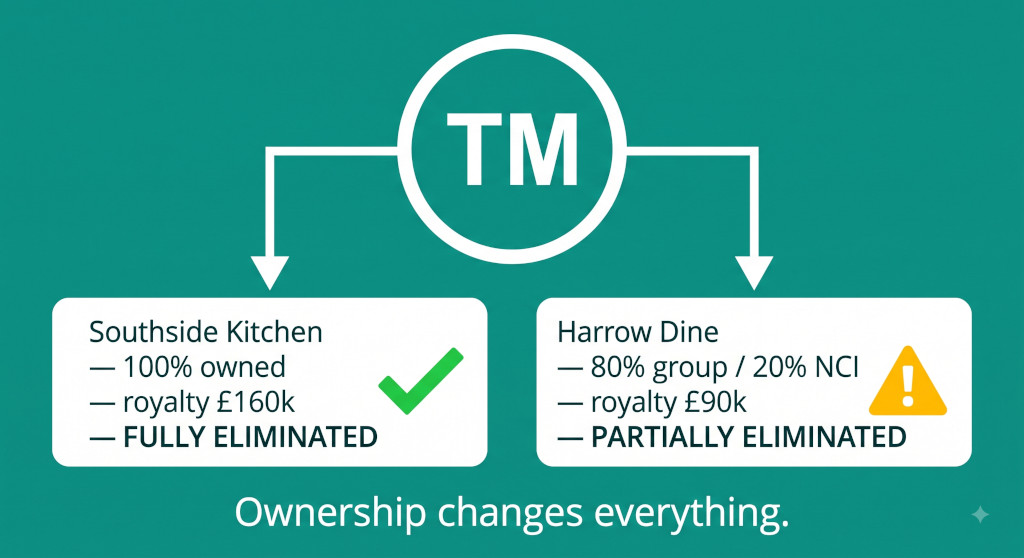
When Marcus, the group finance director of Meridian Restaurant Group, prepared the annual consolidation, the numbers in the IP entity looked extraordinary. Meridian Brand IP Ltd — the group entity that held the trademarks, recipes, and brand assets — had recorded £330,000 of royalty income during the year. Against relatively modest costs, it showed a profit margin that no operating restaurant could dream of matching.
The restaurant entities, meanwhile, showed royalty expenses that suppressed their EBITDA margins by five percentage points compared to what their operational performance would otherwise suggest. The board was using entity-level accounts to assess restaurant performance. The results looked worse than reality.
At consolidation, Marcus eliminated £232,000 of the royalty income. The remaining £98,000 stayed. And when he tried to explain to the board why some royalties disappeared and others did not, he realised that most people in the room — including the CFO — had never had to think about why ownership percentage determines what survives in consolidated accounts. This post works through exactly that question, using Meridian as the worked example.
Stop building consolidations in spreadsheets.
BrizoConsol automates multi-entity consolidation — setup in minutes, reports the same day.
Why Restaurant Groups Use an IP Holding Entity
Separating intellectual property — the brand, trademarks, proprietary recipes, technology systems, and trade dress — from the operating restaurant entities is standard practice in established restaurant groups. The IP entity owns the brand and licences it to each operating restaurant in exchange for a royalty, typically calculated as a percentage of net restaurant revenue. This structure achieves several objectives: it ring-fences the brand from operational risk, simplifies brand acquisitions and disposals, enables brand licensing to external franchisees, and creates a clean transfer-pricing framework for multi-jurisdictional groups.
From a management accounting perspective, it also makes each restaurant directly comparable on a royalty-adjusted basis, regardless of whether it is operated by the group or by an external franchisee. The 5% royalty on revenue is the same whether the restaurant is wholly owned by the group or partly owned by a JV partner.
But from a consolidation perspective, the ownership percentage of each restaurant entity changes everything about how the royalty is treated in the group accounts.
The Three Sources of Royalty Income to Untangle
In Meridian’s case, the IP entity receives royalties from three distinct sources, each requiring different treatment at consolidation:
| Royalty source | Group ownership | Annual royalty (£) | Consolidation treatment |
|---|---|---|---|
| Southside Kitchen Ltd (restaurant chain) | 100% | 160,000 | Eliminate 100% |
| Harrow Dine Ltd (JV restaurant, 80% group / 20% NCI) | 80% | 90,000 | Eliminate 80% — keep 20% |
| External third-party licensees (franchisees outside the group) | 0% | 80,000 | Keep 100% — genuine external income |
| Total royalty income in IP entity | 330,000 |
The external licensee royalties are unambiguously real external income and require no elimination. The Southside Kitchen royalties are unambiguously internal and require full elimination. The Harrow Dine royalties sit in between — and this is where the consolidation requires careful thought.
Case 1: The 100% Owned Restaurant — Full Elimination
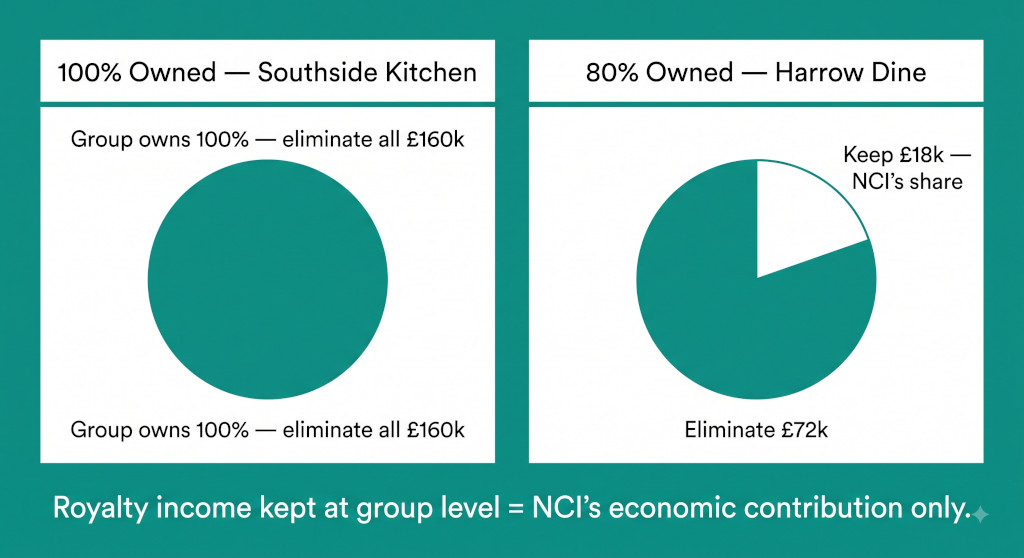
Southside Kitchen Ltd is wholly owned by the group. It pays £160,000 of royalties to Meridian Brand IP Ltd during the year. In Southside Kitchen’s accounts, this is a legitimate expense — it uses the Meridian brand and pays for that right. In the IP entity’s accounts, it is genuine income. Both entries are correct at entity level.
At consolidation, however, neither should exist. The group does not pay itself to use its own brand. If all of Meridian’s restaurants were in a single legal entity, there would be no royalty — just a brand owned and used by the same organisation. The entire £160,000 is eliminated:
| Account | Dr | Cr |
|---|---|---|
| Royalty income (Meridian Brand IP Ltd) | £160,000 | |
| Royalty expense (Southside Kitchen Ltd) | £160,000 |
Both the income and the expense disappear entirely. The consolidated P&L shows neither. The net effect on consolidated profit is zero — the elimination is symmetric. Southside Kitchen’s EBITDA in the consolidated accounts increases by £160,000 compared to its entity-level accounts, because the royalty expense is no longer deducted.
Case 2: The Partly Owned JV Restaurant — Partial Elimination
Harrow Dine Ltd is 80% owned by the group. The remaining 20% is held by an external hospitality investor — a non-controlling interest (NCI). Harrow Dine pays £90,000 of royalties to Meridian Brand IP Ltd during the year.
The critical question is: from the group’s perspective, who is actually paying the royalty?
The group owns 80% of Harrow Dine. The group’s 80% share of the £90,000 royalty expense is effectively the group paying money to itself — an internal transaction that should be eliminated. But the NCI’s 20% share of the £90,000 royalty expense is a cost borne by the external investor. That external investor’s £18,000 share of the royalty flows to Meridian Brand IP Ltd as genuine external income — as real as any royalty paid by a third-party franchisee.
The elimination is therefore partial:
| Account | Dr | Cr |
|---|---|---|
| Royalty income (Meridian Brand IP Ltd — group’s 80% share) | £72,000 | |
| Royalty expense (Harrow Dine Ltd — group’s 80% share) | £72,000 |
Only 80% of the Harrow Dine royalty is eliminated — the portion that represents the group paying itself. The remaining £18,000 (the NCI’s 20% share) stays as royalty income in the consolidated P&L. It represents genuine income earned by the group from an external economic party — the minority investor bears this cost from their own 20% stake.
The test for how much to eliminate: multiply the royalty by the group’s ownership percentage. Eliminate that amount. The remainder — the NCI’s percentage share — represents income from a party who is economically external to the group, even though they are a co-owner of the subsidiary. Never eliminate 100% of a royalty paid by a partly-owned subsidiary.
The Consolidated Royalty Position After All Eliminations
After applying both eliminations, the consolidated P&L carries the following royalty balances:
| Royalty income from external licensees (no elimination) | £80,000 |
| Royalty income from Harrow Dine — NCI’s 20% share (kept) | £18,000 |
| Royalty income from Southside Kitchen (fully eliminated) | — |
| Royalty income from Harrow Dine — group’s 80% share (eliminated) | — |
| Consolidated royalty income | £98,000 |
On the expense side, the consolidated P&L shows £90,000 of royalty expense from Harrow Dine (its full expense, since 100% of a subsidiary’s P&L is included before NCI allocation) less £72,000 eliminated. The net royalty expense from Harrow Dine in the consolidated P&L is £18,000 — and this is exactly offset by the £18,000 of royalty income kept from the NCI’s share. The net group royalty position from the Harrow Dine relationship is zero, as it should be: the 80% owned by the group cancels; the 20% owned by the NCI is a wash between income (in the IP entity) and expense (in Harrow Dine, borne by the NCI).
The only royalty income that survives in the consolidated accounts is the £80,000 from external third-party licensees — precisely the amount the group earned from parties entirely outside the group perimeter.
A common error: eliminating 100% of royalties paid by a partly-owned subsidiary. This removes real external income from the consolidated P&L — income funded by the external minority investor — and understates the group’s consolidated royalty revenue. Always identify the ownership percentage and eliminate only the group’s proportionate share.
How the NCI Calculation Is Affected
The NCI’s share of Harrow Dine’s profit is calculated after the royalty expense — Harrow Dine’s P&L already includes the full £90,000 royalty charge before NCI allocation. The NCI therefore bears 20% of that £90,000 = £18,000 as part of their share of the subsidiary’s costs.
This is exactly the amount kept as royalty income in the consolidated P&L. The group’s equity holders receive £18,000 of royalty income from the IP entity (borne by the NCI), and the NCI’s profit allocation is reduced by £18,000 (their 20% share of the royalty expense in Harrow Dine). The two offset each other in the group’s equity — the net effect on the group’s attributable profit is zero from the Harrow Dine royalty, which is correct. The IP entity earned royalty income from the NCI; the NCI’s profit share is commensurately reduced.
The Entity-Level Margin Distortion
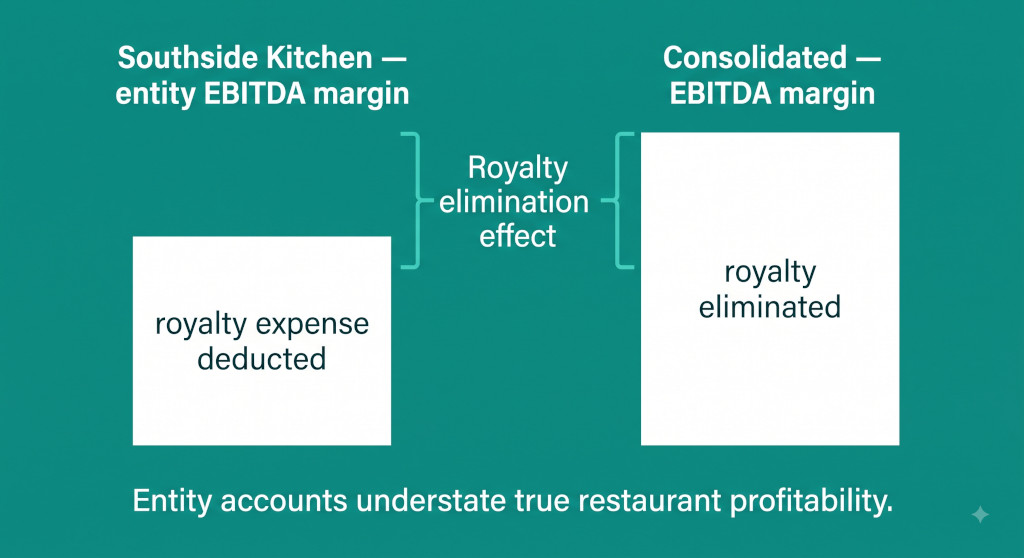
The most practically important consequence of the royalty structure — and the one most frequently misunderstood by non-accountants in restaurant groups — is the systematic distortion of entity-level profitability compared to consolidated profitability.
At entity level, each restaurant records a royalty expense that typically represents 4–6% of revenue. For a restaurant with a 15% EBITDA margin before royalties, that 5% royalty brings the entity-level margin down to 10%. The entity looks meaningfully less profitable than it actually is from the group’s economic perspective.
The consolidated accounts show the restaurant’s true operational profitability — the 15% margin — because the royalty expense is eliminated. This is not a cosmetic difference; it changes how the board should read individual restaurant performance, how covenant compliance is assessed, and how the group’s overall return on capital is presented.
| P&L item | Southside Kitchen — entity accounts (£) | Southside Kitchen — contribution to consolidated (£) |
|---|---|---|
| Revenue (external guests) | 3,200,000 | 3,200,000 |
| Food and beverage cost | (1,024,000) | (1,024,000) |
| Labour | (896,000) | (896,000) |
| Other operating costs | (480,000) | (480,000) |
| Royalty expense | (160,000) | — |
| EBITDA | 640,000 | 800,000 |
| EBITDA margin | 20.0% | 25.0% |
The five-percentage-point difference in EBITDA margin is not a reporting trick. It reflects the fact that at entity level, Southside Kitchen is being charged for the use of a brand it does not own. At consolidated level, the group owns both the brand and the restaurant — the charge disappears, and the margin reflects what the group actually earns from operating this restaurant.
Finance directors need to be explicit with the board about which basis of reporting is being used for performance assessment. If the board is managing to entity-level margins, they are managing to royalty-burdened numbers. If covenant tests reference entity EBITDA, those tests are being applied to a lower base than the group’s true operational performance. The choice matters and should be deliberate.
Consolidating a restaurant group with an IP holding entity?
BrizoConsol handles partial intercompany eliminations automatically — including the NCI-adjusted royalty treatments that trip up manual consolidations.See It In Action
Keeping External and Internal Royalties Separate
The elimination process depends entirely on correctly identifying which royalty income in the IP entity comes from within the consolidation perimeter and which comes from outside it. In practice, this requires the IP entity to maintain its royalty receivable ledger with a clear split between group subsidiaries and external licensees — and to keep that split updated as the group structure changes.
The risk of confusion arises when the group uses the same royalty agreement template for both internal and external licensees, and when the IP entity’s accounts simply aggregate all royalty income on a single line. If the accounts do not distinguish by counterparty type, the consolidation preparer must reconstruct the split from the underlying agreements and revenue schedules — which is both time-consuming and an audit risk.
The cleanest solution is a dedicated income account for intragroup royalties and a separate account for external royalties in the IP entity’s chart of accounts. The intragroup account feeds directly into the consolidation adjustment; the external account is never touched. This small structural choice in the chart of accounts saves material time at each period-end consolidation.
Tax and Transfer Pricing Considerations
The royalty rate charged between group entities must be set on an arm’s length basis for transfer pricing purposes — particularly if the group operates across multiple tax jurisdictions. A royalty rate that is too high (artificially shifting profit to a low-tax IP holding jurisdiction) or too low (failing to compensate the IP entity for the genuine economic value of the brand) creates transfer pricing exposure.
For the consolidation, the rate itself does not affect the amount eliminated — the entire intragroup royalty eliminates regardless of rate. But the rate does affect the entity-level tax liabilities of the restaurant entities (lower rates = higher entity tax; higher rates = lower entity tax). At consolidated level, the deferred tax implications of the royalty structure should be reviewed, particularly where the IP entity and the operating entities are in different tax regimes.
A Practical Checklist for F&B Groups With IP Holding Entities
- Map all intragroup royalty flows. For each royalty agreement between entities within the consolidation perimeter, document: the paying entity, the receiving entity, the rate, and the annual royalty amount. Confirm whether there are any external licensees whose royalties flow through the same IP entity and must be kept separate.
- Identify the ownership percentage of each paying entity. For 100% owned subsidiaries, the elimination is straightforward and total. For partly-owned subsidiaries, calculate the group’s percentage and the NCI’s percentage separately.
- For each 100% owned entity: eliminate the full royalty. Debit royalty income in the IP entity, credit royalty expense in the operating entity. Net P&L effect: zero.
- For each partly-owned entity: eliminate only the group’s proportionate share. Calculate the group’s ownership percentage multiplied by the total royalty. Eliminate that amount only. The NCI’s share remains as royalty income in the consolidated P&L — it is genuine external income.
- Confirm the NCI profit allocation reflects the full royalty expense. The NCI’s share of the subsidiary’s profit is calculated after the royalty charge. Do not adjust the NCI calculation to exclude the royalty — the NCI bears their proportionate share of it.
- Keep external royalties entirely out of the elimination. Royalties from licensees outside the consolidation perimeter are never eliminated. Ensure the IP entity’s accounts clearly segregate internal and external royalty income so that the wrong stream is not accidentally included in the elimination.
- Review the impact on entity-level vs. consolidated EBITDA. Prepare a reconciliation or bridge for the board showing the royalty effect on each restaurant entity’s margin. If performance reporting uses entity-level accounts, management should understand they are looking at royalty-burdened numbers that understate true operational profitability.
- Consider the covenant implications. If bank covenants reference EBITDA or interest cover at an entity level, confirm whether the royalty structure affects the headroom. Where relevant, discuss with lenders whether consolidated EBITDA is a more appropriate reference metric.
Ready to see what your F&B group consolidation should actually look like?
BrizoConsol brings your entities together in minutes — including all intercompany eliminations, with full auditability at every step.Start Free Trial