Central Buying Office Stock Eliminations in a Retail Group: Unrealised Profit, Multi-Category Margins, and the NRV Test That Changes at Consolidation
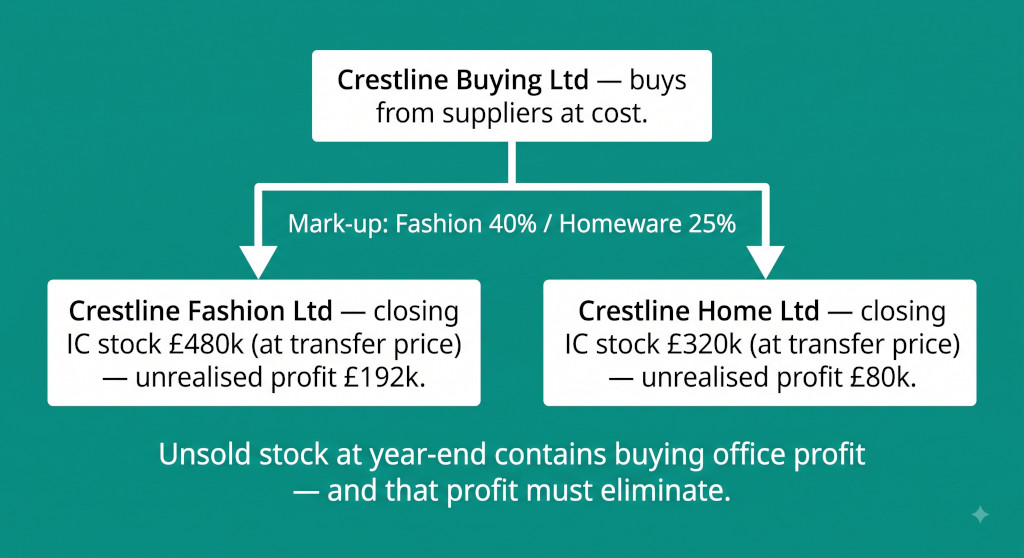
Most retail groups of any scale have separated their buying and sourcing function from their retail operations. The buying office negotiates with suppliers, places orders, takes ownership of stock, and sells goods onward to the retail store entities at a transfer price. The store entities then sell to customers. The buying margin — the difference between what the buying office paid suppliers and what it charged the stores — sits as profit in the buying entity’s accounts.
When stores have unsold stock at year end, that buying margin is still locked inside the inventory balance. The group has not yet earned it — no customer has paid for it. In the consolidated accounts, that unrealised profit eliminates, and the inventory sits at supplier cost rather than transfer price.
For a retail group with multiple product categories traded at different buying margins, the calculation cannot be done on a single blended rate. And when the buying entity’s margin is stripped out at consolidation, the reference point for the lower-of-cost-and-NRV test changes — which means entity-level markdown provisions, calculated against the transfer price, may overstate what the group actually needs to recognise. This post works through both complications using Crestline Retail Group as the worked example.
Intercompany eliminations without the manual work.
BrizoConsol identifies and eliminates intercompany balances automatically at consolidation.
The Crestline Retail Group Structure
Crestline Retail Group Ltd owns two retail chains and a central buying entity that sources all merchandise:
| Entity | Ownership | Role | Buying margin |
|---|---|---|---|
| Crestline Buying Ltd | 100% | Sources all merchandise from third-party suppliers; sells onward to store entities at a mark-up | n/a (earns the margin) |
| Crestline Fashion Ltd | 100% | Women’s and men’s fashion retail chain — 38 stores | 40% (buying office margin on fashion) |
| Crestline Home Ltd | 100% | Homeware, gifting, and interiors retail chain — 21 stores | 25% (buying office margin on homeware) |
The buying margin percentages represent the gross margin that Crestline Buying earns on its intercompany sales. A 40% buying margin on fashion means Crestline Buying sells to Crestline Fashion at a price where the supplier cost represents 60% of the transfer price. A 25% homeware margin means supplier cost represents 75% of the transfer price.
Both margins are set at the start of each trading year following a review of market benchmarks and the buying office’s cost base. They remain fixed throughout the year regardless of how individual product lines perform.
The Intercompany Sales During the Year
| Flow | Supplier cost (£) | Transfer price to stores (£) | Buying office gross profit (£) |
|---|---|---|---|
| Crestline Buying → Crestline Fashion | 7,200,000 | 12,000,000 | 4,800,000 |
| Crestline Buying → Crestline Home | 4,800,000 | 6,400,000 | 1,600,000 |
| Total intercompany stock sales | 12,000,000 | 18,400,000 | 6,400,000 |
Of the £18,400,000 transferred to the store entities during the year, most has been sold to customers — customers whose revenue flows entirely through the store entities’ own P&Ls. But a portion of that stock remains unsold at the year-end balance sheet date. That unsold portion is the focus of the consolidation adjustment.
Closing Inventory: Identifying the Unrealised Profit by Category
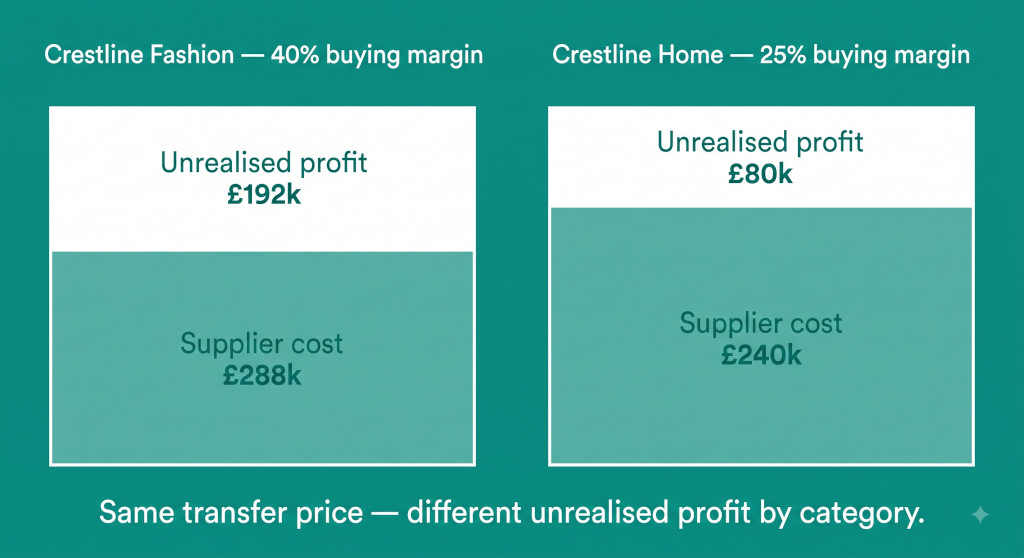
At the balance sheet date, the store entities report the following intercompany-sourced closing inventory (all at the transfer price paid to Crestline Buying):
| Store entity | Closing IC inventory at transfer price (£) | Buying margin | Unrealised profit (£) | Inventory at supplier cost (£) |
|---|---|---|---|---|
| Crestline Fashion Ltd | 480,000 | 40% | 192,000 | 288,000 |
| Crestline Home Ltd | 320,000 | 25% | 80,000 | 240,000 |
| Total | 800,000 | 272,000 | 528,000 |
The unrealised profit in each category is calculated as: closing inventory at transfer price × buying margin percentage. For fashion: £480,000 × 40% = £192,000. For homeware: £320,000 × 25% = £80,000. Total unrealised profit to eliminate: £272,000.
A blended margin calculation would give the wrong answer here. Applying a single average margin of (£272,000 ÷ £800,000) = 34% to any category-level balance would misstate the elimination. Category-level margins must be applied to category-level closing inventory balances. If a single store entity carries both fashion and homeware stock, the split must be done by product category, not by legal entity.
Elimination Step 1: Revenue and Purchases
The first elimination removes the intercompany sales from Crestline Buying’s revenue and the corresponding purchases from the store entities’ cost of goods. This is a straight P&L wash with no net profit effect — it removes the double-counting of the internal transaction without yet addressing the unrealised profit in closing inventory.
| Account | Dr | Cr |
|---|---|---|
| Revenue — intercompany stock sales (Crestline Buying Ltd) | £18,400,000 | |
| Cost of goods — intercompany purchases (Crestline Fashion Ltd) | £12,000,000 | |
| Cost of goods — intercompany purchases (Crestline Home Ltd) | £6,400,000 |
After this elimination, the consolidated revenue line excludes the internal stock sales entirely. The consolidated cost of goods is now based on Crestline Buying’s own supplier purchases — the true external cost of the merchandise. But the inventory on the consolidated balance sheet still carries the store entities’ balances at transfer price. The next step corrects this.
Elimination Step 2: Unrealised Profit in Closing Inventory
The second elimination reduces the closing inventory balance from transfer price to supplier cost, and charges the difference to consolidated cost of goods:
| Account | Dr | Cr |
|---|---|---|
| Cost of goods (consolidated — unrealised profit charge) | £272,000 | |
| Inventory — Crestline Fashion Ltd (reduction to supplier cost) | £192,000 | |
| Inventory — Crestline Home Ltd (reduction to supplier cost) | £80,000 |
After this entry, the consolidated balance sheet carries inventory at £528,000 — the supplier cost of the unsold stock. The consolidated P&L shows £272,000 of additional cost of goods relative to what the entity-level accounts show in aggregate. This is the unrealised profit that the group has not yet earned because the underlying goods have not yet been sold to external customers.
Elimination Step 3: Reversing the Prior Year Opening Inventory
The current year’s unrealised profit elimination is the third successive year Crestline has operated this structure. Last year’s closing inventory contained unrealised profit of £204,000 (Fashion £144,000, Homeware £60,000), which was eliminated in last year’s consolidation. That prior year elimination reduced both the balance sheet inventory and retained earnings at the start of this year.
At the start of the current year, those items from last year’s closing stock have been sold to customers — so the profit is now realised. The prior year elimination must reverse, which increases retained earnings and reduces this year’s consolidated cost of goods:
| Account | Dr | Cr |
|---|---|---|
| Retained earnings (opening — prior year unrealised profit reversal) | £204,000 | |
| Cost of goods (consolidated — prior year reversal credit) | £204,000 |
The prior year elimination self-corrects as the stock sells through. This year’s consolidated cost of goods is therefore: higher by £272,000 (current year unrealised profit) and lower by £204,000 (prior year reversal). Net impact on consolidated COGS this year: £68,000 increase. This is how the system is self-correcting: the only permanent P&L effect at any given year end is the movement in unrealised profit, not the full closing balance.
| Current year unrealised profit eliminated (Step 2) | £272,000 |
| Prior year unrealised profit reversed (Step 3) | (£204,000) |
| Net increase in consolidated COGS this year | £68,000 |
Deferred Tax on the Unrealised Profit Elimination
The unrealised profit elimination creates a temporary difference: the consolidated accounts carry the inventory at a lower value (supplier cost) than the tax base (the transfer price, which is what the store entities paid and what forms the deductible cost when the stock sells). This gives rise to a deferred tax asset — the group will receive a tax deduction on the full transfer price when the stock eventually sells, but has already recognised the reduction in inventory value at consolidation. At a 25% tax rate:
| Account | Dr | Cr |
|---|---|---|
| Deferred tax asset (unrealised profit × 25%) | £68,000 | |
| Deferred tax income (consolidated P&L) | £68,000 |
The DTA of £68,000 represents 25% of the £272,000 current year unrealised profit elimination. The prior year DTA of £51,000 (25% × £204,000) unwinds as the stock sells and is recognised through deferred tax income as the prior year reversal. Net DTA movement this year: £68,000 − £51,000 = £17,000 increase. The DTA sits on the consolidated balance sheet alongside the reduced inventory balance and unwinds period by period as the stock sells through to customers.
The NRV Test: Why Entity-Level Markdown Provisions Can Overstate the Group Position
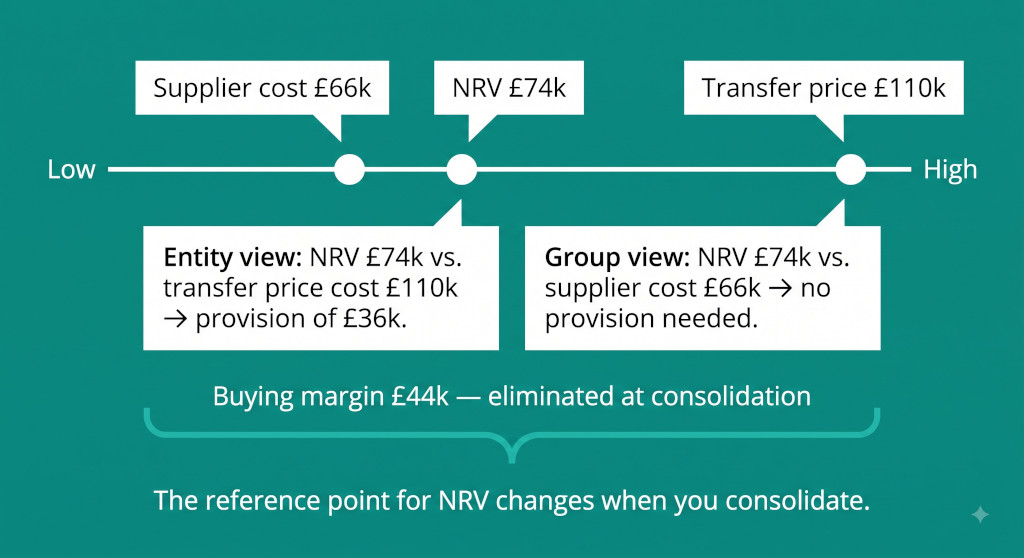
This is the complication that catches retail group controllers off guard most often. Crestline Fashion’s stores carry a markdown provision in their entity accounts: at the balance sheet date, the buying team has reviewed slow-moving fashion lines and identified stock where the expected selling price — net of markdowns needed to clear the lines — falls below the entity’s carrying value (the transfer price). Under the lower-of-cost-and-NRV rule, a provision is required at entity level.
Crestline Fashion has recognised £36,000 of markdown provisions in its entity accounts against fashion lines where the net realisable value is below the transfer price. The transfer price on those specific items totals £110,000, and the expected NRV after clearance markdowns is £74,000.
At entity level, the arithmetic is clear: carrying value £110,000 versus NRV £74,000 — provision of £36,000 required.
At consolidated level, the carrying value of those same items is supplier cost, not transfer price. The buying margin on fashion is 40%, so the supplier cost of those items is £110,000 × (1 − 0.40) = £66,000. Now compare: carrying value at group level £66,000 versus NRV £74,000 — the NRV exceeds the supplier cost by £8,000. No markdown provision is required at consolidated level for this stock.
| Slow-moving fashion lines | Entity level (£) | Consolidated level (£) |
|---|---|---|
| Carrying value (transfer price / supplier cost) | 110,000 | 66,000 |
| Net realisable value (expected clearance proceeds) | 74,000 | 74,000 |
| Headroom / (shortfall) | (36,000) | 8,000 |
| Markdown provision required | 36,000 | — |
The consolidation workbook must reverse the entity-level markdown provision (or rather, prevent it from appearing in the consolidated accounts) on stock where the NRV exceeds the supplier cost, even though NRV falls short of transfer price. This is handled by ensuring the unrealised profit elimination (which reduces inventory from transfer price to supplier cost) and the NRV test (which compares the reduced carrying value to NRV) are applied in the correct sequence.
The correct sequence matters: first apply the unrealised profit elimination to reduce inventory to supplier cost; then apply the NRV test using that reduced carrying value. Applying the NRV test before the elimination — i.e., assessing NRV against the transfer price — will overstate the markdown provision in the consolidated accounts. In a year with significant end-of-season markdowns in the fashion category, this error can materially reduce consolidated gross profit.
The corollary is equally important: for stock where the expected NRV is genuinely below supplier cost — where even after stripping out the buying margin the group is looking at a loss on realisation — a markdown provision is required at consolidated level. These items represent genuine group-level impairment that cannot be rescued by the buying margin elimination. The consolidation team must identify which slow-moving lines fall into this category and ensure those provisions survive the consolidation process.
The Phantom Margin Effect on Store Performance
The buying margin structure systematically suppresses the gross margin reported by each store entity compared to the group’s true economic margin on merchandise. Crestline Fashion’s entity accounts show a gross margin calculated after deducting the transfer price — which includes the buying office’s 40% margin — from net sales revenue. But in reality, 40% of the cost charged to Crestline Fashion was the buying office’s margin, not a true external cost.
A store that achieves a 55% gross margin on customer revenue at transfer-price cost is actually generating a much higher margin on supplier cost. At consolidated level, once the intercompany revenue and purchases eliminate, the gross margin reported for the fashion chain reflects the true economics — what customers paid versus what suppliers were paid.
| Gross margin metric | Crestline Fashion — entity accounts (£) | Crestline Fashion — consolidated contribution (£) |
|---|---|---|
| Net sales to customers | 21,600,000 | 21,600,000 |
| Opening inventory (transfer price / supplier cost) | 2,200,000 | 1,320,000 |
| Purchases in year (transfer price / supplier cost) | 12,000,000 | 7,200,000 |
| Closing inventory (transfer price / supplier cost) | (480,000) | (288,000) |
| Cost of goods sold | (13,720,000) | (8,232,000) |
| Gross profit | 7,880,000 | 13,368,000 |
| Gross margin | 36.5% | 61.9% |
The 25.4 percentage point difference in gross margin is not a measurement error — it reflects the £5,488,000 of buying office margin embedded in the cost of goods charged to the store entity. This margin is real commercial value generated by the buying function, and it appropriately appears in the buying entity’s own P&L. But when boards review entity-level store performance against gross margin targets, they need to understand that those targets are based on transfer-price economics, not supplier-cost economics. The two bases are not interchangeable, and performance benchmarks set on one basis cannot be validly compared against results prepared on the other.
A Practical Checklist for Retail Groups With Central Buying Structures
- Maintain a category-level buying margin schedule. The consolidation workbook must carry the margin for each product category separately. A single blended margin will give incorrect results whenever the category mix in closing inventory differs from the full-year mix of sales — which it routinely will, particularly at year end when seasonal stock has different clearance profiles by category.
- Identify the closing IC inventory balance by category in each store entity. Buying-entity invoices or stock systems should tag all intercompany receipts by category code. If the store entity’s stock system does not distinguish IC stock from externally sourced stock (for groups that also buy direct), the split must be maintained separately in the consolidation workbook.
- Apply the unrealised profit elimination before the NRV test. Reduce inventory to supplier cost first, then assess NRV against that reduced carrying value. Any markdown provision built on a transfer-price cost base must be reassessed using supplier cost before surviving into the consolidated accounts.
- Identify stock where NRV genuinely falls below supplier cost. These items require a consolidated-level markdown provision regardless of the entity-level position. The buying margin does not rescue a line that is trading below supplier cost — the group-level loss is real and must be recognised.
- Carry the prior year elimination in the workbook and reverse it at the start of each period. The prior year’s closing unrealised profit becomes the current year’s opening unrealised profit. It reverses as the stock sells, reducing current year consolidated COGS. Confirm each year that the prior year elimination balance agrees to the opening position in the current year workbook.
- Calculate the deferred tax asset on the current year elimination. The tax base of the store entities’ inventory is the transfer price; the consolidated carrying value is supplier cost. The temporary difference equals the total unrealised profit elimination, and a DTA arises at the applicable tax rate. Unwind the prior year DTA as part of the same workbook step.
- Maintain a reconciliation between entity and consolidated gross margins for board reporting. The margin gap created by the buying structure is significant (typically 20–40 percentage points depending on the buying margin). If the board reviews entity-level store margins, they should understand these are transfer-price margins. A bridge from entity to consolidated gross margin, showing the buying margin elimination and any NRV adjustments, should accompany the consolidated accounts narrative.
- Review the buying margin rate annually for arm’s length compliance. If the buying entity and store entities operate in different tax jurisdictions, the margin rate is a transfer price and must be supportable on an arm’s length basis. Even within a single jurisdiction, documenting the basis for the margin (cost-plus, comparable uncontrolled price, or resale price method) protects the group if the rate is ever challenged by a tax authority.
Running a retail group consolidation with a central buying structure?
BrizoConsol handles category-level unrealised profit eliminations automatically — including the NRV reassessment and deferred tax — across any number of store entities. See It In Action