How to Prepare a Consolidated Cash Flow Statement From Multiple Entities
When the audit committee asked for a group cash flow statement for the first time, Priya assumed the hard work was already done. The group had five entities, each with its own monthly cash flow report, and she had a consolidation workbook that was pulling together the P&L and balance sheet without problems. Surely the cash flow was just a matter of summing the five entity statements and perhaps eliminating a few intercompany lines.
She spent an afternoon trying. The resulting statement showed the group generating £1.4 million more operating cash flow than it actually had. A £300,000 intercompany loan from the parent to a subsidiary was appearing as both a financing outflow and an investing inflow. The FX line at the bottom of the statement — the line that reconciles the opening and closing cash position after translation effects — was £180,000 off, and she couldn’t find where the difference was coming from. The statement didn’t balance, and she didn’t know which part of it was wrong.
This is the standard first encounter with the consolidated cash flow statement. It is the most technically demanding of the three primary group financial statements because it has more elimination requirements than the P&L or balance sheet, and because it introduces a category of cash flow — the effect of exchange rate changes on cash — that doesn’t appear in entity-level reporting at all. This post works through the correct method step by step, with a full worked reconciliation at the end.
Stop building consolidations in spreadsheets.
BrizoConsol automates multi-entity consolidation — setup in minutes, reports the same day.
Why You Can’t Simply Add the Entity Cash Flow Statements Together
The consolidated P&L eliminates intercompany revenue and cost. The consolidated balance sheet eliminates intercompany receivables and payables. The consolidated cash flow statement needs to eliminate intercompany cash movements — but those movements appear in different sections of the statement depending on their nature, and they need to be eliminated in pairs that often span different sections.
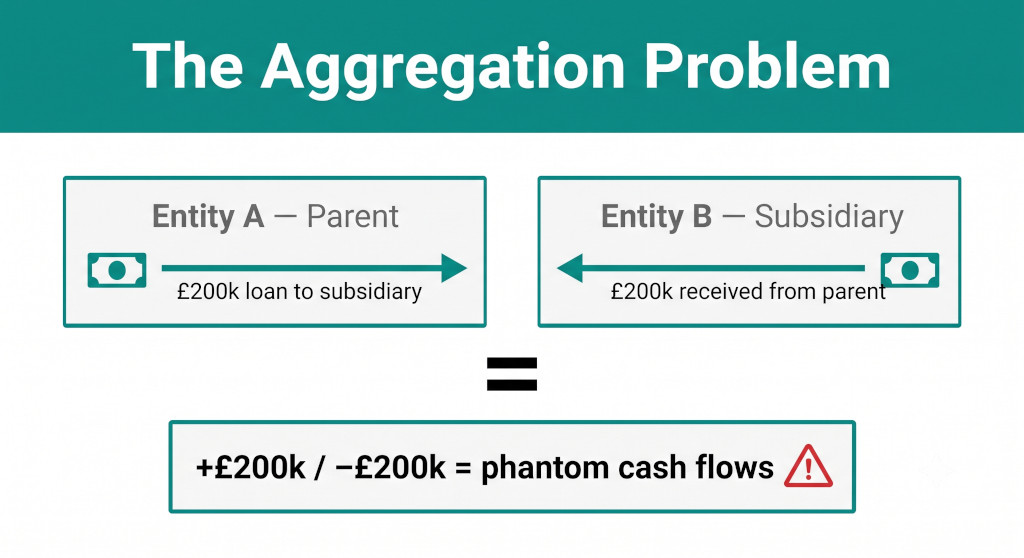
Consider the most common intercompany cash flow: a loan from the parent to a subsidiary. In the parent’s entity cash flow, this is a cash outflow in investing activities (a loan advanced to a related party). In the subsidiary’s entity cash flow, this is a cash inflow in financing activities (a loan received from a related party). If you add the two statements together, you get a phantom £200,000 investing outflow and a phantom £200,000 financing inflow — both of which need to be eliminated entirely from the consolidated statement, because from the group’s perspective no external cash moved at all.
Intercompany trading creates a similar problem. If the parent sells goods to a subsidiary and receives payment during the period, that cash receipt appears in the parent’s operating cash flows. The same cash appears as an operating outflow in the subsidiary’s statement. Aggregating the two double-counts both the inflow and the outflow, inflating the gross operating cash flows while leaving the net figure unchanged — until working capital movements introduce a timing difference, at which point even the net figure becomes wrong.
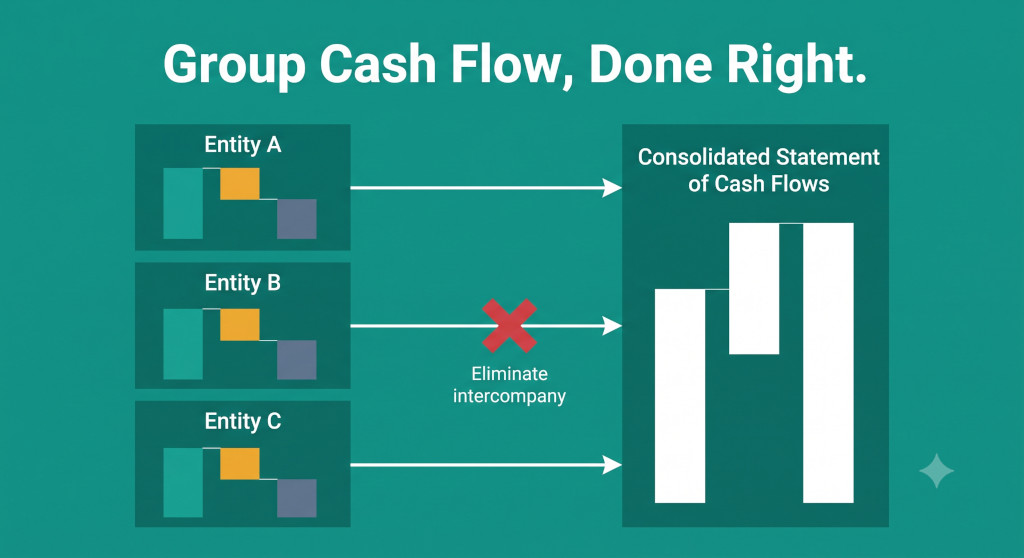
The reliable method for a multi-entity group is not to aggregate entity cash flow statements. It is to prepare the consolidated cash flow statement from the consolidated P&L and the consolidated balance sheet, using the indirect method — and then add the effect of exchange rates on cash as a separate reconciling item. This approach automatically eliminates all intercompany cash flows, because they have already been eliminated in the consolidated statements you’re starting from.
The Indirect Method: The Correct Starting Point
The indirect method builds the operating section of the cash flow statement by starting with consolidated profit before tax and working backwards to operating cash flow. It is the method used by the majority of groups, and it is structurally more robust for consolidated reporting than the direct method because it derives its inputs from the consolidated P&L and balance sheet rather than from aggregated entity cash receipts and payments.
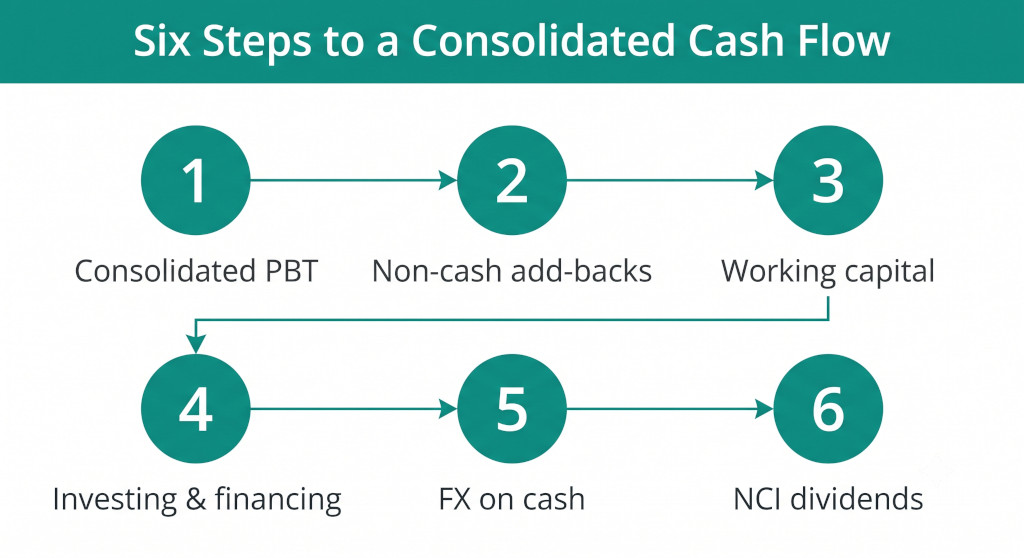
The six-step method below follows the indirect method. Each step takes a specific input from the consolidated financial statements and applies the eliminations or adjustments that are unique to the group context. Steps 1–3 build the operating section. Step 4 covers investing and financing. Steps 5 and 6 handle the two items that have no direct entity-level equivalent: foreign exchange effects on cash, and dividends paid to non-controlling interests.
Step 1: Start With Consolidated Profit Before Tax
The first line of the consolidated cash flow statement under the indirect method is consolidated profit before tax (PBT) — the same figure that appears on the last line of the consolidated P&L before the tax charge. This figure has already had all intercompany revenue, cost, and profit eliminations applied: intercompany sales have been eliminated, unrealised intercompany profit in inventory has been reversed, and any intercompany management charges have been removed. You do not need to apply any further intercompany eliminations to the PBT figure itself.
What you are doing in the indirect method is reconciling this PBT to operating cash flow by identifying every item that caused PBT and operating cash flow to differ. Those items fall into two categories: non-cash items included in PBT that didn’t involve any cash movement, and changes in working capital that caused cash to move without affecting PBT.
Step 2: Add Back Non-Cash Charges and Remove Non-Operating Items
Non-cash charges are expenses that reduced PBT but involved no outflow of cash. The most common are depreciation, amortisation, and impairment charges. These are added back to PBT in the operating section because they reduced profit but not cash.
Non-operating items are cash flows that are included in PBT but belong in a different section of the cash flow statement — most commonly finance income (interest received, which belongs in investing activities under IAS 7) and finance costs (interest paid, which can be classified in operating or financing activities depending on the group’s accounting policy). These are removed from the operating section and presented in the correct section separately.
For a group with foreign subsidiaries, there is one additional non-cash item that requires careful treatment: the unrealised foreign exchange gain or loss on intercompany monetary items. If the parent has a foreign currency intercompany loan to a subsidiary, retranslation of that loan at the closing rate generates a gain or loss in the P&L — but it is not a cash flow. It must be reversed out of operating cash flows as a non-cash item. This is separate from the exchange rate effect on cash (Step 5), which deals with the translation of foreign subsidiary cash balances, not monetary items.
Common mistake: Including the foreign exchange gain or loss on intercompany loans in the operating section without reversing it out. At the entity level, this gain or loss affects profit; at the group level, it is eliminated as part of the intercompany elimination — but only from the balance sheet and P&L. Unless it is also reversed from the operating cash flow section, it appears as a phantom operating cash movement that makes the statement fail to reconcile.
Step 3: Working Capital Movements Across the Group
Working capital movements show how changes in trade receivables, inventories, and trade payables affected operating cash flow during the period. In a consolidated cash flow statement, these movements are taken from the movement in the consolidated balance sheet — not from the sum of entity-level movements — which means they automatically exclude intercompany balances that have already been eliminated in the consolidation.
The calculation for each working capital line is:
Movement in trade receivables: Opening consolidated trade receivables (excl. intercompany) £2,140,000 Closing consolidated trade receivables (excl. intercompany) £2,380,000 ────────────────────────────────────────────────────────── Increase in trade receivables (cash outflow) £(240,000)
The critical point is that the opening and closing receivables figures used here must be the consolidated figures — after intercompany elimination — not the sum of entity figures. If Entity A has a £180,000 intercompany receivable from Entity B, that balance should have been eliminated from the consolidated balance sheet, and therefore from both the opening and closing figures used in this calculation. If you use entity-level figures for the working capital movements, you will include working capital movements that relate entirely to intercompany balances and that have no effect on the group’s actual external cash position.
For groups with foreign subsidiaries, the working capital movement also needs to be checked against the exchange rate effect: if a foreign subsidiary’s receivables increased during the period, part of that increase may be attributable to retranslation at a different closing rate rather than to actual trading movements. The retranslation effect belongs in Step 5 (exchange rate effects on cash), not in operating working capital. Practically, this means the working capital movements you extract from the consolidated balance sheet movement will be the correct after-translation figure — but you should be aware that the operating cash flow will look different from what the individual entity statements show, because the entity statements are in local currency and the consolidated statement is in the presentation currency.
Step 4: Investing and Financing Activities — Eliminating Intercompany Flows
In the investing and financing sections, intercompany cash flows need to be eliminated explicitly because they don’t come out of the consolidated P&L and balance sheet automatically the way operating items do. The most common intercompany items requiring elimination in these sections are intercompany loans and intercompany dividends.
Intercompany loans
A loan advanced by the parent to a subsidiary appears in the parent’s investing activities as a cash outflow and in the subsidiary’s financing activities as a cash inflow. In the consolidated statement, both are eliminated entirely. The journal that eliminates the loan balance from the consolidated balance sheet (Dr Intercompany Loan Payable, Cr Intercompany Loan Receivable) also eliminates any new lending in the period, so the movement in the intercompany loan balance does not appear in either section of the consolidated cash flow.
If a cash flow statement is being prepared from the consolidated balance sheet movement (as the indirect method requires), intercompany loans won’t appear at all, because they’ve been eliminated from both opening and closing balance sheet positions. The danger arises if someone tries to cross-check the consolidated investing section against entity-level cash flow statements — the intercompany loan movement will appear at entity level but not in the consolidated statement, and both are correct.
Intercompany divid dividends
Dividends paid by a subsidiary to its parent are an outflow in the subsidiary’s financing activities and an inflow in the parent’s investing activities. In the consolidated statement, dividends paid between wholly-owned group entities are eliminated entirely — the cash simply moved within the group.
However, if the subsidiary has a non-controlling interest, the dividend paid to the NCI is a real cash outflow from the group’s perspective: it is cash that left the group entirely. This portion of the subsidiary’s dividend payment — the NCI’s share — must remain in the consolidated cash flow statement as a financing outflow. See Step 6 for how to present this correctly. For a detailed treatment of NCI calculations across the equity statement, see NCI in the Consolidated Statement of Changes in Equity.
For an acquisition during the period, the cash paid to acquire the subsidiary is shown as an investing outflow in the consolidated statement. The cash and cash equivalents held by the acquired subsidiary at the date of acquisition are shown as a separate line: “Cash acquired on acquisition of subsidiary.” This netting is required under IAS 7 and means the investing section reflects the net cash cost of the acquisition, not the gross purchase price.
Consolidated financial statements without the manual work
BrizoConsol produces consolidated P&L, balance sheet, and cash flow from your connected accounting software — with eliminations applied automatically and full drill-down to the underlying transactions.See It In Action
Step 5: The Effect of Exchange Rates on Cash and Cash Equivalents
This is the line that causes the most confusion, and the one that was responsible for the £180,000 discrepancy in Priya’s statement. It is a reconciling item, not a cash flow — it explains the difference between (a) the movement in consolidated cash and cash equivalents as shown by the opening and closing balance sheet, and (b) the net cash generated or used during the period as shown by the operating, investing, and financing sections of the statement.
The effect arises because foreign subsidiary cash balances are translated at the closing exchange rate for the balance sheet, but cash flows during the period are translated at the average rate (or, for significant individual transactions, at the rate on the transaction date). The difference between these two translation bases is a non-cash translation effect that must be shown separately so that users of the statement can understand how much of the change in the group’s cash balance was due to actual cash generation and how much was due to currency movements.
Reconciliation — Group Cash Movement (simplified): Opening cash (translated at prior year closing rate) £1,820,000 + Net cash from operating activities £ 634,000 + Net cash from investing activities £ (412,000) + Net cash from financing activities £ (180,000) + Effect of exchange rates on cash £ 58,000 ────────────────────────────────────────────────────── Closing cash (translated at current year closing rate) £1,920,000
The £58,000 exchange rate effect is not a separate cash flow — it is a plug that makes the statement balance. Specifically, it represents the difference between the opening cash balances of the foreign subsidiaries translated at the prior year closing rate versus those same balances translated at the current year closing rate. If sterling strengthened against the euro during the year, the euro cash balances the subsidiaries held throughout the year are worth less in sterling at year-end than at the start, even if no euro was spent or received. That movement belongs in this line.
For a full explanation of how exchange rate differences flow through the financial statements, see Currency Translation Under IAS 21, ASC 830 and FRS 102.
Step 6: Dividends Paid to Non-Controlling Interests
As noted in Step 4, dividends paid between wholly-owned group entities are eliminated. But when a subsidiary has a non-controlling interest and declares a dividend, the portion paid to the NCI leaves the group entirely. This is a real financing outflow that must appear in the consolidated cash flow statement.
The presentation is in financing activities, typically as a separate line: “Dividends paid to non-controlling interests.” The amount is the NCI’s ownership percentage multiplied by the total dividend declared by the subsidiary — not the total dividend, because the group’s share is an intragroup transfer that is eliminated.
Example — subsidiary declares £100,000 dividend; group owns 75%, NCI owns 25%: Cash paid to parent (eliminated on consolidation): £75,000 Cash paid to NCI (retained in consolidated cash flow): £25,000 Only the £25,000 NCI dividend appears in the consolidated statement of cash flows as a financing outflow. The £75,000 paid to the parent is an intercompany cash flow and is eliminated in full.
For a detailed treatment of how NCI balances move across all three financial statements, see How to Calculate Non-Controlling Interest in Financial Consolidation.
Worked Example: Full Consolidated Cash Flow Statement
The following example shows the complete consolidated cash flow statement for a group with three entities — a UK parent (GBP functional currency), a German subsidiary (EUR functional currency), and a Singapore subsidiary (SGD functional currency). The German subsidiary is 80% owned; the Singapore subsidiary is 100% owned. Exchange rates: EUR/GBP average 0.856, closing 0.841; SGD/GBP average 0.573, closing 0.581.
| Line Item | £’000 | £’000 |
|---|---|---|
| Operating Activities | ||
| Consolidated profit before tax | 1,284 | |
| Adjustments for non-cash items: | ||
| Depreciation and amortisation | 318 | |
| Impairment charge (goodwill) | 45 | |
| Unrealised FX loss on intercompany monetary items (reversed) | (22) | |
| Share-based payments expense | 17 | 358 |
| Finance income (reclassified to investing) | (38) | |
| Finance costs (reclassified to financing) | 94 | |
| Changes in working capital: | ||
| Increase in trade receivables | (240) | |
| Decrease in inventories | 83 | |
| Increase in trade payables | 127 | (30) |
| Income taxes paid | (334) | |
| Net cash from operating activities | 1,334 | |
| Investing Activities | ||
| Purchase of property, plant and equipment | (618) | |
| Proceeds from disposal of equipment | 41 | |
| Interest received | 38 | |
| Cash acquired on acquisition (net of consideration paid) | (210) | |
| Net cash used in investing activities | (749) | |
| Financing Activities | ||
| Proceeds from new bank borrowings | 500 | |
| Repayment of lease liabilities | (187) | |
| Interest paid | (94) | |
| Dividends paid to equity holders of the parent | (400) | |
| Dividends paid to non-controlling interests | (32) | |
| Net cash used in financing activities | (213) | |
| Effect of exchange rates on cash and cash equivalents | 58 | |
| Net increase in cash and cash equivalents | 430 | |
| Cash and cash equivalents at beginning of period | 1,820 | |
| Cash and cash equivalents at end of period | 2,250 | |
Notice several features of this statement. The unrealised FX loss on intercompany monetary items (£22,000) is reversed out in the operating section — it was in PBT but is not a cash flow. The NCI dividend (£32,000) is 20% of the total dividend declared by the German subsidiary, representing the minority shareholder’s cash receipt. The effect of exchange rates (£58,000) makes the statement balance: the closing cash of £2,250,000 equals the opening cash of £1,820,000 plus the net cash movements of £372,000 (1,334 – 749 – 213) plus the FX effect of £58,000. Without the FX line, the statement would be £58,000 short and would fail to reconcile to the balance sheet.
Practical Checklist: Preparing the Consolidated Cash Flow Statement
- Start from the consolidated P&L and balance sheet. Do not aggregate entity cash flow statements. The indirect method applied to consolidated statements eliminates intercompany flows automatically.
- Identify every non-cash item in consolidated PBT. At minimum: depreciation, amortisation, impairment charges, share-based payments, and unrealised FX gains/losses on intercompany monetary items. All must be reversed in the operating section.
- Use consolidated balance sheet movements for working capital. The working capital figures must be post-elimination — intercompany receivables and payables should already have been removed from both opening and closing consolidated balance sheet positions. Verify this before calculating the movements.
- Identify all intercompany cash flows that appear in investing or financing activities. Map every intercompany loan and dividend in the period. Confirm which entity holds the receivable and which holds the payable, and verify that both sides are eliminated from the consolidated statement.
- Calculate the FX effect on cash as a plug. Closing cash per the consolidated balance sheet, minus opening cash, minus net cash from operating/investing/financing activities. If the residual is not explained by the movement in foreign currency cash balances, investigate before presenting it as the FX line.
- Identify dividends paid to NCI separately. The NCI’s share of any subsidiary dividend is a real financing outflow and must not be eliminated. Present it as a separate line in financing activities.
- Reconcile the closing cash figure to the balance sheet. The closing cash and cash equivalents on the cash flow statement must equal the cash and cash equivalents line on the consolidated balance sheet, translated at the closing rate. If it doesn’t, the FX effect has been calculated incorrectly or an intercompany elimination has been missed.
- Cross-check interest paid and tax paid against the P&L accruals. Interest paid equals finance costs in the P&L adjusted for the movement in accrued interest on the balance sheet. The same logic applies to tax paid versus the tax charge. Any material difference is a sign of an error in either the cash flow or the balance sheet.
The consolidated cash flow statement is the hardest of the three primary group statements to get right, but it is also the one most immediately useful to boards and lenders — cash generation, unlike profit, is difficult to inflate through accounting choices. A correctly prepared consolidated statement built from the indirect method, with intercompany flows eliminated and FX effects properly isolated, is both technically reliable and clearly auditable. For an end-to-end look at how the intercompany elimination process feeds into the consolidated statements, and for practical guidance on reconciling intercompany balances before close, those posts provide the necessary foundation for getting the inputs right before the cash flow statement is assembled.
Consolidated cash flow, automatically
BrizoConsol produces the consolidated statement of cash flows from your connected accounting software — indirect method, intercompany eliminations applied, FX effects calculated. Start free today. Start Free Trial