The Margin Hidden in Your Closing Stock: Eliminating Unrealised Intercompany Profit in F&B Group Consolidation
When Priya, the group finance director of Latitude Food Group, prepared the December consolidation, the gross margin looked wrong. The central kitchen entity — Central Kitchen Ltd — was showing a healthy 25% margin on its internal sales. The restaurant and retail subsidiaries were showing their own margins on food sold to customers. But when Priya aggregated everything and looked at the consolidated gross margin, it was lower than she expected. The combined entity results added up to more profit than the group had actually earned from external customers.
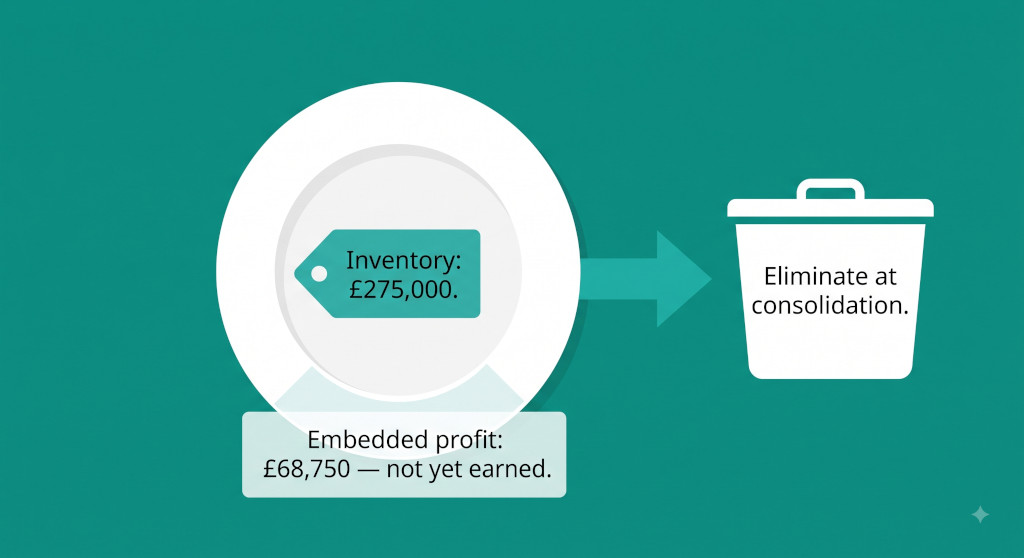
The source of the discrepancy was sitting in two stockrooms: £190,000 of food inventory in the restaurants and £85,000 of packaged goods in the retail entity, all of it purchased from Central Kitchen Ltd at a transfer price that included a 25% margin. That inventory had not been sold to a single external customer yet. From the group’s perspective, the profit Central Kitchen had recognised on selling it internally had not been earned. It was sitting, hidden, in closing stock — and it was overstating the group’s consolidated profit by £68,750.
This is the intercompany inventory problem in F&B groups. It only exists when you consolidate. At entity level, every set of accounts is correct: Central Kitchen recognises revenue on its internal sales, and the restaurants and retail entity carry inventory at cost. But the “cost” to those subsidiaries includes a margin that belongs to a fellow group entity — and at group level, that margin disappears until the food is sold to an actual external customer.
Intercompany eliminations without the manual work.
BrizoConsol identifies and eliminates intercompany balances automatically at consolidation.
Why F&B Groups Create This Problem by Design
The central kitchen or central production structure is standard practice in multi-entity F&B groups. Centralising food production achieves economies of scale, ensures consistent product quality, enables bulk purchasing from suppliers, and simplifies food safety management. The central entity produces — or procures and repackages — food and supplies it to the operating restaurants or retail entities at an agreed transfer price.
That transfer price almost always includes a margin. The central kitchen is not a cost centre passing food through at cost; it is structured as a profit-making entity that charges the operating entities a price that covers its costs and contributes to group overhead. This is correct management accounting practice and entirely sensible for performance measurement at entity level.
But it creates a consolidation problem. When a restaurant buys chicken from the central kitchen at £12 per kg and the central kitchen’s production cost is £9 per kg, the restaurant’s inventory includes £3 of profit per kg that the group has not earned from any external customer. At period end, if the chicken is still in the fridge, that £3 per kg sits in the consolidated balance sheet as inventory — and the consolidated P&L has recognised £3 per kg of profit that has not yet been realised through an external sale.
The consolidation test: if Central Kitchen and the restaurants were one entity, no internal sale would exist. The food would simply move from the kitchen to the restaurant at production cost, with no margin recognised until an external customer pays. Any profit recognised at transfer between group entities is unrealised until the food leaves the group entirely.
Quantifying the Unrealised Profit in Closing Inventory
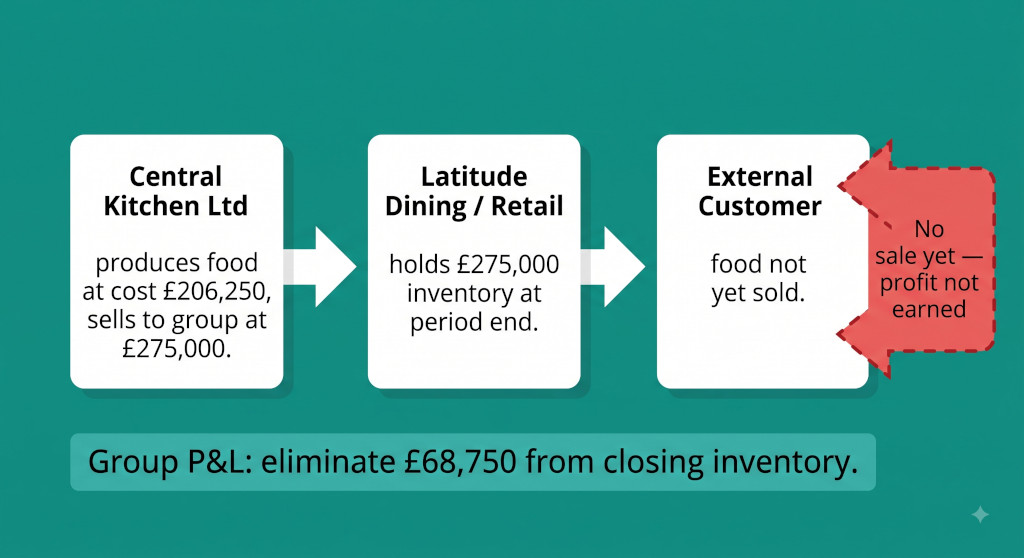
Latitude Food Group has three entities relevant to this calculation: Central Kitchen Ltd (the production entity), Latitude Dining Ltd (the restaurant chain), and Latitude Retail Ltd (which supplies packaged products to third-party retailers). Both Latitude Dining and Latitude Retail purchase their food supply from Central Kitchen.
During the year, Central Kitchen sold £1,200,000 of food and packaged products to the two operating entities. Its production cost for those sales was £900,000, giving it a 25% margin on revenue (or 33% on cost). Central Kitchen’s accounts correctly show £1,200,000 of internal revenue and £300,000 of gross profit. The operating entities correctly show £1,200,000 of purchases from Central Kitchen.
At 31 December, the operating entities have not sold all of their Central Kitchen stock:
| Entity | Closing inventory from Central Kitchen (£) | Embedded profit margin (25%) (£) | Group cost (£) |
|---|---|---|---|
| Latitude Dining Ltd (food in restaurant fridges and dry stores) | 190,000 | 47,500 | 142,500 |
| Latitude Retail Ltd (packaged goods awaiting delivery to retailers) | 85,000 | 21,250 | 63,750 |
| Total closing inventory from intragroup purchases | 275,000 | 68,750 | 206,250 |
The group’s consolidated balance sheet should show this inventory at £206,250 — the cost to the group of producing it. It currently shows £275,000. The £68,750 difference is the unrealised profit that must be eliminated.
The Three Journals Required
Correctly eliminating intercompany inventory profit in an F&B group requires three adjustments: one to remove the gross-up of internal revenue, one to remove the unrealised profit embedded in closing inventory, and one to reverse the prior year’s closing inventory elimination as that stock has now been sold.
Journal 1: Eliminate Intercompany Revenue and Purchases
This journal removes the intragroup trading from the consolidated P&L entirely. Central Kitchen’s internal sales revenue and the corresponding purchases recognised by the operating entities are cancelled against each other:
| Account | Dr | Cr |
|---|---|---|
| Revenue — intragroup food sales (Central Kitchen) | £1,200,000 | |
| Purchases / Cost of goods sold — intragroup (Operating entities) | £1,200,000 |
This elimination has no net effect on consolidated profit — it simply removes the gross presentation of internal revenue and internal purchases. The consolidated P&L shows only external revenue (food sold to restaurant guests and retail partners) and the cost of producing that food. Central Kitchen’s internal margin is invisible at group level until the food is sold externally.
Journal 2: Eliminate Unrealised Profit in Closing Inventory
This journal reduces the closing inventory in the consolidated balance sheet from the transfer price (£275,000) to the group’s production cost (£206,250), and charges the £68,750 difference to the consolidated cost of goods sold:
| Account | Dr | Cr |
|---|---|---|
| Cost of goods sold (group consolidation adjustment) | £68,750 | |
| Inventory — closing (balance sheet) | £68,750 |
This is the adjustment that directly reduces consolidated profit. It recognises that £68,750 of the profit Central Kitchen recognised on internal sales has not yet been earned — it remains embedded in stock that has not reached an external customer. The debit increases COGS; the credit reduces inventory to group cost.
Journal 3: Reverse the Prior Year’s Closing Inventory Elimination
In the prior year, the group eliminated £55,000 of unrealised profit from closing inventory (the operating entities held £220,000 of Central Kitchen stock at the prior year end, at a 25% embedded margin). In the current year, that opening inventory has been sold to external customers — the profit is now realised. The prior year elimination is reversed:
| Account | Dr | Cr |
|---|---|---|
| Inventory — opening (or retained earnings) | £55,000 | |
| Cost of goods sold (group consolidation adjustment) | £55,000 |
The opening inventory that was written down at the prior year end is now sold. The group can recognise the profit it deferred. This credit to COGS reduces the current year’s cost of goods sold, partially offsetting the debit from Journal 2. The net impact of Journals 2 and 3 combined is a £13,750 increase in consolidated COGS (£68,750 new elimination minus £55,000 reversal).
Managing intercompany inventory across multiple F&B entities?
BrizoConsol handles intercompany eliminations automatically — including the inventory profit adjustments that reset each period as your closing stock changes.See It In Action
The Net Effect on the Consolidated Accounts
After all three journals, the consolidated position is:
| Line item | Pre-elimination (£) | Journals 1–3 (£) | Consolidated (£) |
|---|---|---|---|
| Revenue (incl. £1.2m IC sales) | 4,700,000 | (1,200,000) | 3,500,000 |
| Cost of goods sold | (3,210,000) | 1,186,250 | (2,023,750) |
| Gross profit | 1,490,000 | (13,750) | 1,476,250 |
| Closing inventory | 975,000 | (68,750) | 906,250 |
The £1,186,250 net credit to COGS in the elimination column is made up of: Journal 1 credit of £1,200,000 (removing IC purchases), less Journal 2 debit of £68,750 (closing inventory unrealised profit), plus Journal 3 credit of £55,000 (opening inventory reversal). The net effect on consolidated profit is a reduction of £13,750 compared to the sum of entity profits — the year-on-year increase in the unrealised profit embedded in closing inventory.
Why the Gross Margin Looks Different at Group Level
This adjustment is the reason Priya’s consolidated gross margin did not match her expectations. At entity level, Central Kitchen shows a strong 25% margin on its internal sales, and the operating entities show their own margins on external revenue. At group level, the profit Central Kitchen made on the food still in the restaurants’ fridges is removed — which reduces the consolidated gross profit and compressed the consolidated gross margin percentage.
The consolidated gross margin should always be calculated on group cost (what it actually cost the group to produce the food) against external revenue (what external customers paid). The entity-level margins are management accounting tools. The consolidated margin is the economic reality.
Seasonal F&B groups face this problem most acutely at certain period ends. A group that produces Christmas hampers or Easter eggs in a central facility will accumulate very large volumes of intercompany inventory in the weeks before those products ship to retailers. If the period end falls when that inventory is at peak levels — which it often does for groups with December year-ends — the elimination can be material. Always identify whether your period-end date coincides with a seasonal inventory peak before finalising the consolidation.
How to Identify Which Inventory Comes From Intragroup Purchases
The elimination requires knowing exactly how much of the closing inventory in each operating entity was sourced from another group entity — and at what transfer price. In practice, this requires each operating entity to maintain a clear split in its inventory records between externally sourced stock and internally sourced stock.
For groups where the central kitchen is the primary or sole supplier, this is straightforward: all inventory comes from Central Kitchen and the full closing balance is subject to the elimination. For groups where operating entities also buy from external suppliers, a more detailed analysis is needed to isolate the intragroup-sourced portion.
The calculation of the embedded margin requires knowing Central Kitchen’s standard margin on intragroup sales. If Central Kitchen uses a single standard markup across all products, the calculation is simple. If it uses different margins for different product categories — say, 30% on prepared meals but 20% on beverages — the elimination must be calculated separately for each category, using the inventory split by product type from the operating entities’ stock records.
Ask Central Kitchen for a schedule of intragroup sales by product category and margin, cross-referenced to the quantities still in inventory in the operating entities at period end. This is the source document for the elimination calculation and should be retained for audit. Without it, the elimination is an estimate rather than a precise calculation.
Deferred Tax on the Inventory Elimination
The elimination of £68,750 of unrealised profit from closing inventory creates a temporary difference for deferred tax purposes. In the operating entities’ tax returns, inventory is held at the transfer price (£275,000 — the amount they paid, and therefore their tax deductible base). In the consolidated accounts, the same inventory is carried at £206,250. The consolidated carrying value is lower than the tax base — which is an unusual direction for a temporary difference.
Because the tax base (£275,000) is higher than the consolidated accounting value (£206,250), when the inventory is eventually sold and the tax deduction is claimed at the higher amount, the group will pay less tax than its consolidated profit would suggest. This is a deferred tax asset of £68,750 × 25% = £17,188, recognised in the consolidation workings alongside Journal 2.
| Account | Dr | Cr |
|---|---|---|
| Deferred tax asset | £17,188 | |
| Deferred tax income (P&L) | £17,188 |
This deferred tax asset partially offsets the COGS charge from Journal 2. The net P&L impact of the closing inventory elimination (Journal 2 plus this deferred tax entry) is £68,750 – £17,188 = £51,562. The deferred tax asset reverses in the period when the inventory is sold and the actual tax deduction is taken.
The Self-Correcting Nature of the Elimination Over Time
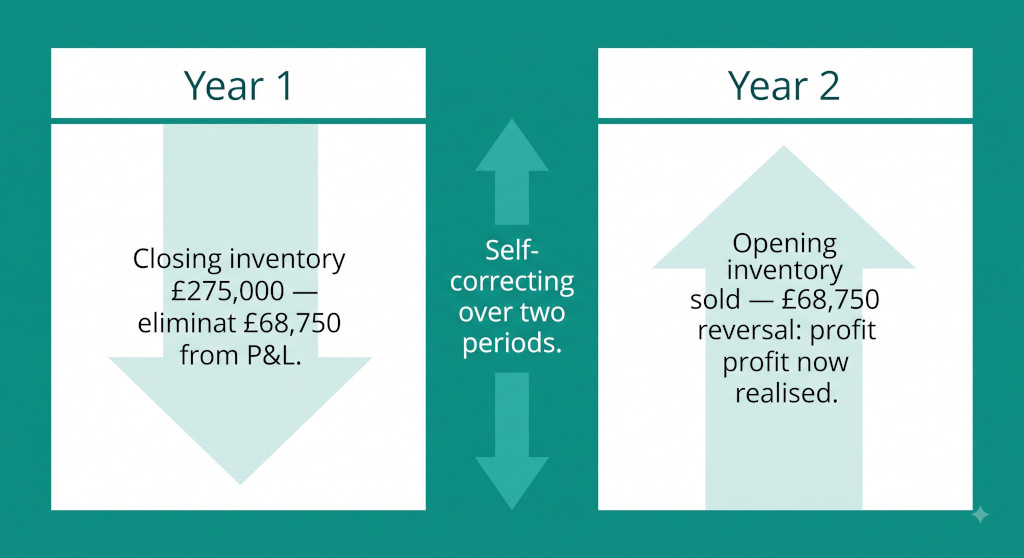
The intercompany inventory elimination is not a permanent charge to the group — it is a timing adjustment. Over a two-year cycle, it is self-correcting:
In year one, the group eliminates £68,750 of unrealised profit from closing inventory. The consolidated profit is reduced by £68,750 (before tax). In year two, that inventory is sold to external customers. The group now has the right to recognise the profit — and the year-one elimination reverses through a credit to COGS. The £68,750 flows back into consolidated profit in year two, when the external sale actually occurs.
The only permanent effect on consolidated profit in any given period is the change in the unrealised profit balance from one year to the next. If the closing inventory stays constant year on year (same volume of stock, same margin), the elimination and the reversal are equal and the net P&L impact is zero. If closing inventory grows — because the group is expanding, because there is a seasonal build-up, or because margins have increased — the net P&L charge increases. If closing inventory shrinks, the net P&L benefit increases.
This is why Priya’s consolidated gross margin looked different from the entity-level margins. The consolidated margin in any period reflects the group’s actual production cost for food sold to external customers in that period — not the transfer price at which it passed through the group’s internal supply chain.
A Practical Checklist for F&B Groups With Central Kitchen Structures
- Map all intragroup food supply relationships. Identify every entity that sells food or packaged goods to another entity within the consolidation perimeter. A central kitchen is the most common, but secondary supply relationships (one regional kitchen supplying another, a shared cold-storage entity charging out at cost-plus) also create this issue.
- Obtain closing inventory schedules from each operating entity. For each entity, identify the closing balance of inventory sourced from intragroup suppliers. The inventory records should distinguish between internally sourced and externally sourced stock.
- Confirm the intragroup transfer pricing margin. Obtain Central Kitchen’s standard margins by product category. If margins differ by product type, ensure the operating entities’ inventory schedules are split by category so the correct margin can be applied to each portion.
- Calculate the unrealised profit in closing inventory. Apply the margin to the intragroup-sourced closing inventory balance. Document the calculation, the margin rates used, and the source of the inventory figures.
- Post Journal 1: eliminate intragroup revenue and purchases. This has no net profit impact but removes the gross presentation of internal trading from the consolidated P&L.
- Post Journal 2: eliminate unrealised profit from closing inventory. Debit COGS, credit inventory. The closing inventory in the consolidated balance sheet reduces to group production cost.
- Post Journal 3: reverse the prior year’s closing inventory elimination. Credit COGS (or debit opening retained earnings) for the prior year’s elimination amount. This reflects that last year’s inventory has now been sold externally.
- Post the deferred tax entry. Recognise a deferred tax asset equal to the closing inventory unrealised profit multiplied by the applicable tax rate. Reverse the prior year’s deferred tax asset simultaneously.
- Reconcile the consolidated gross margin. After all eliminations, the consolidated gross margin should reflect the group’s true production cost against its external revenue. If it still looks wrong, the inventory split between intragroup and external sourcing may be incomplete.
Ready to get your F&B group consolidation right?
BrizoConsol consolidates multiple entities automatically — eliminating intercompany transactions and giving your group a clean set of accounts at every period end. Start Free Trial