Consolidated Revenue Reporting for a Hotel Group With Branded, Managed, and Leased Properties: Why Each Model Produces a Different Group P&L
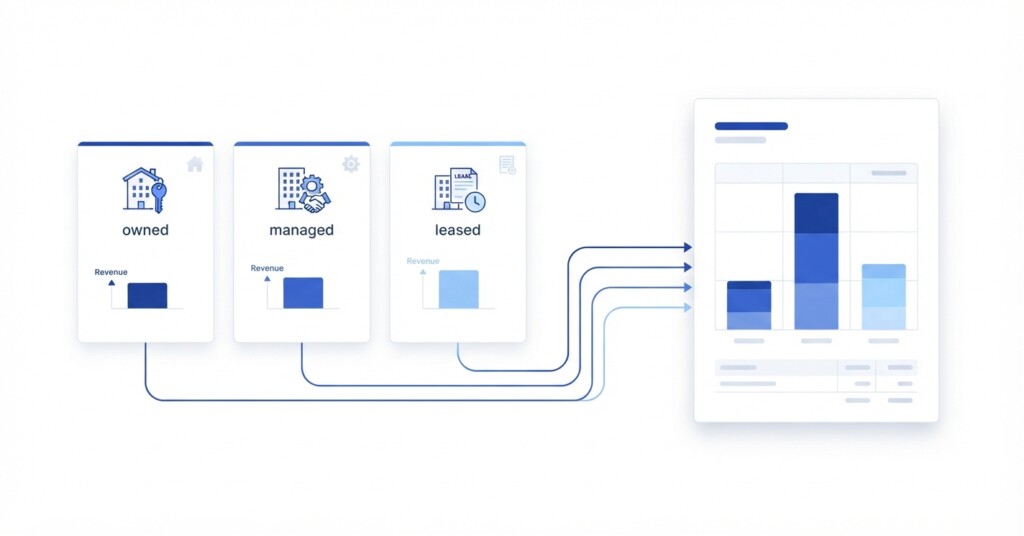
For a hotel group operating across multiple properties, the question of how to report consolidated revenue sounds straightforward until you realise that three common property models — branded owned, managed, and leased — each produce a structurally different profit and loss account at the entity level. When you bring those entities together into a group P&L, the differences compound. Revenue lines that look comparable in isolation are built on entirely different accounting treatments, and combining them without understanding the mechanics leads to a group report that is misleading at best, and materially misstated at worst.
This article walks through how each property model generates revenue and cost at the entity level, how those flows behave differently at group consolidation, and where the real risk sits for finance teams trying to produce accurate, auditable group reporting each month.
The Three Property Models and What They Mean for Revenue Recognition
Before touching the consolidation workpapers, finance teams need to be clear on what each property model actually means for the legal entity that holds it.
Stop building consolidations in spreadsheets.
BrizoConsol automates multi-entity consolidation — setup in minutes, reports the same day.
A branded owned property is one where the hotel group owns the real estate and operates the hotel under its own brand. All room revenue, food and beverage income, and ancillary revenue flows into the entity that owns the property. The entity bears all operating costs: staff, utilities, property maintenance, and debt service on the asset. The P&L looks like a full hospitality business.
A managed property is one where the group manages a hotel on behalf of a third-party owner. The group entity recognises a management fee — typically a base fee as a percentage of total revenue, plus an incentive fee based on profitability — but does not record the underlying room revenue or operating costs of the hotel itself. The managed hotel’s revenues and costs belong to the owner. IFRS 15 and FRS 102 Section 23 both require careful judgement here: the group is acting as agent, not principal, so only the fee is income.
A leased property sits between the two. The group leases the hotel from a property owner and operates it, taking on all operating risk. Under IFRS 16, the group recognises a right-of-use asset and a lease liability on the balance sheet. Rent is split between depreciation of the right-of-use asset and finance charges rather than appearing as an operating lease cost line, which changes EBITDA materially compared with pre-IFRS 16 treatment.
The revenue line in each entity’s P&L is not equivalent across these three models. A group CFO reviewing a consolidated P&L that blends owned property room revenue, management fee income, and leased property room revenue is looking at three different things presented as one number. Normalisation notes are essential.
What Group Consolidation Does to Each Model
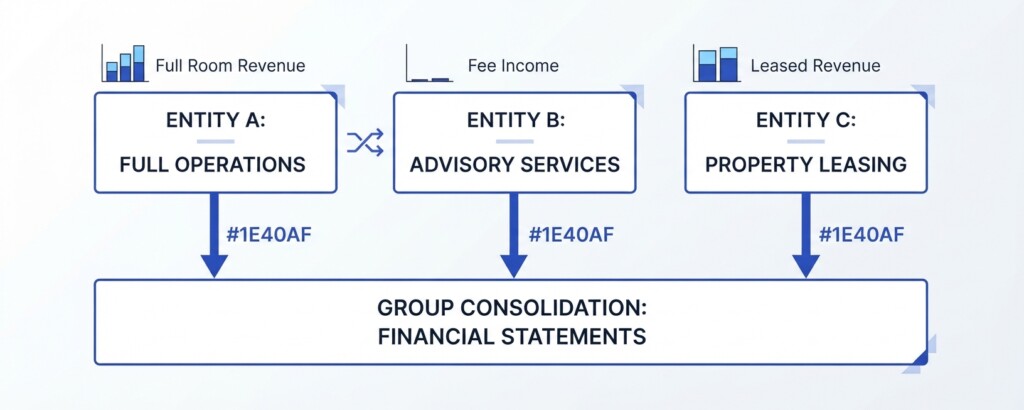
When the group consolidates, the first task is aggregating all entity P&Ls line by line. The problem is that the composition of the revenue line differs across entities. An owned hotel with £8 million in room revenue and a managed property generating £1.2 million in management fees are not contributing £9.2 million of equivalent income to the group. The £8 million represents full operational revenue with corresponding operating costs; the £1.2 million is almost entirely margin, with minimal direct cost of sale.
At the gross level, the group P&L will aggregate these correctly if the chart of accounts is structured to distinguish revenue types. In practice, many SME hotel groups use a common revenue nominal code across all entities, which collapses the distinction entirely. The result is a group gross revenue figure that blends principal revenue with agent fee income, making gross margin analysis meaningless.
Intercompany Eliminations: Where the Real Complexity Sits
Hotel groups frequently have intercompany transactions that must be eliminated on consolidation. Common examples include a central services entity recharging IT, HR, sales, and marketing costs to the operating entities; a treasury entity lending funds to property entities; and a brand entity charging royalties to the managed or leased property operators (where the group retains the brand relationship).
Each of these creates an intercompany balance that must be eliminated. The central services recharge appears as income in the services entity and as an overhead cost in the receiving entity. At group level, both sides are eliminated. The loan creates an intercompany receivable and payable that net to zero on the consolidated balance sheet. Royalty charges create the same pattern as the services recharge.
The risk in hotel groups specifically is that the management fee paid by a third-party-owned managed property is not an intercompany transaction — it is genuine third-party income. But if the group also manages some of its own subsidiary properties and charges an internal management fee between entities, that internal fee must be eliminated. Misclassifying an external management fee as intercompany directly distorts group operating profit, while failing to eliminate an internal one artificially inflates both consolidated revenue and overheads, skewing margins even though the net impact on operating profit is nil.
| Account | Dr | Cr |
|---|---|---|
| Intercompany Management Fee Income (Central Services Entity) | 480000 | |
| Intercompany Management Fee Expense (Owned Property Entity) | 480000 |
Elimination of internal management fee charged by central services entity to wholly owned branded property entity for the year ended 31 December. Both amounts are intragroup and must be eliminated on consolidation. The net effect on group profit is nil.
FX Translation: Owned vs Leased vs Managed in a Multi-Currency Group
Groups operating hotels in multiple countries face FX translation as an additional consolidation step. Under IAS 21 and FRS 102 Section 30, each foreign subsidiary translates its P&L at average exchange rates for the period and its balance sheet at the closing rate. The difference between these two rates creates a translation reserve movement that goes to other comprehensive income, not to operating profit.
For a managed property entity sitting in, say, a eurozone jurisdiction, the management fee income earned in euros is translated at average rates into the group reporting currency. This is typically a modest figure with a small absolute FX translation effect. For an owned or leased property entity in the same jurisdiction, every line of the P&L — room revenue, payroll, utilities, depreciation — is translated, and the right-of-use asset and lease liability on the balance sheet create additional closing-rate translation exposure.
Groups sometimes underestimate how much of their reported group revenue variance month to month is driven by FX translation rather than underlying trading. Without a currency analysis overlay on the group P&L, the finance team cannot distinguish a genuine revenue improvement in a eurozone owned property from a favourable exchange rate movement.
If your group uses average rates for P&L translation and different rates for any balance sheet items without a documented, consistent FX policy, your consolidation is likely to contain unexplained differences. These often surface as a ‘plug’ in intercompany reconciliations or as unexplained movements in retained earnings. Audit teams will focus on this area.
Non-Controlling Interests in Part-Owned Properties and Joint Ventures
Many hotel groups hold properties through joint structures or part-own subsidiaries where a third party holds a minority stake. Where the group controls the entity (typically majority ownership and decision-making power), the subsidiary is consolidated in full, and the minority shareholder’s share of net assets and profit is presented as a non-controlling interest (NCI) in the group accounts. Genuine joint ventures under joint control, by contrast, are accounted for using the equity method rather than full consolidation.
The practical effect on the consolidated P&L for a controlled subsidiary is that 100% of its revenue, costs, and profit are included in the group P&L, but the NCI’s share of profit after tax is then deducted to arrive at profit attributable to owners of the parent. For a hotel group where an operating entity leasing a property is held 70% by the group and 30% by a property developer, this means the full operating P&L of the leased property — including the gross room revenue — lands in the group P&L, while the developer’s 30% share of net profit is shown as NCI at the foot of the P&L.
This is frequently confused in management reporting. Finance managers sometimes exclude NCI-held entities from management P&Ls to show ‘our share’ only, which is a valid management choice but needs to be clearly labelled and applied consistently. Mixing full consolidation treatment for some entities and proportionate treatment for others in the same management report creates an unreliable document.
| Property Model | Revenue in Group P&L | Cost of Sale Pattern | NCI Relevance | Key Consolidation Risk |
|---|---|---|---|---|
| Branded Owned | Full room & F&B revenue | High — all operating costs | Relevant if entity is part-owned | Intercompany recharge eliminations |
| Managed | Management fee only (agent) | Low — fee income is high margin | Usually N/A — group is manager | Misclassifying as principal revenue |
| Leased (IFRS 16) | Full room & F&B revenue | High — depreciation replaces rent | Relevant if operating entity is part-owned | EBITDA distortion vs pre-IFRS 16 peers |
The Group P&L in Practice: A Simple Illustration
Consider a small hotel group with three entities: an owned branded hotel in London, a managed property in Edinburgh where the group earns a fee, and a leased hotel in Dublin held 70% by the group and 30% by an external investor.
| London — Owned Hotel: Room & F&B Revenue | £8,400,000 |
| Edinburgh — Managed Property: Management Fee Income | £950,000 |
| Dublin — Leased Hotel: Room & F&B Revenue (100%) | £5,200,000 |
| Less: Intercompany Recharges Eliminated | (£620,000) |
| Consolidated Group Revenue | £13,930,000 |
| Illustrative Group Operating Expenses and Tax | (£12,578,000) |
| Consolidated Profit for the Year | £1,352,000 |
| Less: NCI Share of Dublin Entity Profit (30%) | (£312,000) |
| Profit Attributable to Owners of Parent (illustrative) | £1,040,000 |
Note that the revenue line of nearly £14 million contains three structurally different income streams. The Edinburgh £950,000 is almost entirely margin; the London and Dublin revenues each carry millions of pounds of operating cost. A group EBITDA margin calculated on total revenue will be distorted unless the analyst understands the composition.

Financial Close Challenges for Hotel Groups
Hotel group finance teams face a monthly close process that combines the usual consolidation workload with hospitality-specific data: property management system revenue feeds, occupancy and RevPAR data from multiple properties, and revenue apportionment between room types, packages, and ancillary services. Mapping PMS output to the nominal ledger consistently across entities — especially where different properties use different systems — is a perennial source of delay.
Intercompany reconciliation is another common bottleneck. The central services entity, the brand entity, and each property entity need to agree their intercompany balances before consolidation can close. In a group using separate accounting systems per entity and spreadsheet-based consolidation, a single disputed recharge can delay the group close by several days while emails are exchanged between the property controller and the central finance team.
FX translation adds a further step for international groups. Average rates need to be agreed and applied consistently, translation differences need to be calculated and posted to OCI, and the consolidation workpapers need to show the movement clearly enough to satisfy auditors. All of this is doable in Excel, but it becomes progressively harder to maintain as the group adds entities, changes its property mix, or acquires new businesses mid-year.
Where Connected Accounting Data Makes a Material Difference
The core problem in hotel group consolidation is fragmentation. Each entity has its own data, its own system, and its own close timetable. Consolidation then requires someone to collect all of that, apply eliminations, translate currencies, and assemble a group report — usually in a spreadsheet that is one formula error away from a material misstatement.
Groups that connect their entity-level accounting data to a consolidation layer — whether through API integrations, shared chart of accounts standards, or a dedicated consolidation tool — reduce the manual rekeying and reconciliation effort significantly. Intercompany balances can be matched automatically rather than reconciled by email. FX rates can be applied consistently from a single source. Eliminations can be rule-based rather than manually calculated each month.
The management reporting layer also improves. If the system distinguishes revenue by property model (owned, managed, leased) and by entity at source, the group P&L can present a meaningful split without requiring a separate analytical workbook. Finance managers can see that the group’s headline revenue growth is driven by new managed properties (fee income) rather than improved room yield at owned hotels — a distinction that matters enormously for cash flow, capital allocation, and investor reporting.
A clean consolidation is not just an accounting requirement — it is a management tool. Hotel group executives making decisions about which model to apply to a new property need accurate data on how each model affects group margin, group cash flow, and group balance sheet. That data only exists if the consolidation captures it correctly.
Practical Steps for SME Hotel Group Finance Teams
- Standardise your chart of accounts across entities to distinguish revenue by type — room revenue, F&B, management fees, and other income should be separate nominals, not collapsed into a single revenue code.
- Document clearly which entities are consolidated as subsidiaries (full consolidation, with NCI if part-owned), and which are equity-accounted associates or joint ventures, and review this each time the group structure changes.
- Establish a written FX policy specifying the rate source, the rate type (average vs spot), and the frequency of rate updates, and apply it consistently across all entities and reporting periods.
- Build an intercompany matrix at the start of each year listing all expected intragroup transactions by entity pair, so that reconciliation at month-end is a checking exercise rather than a discovery exercise.
- Separate external management fee income from internal management fee recharges in both the ledger and the consolidation workpapers, and ensure the elimination schedule accounts for both correctly.
- Review EBITDA calculations carefully where IFRS 16 applies to leased properties — the treatment replaces cash rent with depreciation and finance charges, making EBITDA higher than under the old operating lease model for the same economic transaction.
- Consider whether your management reporting P&L should present revenue by property model as a standard view, so that readers always understand the composition of the headline revenue number.
The Audit and Compliance Dimension
For hotel groups preparing statutory consolidated accounts, auditors will focus specifically on revenue recognition across models — particularly the agent vs principal distinction for managed properties, the completeness of intercompany eliminations, and the correct calculation of NCI. Groups that cannot produce a clear elimination schedule, a reconciled intercompany matrix, and a documented FX translation workpaper will spend significant time in audit fieldwork resolving queries that should have been answered at the close.
The investment in getting consolidation mechanics right is not just about producing better management reports. It reduces audit cost, reduces the risk of restatement, and gives the group’s CFO a defensible basis for the numbers presented to boards, lenders, and investors. For SME hotel groups in particular — where finance teams are often small and the group structure grows faster than the finance infrastructure — building the consolidation discipline early is far cheaper than retrofitting it later.
See How Multi-Entity Consolidation Works in Practice
If your hotel group is managing consolidation across owned, managed, and leased properties in Excel, explore how a connected consolidation tool handles intercompany eliminations, FX translation, and group reporting automatically.