Earn-Outs in Professional Services Acquisitions: Why the Contingent Consideration Accounting Only Exists in Your Group Accounts
Professional services acquisitions are structured differently from most deals. When a corporate group acquires a manufacturing business or a property company, the value sits in physical assets, contracts, or intellectual property — things that will generate returns regardless of who continues to work there. When a corporate group acquires a consulting practice, a law firm, or an accountancy business, the value sits in the partners and the client relationships they maintain. Lose the partners after the acquisition and you have paid full price for an empty building.
This is why earn-outs dominate professional services deal structures. Rather than paying the full consideration upfront, the acquirer pays a base price and holds back a portion — contingent on the acquired firm hitting revenue or profit targets over the next two or three years. The partners stay, the clients stay, and the earn-out is paid only if performance justifies it.
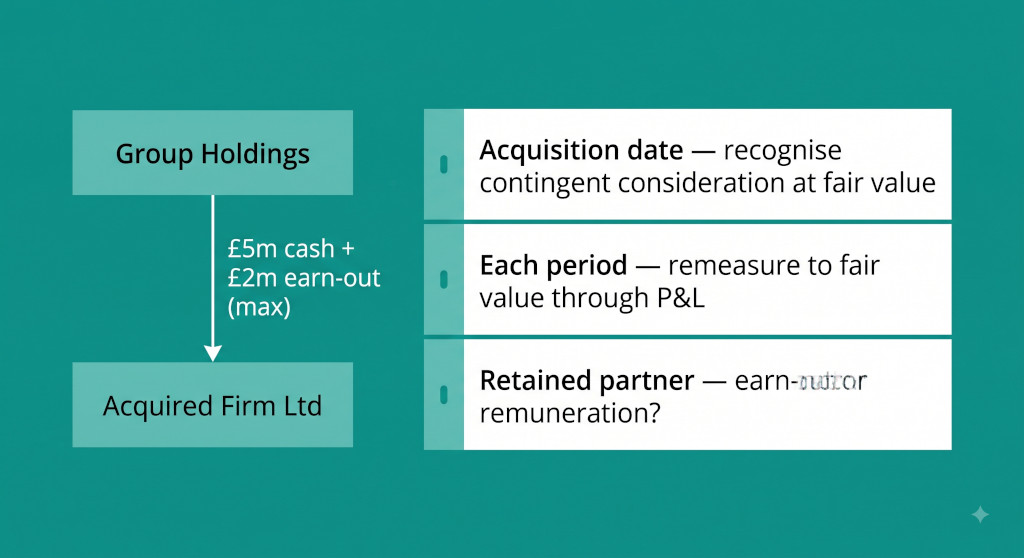
The earn-out arrangement makes commercial sense. It creates significant consolidation accounting complexity. The contingent consideration — the earn-out — must be recognised at fair value on the acquisition date under IFRS 3, remeasured to fair value at every subsequent balance sheet date, and the movement taken through the consolidated profit and loss account. The critical point is that all of this accounting exists only at group level. The acquired entity — the consulting firm — records no entry for the earn-out in its own accounts. The group consolidation workings carry the entire earn-out liability and every remeasurement gain or loss. Any group accountant who looks only at the subsidiary’s trial balance will miss it entirely.
Stop building consolidations in spreadsheets.
BrizoConsol automates multi-entity consolidation — setup in minutes, reports the same day.
IFRS 3 — The Framework
Under IFRS 3 Business Combinations, contingent consideration is part of the purchase price for the acquired business. On the acquisition date, the group must estimate the fair value of the earn-out — what it would cost today to settle the earn-out obligation, taking into account the probability of hitting the performance targets and the time value of money. This fair value is added to the consideration transferred and increases the goodwill recognised on acquisition.
After the acquisition date, the treatment depends on how the contingent consideration is classified:
- If the earn-out will be settled in cash (the common case in professional services), it is a financial liability. Under IFRS 9, financial liabilities at fair value through profit or loss are remeasured at each balance sheet date, with any change in fair value recognised in the consolidated P&L.
- If the earn-out will be settled by issuing shares in the acquirer, it may be an equity instrument. Equity-classified contingent consideration is not remeasured after the acquisition date.
Most professional services earn-outs are cash-settled, which means the group faces a recurring P&L charge or credit at every balance sheet date until the earn-out is settled.
The remeasurement of a cash-settled earn-out after the acquisition date goes through the consolidated P&L — not through goodwill. This is a common error. IFRS 3 prohibits retrospective adjustment of goodwill for post-acquisition fair value changes in contingent consideration. Goodwill is fixed at the acquisition date (subject to the measurement period of up to twelve months). Every subsequent remeasurement is a P&L item.
The Scenario: Apex Advisory Acquires Summit Consulting
Apex Advisory Group acquires Summit Consulting Ltd on 1 January Year 1. The deal terms are:
- Base purchase price: £5,000,000, paid in cash at completion
- Contingent consideration: up to £2,000,000, payable after two years, based on Summit’s cumulative revenue over Years 1 and 2
- Performance condition: £2,000,000 is payable if cumulative revenue exceeds £8,000,000; £1,000,000 if cumulative revenue exceeds £6,000,000; £nil if below £6,000,000
On the acquisition date, Apex’s advisers assess the probability of each outcome:
| £2,000,000 outcome — 50% probability | £1,000,000 |
| £1,000,000 outcome — 30% probability | £300,000 |
| £nil outcome — 20% probability | £0 |
| Probability-weighted undiscounted earn-out | £1,300,000 |
| Discount factor (2 years at 6%) | × 0.890 |
| Fair value of contingent consideration at acquisition date | £1,157,000 |
The acquisition date journal in the consolidated workings records:
| Account | Dr | Cr |
|---|---|---|
| Net assets acquired (at fair value) | £820,000 | |
| Customer relationships intangible (IFRS 3 fair value uplift) | £1,400,000 | |
| Goodwill | £3,937,000 | |
| Cash — base consideration paid | £5,000,000 | |
| Contingent consideration liability | £1,157,000 |
Acquisition date journal — consolidated workings only. Summit Consulting’s entity accounts record nothing relating to the earn-out. Goodwill = total consideration (£5,000,000 + £1,157,000) less fair value of net assets (£2,220,000 including customer relationships intangible) = £3,937,000. The customer relationships intangible arises from the IFRS 3 fair value exercise and will be amortised in the consolidated accounts — another entry that exists only at group level.
Year-End Remeasurement — Year 1
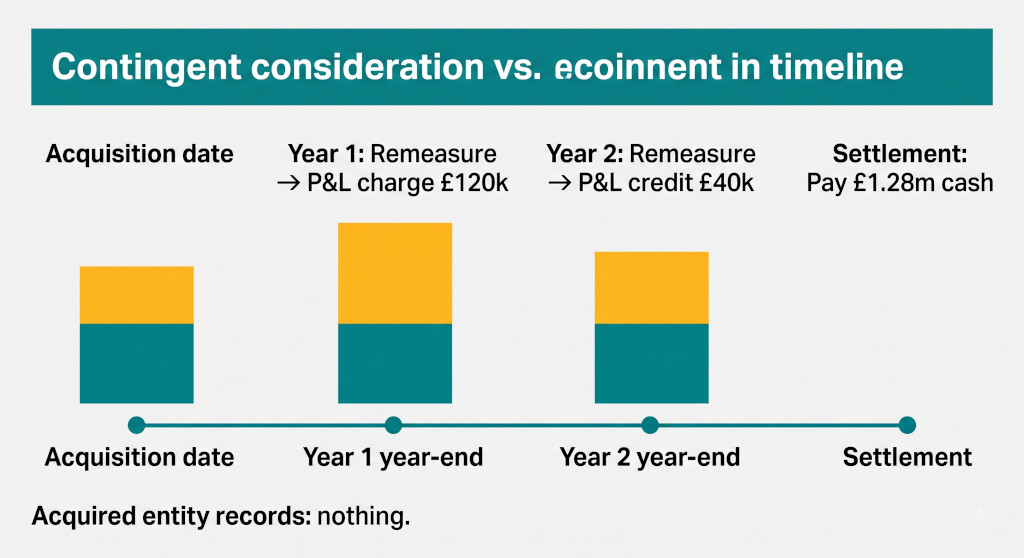
At 31 December Year 1, Summit’s Year 1 revenue came in at £4,100,000. The run rate looks stronger than originally expected. Apex’s finance team reassess the probability of each outcome:
| £2,000,000 outcome — revised to 65% probability | £1,300,000 |
| £1,000,000 outcome — revised to 30% probability | £300,000 |
| £nil outcome — revised to 5% probability | £0 |
| Probability-weighted undiscounted earn-out | £1,600,000 |
| Discount factor (1 year remaining at 6%) | × 0.943 |
| Fair value of contingent consideration at 31 Dec Year 1 | £1,509,000 |
The carrying value of the contingent consideration liability was £1,157,000. The fair value at year end is £1,509,000 — an increase of £352,000. This increase is a P&L charge in the consolidated accounts:
| Account | Dr | Cr |
|---|---|---|
| Finance costs — remeasurement of contingent consideration | £352,000 | |
| Contingent consideration liability | £352,000 |
Year 1 remeasurement — consolidated workings only. The increase in the earn-out liability (performance is tracking better than expected) creates a finance cost in the consolidated P&L. Goodwill is not adjusted. Summit Consulting’s entity accounts are unaffected.
Year-End Remeasurement — Year 2
At 31 December Year 2, Summit’s cumulative two-year revenue is £7,800,000 — above the £6,000,000 threshold but below the £8,000,000 maximum. The earn-out is now determinable: £1,000,000 is payable, with no remaining uncertainty. The liability must be remeasured to £1,000,000 (no discount as it is due for immediate settlement):
| Carrying value of liability at start of Year 2 | £1,509,000 |
| Fair value at 31 Dec Year 2 (certain at £1,000,000) | £1,000,000 |
| Remeasurement gain — P&L credit | £509,000 |
| Account | Dr | Cr |
|---|---|---|
| Contingent consideration liability | £509,000 | |
| Finance income — remeasurement of contingent consideration | £509,000 |
Year 2 remeasurement — performance came in below the maximum earn-out; the liability reduces and a gain is recorded in the consolidated P&L. The earn-out is now settled at a known amount; the liability is reclassified to current liabilities pending cash payment.
When the earn-out is paid:
| Account | Dr | Cr |
|---|---|---|
| Contingent consideration liability | £1,000,000 | |
| Cash | £1,000,000 |
Settlement of earn-out — cash outflow in the consolidated cash flow statement classified as a financing activity (repayment of a financial liability). Only the portion of the original fair value (£1,157,000) is shown in financing; any amount paid in excess of original fair value is an operating cash outflow per IAS 7. In this case, the total paid (£1,000,000) is below the original fair value, so the entire amount is a financing outflow.
The Earn-Out vs. Remuneration Problem
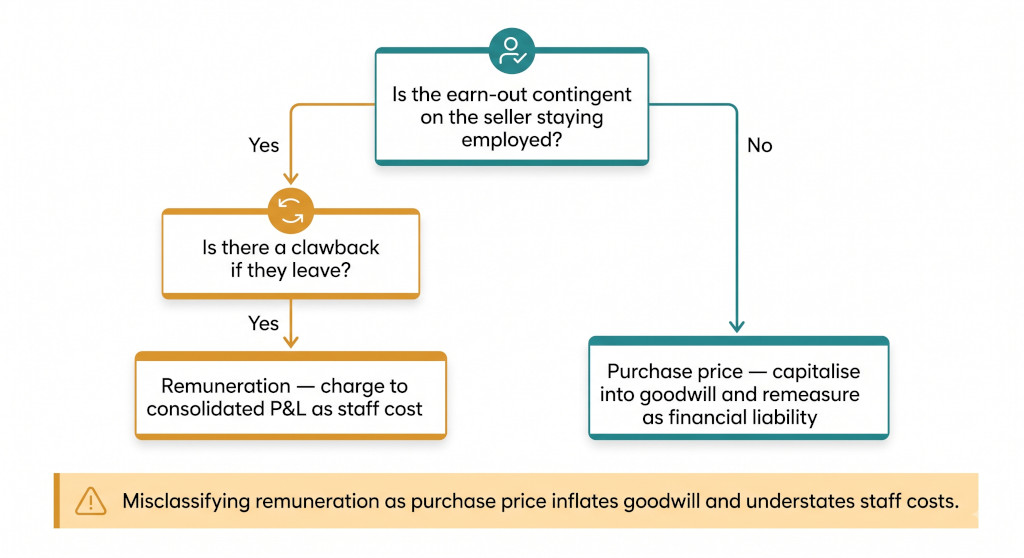
The most frequently mishandled area in professional services acquisition accounting is the boundary between contingent consideration (part of the purchase price, capitalised into goodwill) and remuneration (a post-acquisition staff cost, expensed as incurred). IFRS 3 is explicit: if an earn-out arrangement requires the selling partners to remain employed, and if non-employment would result in forfeiture of the earn-out, the arrangement is economically remuneration — not purchase price.
The test is straightforward in principle and difficult in practice. Consider two partners who sell their consulting firm:
| Partner A earn-out terms | Partner B earn-out terms |
|---|---|
| Earn-out payable regardless of whether Partner A stays employed | Earn-out forfeited if Partner B leaves before end of Year 2 |
| Based purely on the acquired firm’s revenue — no individual performance condition | Based on Partner B’s own client book revenue |
| Transferable to Partner A’s estate if Partner A dies | Not transferable — personal to Partner B |
| Classification: contingent consideration — purchase price | Classification: remuneration — staff cost in consolidated P&L |
Partner A’s earn-out behaves like a vendor earn-out: it accrues to the seller regardless of employment, depends on entity performance not personal contribution, and transfers on death. These are the hallmarks of a price adjustment. Partner B’s earn-out can only be earned by showing up and retaining personal clients — it is functionally indistinguishable from a retention bonus.
Misclassifying Partner B’s arrangement as contingent consideration rather than remuneration has a direct impact on goodwill. If it is treated as purchase price, the initial fair value of the earn-out is capitalised into goodwill. Goodwill is overstated. The annual remeasurement charges sit in finance costs rather than staff costs. If it is correctly treated as remuneration, no initial liability is recognised; instead, the expected earn-out is accrued as a staff cost in the consolidated P&L each period, based on the probability of it being earned. The group’s profit before tax is lower each year, but goodwill is correctly stated.
The consolidation journal for Partner B’s arrangement — treated as remuneration — accrues the expected earn-out as a staff cost each year:
| Partner B’s maximum earn-out | £500,000 |
| Probability of earning maximum (Year 1 assessment) | 60% |
| Expected earn-out | £300,000 |
| Earn-out period (2 years) | ÷ 2 |
| Year 1 consolidated staff cost accrual | £150,000 |
| Account | Dr | Cr |
|---|---|---|
| Staff costs — earn-out remuneration accrual | £150,000 | |
| Accruals — earn-out remuneration | £150,000 |
Year 1 consolidated journal — Partner B’s earn-out treated as post-acquisition remuneration. The accrual is reassessed each period based on the revised probability of performance. If Partner B leaves employment in Year 2, the accrual is reversed; no earn-out is payable. Partner B’s individual service company (if applicable) records salary and fees — not the earn-out accrual. This entry exists only in the group consolidation workings.
The Customer Relationships Intangible — Another Consolidation-Only Entry
Professional services acquisitions almost always require recognition of a customer relationships intangible under IFRS 3. The acquired firm’s client relationships are separable — they can be distinguished from goodwill, they arise from contractual or legal rights, and they can be sold or transferred. IFRS 3 requires them to be recognised at fair value at the acquisition date, separately from goodwill.
The acquired entity — Summit Consulting in this example — records no such intangible in its own accounts. Summit built those client relationships through normal operations and expensed the costs as incurred; nothing is capitalised in Summit’s entity balance sheet for client relationships. At group level, the IFRS 3 fair value exercise puts a value on them — £1,400,000 in this example — and that intangible is then amortised in the consolidated accounts over its estimated useful life.
| Customer relationships intangible — recognised at acquisition | £1,400,000 |
| Estimated useful life | 7 years |
| Annual amortisation (straight-line) | £200,000 |
| Deferred tax liability at acquisition (25% rate) | £350,000 |
| Net intangible recognised at acquisition (after deferred tax) | £1,050,000 |
The amortisation journal in the consolidated workings each year:
| Account | Dr | Cr |
|---|---|---|
| Amortisation of customer relationships intangible | £200,000 | |
| Accumulated amortisation — customer relationships | £200,000 |
Annual consolidation journal — amortisation of the IFRS 3 customer relationships intangible. This charge appears only in the consolidated P&L; Summit’s entity accounts show no intangible amortisation. The deferred tax liability recognised at acquisition unwinds over the same 7-year period as a deferred tax credit in the consolidated P&L.
Pulling It Together — The Consolidated P&L Impact Over Two Years
The table below shows the items that appear in the consolidated P&L but do not appear in any of the individual entity accounts:
| Consolidated P&L item (group-only) | Year 1 | Year 2 |
|---|---|---|
| Finance costs — earn-out remeasurement (Partner A) | £(352,000) | £509,000 |
| Staff costs — earn-out remuneration accrual (Partner B) | £(150,000) | £(150,000) |
| Amortisation — customer relationships intangible | £(200,000) | £(200,000) |
| Deferred tax credit — intangible unwind (25%) | £50,000 | £50,000 |
| Net group-level P&L impact | £(652,000) | £209,000 |
None of these items appear in the trial balances of Apex Advisory Group or Summit Consulting. They exist only in the group consolidation workings. A group accountant consolidating Summit’s accounts for the first time would find a profitable consulting firm with clean entity accounts — and would miss over £600,000 of Year 1 charges if they did not maintain and apply the acquisition accounting schedule correctly at every reporting period.
Acquisition accounting that doesn’t fall apart at year three
BrizoConsol lets you maintain your IFRS 3 acquisition schedules — goodwill, intangibles, contingent consideration — alongside your standard consolidation eliminations, so every period-end produces a consolidated pack that reflects the full economics of the deal.See It In Action
Practical Checklist for Earn-Out Contingent Consideration
- At acquisition, assess every earn-out arrangement against the earn-out vs. remuneration test before recognising any contingent consideration liability. If an earn-out is forfeited on departure, it is remuneration — not purchase price.
- For contingent consideration classified as purchase price, calculate fair value at the acquisition date using expected value (probability-weighted outcomes) discounted at an appropriate rate. Add to goodwill.
- At each subsequent balance sheet date, remeasure cash-settled contingent consideration to fair value. Record the movement in the consolidated P&L (finance costs/income) — not in goodwill.
- For earn-outs classified as remuneration, accrue the expected earn-out as a staff cost each period based on the probability of the performance condition being met. Reverse the accrual if the condition is no longer expected to be met or if employment terminates.
- Maintain an acquisition schedule for every acquired entity showing the goodwill, intangibles, contingent consideration, and deferred tax recognised at acquisition, updated at each reporting date. This schedule drives the group-only consolidation journals that will never appear in any entity trial balance.
- Classify earn-out cash flows correctly in the consolidated cash flow statement: the original fair value portion as a financing activity (repayment of financial liability); any excess payment as an operating activity.
- Disclose the earn-out in the group financial statements — the nature of the arrangement, the range of possible outcomes, the discount rate, and the sensitivity of fair value to key assumptions.
The earn-out is commercially straightforward — the acquired partners earn more if they deliver more. The consolidation accounting is not. Getting it right requires maintaining a separate acquisition workings schedule for the life of the earn-out arrangement, recognising and remeasuring a liability that never touches the acquired entity’s books, and making a clear judgement call on the earn-out vs. remuneration boundary that can materially affect both goodwill and reported profit. For broader context on how professional services group consolidations are structured, the overview in Financial Consolidation for Professional Services Groups sets out the full framework.
Ready to close the gap between your entity accounts and your group accounts?
BrizoConsol is built for finance teams who consolidate complex multi-entity groups — including professional services firms with acquisition accounting, earn-outs, and LLP subsidiaries. Start your free trial today. Start Free Trial