Financial Consolidation for Professional Services Groups: How Multi-Entity Consultancies and Practices Get Clean Group Accounts
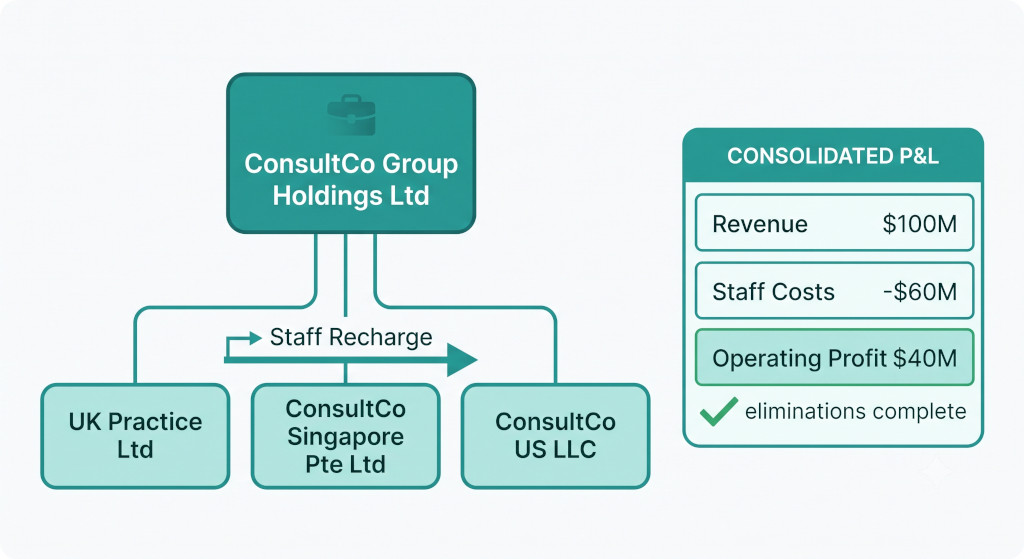
James is Finance Director at a management consulting group. The partnership was founded in London, opened a Singapore office three years ago to serve Asian clients, and last year incorporated a US LLC to pursue a New York opportunity. Each office runs its own books — UK Practice Ltd on Xero, ConsultCo Singapore Pte Ltd on QuickBooks, and the US entity on a local accountant’s desktop software. The monthly close produces three separate sets of accounts in three currencies. Producing a consolidated group P&L for the PE investor on the board takes James’s team the better part of two weeks.
Financial consolidation for professional services groups involves challenges that are fundamentally different from those in product or retail businesses. There is no physical inventory. But there are intercompany staff recharges, shared service cost allocations, management fees flowing from the operating practices to the holding entity, work in progress sitting across multiple entities, and multi-currency translation across three jurisdictions. Each of these must be handled correctly before a consolidated P&L reflects the true economic performance of the group.
This guide explains how professional services groups are typically structured, where the consolidation complexity lies, and how to move from a fortnight of manual effort to a process that takes days.
Automate NCI calculations across all your entities.
BrizoConsol handles non-controlling interest automatically — no manual adjustments required.
What Makes Professional Services Group Consolidation Harder Than Most Sectors
| Challenge | Why it’s professional services-specific |
|---|---|
| Intercompany staff recharges | Consultants seconded across entities generate high-volume recharge transactions monthly — matching and eliminating them is one of the most time-consuming parts of the close |
| Management fees and shared service allocations | Holding entities recover shared costs through fees charged to operating practices — both the income and expense must be eliminated, and amounts change as the group grows |
| Work in progress across entities | WIP sitting in the wrong entity inflates the consolidated balance sheet — intercompany project arrangements must be reviewed as part of every close |
| Multi-currency translation | International offices introduce IAS 21 translation requirements — CTA compounds quickly in professional services groups where overseas offices grow rapidly |
| Inconsistent chart of accounts | Revenue lines in particular are coded differently across entities — “Consultancy Fees” vs “Professional Services Revenue” — requiring careful mapping before consolidated revenue is meaningful |
How Professional Services Groups Are Typically Structured
The legal architecture of a professional services group usually follows one of two patterns. The first is a holding company with wholly owned operating subsidiaries — a common structure for consulting firms, accounting practices, and engineering groups that have expanded internationally. The holding entity may provide shared services (HR, finance, IT, business development) and charge the operating practices for those services. Each operating subsidiary employs its own fee-earners and invoices clients directly.
The second pattern is a partnership or LLP structure at the top, with one or more service companies or international subsidiaries below. Law firms and accountancy practices often use this model. The LLP or partnership itself may not consolidate in the traditional sense, but the service companies and overseas entities must be brought together for management reporting and, increasingly, for bank covenant or investor requirements.
Regardless of structure, three features are almost universal in professional services groups: intercompany recharges for staff or services shared across entities; a holding or management entity that charges a fee downward; and at least one overseas subsidiary operating in a different currency.
The Consolidation Challenges Unique to Professional Services Groups
1. Intercompany staff recharges
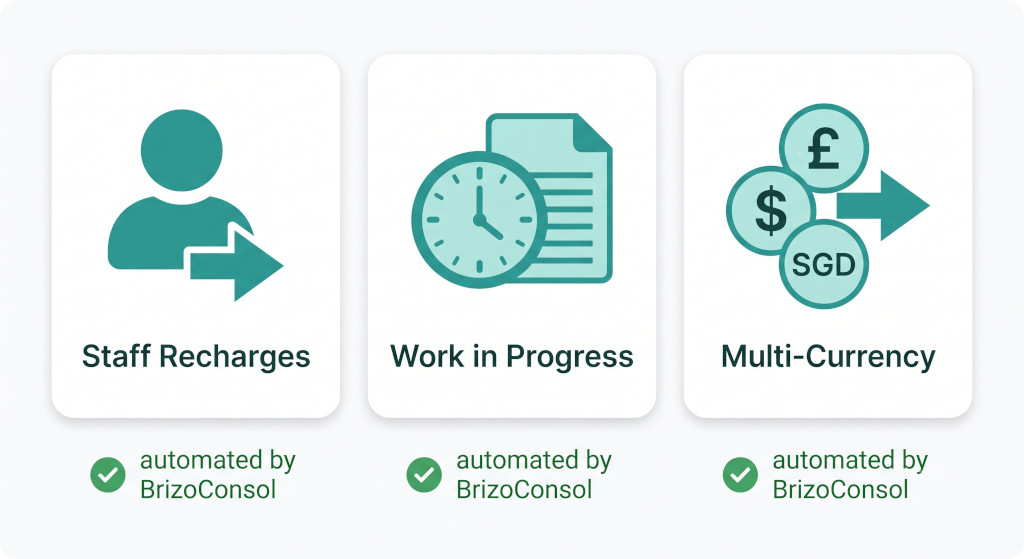
It is common for a UK-based practice to second consultants to an overseas office for a project. The UK entity employs those staff and bears their salary cost; the Singapore entity generates the fee income. Without a recharge arrangement, the UK entity shows inflated costs and the Singapore entity shows inflated margins. With a recharge, an intercompany transaction is created — the Singapore entity pays the UK entity for the staff time — which must then be eliminated at consolidation. In a busy group, dozens of these recharges occur each month, and matching them across entities is one of the most time-consuming parts of the close.
2. Management fees and shared service allocations
The holding entity typically provides services — finance, HR, IT infrastructure, business development — that benefit all operating entities. It recovers those costs through a management fee or cost allocation charged to each subsidiary. From a group perspective, this is simply an internal cash transfer. At consolidation, both the income in the holding entity and the expense in the subsidiaries must be eliminated. If the allocation method changes (as it often does when the group grows), the elimination amounts change too.
3. Work in progress across multiple entities
Professional services firms carry WIP — unbilled time and disbursements on open engagements — on the balance sheet. In a consolidated context, WIP that relates to intercompany projects must be reviewed carefully. If Entity A is performing work for Entity B on a client project that Entity B is billing externally, the WIP should sit in Entity B (the entity with the client relationship), not Entity A. Misclassification of intercompany WIP inflates the consolidated balance sheet.
4. Multi-currency translation
An overseas subsidiary reports in its local currency. Its P&L must be translated at the average rate for the period; its balance sheet at the closing rate; its equity at historical rates. The residual difference goes into the cumulative translation adjustment reserve. For a professional services group where the overseas entities may be growing faster than the domestic practice, the CTA movement can be significant and must be tracked carefully each period. Getting the CTA right at consolidation is non-negotiable for a clean audit.
5. Inconsistent chart-of-accounts structures
Professional services groups that have grown organically or through merger often have inconsistent account structures across entities. “Consultancy fees” in one entity may be coded differently from “professional services revenue” in another. Before consolidation can produce meaningful results, every entity’s accounts must be mapped to a common group chart of accounts. In a services business, this is especially important for revenue recognition — understanding whether the group’s revenue lines are being classified consistently across entities.
A Practical Example: ConsultCo Group
ConsultCo Group Holdings Ltd owns three subsidiaries: UK Practice Ltd (GBP), ConsultCo Singapore Pte Ltd (SGD), and ConsultCo US LLC (USD). The holding entity provides shared services and charges each operating entity a monthly management fee. UK Practice Ltd seconds two senior consultants to the Singapore office each month, recharging their fully loaded cost at cost plus 5%.
Before intercompany eliminations, the combined revenue and cost lines look like this:
| Entity | External Revenue (£) | Intercompany Income (£) | Staff Costs (£) | Operating Profit (£) |
|---|---|---|---|---|
| Holdings Ltd | — | 360,000 | 240,000 | 120,000 |
| UK Practice Ltd | 2,100,000 | 84,000 | 1,260,000 | 684,000 |
| ConsultCo Singapore (translated) | 980,000 | — | 637,000 | 200,000 |
| ConsultCo US (translated) | 740,000 | — | 518,000 | 102,000 |
| Combined (pre-elimination) | 3,820,000 | 444,000 | 2,655,000 | 1,106,000 |
The intercompany income of £444,000 comprises the management fee income in Holdings (£360,000) and the staff recharge income earned by UK Practice from the Singapore entity (£84,000 — the fully loaded cost of two seconded consultants plus 5% mark-up). Both flows must be eliminated. The Singapore entity’s staff costs include the £84,000 recharge it has paid to UK Practice; that cost also reverses at consolidation, replaced by the underlying salary cost that sits in UK Practice.
After eliminations, the consolidated view is:
| Line Item | Amount (£) |
|---|---|
| External Revenue | 3,820,000 |
| Consolidated Revenue | 3,820,000 |
| Staff Costs (consolidated) | (2,655,000) |
| Less: Management fee expense elimination (operating entities) | 360,000 |
| Less: Staff recharge expense elimination (Singapore) | 84,000 |
| Consolidated Staff and Operating Costs (net) | (2,211,000) |
| Consolidated Operating Profit | 1,609,000 |
| Consolidated Operating Margin | 42.1% |
The operating margin of 42.1% is the number that matters to the board and the PE investor. The pre-elimination combined figure of £1,106,000 understates true profitability because the elimination of the management fee (which was an expense in the operating entities) releases £360,000 back into the consolidated result — income and expense cancel, and the true economic profit of the group is revealed.
A common misconception is that eliminating the management fee “increases” group profit. It does not. The elimination simply removes a transaction that was never real from the group’s perspective — the cash moved between entities under common control, with no external counterparty. The consolidated profit is what the group earned from external clients.
The Intercompany Recharge Elimination in Practice
The key elimination journals for a professional services group are straightforward in principle, though the volume of recharge lines can make them complex to maintain manually.
Elimination 1 — Management fee income and expense:
| Dr £ | Cr £ | |
|---|---|---|
| Management Fee Income (Holdings Ltd) | 360,000 | |
| Management Fee Expense (Operating Entities) | 360,000 | |
| Total | 360,000 | 360,000 |
Being: elimination of intra-group management fee. Net effect on consolidated equity: nil.
Elimination 2 — Intercompany staff recharge:
| Dr £ | Cr £ | |
|---|---|---|
| Staff Recharge Income (UK Practice Ltd) | 84,000 | |
| Staff Recharge Expense (ConsultCo Singapore) | 84,000 | |
| Total | 84,000 | 84,000 |
Being: elimination of intercompany staff recharge. The underlying salary cost remains in UK Practice’s staff costs, correctly reflecting where the economic cost sits.
Elimination 3 — Intercompany receivable and payable balances:
| Dr £ | Cr £ | |
|---|---|---|
| Intercompany Payable (Operating Entities) | 444,000 | |
| Intercompany Receivable (Holdings / UK Practice) | 444,000 | |
| Total | 444,000 | 444,000 |
Being: elimination of intercompany balance sheet positions. Any difference between receivable and payable balances indicates timing differences or reconciling items that must be investigated before the consolidated balance sheet can be signed off.
Work in Progress (WIP) in a Consolidated Context
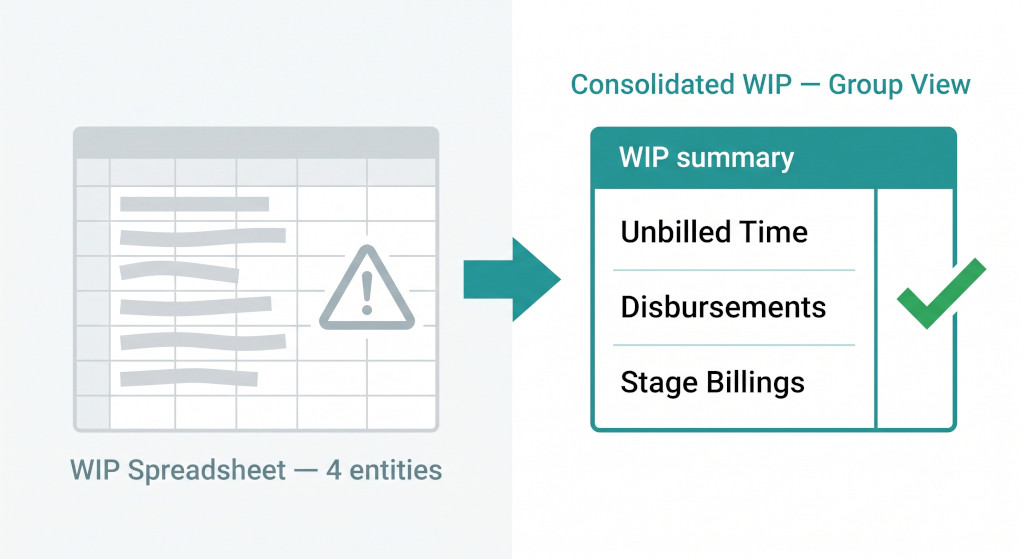
WIP on the consolidated balance sheet should represent the value of work performed for external clients that has not yet been billed. In a multi-entity group, the risk is that intercompany projects inflate the consolidated WIP figure.
Consider a scenario where the UK Practice records WIP for work performed on a client project being managed by the Singapore entity. If both entities recognise WIP independently, the same economic activity appears twice on the consolidated balance sheet. The correct treatment is to ensure WIP sits only in the entity that holds the client contract and will invoice externally — or, where work is genuinely split, to recognise WIP at the entity level only for the value delivered to the external client by each entity directly.
In practice, most professional services groups do not have a formal intercompany WIP review as part of their close process. It tends to surface at year-end when the auditors query the WIP balance — at which point it is expensive to untangle. Building a WIP review into the intercompany elimination process from the outset prevents the problem from compounding.
Currency Translation for International Offices
ConsultCo Singapore reports in SGD and ConsultCo US reports in USD. Before either entity can be included in the GBP consolidated accounts, their financials must be translated following IAS 21: P&L items at the average rate, balance sheet at the closing rate, and equity at historical rates. The resulting translation difference accumulates in the cumulative translation adjustment reserve in the consolidated statement of changes in equity.
For a professional services group where the overseas offices are growing rapidly, the CTA movement can be material. A strengthening USD or SGD relative to GBP will increase the reported value of those subsidiaries’ assets when translated — a positive CTA movement. A weakening will reduce it. Neither flows through the P&L; both affect the balance sheet and the equity position. Auditors will expect a full CTA roll-forward for each overseas entity, reconciling the opening balance, the current-period movement, and the closing balance.
Professional services groups with overseas offices often underestimate how quickly the CTA balance grows. After three years of significant USD/GBP movement, it is not unusual for the CTA reserve to represent 8–12% of the overseas subsidiary’s net assets. Tracking this accurately from the outset saves significant audit preparation time.
How BrizoConsol Handles Professional Services Group Consolidation
BrizoConsol connects directly to Xero, QuickBooks, MYOB, and Zoho Books. For a group like ConsultCo — where the UK entity runs on Xero and the Singapore entity runs on QuickBooks — BrizoConsol pulls trial balance data from both simultaneously, without requiring manual exports or reformatting.
| Capability | How BrizoConsol handles it for professional services groups |
|---|---|
| AI account mapping | Identifies how each entity’s accounts relate to the group chart of accounts — learns that “Consultancy Fees” in the UK and “Professional Services Revenue” in Singapore map to the same group revenue line; remembers that mapping permanently |
| Automated intercompany eliminations | Management fees, staff recharges, and intercompany loan interest configured once and run automatically each period; when recharge amounts change, the updated amounts apply to existing rules without rebuilding setup from scratch |
| IAS 21 currency translation | Exchange rates maintained centrally; P&L and balance sheet translated at correct rates automatically; CTA calculated and tracked for each overseas entity; CTA roll-forward available as a standard report |
| Consolidated reporting | Group P&L showing true external revenue, consolidated staff costs, and group operating margin available within days of period end — not two weeks |
The result for a group like ConsultCo is a close process that compresses from two weeks to two or three days. The partners receive their consolidated P&L by the fourth working day of the month. The PE investor gets the board pack on time. And James’s team stops spending the close period reconciling spreadsheet tabs and starts using the numbers to run the business.
Getting Started: What Professional Services Groups Need to Prepare
The setup for a professional services group consolidation follows three preparatory steps:
1. Agree the group chart of accounts
Focus particularly on how revenue lines are classified across entities and which accounts are designated as intercompany. In professional services groups, revenue classification is the most common source of inconsistency across entities — resolve it at the mapping stage, not at consolidation time.
2. Document all intercompany arrangements
Management fees, staff recharge rates, intercompany loans, and any intercompany project billing arrangements should all be listed, with the account codes used on each side of each transaction. This is the input BrizoConsol uses to configure the standing elimination rules.
3. Gather historical exchange rates for overseas entities
Specifically, the rate at which equity was originally contributed to each overseas subsidiary. This supports the CTA calculation from the first period and avoids a reconciliation gap when the auditors request the CTA roll-forward.
With those inputs in place, BrizoConsol can typically be live and producing consolidated output within a single working day. The first period may involve some mapping refinement, but by the second close most professional services groups are running their full consolidation — eliminations, translation, and reports — in hours rather than days.
Conclusion: Professional Services Groups Need Consolidation That Reflects How They Actually Work
A professional services group is not a simple business to consolidate. The combination of high-volume staff recharges, management fee eliminations, intercompany WIP risk, multi-currency translation across growing overseas offices, and inconsistent revenue coding across entities creates a consolidation requirement that manual processes handle poorly and spreadsheets handle worse.
The finance teams that have solved this consistently have one thing in common: they have stopped treating the monthly close as a manual assembly exercise and built it on a process that runs systematically. Staff recharge eliminations configured once and applied every period. Currency translation at the correct IAS 21 rates without manual worksheets. Account mappings that learn and persist. A CTA roll-forward that is always current.
For a group like ConsultCo, that shift means James’s team closes in days instead of weeks, the board pack reaches the PE investor on time, and the consolidated accounts actually reflect the economic reality of the group — not an approximation of it assembled under pressure at the end of the month.
Ready to close your professional services group in days, not weeks?
BrizoConsol connects to Xero, QuickBooks, MYOB, and Zoho Books. Intercompany recharges, management fees, currency translation, and consolidated reports — automated from day one. Start Free Trial