Financial Consolidation for Hospitality Groups: How Multi-Entity Hospitality Businesses Get Clean Group Accounts
Hotels, restaurants, and accommodation chains face a consolidation picture unlike almost any other industry. Here is how to handle it correctly.
A four-property hotel group. A restaurant chain with six operating companies under a shared brand. A resort that owns its land through a separate property holding entity, operates its rooms through another, and manages the whole thing through a head office management company. These are the structures that finance teams in hospitality deal with every month — and none of them are straightforward to consolidate.
The numbers move across entities constantly. The management company charges the hotels. The hotels share a central reservation system whose cost gets allocated across properties. One entity’s peak season is another’s off-season. And if you operate internationally, the NZD and AUD versions of the same KPIs tell very different stories depending on what rate you use to translate them.
Automate NCI calculations across all your entities.
BrizoConsol handles non-controlling interest automatically — no manual adjustments required.
This guide explains the consolidation challenges specific to hospitality groups, walks through how intercompany eliminations work in this sector, and shows what a consolidated hospitality group accounts process actually looks like in practice.
Why Hospitality Groups Are Structured the Way They Are
To understand why consolidation is complex in hospitality, you first need to understand why the sector almost always uses multiple legal entities — even when it might be simpler not to.
The most common reason is liability separation. Each hotel or restaurant operates under its own company so that a claim against one property does not flow to the others. The second reason is financing: lenders often require a specific entity structure before they will advance against a property. The third is tax: management company structures let profitable operating entities make deductible payments to a related service company, which can smooth the tax position across the group.
The result is that most hospitality groups of any size end up with at least three types of entity:
- Operating entities — the hotels, restaurants, or venues themselves. Revenue is earned here; staff are employed here.
- A management or services entity — charges the operating entities for management services, reservations, marketing, branding, and sometimes finance function costs.
- Property holding entities (PropCo) — own the land and buildings, and charge operating entities rent. These sometimes involve third-party investors or co-ownership structures that add further complexity.
Once you have these three types of entity trading with each other, you have a consolidation job. Every transaction flowing between them needs to be identified, matched, and eliminated before the group accounts can be finalised.
The Consolidation Challenges Unique to Hospitality Groups
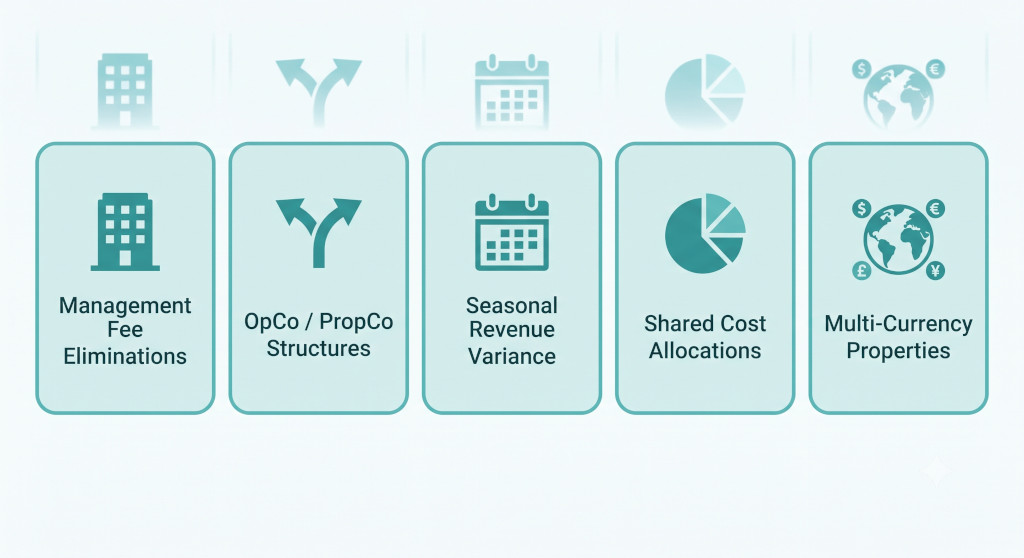
1. Intercompany Management Fees
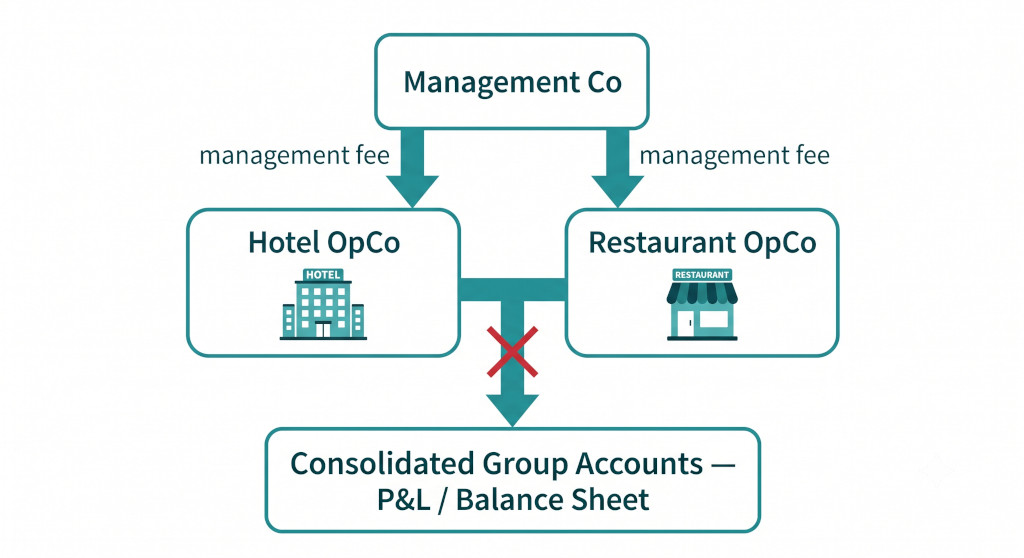
The management company charges each operating entity a fee — commonly a percentage of revenue, a flat monthly fee, or a combination of both. From the group’s perspective, this is an internal transfer. The management company has revenue; the hotels have an expense. When you consolidate, both sides cancel out, and neither the revenue nor the expense should appear in the group accounts.
What makes this tricky in practice is timing. The management company raises its invoices monthly, but individual properties sometimes book the expense in a different period — particularly around year-end. If the management company has recognised revenue in December but one of the hotels accrues the management fee expense in January, you have a mismatch. Even though the amounts are equal and the transaction is purely internal, the mismatch creates a difference in your consolidated numbers that has to be investigated and resolved before you can close.
Practical note: Build a standard closing-date policy for management fee accruals across all entities and document it. If every entity recognises the fee on the last day of the month, mismatches disappear at source rather than being discovered at consolidation time.
2. OpCo / PropCo Rent and Lease Eliminations
If the group owns a property through a separate holding entity, the operating company pays rent to the property holding company. In the group accounts, that rent is an intercompany transaction and must be eliminated. The PropCo’s rental income disappears; the OpCo’s rent expense disappears.
What remains in the group accounts is the underlying asset (the property at its carrying value), the associated depreciation, and the group’s net position. This is what external stakeholders — lenders, investors, potential acquirers — actually need to see.
Where groups with IFRS-reporting obligations also need to watch is IFRS 16: right-of-use assets and lease liabilities recorded at the OpCo level are intercompany balances from the group’s perspective and need to be eliminated as part of the consolidation. Many hospitality groups running on cloud accounting software find their consolidation software handles the income/expense elimination but misses the balance sheet entries. Make sure you check both sides.
3. Shared Cost Allocations
A hotel group’s central reservation system, loyalty programme, shared marketing budget, and group insurance all benefit every property in the group. The management entity typically pays for these centrally and then recovers a portion from each hotel through an allocation or recharge. These allocations are intercompany transactions that must be eliminated on consolidation.
The challenge is that cost allocations are often more granular than management fees — there may be separate charges for technology, marketing, finance, and HR — and matching them across entities in the general ledger requires a consistent intercompany account coding structure across every entity in the group. If one property books the technology recharge to IT Expenses and another books it to Overheads, manual matching at consolidation time is genuinely painful.
4. Seasonal Revenue Variance Across the Group
Unlike most industries, hospitality groups often contain entities with opposing seasonal patterns. A ski resort does its peak revenue in winter; a beach property does its peak in summer. A city-centre business hotel is quiet in December but strong in February; a holiday resort is the reverse.
This creates a situation where the consolidated monthly accounts swing significantly by season in ways that don’t reflect operational performance at the group level. Finance teams preparing group accounts for boards or lenders need to be especially careful about how they present this — trailing twelve-month comparisons, same-period year-on-year analysis, and RevPAR (Revenue per Available Room) by entity tend to be more useful for hospitality groups than standard month-on-month variances.
5. Multi-Currency Properties
Groups with international properties need to translate each foreign subsidiary’s accounts into the group’s presentation currency before consolidation. Under IAS 21, the rules are: translate P&L items at the average rate for the period, translate balance sheet items at the closing rate, and take the resulting difference to a Currency Translation Adjustment (CTA) in group equity.
For hospitality groups, the rate-sensitivity is high because revenue is large relative to asset values. A 5% movement in the AUD/NZD rate will have a material effect on a NZD property’s contribution to the group P&L when translated back to AUD — even if the property performed consistently in its local currency.
A Worked Example: Meridian Hospitality Group
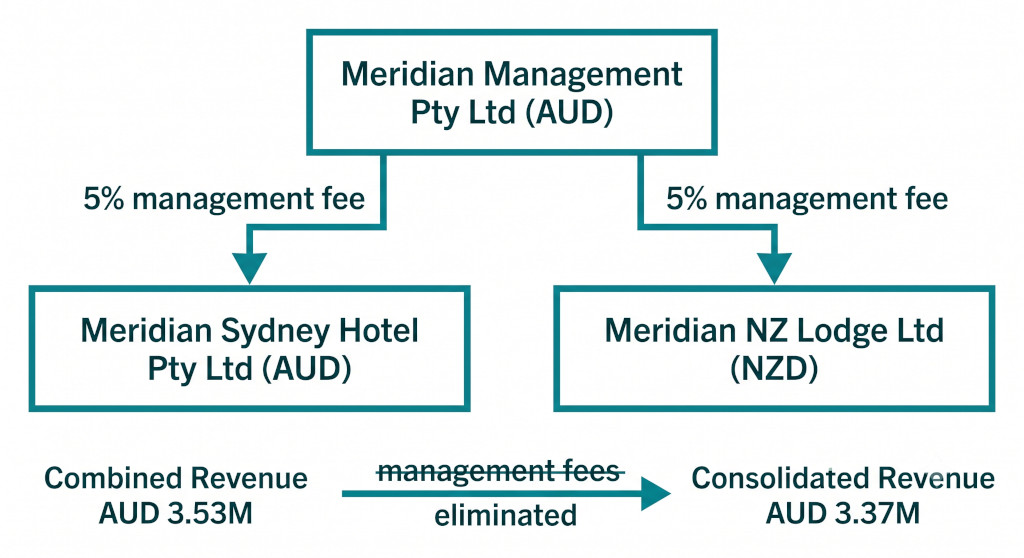
Consider a fictional group, Meridian Hospitality Group, which operates through three entities:
- Meridian Management Pty Ltd — the management company (AUD), charges a 5% management fee on operating revenue to each hotel
- Meridian Sydney Hotel Pty Ltd — operating entity, Sydney (AUD), revenue AUD 2.0M for the year
- Meridian NZ Lodge Ltd — operating entity, Queenstown (NZD), revenue NZD 1.5M for the year, translated at average rate 0.91 = AUD 1.365M
Before consolidation, the combined accounts look like this:
Combined (Pre-Consolidation) P&L — AUD thousands
| Line | Management Co | Sydney Hotel | NZ Lodge (translated) | Combined |
|---|---|---|---|---|
| Revenue | 168 | 2,000 | 1,365 | 3,533 |
| Management fee income | 168 | — | — | — |
| Operating revenue | — | 2,000 | 1,365 | — |
| Management fee expense | — | (100) | (68) | (168) |
| Other operating costs | (90) | (1,500) | (1,050) | (2,640) |
| Net profit | 78 | 400 | 247 | 725 |
The combined revenue shows AUD 3.533M — but AUD 168K of that is the management fee the group paid to itself. The combined profit shows AUD 725K — but AUD 168K of both income and expense cancel each other out internally. The real economic picture is different.
After consolidation — eliminating the management fee income and expense, and adding a CTA for the NZD translation difference:
Consolidated P&L — AUD thousands
| Line | Amount | Note |
|---|---|---|
| Group revenue | 3,365 | AUD 2,000 + NZD 1,365 translated; management fees eliminated |
| Management fee income | (168) | Eliminated — internal to group |
| Management fee expense | 168 | Eliminated — internal to group |
| Group operating costs | (2,640) | External costs only |
| Group management costs | (90) | Management Co’s own external costs remain |
| Consolidated net profit | 635 | Correct group economic profit |
| CTA (NZD translation) | (14) | Taken to group equity, not P&L |
Consolidated revenue is AUD 3.365M, not 3.533M. Group profit is AUD 635K, not 725K. The management company’s external overheads (AUD 90K) still appear, because those are genuine costs borne by the group — but the intercompany management fee circuit disappears completely. This is what the group’s bankers, investors, and directors actually need to see.
What the CTA represents: The NZD balance sheet is translated at the closing rate and the NZD P&L is translated at the average rate. Because those two rates differ, a balancing difference arises — that is the CTA. It is not a real gain or loss; it is the mathematical consequence of measuring a foreign entity in a different currency across different dates. Under IAS 21 it sits in group equity until the subsidiary is sold.
How to Handle Intercompany Loans in a Hospitality Group
It is common for the management company or a parent entity to advance funds to operating entities — for a refurbishment, a working capital bridge, or to cover a loss-making season. These intercompany loans need to be eliminated in the consolidated balance sheet: the loan receivable in one entity and the loan payable in another are the same instrument viewed from both sides, and they net to zero in the group accounts.
Interest charged on the loan adds a further step: the interest income in the lender entity and the interest expense in the borrower entity are also intercompany and must be eliminated from the consolidated P&L.
The elimination journal for a AUD 200K intercompany loan with AUD 8K interest for the year looks like this:
Elimination Journal — Intercompany Loan and Interest
| Dr Intercompany loan payable (OpCo) | 200,000 |
| Cr Intercompany loan receivable (Management Co) | |
| 200,000 | |
| Dr Intercompany interest income (Management Co) | 8,000 |
| Cr Intercompany interest expense (OpCo) | |
| 8,000 |
If the loan carries a below-market interest rate — a common arrangement between related entities — there may also be an IFRS 9 fair value adjustment to consider in statutory accounts. For management accounts purposes most groups simply eliminate the loan and interest and note the arrangement in the disclosures.
Segment and KPI Reporting Across a Hospitality Group
One of the most valuable things a consolidated view gives a hospitality group is the ability to compare entity performance on a like-for-like basis. The key metrics that matter most are:
- RevPAR (Revenue per Available Room) — total room revenue divided by available rooms. This should be tracked at entity level alongside consolidated group totals, because blending a resort’s RevPAR with a city hotel’s gives a meaningless average.
- EBITDA by entity — management company overheads are allocated across entities for internal purposes. Consolidated EBITDA shows what the group actually generates before debt service and tax.
- Occupancy rate by property — again, entity-level detail preserved alongside the group view is what directors and asset managers need.
- Direct payroll as a % of revenue — hospitality is labour-intensive. Tracking this ratio across entities flags operational efficiency differences between properties early.
Finance leaders in hospitality groups often need both a statutory consolidation view (IFRS-compliant, intercompany fully eliminated) and a management reporting view (property-level P&Ls with management fees shown as a line item rather than eliminated). These are two different outputs from the same underlying data, and good consolidation software lets you run both without maintaining two separate workbooks.
See How BrizoConsol Handles Hospitality Group Consolidation
BrizoConsol pulls live data from Xero, MYOB, QuickBooks, and Zoho Books across every entity in your group — eliminating intercompany management fees, rents, loans, and cost allocations automatically, and translating foreign currencies under IAS 21. See it in action
Where the Spreadsheet Approach Breaks Down
Many hospitality groups run their consolidation in Excel. It works — until it doesn’t. The specific failure modes in hospitality are worth naming:
Management fee mismatches. When one entity’s books are a day late being closed, the management fee income and expense don’t net to zero. In a spreadsheet, someone has to find and reconcile this manually every month. In consolidation software with live source-data feeds, the mismatch is flagged automatically.
Currency translation errors. Applying the correct average rate to P&L items and the closing rate to balance sheet items, consistently, across every account in a foreign entity’s trial balance, in a spreadsheet formula, is error-prone. The CTA calculation that flows from this is particularly sensitive — a single rate applied to the wrong account can move the CTA figure by tens of thousands.
Version control. Hospitality groups with seasonal peaks often need to restate prior periods when late invoices come in from suppliers. In a spreadsheet-based consolidation, restatement cascades through multiple tabs and multiple versions of the file. The risk of the wrong version going to the board is real.
Entity-level drill-down. When a lender asks which property drove the revenue shortfall last quarter, the spreadsheet answer is manual — someone has to go back into each entity’s accounts and pull the data. A consolidation tool that maintains the link between the consolidated figure and the source transaction makes this a thirty-second exercise.
Watch for this: If your management fee is a percentage of operating revenue, and operating revenue is translated at the average rate for a foreign entity, the management fee amount also needs to be translated at the average rate. Groups sometimes accidentally translate the management fee at the closing rate because it’s a balance carried at period end — this introduces a spurious difference in your elimination that isn’t a real mismatch.
Setting Up a Hospitality Group for Clean Consolidation
If you are building or improving your consolidation process for a hospitality group, the highest-impact steps are:
First, establish a common chart of accounts across all entities. The management company, the operating hotels, and the property holding entity don’t all have the same activities — but they should all use the same account codes for intercompany items. If every entity uses code 2800 for “Intercompany Payable” and code 4800 for “Intercompany Income,” the matching process is mechanical rather than judgement-based.
Second, adopt a closing calendar that all entities adhere to. Management fees, rent charges, and cost allocations should be raised and posted by the same date in every entity. The management company should not be closing its books on the 5th of the following month while the hotels close on the 3rd.
Third, document your intercompany agreement. The management fee rate, the cost allocation methodology, and the interest rate on any loans should all be in writing — not because IFRS requires it for management accounts, but because it makes every consolidation review faster and every audit question easier to answer.
Fourth, use consolidation software that connects directly to your accounting systems. Pulling trial balances from Xero or MYOB into a consolidation tool eliminates re-keying errors and gives you a real-time view of where the numbers stand before close — rather than a six-day spreadsheet exercise after close.
Start Consolidating Your Hospitality Group in Minutes
Connect your entities’ Xero, MYOB, QuickBooks, or Zoho Books accounts to BrizoConsol. Intercompany management fees, rents, and loans are identified and eliminated automatically. Your first consolidated P&L is ready before your close cycle finishes. Start Your Free Trial
Summary
Hospitality groups consolidate across a distinctive mix of entity types — management companies, operating entities, and property holding structures — with intercompany management fees, rent charges, cost allocations, and intercompany loans flowing between them. Seasonal patterns create month-on-month revenue volatility that requires careful framing in board and lender reporting. International properties add IAS 21 currency translation and CTA calculations on top.
The consolidation mechanics are the same as any multi-entity group — eliminate intercompany transactions, translate foreign currencies, aggregate the rest — but the volume and variety of intercompany flows in a typical hospitality structure means that manual, spreadsheet-based consolidation is unusually fragile. Groups that move to purpose-built consolidation software typically cut their monthly close time significantly and gain the entity-level drilldown that lenders and directors increasingly expect as standard.