Why Does My CTA Not Reconcile?
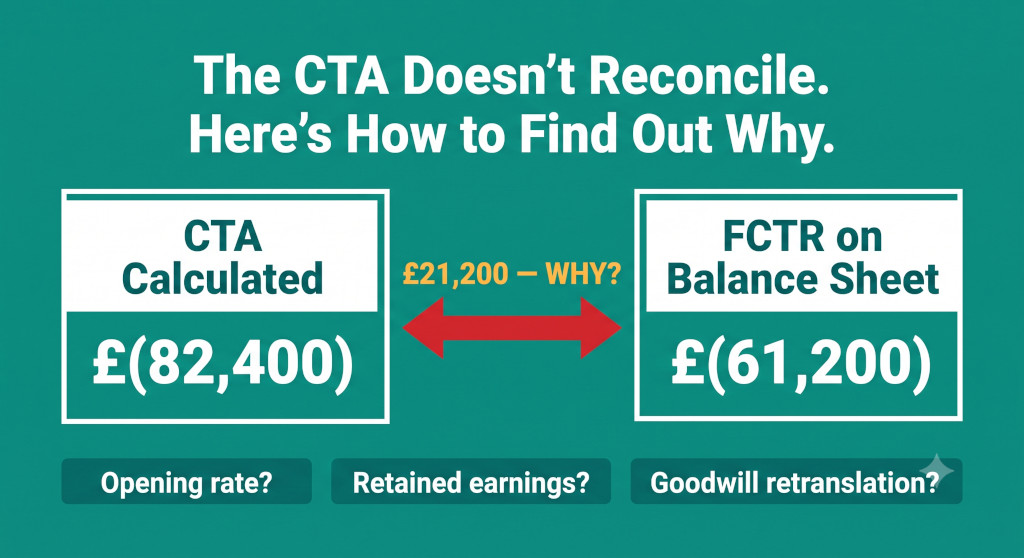
Anna had followed the three-rate rule correctly. P&L at the average rate, balance sheet at the closing rate. She had even calculated the CTA using the standard formula and got £(82,400) for her French subsidiary. But when she checked the foreign currency translation reserve on the consolidated balance sheet — the account where the CTA sits — it showed £(61,200). The difference was £21,200, and it had no obvious source.
She checked her rates. She recalculated the closing net assets. She verified the opening balance. Everything looked right, and yet the two figures wouldn’t agree. The CTA calculation said one thing; the balance sheet said another.
The CTA reconciliation failure is one of the most frustrating problems in multi-currency consolidation because the CTA itself is already a residual — a plug figure that exists to absorb rate differences — and when that plug doesn’t reconcile, there is no intuitive place to look first. This post provides the diagnostic framework: seven root causes ordered by frequency, and a worked example showing how to trace a specific reconciliation gap to its source.
Automate NCI calculations across all your entities.
BrizoConsol handles non-controlling interest automatically — no manual adjustments required.
What a Correctly Reconciled CTA Looks Like
Before diagnosing the failure, it helps to be precise about what the CTA reconciliation is actually checking. There are two distinct reconciliations that practitioners sometimes conflate, and they fail for different reasons.
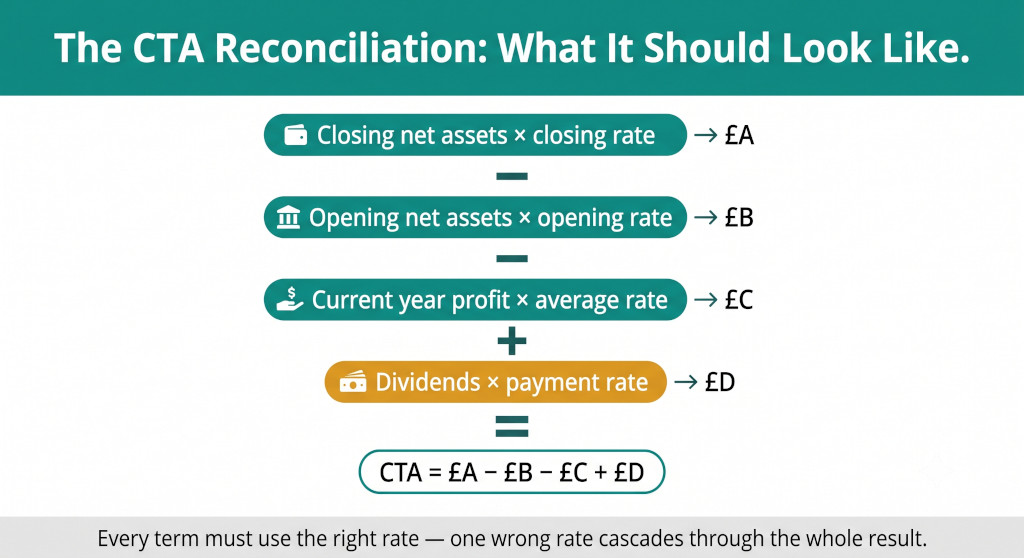
The current-year CTA movement reconciliation asks whether the CTA for the current period — calculated as the difference between the closing net assets at the closing rate and the “expected” closing net assets (opening net assets at the opening rate plus current year profit at the average rate less dividends at payment rates) — agrees to the movement posted in the foreign currency translation reserve in the period.
The cumulative FCTR balance reconciliation asks whether the total accumulated balance in the foreign currency translation reserve on the consolidated balance sheet agrees to the sum of all annual CTA movements since the subsidiary was first consolidated.
A failure in the current-year movement reconciliation is usually caused by an error in the current period’s calculation. A failure in the cumulative balance reconciliation can be caused by a current-period error, a prior-period error, or a failure to roll the reserve forward correctly. Establishing which reconciliation is failing — and whether the gap is new this period or was present in prior periods — is the first diagnostic step, for exactly the same reason as with the consolidated balance sheet imbalance: a persistent gap points to a prior-period error; a new gap points to the current close.
The CTA formula for a single subsidiary in a single period is:
CTA = (Closing net assets in functional currency × closing rate) MINUS (Opening net assets in functional currency × opening rate) MINUS (Current year profit in functional currency × average rate) PLUS (Dividends paid in functional currency × rate at payment date)
Each term uses a different rate. An error in any one rate — using this year’s closing rate instead of last year’s closing rate as the “opening rate”, or using the closing rate instead of the average rate for profit — will cause the CTA to be wrong and the reconciliation to fail.
Seven Root Causes of a CTA Reconciliation Failure
Root Cause 1: Retained Earnings Translated at the Closing Rate Instead of Derived
This is the most common cause, and it produces a CTA reconciliation failure that looks, at first glance, like a rate error but is actually a structural error in how retained earnings is being handled.
The correct treatment of closing retained earnings for a foreign subsidiary in the group accounts is to derive it — starting from the prior period’s group retained earnings for that entity, then adding the current year’s profit translated at the average rate, then deducting any dividends translated at the payment-date rate. The result is the group retained earnings for that subsidiary in the presentation currency.
What many consolidation models do instead is translate closing retained earnings — taking the subsidiary’s local-currency retained earnings balance and multiplying it by the closing rate. This is the wrong approach. It treats retained earnings as if it were a balance sheet item (which translates at the closing rate) rather than the accumulated sum of historical P&L items (each of which should translate at that period’s average rate). The difference between the “translate at closing rate” figure and the “derive from accumulated average-rate profits” figure is a number that won’t match the CTA, and the reconciliation will fail by that exact amount.
How to identify this error: In the consolidation model, find the formula for closing retained earnings for the foreign subsidiary. If it multiplies a local-currency retained earnings balance by any exchange rate — closing, average, or otherwise — it is wrong. Closing retained earnings in the group model for a foreign subsidiary should be a prior-period carry-forward plus a current-period addition, with no exchange rate multiplication on the closing balance itself.
Root Cause 2: Wrong Opening Rate
The “opening rate” in the CTA formula is the prior period’s closing rate — the rate on the last day of the previous reporting period. It is not this period’s average rate, it is not last year’s average rate, and it is not a rate from any other point in time.
If the model uses the current period’s average rate as the opening rate — perhaps because the rate table has a single “average rate” column and the preparer used it for both the opening and average rate inputs — the opening net assets will be translated at the wrong rate. Since the opening net assets are typically the largest component in the CTA formula, a rate error here has the largest impact on the result.
Check: In the rate table or rate input section of the consolidation model, confirm that there are three distinct rates for each currency for each period: opening (= prior period closing), average, and closing. If there are only two rates (average and closing), the opening rate input is missing and the formula is using a substitute that is wrong.
Root Cause 3: Dividends Omitted or Translated at the Wrong Rate
Dividends paid by the foreign subsidiary during the period reduce its net assets and should be reflected in the CTA calculation. Specifically, dividends must be added back in the CTA formula (since the dividend reduces closing net assets but was eliminated in the consolidation, it must be recognised as a separate item in the CTA workings). The dividend should be translated at the exchange rate on the date it was paid, not at the average rate or the closing rate.
Two common errors: omitting the dividend from the CTA formula entirely (which means the closing net assets appear lower than expected and the CTA is understated or overstated depending on currency direction), or including the dividend but using the average rate rather than the payment-date rate. The difference between the average rate and the payment-date rate is usually small but can be meaningful for large dividends paid at a time when the currency moved significantly.
Root Cause 4: Mid-Year Acquisition — Wrong Opening Net Assets
For a subsidiary acquired during the current period, the “opening net assets” in the CTA formula is not zero and is not the subsidiary’s net assets at the beginning of the group’s financial year. It is the fair value of the subsidiary’s net assets at the acquisition date, translated at the exchange rate on that date. This is the rate and value at which those net assets entered the consolidated balance sheet — from that point forward, the CTA tracks the translation movement on those fair-value net assets.
A common error for mid-year acquisitions is to use the book value of net assets at acquisition rather than the fair value after purchase price allocation. If PPA adjustments increased net assets (through property uplifts, customer relationship intangibles, or other fair value items net of deferred tax), using book value understates the opening net assets in the CTA formula, which overstates the CTA.
The second common error for mid-year acquisitions is to use the average rate for the acquisition-date translation rather than the spot rate on the acquisition date. Unless the acquisition occurred on the first day of the period (making the average rate irrelevant as an approximation), the correct rate is the rate on the specific date consideration was transferred and control passed.
Root Cause 5: CTA Not Rolled Forward — Recalculated From Scratch
The foreign currency translation reserve is cumulative. Each period’s CTA movement is added to the prior period’s FCTR balance to produce the new closing FCTR balance. If the consolidation model recalculates the CTA from scratch each period — applying the opening/average/closing rate formula to the current period’s figures only and posting the result as the full FCTR balance rather than as the movement — the FCTR will equal only the current year’s CTA, not the accumulated total.
In the first period of consolidation, the two approaches give the same answer (since the opening FCTR is zero). From the second period onwards, they diverge: the “recalculate from scratch” approach systematically understates (or overstates, depending on currency direction) the cumulative FCTR by the amount of all prior periods’ CTA. The reconciliation gap grows each period as the prior-period CTA movements accumulate in the correct balance but are wiped each time in the incorrect model.
The cumulative FCTR reconciliation is the test: does the FCTR balance equal the sum of every annual CTA movement since the subsidiary was first consolidated? If the model recalculates rather than rolls forward, the sum of annual movements will exceed (or fall short of) the FCTR balance by the amount of all prior movements except the current year’s.
Root Cause 6: NCI Share of CTA Not Split Out
For a foreign subsidiary with a non-controlling interest, the CTA must be split between the parent shareholders’ portion (which goes to the parent’s FCTR within equity) and the NCI’s portion (which adjusts the NCI balance). The split follows the same proportions as profit attribution: if the group owns 75%, then 75% of the CTA goes to the parent’s FCTR and 25% adjusts the NCI balance.
If the full CTA is credited to the parent’s FCTR without splitting — either because the NCI/CTA split was not implemented in the model or because the subsidiary was recently acquired and the split was overlooked — the parent’s FCTR will be overstated and the NCI balance will be understated. The FCTR reconciliation will fail, and the NCI closing balance reconciliation will also fail, by the same amount (the NCI’s share of the cumulative CTA).
Root Cause 7: Goodwill Retranslation Omitted
This is the most frequently overlooked cause of a CTA reconciliation failure, particularly for practitioners who are otherwise applying the translation rules correctly.
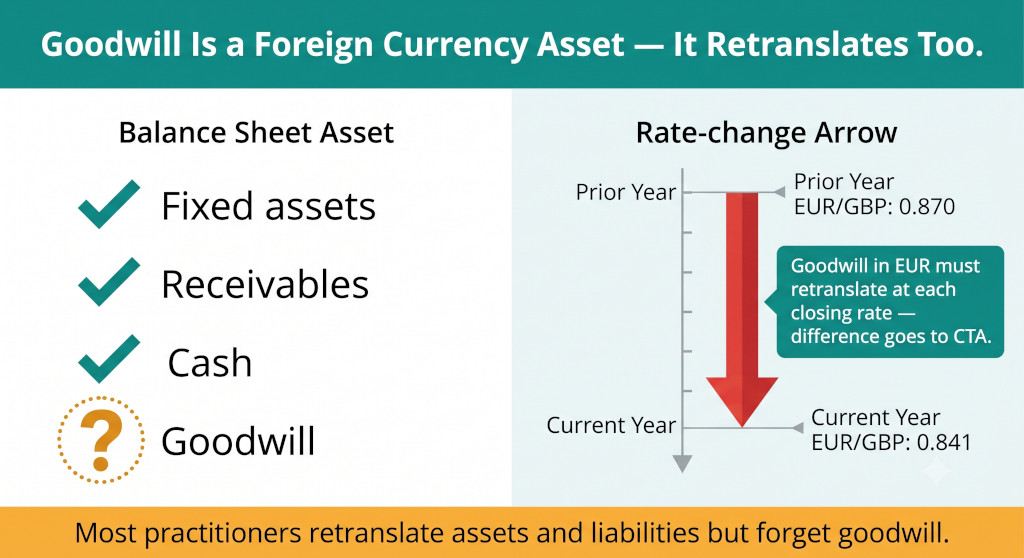
Goodwill arising on the acquisition of a foreign subsidiary is denominated in the subsidiary’s functional currency, not in the group’s presentation currency. It arises because the consideration was paid in (or is equivalent to) the functional currency of the subsidiary’s economy, and the excess consideration over fair value net assets is a foreign-currency asset. Under IAS 21, all foreign-currency assets and liabilities translate at the closing rate at each period end. Goodwill is a foreign-currency asset. Therefore, goodwill must retranslate at the closing rate each period, and the resulting retranslation difference goes to the CTA.
In practice, many consolidation models carry goodwill at the exchange rate prevailing at acquisition — either because the goodwill was calculated in the presentation currency from the outset, or because the model treats goodwill as a presentation-currency asset (which it is not, for a foreign subsidiary). The effect is that the goodwill balance on the consolidated balance sheet does not move with exchange rate changes, while the other assets and liabilities of the subsidiary do. The difference between goodwill retranslated at the current closing rate and goodwill at the acquisition rate is a CTA movement that is missing from the FCTR.
Goodwill CTA movement example: Goodwill at acquisition: €880,000 Acquisition-date rate (EUR/GBP): 0.862 Goodwill in GBP at acquisition: £758,560 Current year closing rate (EUR/GBP): 0.841 Goodwill retranslated at closing rate: £740,080 ────────────────────────────────────────────────── CTA on goodwill retranslation: £(18,480) — loss in OCI
If this £(18,480) goodwill retranslation CTA is excluded from the FCTR and excluded from the CTA workings, the calculated CTA will not agree to the FCTR balance by £(18,480). The FCTR needs to include this movement; the CTA calculation needs to include this component.
Worked Example: Diagnosing Anna’s £21,200 Reconciliation Gap
Anna’s French subsidiary (functional currency EUR, group presentation currency GBP) was acquired fourteen months ago. The relevant exchange rates are:
EUR/GBP Acquisition date rate: 0.862 Prior year closing rate (opening): 0.854 Current year average rate: 0.847 Current year closing rate: 0.831
Anna’s CTA calculation (as prepared):
| Component | EUR ‘000 | Rate used | GBP ‘000 |
|---|---|---|---|
| Closing net assets (ex goodwill) | 2,140 | 0.831 (closing) | 1,778 |
| Less: Opening net assets | (1,900) | 0.854 (opening) | (1,623) |
| Less: Current year profit | (290) | 0.847 (average) | (246) |
| CTA calculated by Anna | (91) |
Anna’s CTA is £(91k). Her FCTR shows £(61k) — a gap of £(30k) after accounting for the £(9k) current-year CTA movement she posted last year (prior year CTA was £(52k), plus this year’s movement of £(9k) expected = £(61k) cumulative). She expected her FCTR to move to £(61k) + £(91k) = £(152k), but it only shows £(130k) — wait, let me reconstruct this more carefully for the narrative.
More precisely: her calculated CTA movement for the current year is £(91k). But when she checks the FCTR, it has moved by only £(70k) in the current year (prior year closing FCTR £(52k), current year closing FCTR £(122k), movement £(70k)). The gap between her calculated CTA of £(91k) and the posted movement of £(70k) is £21k — the reconciliation gap she’s been staring at.
She works through the seven root causes:
Root Cause 1 (retained earnings): She checks the formula for French subsidiary retained earnings in the group model. It is derived correctly — prior year group retained earnings plus current year average-rate profit — not translated at the closing rate. No error here.
Root Cause 2 (opening rate): The rate table shows three rates. The opening rate is correctly set to 0.854, which was last year’s closing rate. No error here.
Root Cause 3 (dividends): No dividends were paid by the French subsidiary this year. Not applicable.
Root Cause 4 (mid-year acquisition opening): The subsidiary was acquired fourteen months ago — a partial year in the prior period. She checks: the opening net assets used in the current year’s CTA (€1,900k) should be the prior year closing net assets, which they are. The acquisition-period CTA calculation used the correct fair-value net assets and the acquisition-date rate. No error here.
Root Cause 5 (roll-forward): The model correctly adds each year’s CTA movement to the prior year’s FCTR balance. No recalculation-from-scratch error.
Root Cause 6 (NCI split): The French subsidiary is 100% owned. NCI is not applicable.
Root Cause 7 (goodwill retranslation): She checks the goodwill line in the consolidation model. Goodwill on the French acquisition is €280,000, calculated at the acquisition date. In the model, goodwill is carried at £241k — the acquisition-date sterling amount (€280k × 0.862). It has not been retranslated since acquisition.
Goodwill retranslation — French subsidiary: Goodwill: €280,000 Prior year closing rate: 0.854 → £239k (should have been retranslated here too) Current year closing rate: 0.831 → £233k CTA on goodwill for current year: £233k − £239k = £(6k) — loss in OCI this year But goodwill has never been retranslated — not even in prior year: Acquisition rate translation: 0.862 → £241k Current closing rate translation: 0.831 → £233k Total missing CTA since acquisition: £(8k) current year + £(13k) prior year = £(21k)
The £21k gap is precisely accounted for by the cumulative goodwill retranslation CTA that has never been posted. Goodwill has been carried at its acquisition-date sterling amount (£241k) throughout the fourteen months since acquisition, rather than being retranslated at each period-end closing rate. The missing CTA — the difference between goodwill at the acquisition rate and goodwill at the current closing rate, adjusted for the rate change in the prior period — equals the £21k reconciliation gap.
Anna corrects the model by retranslating goodwill at each period-end closing rate, posting the resulting retranslation difference to OCI as part of the CTA. The prior-period goodwill retranslation CTA (£13k) is posted as a prior-period correction to the FCTR; the current-year movement (£8k) is included in the current period’s CTA. The FCTR reconciliation closes.
One More Complication: Hyperinflationary Economies
For subsidiaries operating in hyperinflationary economies (designated under IAS 29), the standard IAS 21 translation approach does not apply. The subsidiary’s financial statements must first be restated into current purchasing power units using a general price index before being translated into the presentation currency at the current closing rate. The CTA mechanics change materially in a hyperinflationary context — the restated closing figures are all translated at the closing rate, removing the average rate / closing rate mismatch that generates the normal CTA. Groups with subsidiaries in hyperinflationary economies (Argentina, Zimbabwe, and others designated from time to time) need a separate CTA calculation methodology for those entities. This is an advanced topic beyond the scope of this post, but practitioners in affected groups should be aware that the standard seven-root-cause diagnostic may not apply.
Practical Checklist: CTA Reconciliation Failure
- Establish whether the gap is in the current-year movement or the cumulative FCTR balance. Compare the current-year CTA calculation to the current-year FCTR movement (not the closing balance). If those agree, the gap is in prior-period accumulation. If they don’t, the current period’s calculation has an error.
- Check retained earnings treatment. For every foreign subsidiary, confirm that closing retained earnings in the group model is derived (prior period carry-forward + current-year average-rate profit), not translated (local currency × any rate). Any instance of retained earnings × closing rate is wrong.
- Verify three distinct rates per entity per period. Opening rate = prior year’s closing rate. Average rate = period average. Closing rate = period-end spot. If the rate table has only two inputs, the opening rate is being incorrectly approximated.
- Check dividend treatment. Any dividends paid by the subsidiary must be included in the CTA formula, translated at the exchange rate on the payment date. Confirm they are neither omitted nor translated at the average rate.
- For mid-year acquisitions, verify opening net assets. The opening net assets for CTA purposes are the fair-value net assets at the acquisition date (post-PPA), translated at the spot rate on the acquisition date — not book value, not beginning of year, not average rate.
- Confirm the FCTR is rolled forward, not recalculated from scratch. The closing FCTR balance must equal the prior period’s FCTR balance plus the current period’s CTA movement. Sum all annual CTA movements since first consolidation and verify they equal the FCTR balance.
- Check the NCI/CTA split for partially-owned foreign subsidiaries. The CTA must be split in proportion to ownership: the group’s share to the FCTR, the NCI’s share to the NCI balance in equity. An unsplit CTA overstates the FCTR and understates the NCI.
- Check goodwill retranslation for every foreign subsidiary. Goodwill on a foreign subsidiary acquisition is a foreign-currency asset. It must retranslate at the closing rate each period. Confirm the goodwill balance on the consolidated balance sheet moves with exchange rates, and that the retranslation difference is included in the CTA and the FCTR.
- Verify the FCTR is in equity, not retained earnings. Some models accumulate the CTA into retained earnings rather than a separate translation reserve. While both sit within equity, the IFRS presentation requires the CTA to be in a separately labelled OCI reserve. A model that funnels the CTA into retained earnings will show the correct equity total but will fail the FCTR reconciliation because the FCTR balance will be zero.
- For each entity, sum the corrected CTA movements and confirm the FCTR closing balance. Once each root cause has been checked and corrected, rebuild the CTA schedule for each foreign subsidiary from acquisition date to present. The sum of all annual CTA movements should equal the closing FCTR balance. If it does not, a prior-period error remains unaddressed.
The CTA reconciliation failure is solvable — it always has a specific cause, and that cause is always in one of the seven places described above. The diagnostic approach is the same as for any consolidation reconciliation failure: use the amount of the gap as a clue, work through the causes in frequency order, and verify each cause systematically rather than hunting by intuition. For the complete multi-currency consolidation workflow that produces the CTA in the first place, see How to Prepare Consolidated Financial Statements for a Group With Multiple Currencies. For the detailed CTA calculation mechanics including the net investment election and the treatment of intercompany monetary items, see How to Calculate the Cumulative Translation Adjustment. And if the CTA reconciliation failure is also producing a balance sheet imbalance, see Why Doesn’t My Consolidated Balance Sheet Balance? for the broader diagnostic framework.
A CTA that reconciles — every close
BrizoConsol calculates the CTA automatically using the correct rates for each component, retranslates goodwill at each period-end, splits the CTA between parent equity and NCI, and rolls the FCTR forward — so the reconciliation closes without the diagnostic exercise. See It In Action
Stop reconciling. Start reporting.
Multi-currency consolidation that handles the rate mechanics so you don’t have to. Start free today. Start Free Trial