Unrealised Profit in Inventory: How to Eliminate Intragroup Margins From Closing Stock at Consolidation
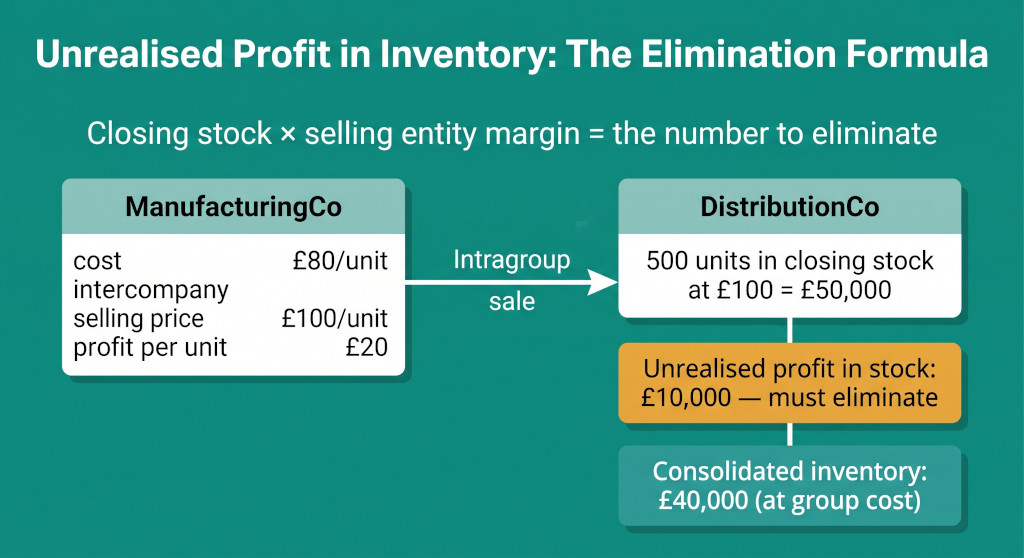
When one group entity sells goods to another, the selling entity records a profit on that sale. From the perspective of the consolidated group, however, no profit has been earned — the goods are still within the group boundary, sitting in the buying entity’s closing stock. The selling entity’s margin on those goods is unrealised: it will only become a genuine group profit when the goods are sold to an external third party. Until that happens, the intercompany margin must be stripped out of the consolidated accounts.
This post covers the formula, the journal, the year-on-year rolling treatment across periods, the difference between upstream and downstream eliminations when NCI is present, and the five errors that appear most often in unrealised profit workpapers.
Why the Elimination Is Required
The consolidated financial statements represent the group as a single economic entity. From that perspective, a sale from ManufacturingCo to DistributionCo — both within the group — is not a sale at all. It is an internal transfer of goods from one part of the enterprise to another. No revenue has been earned from an external customer; no cost has been incurred by the group at the intercompany selling price. The group’s cost of those goods is what ManufacturingCo paid to produce them, not what it charged DistributionCo.
Intercompany eliminations without the manual work.
BrizoConsol identifies and eliminates intercompany balances automatically at consolidation.
If the intercompany profit is not eliminated, the consolidated balance sheet overstates inventory — it shows the goods at the intercompany price rather than the group’s original cost — and the consolidated income statement overstates profit by recognising a margin that has not yet been earned externally. Both distortions are material in groups with significant intragroup trading.
The Formula
Unrealised profit in closing stock — general formula
The formula can equivalently be stated as:
Alternative expression
Worked Example: ManufacturingCo and DistributionCo
ManufacturingCo (100% subsidiary) manufactures components at a cost of £80 per unit and sells them to DistributionCo (another 100% subsidiary) at £100 per unit. DistributionCo sells to external customers at £140 per unit.
Unrealised profit calculation
| Closing stock in DistributionCo (from intercompany source): 500 units × £100 | 50,000 |
| ManufacturingCo’s gross margin %: (£100 − £80) ÷ £100 | 20% |
| Unrealised profit to eliminate: £50,000 × 20% | 10,000 |
| (Equivalently: 500 units × £20 markup per unit = £10,000) | |
The Elimination Journals
Journal 1 — Eliminate unrealised profit in closing stock (year-end)
| Account | Dr (£) | Cr (£) |
|---|---|---|
| Cost of sales (consolidated P&L) | 10,000 | |
| Inventory (consolidated balance sheet) | 10,000 |
This journal reduces consolidated inventory from £50,000 (DistributionCo’s book value) to £40,000 (group cost: 500 × £80) and reduces consolidated profit by £10,000. It is a consolidation-only entry — it does not appear in either entity’s individual accounts.
Note that Journal 1 is separate from the elimination of the intercompany sale itself. The intercompany revenue/purchases elimination (Dr Revenue £200,000 / Cr Purchases £200,000) removes the gross flow through the consolidated P&L for goods that have already been sold externally. Journal 1 is a further adjustment specifically for goods that have not yet been sold externally and remain in closing stock.
The Year-on-Year Rolling Treatment
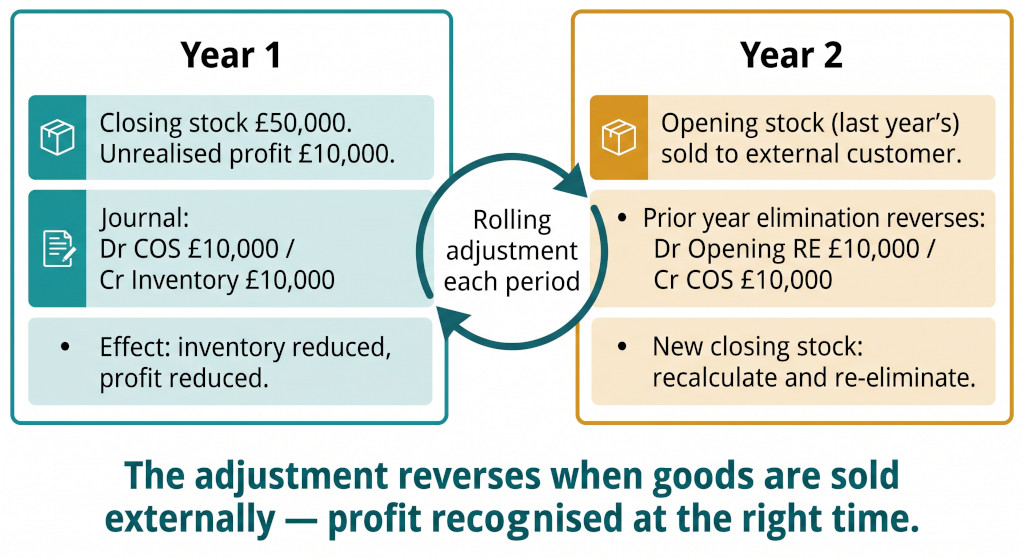
The unrealised profit elimination must be recalculated every reporting period based on the closing stock at each period-end. The stock eliminated in Year 1 will typically be sold externally in Year 2 — at which point the profit becomes realised and the elimination reverses.
In Year 2, the consolidation workpaper must do two things: reverse the Year 1 elimination (because the goods from opening stock have now been sold to external customers and the profit is genuinely realised) and calculate and post a fresh elimination for the new closing stock.
Journal 2 — Reverse prior-year unrealised profit elimination (Year 2 opening)
| Account | Dr (£) | Cr (£) |
|---|---|---|
| Retained earnings / opening equity (prior-year elimination reversal) | 10,000 | |
| Cost of sales (Year 2 consolidated P&L) | 10,000 |
Journal 2 credits Year 2’s cost of sales by £10,000 — increasing Year 2’s consolidated gross profit. This is correct: the goods held in last year’s opening stock have now been sold externally, and the group’s full £40/unit margin (ManufacturingCo’s £20 markup + DistributionCo’s further markup) is now realised. The debit to retained earnings adjusts the opening equity balance that was reduced by Journal 1 in Year 1. Journal 2 and the new year-end Journal 1 are posted together in Year 2’s consolidation workpaper.
Net P&L impact across years: the unrealised profit elimination reduces profit in the period the goods remain in stock and increases profit in the period they are sold externally. Over the life of the stock, the cumulative consolidated profit is identical to what it would have been had there been no intragroup trading — the adjustment is one of timing, not of total profit.
| Year | Opening stock unrealised profit (£) | Closing stock unrealised profit (£) | Net P&L impact of elimination (£) |
|---|---|---|---|
| Year 1 | — | 10,000 | (10,000) — reduces profit |
| Year 2 | 10,000 | 12,000 | (2,000) — reduces profit by incremental increase |
| Year 3 | 12,000 | 12,000 | nil — no change in closing stock unrealised profit |
| Year 4 | 12,000 | 8,000 | +4,000 — increases profit as stock reduces |
The annual P&L impact is equal to the movement in the unrealised profit balance (closing minus opening). In a period where the unrealised profit in closing stock is the same as in opening stock, the net P&L impact is zero — the reversal of the prior-year elimination exactly offsets the new closing elimination.
Upstream vs Downstream: The NCI Difference
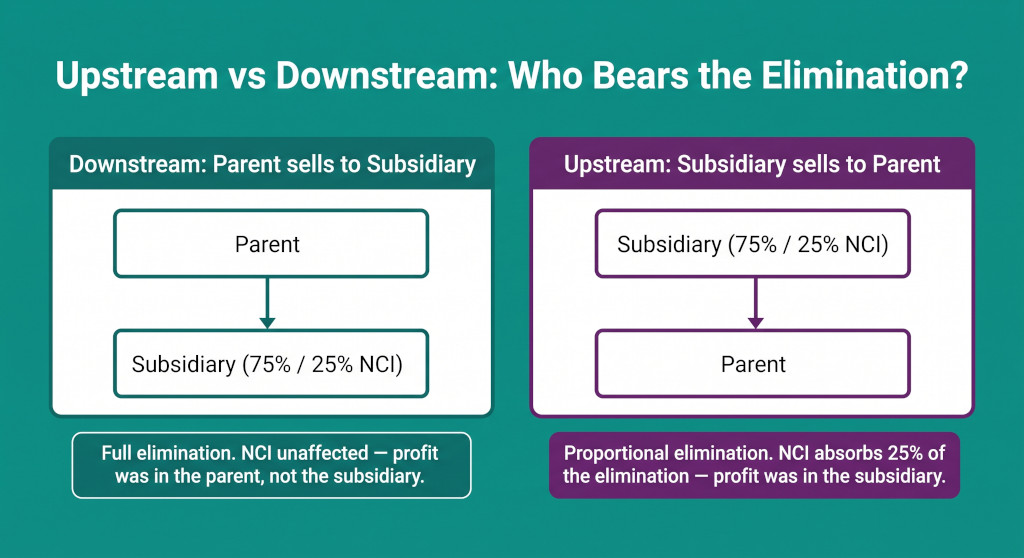
The direction of the intercompany sale — downstream (parent to subsidiary) or upstream (subsidiary to parent) — determines which entity booked the unrealised profit and therefore how the elimination is allocated between the parent’s shareholders and NCI. This distinction only arises when the selling or buying entity has non-controlling interests.
- The selling entity is the parent — the unrealised profit was booked in the parent’s P&L.
- Elimination reverses the parent’s profit: 100% of the elimination reduces the parent’s attributable share of consolidated profit.
- NCI (in the buying subsidiary) is unaffected — the profit being eliminated was never in the subsidiary’s P&L to begin with.
- Journal: Dr COS / Cr Inventory (same as above, no NCI adjustment needed).
- The selling entity is the subsidiary — the unrealised profit was booked in the subsidiary’s P&L.
- Elimination reverses the subsidiary’s profit: the elimination is shared proportionately between parent (75%) and NCI (25%).
- NCI’s share of the elimination must be deducted from NCI’s profit attribution in the consolidation workpaper.
- Journal: Dr COS / Cr Inventory (same as above), plus NCI attribution adjusted.
Using the worked example with SubCo (75% parent, 25% NCI) as the selling entity and ParentCo as the buyer:
Upstream elimination — NCI allocation (SubCo sells to ParentCo, unrealised profit £10,000)
| Total unrealised profit to eliminate | 10,000 |
| Parent’s share of elimination (75%): reduces profit attributable to parent’s shareholders | (7,500) |
| NCI’s share of elimination (25%): reduces NCI attribution | (2,500) |
| Total elimination | (10,000) |
For a detailed treatment of how upstream and downstream eliminations affect NCI across all transaction types — not just inventory — see intercompany eliminations when there is a non-controlling interest.
Partial Stock: When Only Some Closing Stock Came From the Intragroup Seller
In practice, the buying entity will frequently hold a mix of externally-purchased and intragroup-purchased goods in closing stock. The elimination applies only to the portion of closing stock attributable to the intragroup source.
Where the buying entity can identify intercompany units specifically (e.g., by product code or supplier reference), the calculation is straightforward. Where goods are fungible and the entity uses a weighted average cost method, it may be necessary to calculate the proportion of closing stock that came from the intragroup supplier by reference to the proportion of purchases in the period from that source:
Proportion approach — where goods are fungible
Work in Progress and Finished Goods Containing Intragroup Components
Where the buying entity has used the intragroup purchase as a raw material and incorporated it into its own work in progress or finished goods, the unrealised profit elimination becomes a component-level calculation. Only the intragroup margin embedded in the closing WIP or finished goods must be eliminated — not the buying entity’s own subsequent value-add.
For example: ManufacturingCo sells a component to AssemblySubCo at a £10 markup. AssemblySubCo incorporates the component into a finished product with its own labour and overhead. AssemblySubCo’s finished goods closing stock of £200,000 contains £30,000 of intragroup components at the intercompany price. The unrealised profit elimination applies only to the £10 markup embedded in those components — not to the full £200,000 closing stock value or to AssemblySubCo’s own margin on the finished goods.
The NRV Check After Elimination
After stripping out the unrealised profit, the consolidated inventory sits at the group’s original cost. IAS 2 (and its equivalents) require inventory to be carried at the lower of cost and net realisable value. The NRV check must be performed on the post-elimination (group cost) figure — not on the entity’s book value before elimination. If NRV falls below the group cost, a further write-down is required, separate from the unrealised profit elimination journal.
This is a common sequence error: applying the NRV test to DistributionCo’s book value (£100/unit) instead of the group cost (£80/unit). If NRV is £90/unit, no write-down is required at the entity level but the group-cost test would also show no write-down (£90 > £80). But if NRV is £75/unit, the entity shows a £25/unit write-down and the consolidated accounts should show a £5/unit write-down (£80 group cost vs £75 NRV) — the two are different amounts and must be calculated independently.
Five Common Errors
- 1 Using the markup percentage instead of the margin percentage Markup is profit as a percentage of cost; margin is profit as a percentage of selling price. In the worked example: markup = £20/£80 = 25%; margin = £20/£100 = 20%. The formula requires the gross margin percentage (profit/selling price). Applying markup to the intercompany selling price overstates the elimination by 25% in this example.
- 2 Applying the elimination to all closing stock, not just the portion from the intragroup source If DistributionCo holds 800 units in closing stock but only 500 came from ManufacturingCo (the rest from external suppliers), the elimination applies to 500 units only. Applying it to 800 units overstates the adjustment by 60%.
- 3 Forgetting the prior-year reversal in Year 2 The Year 1 elimination is embedded in the opening retained earnings of Year 2. Without Journal 2 (Dr Opening RE / Cr COS), Year 2’s consolidated profit is understated — the Year 1 elimination is effectively double-counted. Most consolidation software handles this automatically; manual workpapers are the primary risk area.
- 4 Missing the NCI attribution adjustment on upstream eliminations For upstream sales (subsidiary to parent), the unrealised profit being eliminated was in the subsidiary’s P&L. NCI’s share of the elimination must be deducted from NCI’s profit attribution. Omitting this leaves NCI’s share of profit overstated by NCI% × unrealised profit.
- 5 Applying the NRV test to entity book value rather than group cost The IAS 2 NRV comparison must be made against the group’s cost (post-elimination), not the entity’s intercompany purchase price. The write-down calculation is independent of the unrealised profit elimination and may produce a different amount.
For the same mechanics applied to F&B groups where intercompany food cost margins flow into restaurant closing stock, see eliminating unrealised intercompany profit in F&B group consolidation. For retail groups with a central buying office selling to branch entities, see central buying office stock eliminations in a retail group. For manufacturing groups where components pass through multiple intercompany stages, see eliminating unrealised intercompany margins in a manufacturing group. For the equivalent treatment when the seller is an associate rather than a subsidiary, see eliminating unrealised profits on associate transactions. For the full intercompany eliminations framework, see intercompany eliminations: a complete guide.
Unrealised profit calculated and eliminated automatically at close
BrizoConsol identifies closing stock sourced from intragroup sales, applies the selling entity’s margin, posts the elimination journal, and reverses it in the following period — so the unrealised profit workpaper runs itself rather than being rebuilt from scratch every close. See It in Action