How to Build a Template-Driven Consolidation Journal Library That Covers Every Elimination Type Your Group Runs Each Period
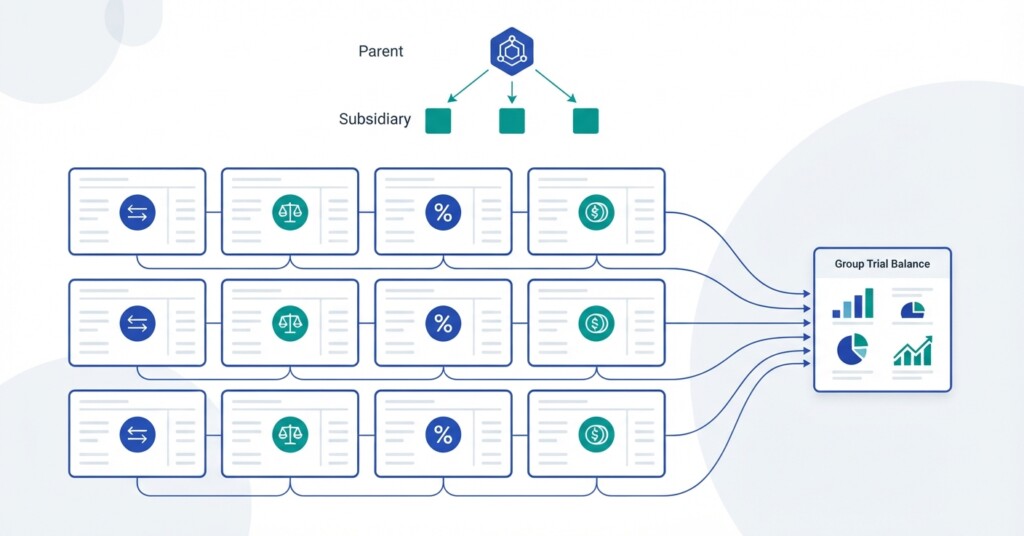
If your group runs five or more entities, your month-end consolidation almost certainly involves repeating the same journal entries, month after month, with only the numbers changing. Intercompany loan eliminations, unrealised profit adjustments, dividend eliminations, minority interest calculations — each one follows a predictable pattern. Yet most finance teams recreate these journals from scratch each period, buried in a chain of Excel files that no one else fully understands. A template-driven consolidation journal library changes that entirely. It codifies every elimination type your group actually runs, turns each one into a reusable structure, and reduces your financial close from a forensic exercise into an execution exercise.
This article walks through how to design and build that library — what to include, how to structure each template, and how to avoid the common mistakes that make consolidation journals unreliable or audit-unfriendly.
Why a Journal Library Matters for Multi-Entity Groups
The core problem with consolidation accounting is not complexity — it is inconsistency. When a different team member prepares the intercompany elimination each month, they may post to slightly different accounts, use different descriptions, or forget a step entirely. These small inconsistencies compound across entities and periods until your trial balance reconciliation becomes a significant investigation rather than a quick check.
Intercompany eliminations without the manual work.
BrizoConsol identifies and eliminates intercompany balances automatically at consolidation.
A journal library solves this by defining, in advance, every elimination your group runs. Each template captures the account codes involved, the debit and credit direction, the entities affected, the FX handling approach, and any notes required for audit purposes. When month-end arrives, the preparer fills in amounts and runs the journal — they do not design it from scratch. This is the same principle that manufacturing uses for standard work instructions, and it is equally powerful in finance.
A consolidation journal library is not a static document — it is a living reference that should be reviewed quarterly as your group structure, intercompany relationships, or reporting requirements change. Build versioning into it from day one.
Step One: Catalogue Every Elimination Type Your Group Actually Runs
Before you can build templates, you need an accurate inventory of what your group eliminates. This sounds obvious, but many finance teams discover mid-build that they have been running informal one-off journals for years that never made it into any standard process. Pull twelve months of consolidation workings and list every journal posted. Group them by type.
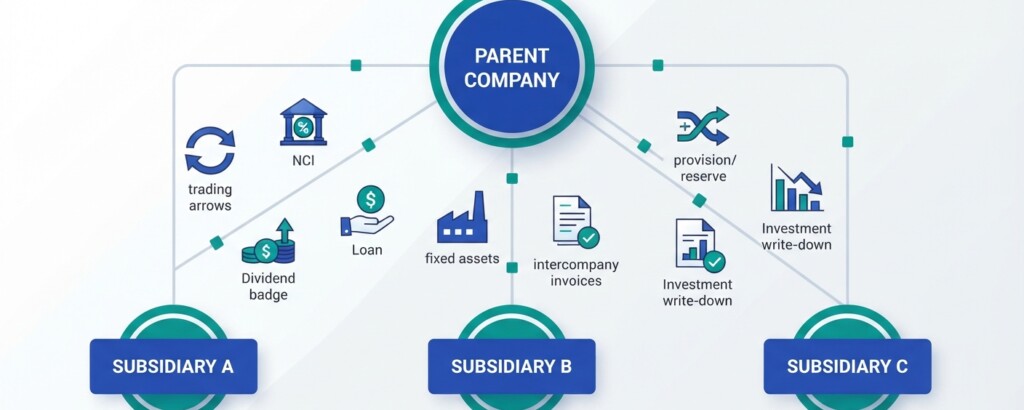
The most common elimination categories for SME groups include intercompany trading (sales and purchases between group entities), intercompany balances (receivables and payables), intercompany loans and interest, dividends paid between group members, unrealised profit in inventory or fixed assets, investment in subsidiary eliminations against equity, and non-controlling interest (NCI) calculations. Some groups also run management fee eliminations, shared service cost allocations, and transfer pricing adjustments.
| Elimination Type | Affected Line Items | Monthly / Annual | FX Sensitivity |
|---|---|---|---|
| Intercompany trading | Revenue, Cost of Sales | Monthly | High if cross-currency |
| Intercompany balances | Debtors, Creditors | Monthly | High if cross-currency |
| Intercompany loans | Loans receivable/payable | Monthly | High if cross-currency |
| Intercompany interest | Interest income/expense | Monthly | Moderate |
| Dividend elimination | Dividend income, Retained earnings | Annual or on declaration | Low |
| Investment vs equity | Investment in subsidiary, Share capital, Reserves | Annual or monthly roll-forward | High |
| Unrealised profit in inventory | Cost of Sales, Inventory | Monthly if material | Moderate |
| NCI calculation | P&L and equity attributable to NCI | Monthly | High |
Step Two: Build a Standard Template Structure for Each Category
Once you have your inventory, build a template for each category. A useful template has six components: a unique reference code, the journal name, the entities involved (seller/buyer, lender/borrower, parent/subsidiary), the account codes on both sides, the calculation driver (what number do you need to know before posting?), and the FX translation approach.
Let us take intercompany trading as a worked example. Entity A (UK parent, GBP functional currency) sells goods to Entity B (German subsidiary, EUR functional currency) at £200,000 for the month. Entity B has recorded the purchase at the EUR equivalent using the transaction rate. At consolidation, both sides must be eliminated — but the amounts may not agree because of timing or rate differences. Your template needs to account for this.
| Account | Dr | Cr |
|---|---|---|
| Intercompany Sales Revenue (Entity A) | 200,000 | |
| Intercompany Cost of Purchases (Entity B) | 200,000 |
Elimination of intercompany trading — Entity A sales to Entity B. Both amounts translated to group presentation currency (GBP) at the average rate for the period. Any residual FX difference is recognised in profit or loss (P&L).
| Account | Dr | Cr |
|---|---|---|
| Intercompany Trade Creditor (Entity B) | 195,000 | |
| Intercompany Trade Debtor (Entity A) | 195,000 |
Elimination of intercompany balance — debtor in Entity A and creditor in Entity B translated to GBP at closing rate. Difference of £5,000 between transaction rate and closing rate is recognised in profit or loss (P&L) in accordance with IAS 21.
Notice that the second journal does not eliminate £200,000 — it eliminates the closing-rate equivalent of the EUR creditor sitting on Entity B’s books. This is a common source of consolidation errors. The intercompany debtor and creditor are both balance sheet items, so they must be translated at the closing rate, not the transaction rate. Under IAS 21, the resulting exchange difference flows to profit or loss (P&L), not the FX translation reserve.
Never translate intercompany balance sheet eliminations at the average rate. Balance sheet items (debtors, creditors, loans) must be retranslated at the closing rate each period. Eliminating at mismatched rates leaves unexplained differences in your consolidation and distorts group equity. This is one of the most frequent FX errors in SME consolidations.
Step Three: Build Your NCI and Investment Elimination Templates
For groups with less-than-100% owned subsidiaries, the investment elimination and NCI calculation are the most technically demanding templates. They are also the ones most likely to be done differently by different preparers. Getting them into a repeatable structure is high value.
The investment elimination removes the parent’s investment in subsidiary from group accounts and replaces it with the underlying net assets at acquisition, with any excess recognised as goodwill. The NCI then takes its proportionate share of net assets and profits. Here is how the calculation looks for a group with an 80% owned subsidiary.
| Net assets of subsidiary at reporting date | £850,000 |
| NCI percentage | 20% |
| NCI share of net assets (balance sheet) | £170,000 |
| Subsidiary profit for period | £120,000 |
| NCI share of profit (P&L) | £24,000 |
| NCI closing equity balance | £170,000 |
| Account | Dr | Cr |
|---|---|---|
| Share Capital — Subsidiary | 200,000 | |
| Retained Earnings — Subsidiary (at acquisition) | 300,000 | |
| Goodwill | 100,000 | |
| Investment in Subsidiary — Parent | 500,000 | |
| Non-Controlling Interest (equity) | 100,000 |
Investment elimination at acquisition date. Parent paid £500,000 for 80% of subsidiary with net assets of £500,000 (share capital £200,000 + retained earnings £300,000). NCI measured at proportionate share of net assets: 20% × £500,000 = £100,000. Goodwill = £500,000 – (80% × £500,000) = £100,000.
| Account | Dr | Cr |
|---|---|---|
| Profit attributable to NCI (P&L) | 24,000 | |
| Non-Controlling Interest (equity) | 24,000 |
Current period NCI profit allocation. 20% of subsidiary profit of £120,000 = £24,000. Reduces profit attributable to owners of parent and increases NCI equity balance.

Step Four: Design the Library Reference Structure
Your journal library needs a reference structure that lets any preparer find, understand, and execute a journal without relying on tribal knowledge. A practical structure includes a unique journal code, a plain-English name, a short description of when it applies, the entities typically involved, the account codes in the group chart of accounts, the FX approach, the calculation inputs required, and a link to any supporting workings template.
- Assign a unique code to every template (e.g., ELIM-01 for intercompany trading, ELIM-02 for intercompany balances, ELIM-05 for NCI allocation). Use these codes as journal descriptions in your consolidation tool so every posted journal is traceable to its template.
- Include a ‘when does this apply’ trigger for each template — for example, ‘post monthly if intercompany sales exceed £10,000’ or ‘post only in the period that dividends are declared, not when paid’.
- Document the calculation inputs clearly — list every number the preparer needs before they can complete the journal, and where to find each one.
- Record the FX treatment explicitly for every line — closing rate, average rate, or historical rate — and explain why.
- Version-control the library with effective dates so that changes in group structure or chart of accounts do not silently break old templates.
- Include a sign-off column for each period so you have evidence that each journal was reviewed, not just prepared.
Step Five: Connect the Library to Your Financial Close Process
A library that lives in a SharePoint folder and gets consulted inconsistently is better than nothing, but a library that is embedded in your close checklist is transformative. Map each journal template to a specific step in your month-end close timeline. Define who prepares it, who reviews it, what the input data source is, and what the output should reconcile to.
In practice, this means your close checklist might say: ‘Day 3 — Finance manager pulls intercompany trading reports from each entity system, completes ELIM-01 template, posts to consolidation layer, confirms revenue elimination ties to intercompany schedule.’ That level of specificity eliminates ambiguity and makes it possible to delegate journals without rework.
The limitation of running this entire process in Excel becomes apparent quickly — a workbook-based library requires discipline to maintain, is vulnerable to formula errors, and does not automatically enforce that all eliminations are posted before the group trial balance is prepared. Consolidation software that allows journal templates to be defined, stored, and applied directly to the consolidation layer removes this fragility. When the numbers change each period, the preparer updates inputs; the journal structure and the posting logic remain intact.
Common Mistakes That Undermine Consolidation Journal Libraries
Several pitfalls regularly undermine consolidation journal libraries, even when the initial design is sound. Understanding them in advance saves significant rework.
The most common is incomplete intercompany matching. If Entity A records an intercompany sale of £200,000 and Entity B records a purchase of £198,000 (due to a timing difference on an invoice), eliminating one without adjusting the other leaves a £2,000 residual. Your library templates should include a reconciliation step before the elimination journal is posted, not after.
Another frequent issue is using the wrong consolidation layer. Some teams post elimination journals directly to entity-level ledgers. This pollutes entity accounts and makes statutory reporting from the individual entity difficult. Eliminations belong in a consolidation-only layer or a group journal that is never pushed back to subsidiary books.
Finally, many teams forget to reverse and repost NCI and unrealised profit journals each period. Unlike a trading elimination (where the underlying transaction is eliminated and done), an unrealised profit adjustment changes as inventory moves. If goods transferred at a mark-up are sold to third parties in the following period, the unrealised profit becomes realised and the elimination must be released. Without a clear reversal template, these adjustments accumulate incorrectly over time.
Maintaining and Evolving the Library Over Time
Group structures change. Entities are acquired or disposed of. Intercompany trading relationships evolve. Your chart of accounts is updated. Each of these events requires a review of your journal library. Schedule a formal library review at least once a year — and immediately after any acquisition, disposal, or significant change to intercompany arrangements.
When a new entity joins the group, work through the full elimination catalogue and identify which templates apply to that entity and whether any new templates are needed. Document this as part of the onboarding process for the new entity, not as a retrospective exercise six months later when discrepancies appear.
A well-maintained library also becomes an invaluable tool for new team members and for accounting firms supporting groups during busy periods. Instead of spending the first two closes understanding what was done historically, a new preparer can work from the library and be productive immediately. That knowledge-transfer value alone justifies the investment in building it properly.
See Template-Driven Consolidation in Practice
If your team is still rebuilding consolidation journals from scratch each period, BrizoConsol provides a structured environment where elimination templates, FX translation, and NCI journals can be defined once and applied consistently every close.