IFRS vs FRS 102: How Goodwill Accounting Differences Force Different Consolidation Adjustments in Mixed-Standard Groups
For SME finance teams managing groups where some entities report under IFRS and others under FRS 102, goodwill is one of the most consequential — and most easily misjudged — differences to reconcile at consolidation. The two frameworks treat goodwill in fundamentally different ways, and those differences do not cancel each other out at group level. They create real, material divergences in your consolidated balance sheet, income statement, and deferred tax position that require deliberate, documented consolidation adjustments every single period.
This article walks through exactly where the differences lie, what journal entries are needed to harmonise them, and how mixed-standard groups can manage the workload without drowning in manual Excel reconciliations.
Why Mixed-Standard Groups Exist in the First Place
Mixed-standard groups are more common than many people expect. A UK-headquartered holding company may prepare its consolidated financial statements under IFRS (required for UK-listed groups or chosen voluntarily), while its smaller subsidiaries — perhaps trading companies, property SPVs, or recently acquired businesses — file their statutory accounts under FRS 102. Some groups acquire overseas subsidiaries whose local GAAP is closer to IFRS than FRS 102. Others have simply grown through acquisition without standardising the accounting policies of each entity.
Stop building consolidations in spreadsheets.
BrizoConsol automates multi-entity consolidation — setup in minutes, reports the same day.
Whatever the cause, the consolidation team must produce a single set of group accounts. That means aligning entity-level figures to the group’s chosen reporting framework — usually IFRS for listed or larger groups — and making adjustments where local GAAP produces different numbers. Goodwill is almost always at the top of that list.
The Core Difference: Amortisation vs Impairment-Only
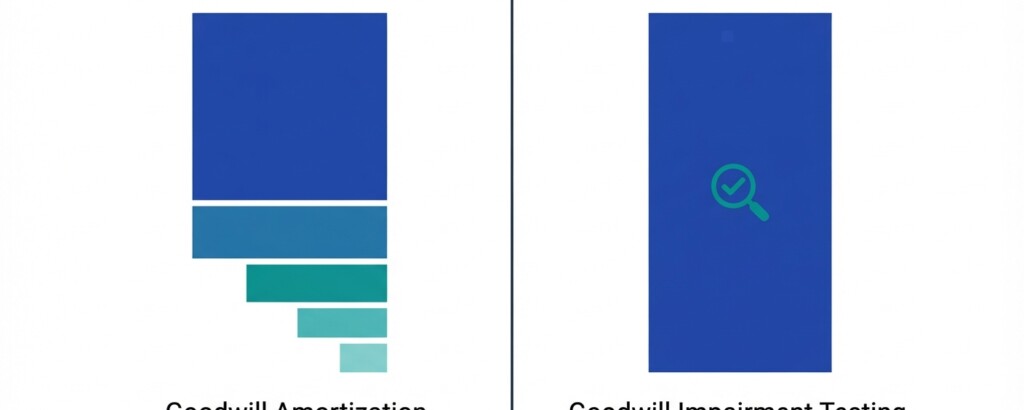
Under FRS 102, goodwill arising on a business combination is treated as a finite-life intangible asset and amortised over its useful economic life. In exceptional cases where a reliable estimate of the useful life cannot be made, the period is capped at 10 years (under FRS 102 paragraph 19.23(a), distinct from the 20-year presumption under superseded UK GAAP). The amortisation charge hits the income statement every year. Under IFRS 3 and IAS 36, goodwill is not amortised at all. Instead, it sits on the balance sheet indefinitely and is tested for impairment at least annually. Only when impairment is identified does the carrying amount reduce.
The IASB reconsidered goodwill amortisation as part of its Business Combinations — Disclosures, Goodwill and Impairment project, but voted in November 2022 to retain the impairment-only model and rejected reintroducing amortisation. Subsequent project publications, including the March 2024 Exposure Draft, maintain the impairment-only approach with targeted improvements to disclosures and the IAS 36 impairment test.
This is not a minor presentational difference. Over a ten-year period, an FRS 102 entity that acquired a business generating £2 million of goodwill will have charged roughly £1 million of amortisation to its income statement (at a 20-year life), reducing both retained earnings and the goodwill carrying amount. The IFRS consolidated group, reporting that same acquisition, will carry the full £2 million on the balance sheet — absent impairment — and will have recorded zero amortisation. When you consolidate the FRS 102 subsidiary into the IFRS group, you cannot simply use the subsidiary’s goodwill figure. You must adjust it.
What the Consolidation Adjustment Actually Looks Like
Assume an FRS 102 subsidiary acquired a business five years ago, generating goodwill of £2,000,000 recognised on its own balance sheet. The subsidiary amortises goodwill over an estimated 20-year useful life. At the group reporting date, the subsidiary’s books show:
| Goodwill at acquisition | £2,000,000 |
| Annual amortisation (£2,000,000 ÷ 20 years) | £100,000 |
| Accumulated amortisation after 5 years | £500,000 |
| Subsidiary carrying amount of goodwill | £1,500,000 |
The IFRS group has performed its annual impairment test and concluded no impairment exists. Under IFRS, goodwill should remain at £2,000,000. The consolidation adjustment must therefore reverse the subsidiary’s accumulated amortisation and remove the annual charge from the current year’s income statement.
| Account | Dr | Cr |
|---|---|---|
| Goodwill (Balance Sheet) | 500,000 | |
| Retained Earnings (Opening — prior periods) | 400,000 | |
| Amortisation Expense (Current Year P&L) | 100,000 |
Consolidation adjustment to reverse FRS 102 goodwill amortisation and reinstate IFRS carrying amount. £400,000 relates to prior four years charged through retained earnings; £100,000 relates to the current reporting period charged to the income statement.
This adjustment increases goodwill on the consolidated balance sheet by £500,000, increases opening retained earnings by £400,000, and reduces the current year amortisation expense by £100,000 — improving reported EBIT. The adjustment must be made at every consolidation, not just once. Each year, the cumulative reversal recognised in equity grows as another £100,000 of amortisation is reversed.
The Deferred Tax Complication
Goodwill itself does not give rise to a deferred tax liability under either IFRS or FRS 102 on initial recognition when it is non-tax-deductible — this is one of the specific exemptions in IAS 12 and Section 29 of FRS 102 respectively. If goodwill has a nil tax base, reversing accounting amortisation at group level remains covered by this exemption under IAS 12.15(a) and 21B, meaning no deferred tax liability is recognised. However, where goodwill is tax-deductible under local tax rules (such as in certain trade and asset acquisitions), the interaction between tax deductions and the accounting carrying amount does create taxable temporary differences that require deferred tax liabilities under IAS 12. Finance teams should involve their tax advisors when setting up these adjustments, particularly where the subsidiary operates in a jurisdiction where goodwill attracts local tax relief.
Do not assume the goodwill adjustment is always tax-neutral. Where goodwill is tax-deductible locally, reversing accounting amortisation maintains a higher carrying amount against a declining tax base, creating a taxable temporary difference that requires a deferred tax liability to be recognised at the consolidated level. Failure to assess this is a common error in SME group reporting and can result in material misstatement.
How NCI Is Affected
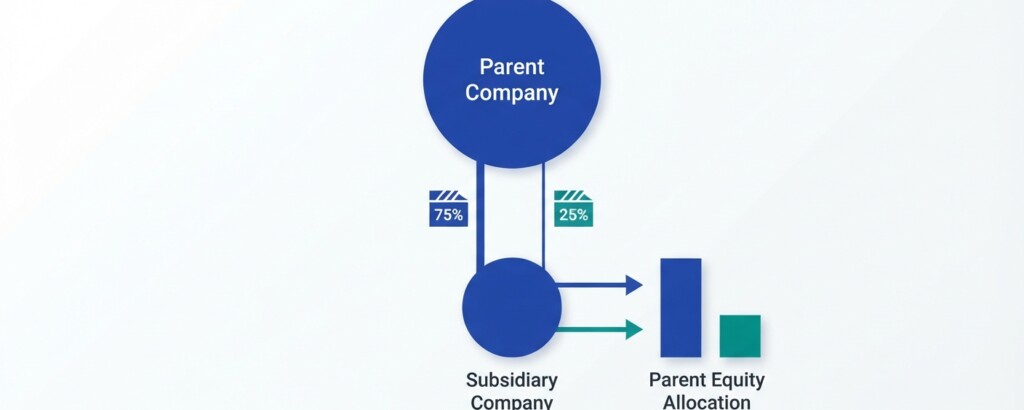
If the subsidiary is not wholly owned, the goodwill adjustment also interacts with the non-controlling interest (NCI) calculation. Under IFRS 3, groups can choose — acquisition by acquisition — whether to measure goodwill using the full goodwill method (where NCI is measured at fair value and goodwill includes the NCI’s share) or the partial goodwill method (where goodwill reflects only the acquirer’s share). FRS 102 uses only the partial goodwill method. If the group uses the full goodwill method under IFRS and the subsidiary used partial goodwill in its own acquisition accounting, there may be a difference in the original goodwill figure itself, not just in subsequent amortisation.
For the consolidation adjustment, the reversal of amortisation also needs to be split between the group’s retained earnings and the NCI equity line, in proportion to the group’s and NCI’s ownership percentages. This adds another layer of complexity that is easy to miscalculate in a manual spreadsheet environment.
Comparing the Key Framework Differences Side by Side
| Area | IFRS (IAS 36 / IFRS 3) | FRS 102 (Section 19) |
|---|---|---|
| Goodwill subsequent measurement | No amortisation; annual impairment test | Amortised over useful economic life (capped at 10 years if unestimable) |
| Impairment testing | At least annually, or when indicator exists; CGU level | When indicators exist; CGU level |
| NCI measurement | Full goodwill or partial goodwill (policy choice) | Partial goodwill only |
| Negative goodwill | Recognised immediately in P&L (bargain purchase gain) | Presented on balance sheet; released to P&L over time |
| Disclosure burden | Higher; must disclose CGU assumptions, sensitivity | Less extensive; proportionate to entity size |
| Deferred tax on goodwill | Deferred tax liability generally not recognised on initial recognition | Similar exemption under Section 29 |
The Practical Consolidation Workflow for Mixed-Standard Groups
Managing these adjustments consistently across a group requires a structured approach. Here is a practical sequence that consolidation teams typically follow:
- Identify every acquisition where goodwill was originally recognised in an FRS 102 subsidiary’s books.
- Document the original goodwill amount, the amortisation policy applied locally, and the acquisition date.
- Calculate cumulative amortisation charged to date under FRS 102.
- Confirm whether the IFRS impairment test would require any write-down — if so, the adjustment is not a full reversal.
- Prepare the consolidation journal to reverse accumulated amortisation, splitting between current year P&L and prior-year retained earnings.
- Assess whether any NCI allocation is required and adjust the NCI equity line accordingly.
- Consider whether deferred tax reassessment is needed with tax advisory input.
- Roll forward the adjustment schedule each period, adding the current year reversal to the cumulative total.
- Ensure the adjustment is clearly documented in the consolidation working papers with cross-references to the impairment assessment.
Each of these steps is manageable in isolation, but across a group with multiple acquired subsidiaries — each with different acquisition dates, different amortisation periods, and potentially partial NCI ownership — the workload compounds quickly. Finance teams running this in Excel are typically maintaining a separate schedule for every acquired entity, which then feeds into the central consolidation model. The risk of formula errors, version control issues, or missed updates when an entity is added or restructured is significant.
FX Translation Adding Another Layer
For groups with overseas subsidiaries, the goodwill adjustment intersects with FX translation. Under IAS 21, goodwill arising on the acquisition of a foreign operation is treated as an asset of that foreign operation and translated at the closing rate. Exchange differences on goodwill flow through other comprehensive income to the translation reserve — not through the income statement. If the group is reversing FRS 102 amortisation on goodwill in a foreign-currency subsidiary, the reinstated goodwill balance itself needs to be retranslated at each period-end closing rate, and the resulting exchange movement tracked through the translation reserve separately from the P&L adjustment.
This is one of the areas where manual consolidation models are most prone to error. The interaction between the consolidation adjustment journal, the retranslation of the adjusted goodwill balance, and the translation reserve can result in small but cumulative errors that are very difficult to trace without a clear audit trail.
Financial Close Implications
For SME groups running a monthly or quarterly close, these goodwill adjustments add time to an already pressured process. The adjustments are not automatic — they require someone to maintain the schedule, apply the current period reversal, check the impairment position, and update NCI allocations. In smaller finance teams, this work often falls to a controller or senior accountant who is simultaneously managing intercompany eliminations, FX retranslation, and management reporting.
Automated consolidation tools that allow standing adjustments — where a journal is defined once and rolls forward each period with the correct period-specific amounts — can meaningfully reduce this workload. Rather than manually updating a spreadsheet each period, the consolidation adjustment is configured as a recurring entry that the system applies automatically, with the ability to override it if the impairment assessment changes. This does not remove the need for judgement, but it removes much of the mechanical effort and reduces the risk of a period being closed without the adjustment being applied.
What to Watch for When Transitioning Between Standards
Some groups consider transitioning FRS 102 subsidiaries to IFRS to simplify consolidation. Under IFRS 1 paragraph D16, a subsidiary adopting IFRS later than its parent can measure its assets and liabilities either at the carrying amounts in the parent’s consolidated financial statements (aligning them directly and eliminating the consolidation difference) or at the amounts required by IFRS 1 at the subsidiary’s own transition date. If the subsidiary elects the latter and applies the optional exemption not to restate past business combinations, pre-transition goodwill in its separate accounts is frozen at the FRS 102 carrying amount. In that scenario, the group must continue making the consolidation adjustment in its consolidated financial statements to reinstate goodwill to the full IFRS carrying amount, as the parent’s consolidated figures are not restated merely because a subsidiary adopted IFRS.
Documenting the transition policy election and its interaction with the consolidated accounts is critical. Clear accounting policy notes ensure continuity and prevent audit issues or comparability errors across reporting periods.
Making the Process Manageable
The practical reality for most SME consolidation teams is that goodwill adjustment schedules grow in complexity as the group grows through acquisition. The teams that manage this well share a few common characteristics: they maintain a master acquisition schedule that is updated at every consolidation, they have a clear policy decision on goodwill method (full or partial) documented at board level, they perform and document the impairment test before finalising the consolidation adjustment, and they review the adjustment in the context of the overall consolidation rather than in isolation.
Groups that struggle tend to have the adjustment buried in a single cell of a large spreadsheet, with no clear audit trail back to the original calculation or the current impairment assessment. When team members change, that institutional knowledge is lost and the adjustment either gets missed entirely or duplicated. Consolidation platforms that maintain a permanent, auditable journal with clear period-by-period history address this directly — the adjustment is visible, traceable, and updated without relying on any single person’s memory of how it was set up.
Consolidate Mixed-Standard Groups Without the Spreadsheet Risk
BrizoConsol is built for SME finance teams managing multi-entity consolidations across different reporting standards. Standing adjustments, intercompany eliminations, FX translation, and NCI calculations handled in one connected platform.