IFRS 18 and Group Consolidation: What Changes, What Doesn’t, and What You Need to Do Now
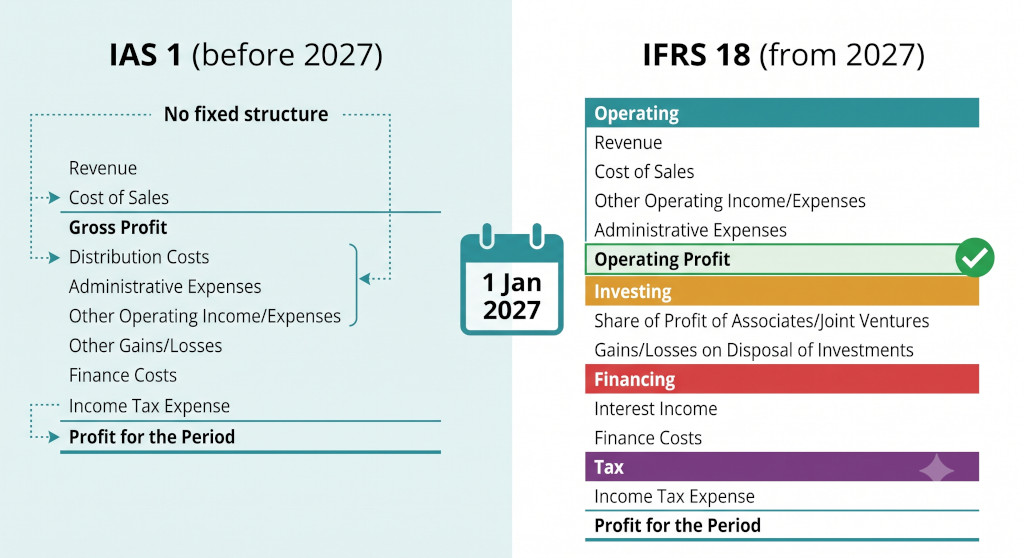
In April 2024, the IASB issued IFRS 18 Presentation and Disclosure in Financial Statements — the most significant overhaul of IFRS income statement presentation in nearly twenty years. IFRS 18 replaces IAS 1 Presentation of Financial Statements in full, effective for annual periods beginning on or after 1 January 2027, with full retrospective restatement of comparatives required.
The standard does not change how transactions are recognised or measured — goodwill is still impairment-only, leases are still on the balance sheet, revenue is still recognised under IFRS 15. What it changes is where in the income statement items appear, what subtotals must be shown, and what disclosures are required when management reports performance using non-IFRS measures. For group finance teams preparing consolidated financial statements, two of these changes are particularly material: the mandatory reclassification of equity-accounted associate and joint venture income, and the new rules on Management Performance Measures.
Apr 2024
Stop building consolidations in spreadsheets.
BrizoConsol automates multi-entity consolidation — setup in minutes, reports the same day.
IFRS 18 Issued IASB publishes IFRS 18, replacing IAS 1. Early adoption permitted from this date.
2025–26
Implementation Window Groups analyse impact, redesign income statement, assess MPM disclosures, update chart of accounts and consolidation models.
1 Jan 2027
Mandatory Effective Date IFRS 18 applies to annual periods beginning on or after this date. Most December year-end groups first apply it for the year ending 31 December 2027, with 2026 comparatives restated.
SFRS (I)
Singapore SFRS(I) Adopts Simultaneously SFRS(I) adopts IFRS verbatim; SGX-listed entities will apply SFRS(I) 18 on the same effective date.
The Core Change: Five Mandatory Income Statement Categories
Under IAS 1, the income statement structure was largely a matter of judgement — entities could present items in any order, use any subtotals they found relevant, and place items such as share of associate profit wherever they chose. IFRS 18 ends this flexibility for income and expense items by defining five mandatory categories:
Operating
Income and expenses from the entity’s main business activities. The residual category — items not classified elsewhere go here.
Investing
Returns from assets that are not within the main business operations: interest and dividends from investments, gains/losses on equity-accounted investees.
Financing
Finance costs on liabilities (including IFRS 16 lease interest on financial liabilities) and interest on pension obligations.
Income Taxes
Income tax expense (current and deferred) — as under IAS 1, presented after the pre-tax subtotal.
Discontinued Operations
Post-tax profit or loss from discontinued operations — same as under IFRS 5; presented below continuing operations.
Within these five categories, IFRS 18 requires four mandatory subtotals in the income statement:
- Operating profit or loss — a new mandatory subtotal; sum of the Operating category
- Profit or loss before financing and income tax — Operating + Investing
- Profit or loss before income tax — Operating + Investing + Financing
- Profit or loss — after income tax and discontinued operations
“Operating profit” as defined by IFRS 18 now has a specific, standardised meaning for the first time in IFRS history. That meaning — and what sits above and below it — is the crux of the consolidation impact.
The Change That Will Hit Groups Hardest: Associates and Joint Ventures
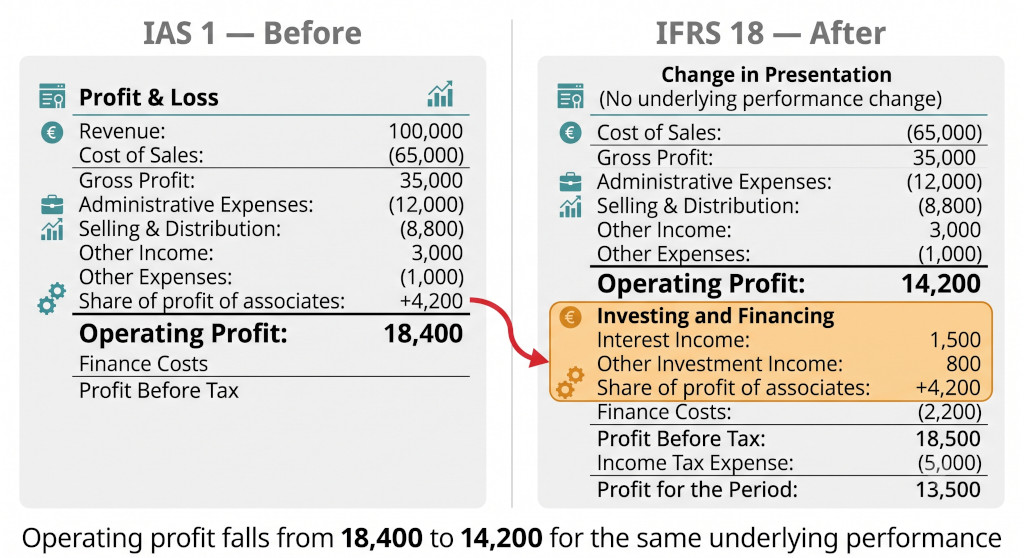
Under IAS 1, the share of profit or loss of equity-accounted associates and joint ventures could be presented almost anywhere in the income statement. Many groups — particularly holding companies, infrastructure groups, and financial services entities with significant associate interests — placed it within or close to operating profit, because the associate’s activities were central to the group’s main business.
IFRS 18 removes that flexibility. Share of profit or loss of equity-accounted investees must go in the Investing category — below operating profit — unless the group qualifies for a narrow exception for entities whose main business activity is investing (such as investment entities under IFRS 10, or banks whose main business is managing financial assets). For most industrial, technology, and professional services groups, the share of associate income will move below the operating profit line.
IAS 1 — Common Presentation (Before)
Revenue 80,000
Cost of sales (45,000)
Gross profit 35,000
Operating expenses (20,600)
Share of associates 4,200
Operating profit: 18,600
Finance costs (3,200)
Profit before tax 15,400
IFRS 18 — Required Presentation (After)
Revenue 80,000
Cost of sales (45,000)
Gross profit 35,000
Operating expenses (20,600)
Operating profit: 14,400
Share of associates 4,200 [Investing]
Profit before fin. & tax: 18,600
Finance costs (3,200)
Profit before tax 15,400
The underlying performance is identical — profit before tax is GBP 15,400 in both columns. But the reported operating profit falls from GBP 18,600 to GBP 14,400. For groups where associate income represents a substantial portion of the total return — private equity holding structures, infrastructure consortia, media groups with significant JV interests — this is not a cosmetic change. It alters the headline metric by which most stakeholders assess operational performance, and triggers a complete redesign of how the group communicates with investors, lenders, and analysts.
Groups with material equity-accounted investments should model the IFRS 18 income statement now — not in 2026. The reclassification of associate income below operating profit will surprise stakeholders who have been using the current operating profit as a KPI, and early communication is essential.
Management Performance Measures: The End of Unchallenged “Adjusted EBITDA”?
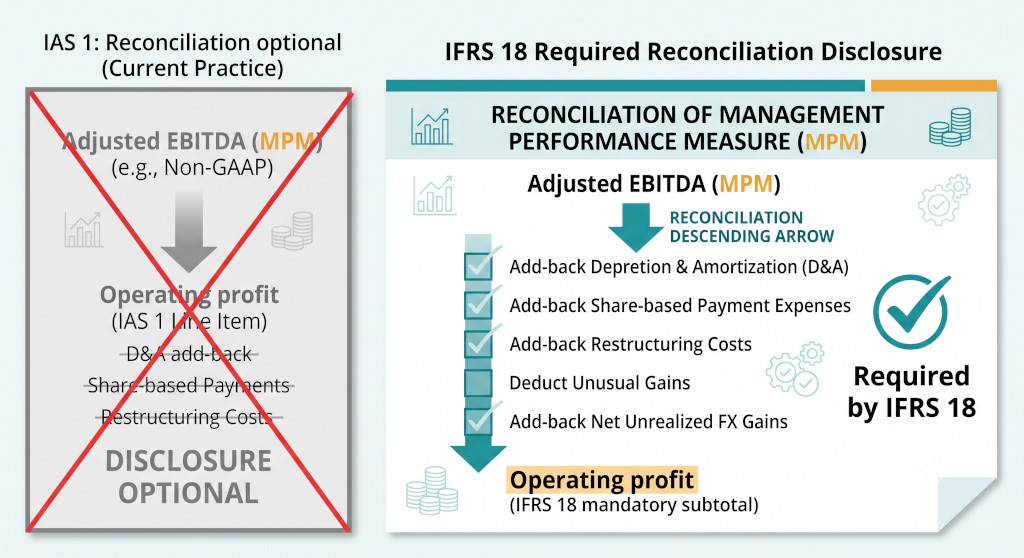
The second major change for group consolidation teams is the new disclosure requirement for Management Performance Measures (MPMs). An MPM is any subtotal of income and expenses that management uses to communicate the entity’s financial performance in public communications — earnings releases, investor presentations, annual report commentary — and that is not explicitly required by IFRS.
Typical MPMs used by listed groups include adjusted EBITDA, adjusted operating profit, underlying profit, core earnings, and normalised revenue. Under IAS 1, these could be included in the financial statements or excluded from them, with reconciliations provided at management’s discretion. IFRS 18 changes this:
- MPMs that appear in the financial statements must be presented in a dedicated note, not on the face of the income statement
- Each MPM must be reconciled to the most directly comparable IFRS-defined subtotal (e.g., “Adjusted EBITDA” reconciled to “Operating profit”)
- Each reconciling item must be labelled, with the income statement category identified
- The tax effect and non-controlling interest effect of each reconciling item must be disclosed
- The reconciliation note must be presented consistently from period to period
Scope of MPMs: IFRS 18 casts the MPM net wider than many groups expect. A measure used in an earnings press release counts as an MPM for IFRS 18 purposes even if it does not appear in the annual report itself. Groups should audit all external communications — analyst calls, CEO letters, investor day presentations — to identify every measure that constitutes an MPM and will require reconciliation.
For group consolidation specifically, the MPM requirement has two consequences. First, the reconciliation note is prepared at the consolidated level, meaning the group finance team — not subsidiary teams — owns it. Second, the reconciling items in the note must be traced back through the consolidation workbook, because the adjustments between “reported” and “adjusted” often include consolidation-level items such as goodwill impairment, acquisition costs, intercompany profit eliminations, and currency retranslation effects.
What Else Changes for Group Finance Teams
IFRS 16 Lease Interest — Category Now Prescribed
Under IAS 1, groups had some flexibility in where lease interest (the finance cost element of IFRS 16) was presented. IFRS 18 clarifies: interest on lease liabilities is a finance cost and falls within the Financing category. IFRS 16 depreciation remains in the Operating category. If your group currently presents lease interest within operating expenses or elsewhere, this must move for IFRS 18 compliance.
Unusual Items — Separate Note Disclosure Required
IFRS 18 introduces the concept of “unusual items” — income and expenses that have limited predictive value because they are clearly distinct from the entity’s typical activities. Unlike the old “extraordinary items” concept (eliminated from IFRS years ago), unusual items are not presented separately on the face of the income statement. Instead, they must be disclosed in a note. For groups, typical candidates include major restructuring charges, significant litigation provisions, and large one-off acquisition costs. The label “unusual” has a specific IFRS 18 meaning and should not be applied routinely.
The Aggregation and Disaggregation Principle
IFRS 18 tightens the rules on how line items are aggregated. Material items must be presented separately; items with different characteristics should not be combined even if individually immaterial. For consolidated income statements, this reinforces good practice — intercompany eliminations should be tracked by line item and category, not presented as a single net consolidation adjustment. BrizoConsol’s intercompany elimination module already tracks eliminations by transaction type, making the IFRS 18 disaggregation requirement straightforward to satisfy.
What IFRS 18 Does Not Change
Given the scope of IFRS 18’s changes, it is equally important to state clearly what it does not touch:
- Recognition and measurement: IFRS 18 is a presentation standard. Goodwill impairment testing (IAS 36 / IFRS 3), lease recognition (IFRS 16), revenue recognition (IFRS 15), and financial instrument measurement (IFRS 9) are all unchanged.
- Consolidation scope: IFRS 10 governs which entities are consolidated. IFRS 18 does not alter the control test, the consolidation procedures, or the intercompany elimination requirements.
- Balance sheet presentation: IAS 1’s balance sheet requirements (current/non-current classification, minimum line items) are carried forward into IFRS 18 substantially unchanged.
- Statement of cash flows: IAS 7 governs cash flow presentation. IFRS 18 includes limited amendments to IAS 7 to align interest and dividend classification with the new income statement categories, but the overall structure of the cash flow statement is unchanged.
- Segment reporting: IFRS 8 operating segments continues to use the management approach. Segment measures may differ from IFRS 18 subtotals; the IFRS 8 reconciliation from segment totals to the financial statements becomes the bridge.
The Impact on Your Consolidation Model and Chart of Accounts
For group finance teams using a trial-balance-based consolidation model, IFRS 18 has two practical consequences that go beyond the income statement layout.
First, the chart of accounts — both at the subsidiary level and in the group’s common chart of accounts — needs to be tagged with the IFRS 18 category (Operating, Investing, Financing, Tax, Discontinued). Every income and expense account must be assigned to exactly one category. This tagging flows into the group consolidation model, so that when subsidiary trial balances are loaded, the consolidated income statement can be assembled correctly by category without manual reclassification at the group level. Groups that use BrizoConsol’s account mapping feature can add the IFRS 18 category as a new dimension to their common chart of accounts — each subsidiary account mapped to both the group chart of accounts line and the IFRS 18 category.
Second, intercompany eliminations must be assigned to the correct IFRS 18 category. A management fee charged by the parent is an operating expense for the subsidiary; the elimination removes it from both the subsidiary’s operating expenses and the parent’s operating income. A dividend paid from a subsidiary to the parent is eliminated in consolidation entirely. An intercompany loan interest — if it were not eliminated — would be Financing for the payer and Investing for the recipient. The elimination entry must map to those categories correctly.
| Intercompany Transaction | Paying Entity — Category | Receiving Entity — Category | Consolidation Elimination |
|---|---|---|---|
| Management fee | Operating (expense) | Operating (income) | DR Operating Income / CR Operating Expense |
| Intragroup interest on loan | Financing (finance cost) | Investing (investment income) | DR Investing Income / CR Financing Cost |
| Dividend from subsidiary | — (equity distribution) | Investing (in parent-only accounts) | Eliminated fully; does not appear in consolidated income statement |
| Goods sold intragroup (unrealised profit) | Operating (revenue) | Operating (cost, adjusted for unrealised profit) | DR Operating Revenue / CR Operating COGS; DR Operating COGS (unrealised profit elimination) |
Implementation Checklist for Group Finance Teams
✅ IFRS 18 Transition Checklist — Group Consolidation
- Confirm effective date for the group: annual periods beginning on or after 1 January 2027; plan for 2026 comparative restatement
- Assign each income and expense account in the group’s common chart of accounts to an IFRS 18 category (Operating / Investing / Financing / Tax / Discontinued)
- Identify all equity-accounted associates and joint ventures; model the impact of reclassifying share of profit from Operating to Investing on the group’s reported operating profit
- Communicate the associate reclassification impact to the CFO, investor relations, and audit committee before the first IFRS 18 annual report — lenders with financial covenants tied to operating profit must be contacted
- Review all financial covenants in the group’s debt agreements for references to “operating profit” or “EBIT” — assess whether the IFRS 18 definition change triggers a breach or renegotiation
- Audit all public communications (earnings releases, investor presentations, CEO letters, annual report commentary) to identify every measure that qualifies as an MPM under IFRS 18
- For each MPM, prepare a draft reconciliation from the MPM to the most directly comparable IFRS 18 subtotal; identify the tax and NCI effect of each reconciling item
- Check IFRS 16 lease interest classification: confirm it is coded to the Financing category in all subsidiary charts of accounts and the group consolidation model
- Review all unusual items candidates (restructuring charges, acquisition costs, large litigation provisions) — confirm they are disclosed correctly as unusual items in the IFRS 18 notes, not on the face of the income statement
- Update the consolidation model to tag all intercompany eliminations to the correct IFRS 18 category for both the payer and receiver
- Restate the 2026 comparative income statement in the IFRS 18 format, including reclassification of associate income — review the comparative with auditors before the 2027 filing
- Update external financial models and analyst guidance to reflect the reclassified operating profit definition
- For SFRS(I) groups: confirm that SFRS(I) 18 is adopted on the same effective date and apply the same analysis above
Preparing for IFRS 18?
BrizoConsol’s account mapping and consolidation engine lets you tag every account to its IFRS 18 category — so your group income statement is automatically assembled in the correct structure, and intercompany eliminations are tracked by category from day one. Start Free Trial