Non-Controlling Interest on the Balance Sheet and Income Statement: Where NCI Appears in Consolidated Financial Statements
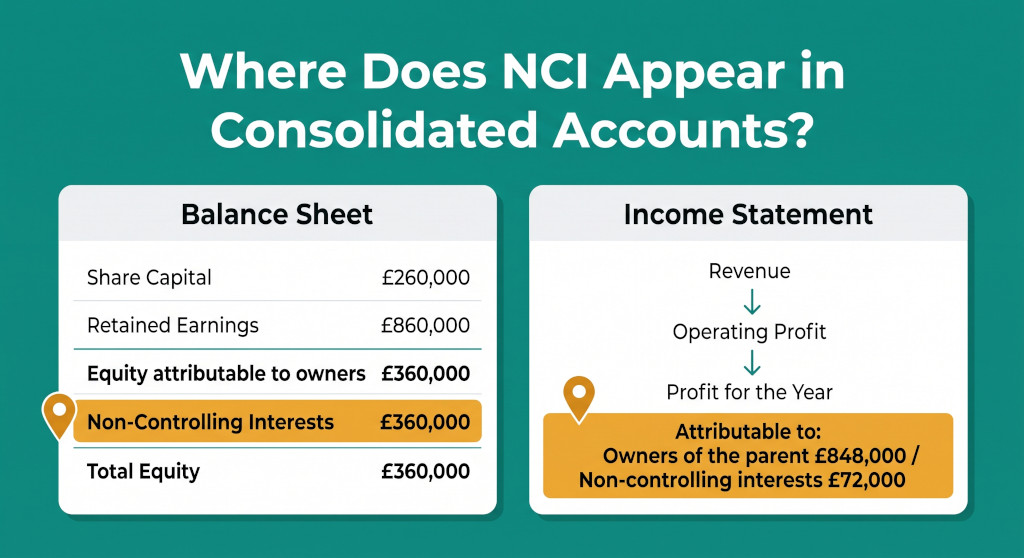
Non-controlling interest appears in three places in a set of consolidated financial statements: in the equity section of the balance sheet, in the profit attribution below the income statement’s profit-for-the-year line, and in the total comprehensive income split in the statement of comprehensive income. It does not appear above the profit line in the income statement. It is not a liability. It is not deducted from revenue or operating profit.
Those facts are straightforward, but the presentation is often misread — particularly by people reviewing consolidated accounts for the first time, or by finance teams consolidating manually without a clear template to follow. This guide shows exactly where NCI sits in each financial statement, explains why it is positioned there, and provides worked examples with annotated layouts so you can follow the numbers from one statement to the next.
Balance Sheet
Bottom of the equity section, separately from parent shareholders’ equity
Automate NCI calculations across all your entities.
BrizoConsol handles non-controlling interest automatically — no manual adjustments required.
Income Statement
Attribution note below “profit for the year” — not a deduction above that line
Below profit for the yearStatement of Comprehensive Income
Attribution split of total comprehensive income, including NCI share of OCI
Below total TCINCI on the Balance Sheet
The rule: NCI is equity
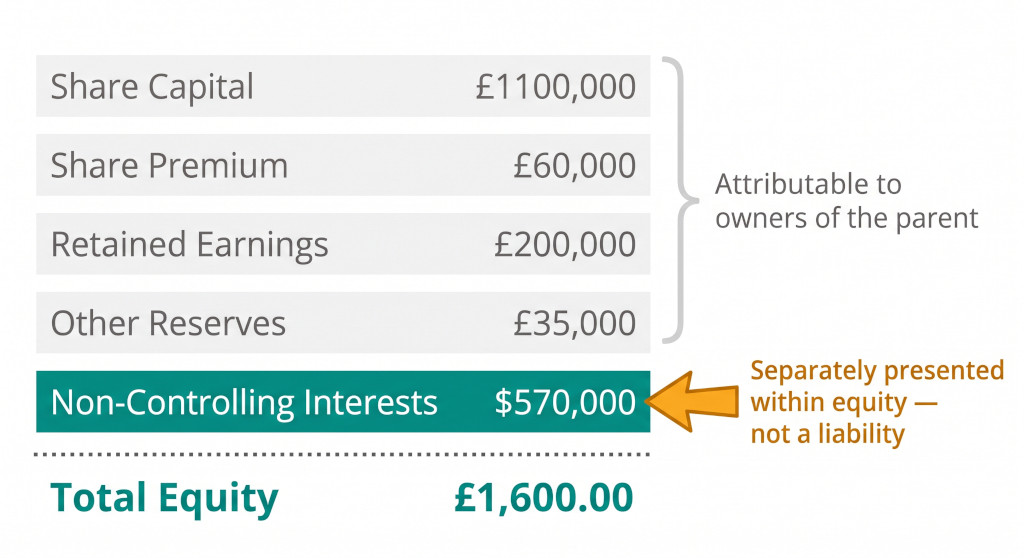
IFRS 10 paragraph 22 is explicit: “Non-controlling interests shall be presented in the consolidated statement of financial position within equity, separately from the equity of the owners of the parent.” The non-controlling interest is not a liability. It is the equity stake held by shareholders who own less than the parent’s controlling interest in a subsidiary — their stake is part of the group’s equity, even though the parent does not own it.
The NCI balance in the equity section represents the minority shareholders’ proportionate share of the net assets of the consolidated subsidiary at the reporting date. It is calculated as:
NCI balance at reporting date
| NCI% × net assets of subsidiary at acquisition date | £X (at initial recognition) |
| + NCI% × subsidiary’s post-acquisition retained earnings | £X |
| + NCI% × subsidiary’s OCI movements post-acquisition | £X |
| − Dividends paid to NCI shareholders | (£X) |
| NCI balance (closing) | £X |
In practice this means: the minority’s slice of everything the subsidiary has built since it joined the group, less any cash the minority has been paid out as dividends.
Format of the equity section
The equity section of the consolidated balance sheet separates the interests of the parent’s shareholders from the NCI. The NCI line sits at the bottom of equity, just above total equity:
Consolidated Statement of Financial Position (extract) — CapitalGroup plc
| Equity and Liabilities | £ |
|---|---|
| Equity attributable to owners of the parent | |
| Share capital | 500,000 |
| Share premium | 300,000 |
| Retained earnings | 900,000 |
| Total equity attributable to owners of the parent | 1,700,000 |
| Non-controlling interests | 360,000 |
| Total equity | 2,060,000 |
The NCI of £360,000 is ManufactureCo’s net assets (£1,200,000) × 30% NCI percentage. It sits inside equity — not between liabilities and equity, and not labelled as a liability.
Why NCI is not a liability
A common point of confusion — especially for non-accountants reading a set of group accounts — is why the NCI is inside equity rather than presented as a form of external obligation. The minority shareholders are third parties who own part of a subsidiary; it can feel as though the group “owes” them something.
The distinction is the nature of the claim. A liability is a present obligation that will be settled by transferring economic resources — cash, assets, services. The NCI does not hold a fixed claim on cash. Minority shareholders own equity, which entitles them to a proportion of dividends if declared, and a proportion of the subsidiary’s net assets if the group were wound up — but neither is a contractual obligation to pay on demand. The group can choose not to pay dividends. Equity is a residual claim, not an obligation, and that is why IFRS 10 puts it inside equity.
(The exception is where the NCI holds a put option on its shares — in that case, a financial liability may need to be recognised for the put obligation. That scenario is addressed separately in the guide to redeemable NCI and put options on non-controlling interests.)
Multi-subsidiary groups
If the group has more than one partly-owned subsidiary, the NCI balance is the aggregate of each subsidiary’s NCI. There is no requirement to show NCI by subsidiary on the face of the balance sheet — a single NCI line is standard. The breakdown by subsidiary appears in the notes, where IFRS 12 requires disclosure of financial information about subsidiaries with material NCI, including the NCI balance for each.
NCI on the Income Statement
The rule: attribution below profit for the year
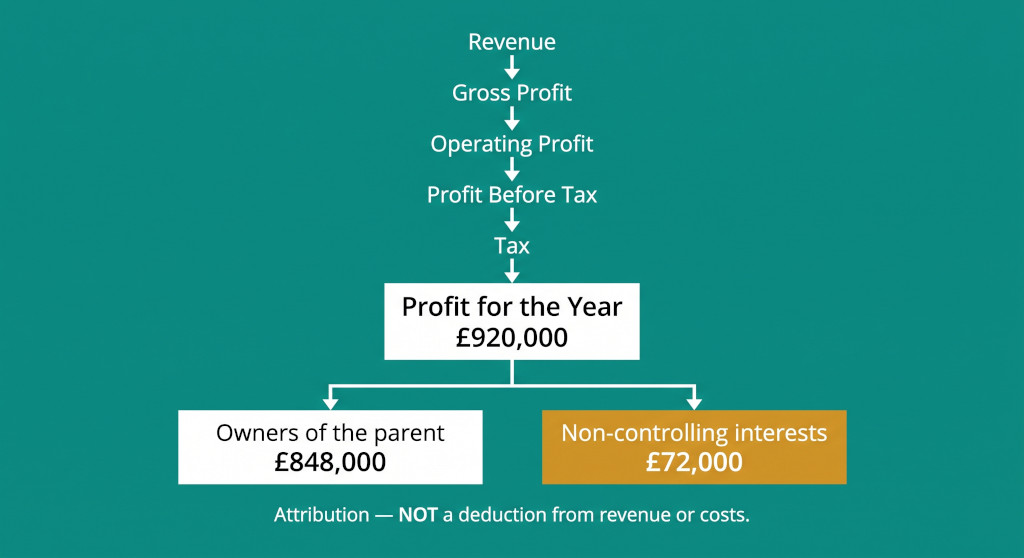
The consolidated income statement presents 100% of the revenues, costs, and profit of every consolidated entity — including the subsidiary in which the minority holds a stake. The income statement does not subtract the minority’s share at any point above the profit-for-the-year line. Revenue is 100% of consolidated revenue. Operating profit is 100% of consolidated operating profit. Tax is 100% of consolidated tax.
NCI appears only in the attribution section at the foot of the income statement, splitting the total profit for the year between the two groups of shareholders who earned it:
Consolidated Income Statement (extract) — CapitalGroup plc, year ended 31 December 2026
| Item | £ |
|---|---|
| Revenue | 4,800,000 |
| Cost of sales | (3,200,000) |
| Gross profit | 1,600,000 |
| Administrative expenses | (420,000) |
| Distribution costs | (260,000) |
| Operating profit | 920,000 |
| Finance income | 15,000 |
| Finance costs | (35,000) |
| Profit before tax | 900,000 |
| Income tax expense | (200,000) |
| Profit for the year | 700,000 |
| Attributable to: | |
| Owners of the parent | 628,000 |
| Non-controlling interests | 72,000 |
| 700,000 | |
The NCI of £72,000 is 30% × ManufactureCo’s profit after tax of £240,000. Revenue, costs, and profit above the line are 100% consolidated — the NCI never appears as a deduction from revenue or operating profit. The attribution section simply splits the single total profit figure between the two equity holder groups.
Why NCI is not deducted above the profit line
The income statement presents the group’s financial performance. The group includes the subsidiary in full — it is consolidated because the parent controls it, not merely because the parent owns a portion of it. Control is the threshold for consolidation, and once the subsidiary is consolidated, all of its revenues and costs are included in full. The NCI reflects the fact that third parties own a portion of one of those entities — but that doesn’t change how much revenue the group generated or how much it cost to generate it. Those figures are 100% consolidated regardless of ownership percentage.
The attribution is an allocation of a total figure, not a deduction from it. Total profit for the year is £700,000. Of that £700,000, £72,000 belongs to the minority shareholders of ManufactureCo and £628,000 belongs to CapitalGroup’s own shareholders. The sum is still £700,000.
Earnings per share uses the parent’s share only
Earnings per share is calculated on the profit attributable to the ordinary equity holders of the parent — that is, £628,000 in the example above, not £700,000. The NCI’s £72,000 does not belong to CapitalGroup’s shareholders and is therefore excluded from EPS. This is why EPS can appear low relative to the group’s total profit in groups with material minority interests.
NCI in the Statement of Comprehensive Income
The statement of comprehensive income presents both profit for the year and other comprehensive income (OCI) — items recognised directly in equity, such as currency translation adjustments on foreign subsidiaries, revaluation surpluses, and actuarial gains and losses on defined benefit pension plans. Where a subsidiary in which there is a NCI generates OCI, the NCI is allocated its proportionate share of that OCI, and the total comprehensive income is attributed between the parent’s shareholders and the NCI in the same way as profit:
Consolidated Statement of Comprehensive Income (extract) — CapitalGroup plc
| Item | £ |
|---|---|
| Profit for the year | 700,000 |
| Other comprehensive income | |
| Currency translation adjustments — foreign subsidiary | 60,000 |
| Other comprehensive income for the year | 60,000 |
| Total comprehensive income for the year | 760,000 |
| Attributable to: | |
| Owners of the parent (£628,000 + £42,000 CTA) | 670,000 |
| Non-controlling interests (£72,000 + £18,000 CTA) | 90,000 |
| 760,000 | |
ManufactureCo (30% NCI) generated a currency translation adjustment of £60,000. Of this, 30% (£18,000) is allocated to the NCI and 70% (£42,000) to the parent. The NCI’s total comprehensive income is £72,000 (profit) + £18,000 (OCI) = £90,000. For more detail on the CTA split calculation, see NCI and currency translation adjustments.
The OCI allocation to NCI is one reason the NCI balance on the balance sheet does not simply move by the profit attribution each period. If there is a currency translation adjustment or a revaluation surplus on a partly-owned subsidiary, the NCI’s share of that OCI feeds through to the NCI balance in equity — a movement that does not appear in the income statement at all.
How the Three Statements Connect: the NCI Rollforward
The NCI balance on the balance sheet at the end of a period should be fully explainable from the opening balance plus the movements during the year. Those movements come directly from the income statement and the statement of comprehensive income:
NCI equity rollforward — CapitalGroup plc (ManufactureCo, 30% NCI)
| Movement | Source | £ |
|---|---|---|
| Opening NCI balance (1 Jan 2026) | Prior year balance sheet | 282,000 |
| NCI share of profit for the year | Income statement attribution | 72,000 |
| NCI share of OCI (CTA) | Statement of comprehensive income | 18,000 |
| Dividends paid to NCI shareholders | Cash flow / SoCE | (12,000) |
| Closing NCI balance (31 Dec 2026) | Balance sheet | 360,000 |
This rollforward is the NCI column in the statement of changes in equity — a statement that is sometimes produced separately but always required under IAS 1. For the full mechanics of building the NCI column in the SoCE, see NCI in the consolidated statement of changes in equity.
The rollforward makes clear that the NCI balance is not arbitrary — every movement has a source in another financial statement. If the closing NCI balance does not reconcile from the opening balance using these four inputs, there is an error: either in the profit attribution, in the OCI allocation, in the dividend figure, or in the opening balance itself.
Common Presentation Errors
Several errors in NCI presentation appear regularly in group accounts, particularly in groups consolidating manually or using accounting systems not designed for multi-entity reporting.
The most common is presenting NCI between liabilities and equity — as “minority interest” in a separate section that is neither clearly a liability nor clearly equity. This was permitted under old UK GAAP (pre-FRS 102) and is still seen in accounts prepared by people whose training pre-dates the current standards. Under IFRS 10 and FRS 102 Section 9, NCI must sit inside equity, clearly labelled and separated from the parent’s equity.
A second error is deducting NCI from operating profit or from profit before tax in the income statement, as though it were a cost of the period. This understates operating profit and produces a misleading picture of the group’s performance. NCI is an allocation of the profit that has already been earned — it is not a cost of earning it.
A third error is omitting the OCI allocation to NCI entirely. If a partly-owned subsidiary generates a currency translation adjustment, a revaluation surplus, or an actuarial gain or loss, the NCI’s share must be reflected in both the statement of comprehensive income and the NCI equity balance. Omitting it leaves the NCI balance understated and the OCI attributable to the parent overstated.
Finally, in multi-subsidiary groups, a single NCI line on the face of the balance sheet is correct — but the note disclosure breaking down the NCI by subsidiary is required by IFRS 12. Omitting this note is a disclosure error rather than a measurement error, but it is commonly flagged in audit reviews.
Pre-FRS 102 historical accounts: If you are reviewing older consolidated accounts prepared under previous UK GAAP (FRS 2 and FRS 6), you may see minority interest presented as a separate line between long-term liabilities and equity. This is no longer permitted. If restating historical accounts or comparing across years where the accounting framework changed, note that the reclassification into equity under FRS 102 does not change the amounts — only where on the face they appear.
FRS 102 Position
FRS 102 Section 9 paragraph 22 reproduces the same requirement as IFRS 10: “The non-controlling interest shall be presented in the consolidated statement of financial position within equity, separately from the equity of the owners of the parent.” The income statement attribution format is identical under FRS 102. There is no difference in the presentation requirements between IFRS and FRS 102 for NCI on the balance sheet and income statement — the standards converge on both points.
Checklist: NCI Presentation in Consolidated Financial Statements
- Balance sheet: NCI is presented within equity, clearly separated from the equity attributable to owners of the parent, with its own labelled line.
- Balance sheet: NCI is not presented between liabilities and equity, and is not labelled as a liability or obligation.
- Income statement: NCI appears only in the attribution section below profit for the year — not as a deduction from revenue, gross profit, or operating profit.
- Income statement: The attribution totals (parent + NCI) agree to the profit-for-the-year line exactly.
- Statement of comprehensive income: Total comprehensive income is also attributed between the parent and NCI, including any OCI items from partly-owned subsidiaries.
- NCI rollforward: Opening NCI balance + profit attribution + OCI allocation − dividends = closing NCI balance. This reconciliation agrees to both the income statement attribution and the balance sheet closing figure.
- EPS: Earnings per share uses only the profit attributable to owners of the parent — not the group’s total profit for the year.
- IFRS 12 note: For subsidiaries with material NCI, the notes disclose the NCI balance attributable to each subsidiary, the NCI’s share of profit, and summarised financial information about each material subsidiary.
For a complete walkthrough of how NCI is calculated from first principles, see how to calculate non-controlling interest (NCI) in financial consolidation. For intercompany eliminations where a subsidiary has a NCI — which affects the profit figure before the attribution is applied — see intercompany eliminations when there is a non-controlling interest. For a full worked consolidation that includes the NCI balance sheet and income statement presentation in context, see a complete consolidation worked example.
Consolidated financial statements your board can read
BrizoConsol produces the full set of consolidated financial statements — balance sheet, income statement, statement of comprehensive income, and SoCE — with NCI correctly presented and reconciled across all statements. See it for your group. See It in Action