How to Review Consolidated Financial Statements Before Board Reporting
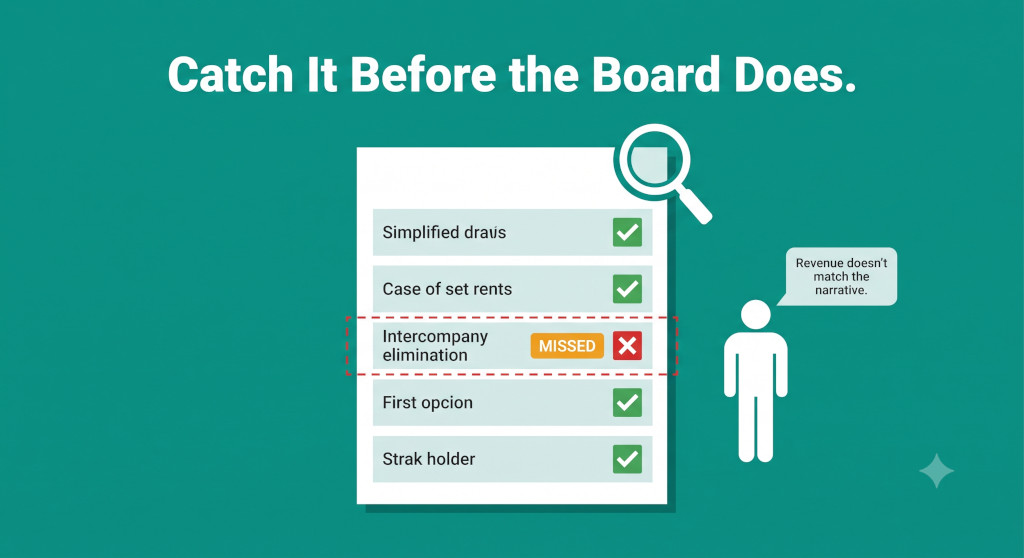
Elena had sent the board pack at 5 pm on the Friday before the quarterly board meeting. At 9 am Saturday her phone rang. It was the CFO. One of the non-executive directors — a former finance director herself — had been reading the pack over the weekend and had spotted that the revenue figure in the consolidated income statement was £420,000 higher than the revenue figure quoted in the CEO’s written narrative. Which one was right?
Neither, as it turned out. The narrative figure was the one the CEO had used in his draft, calculated from the entity-level management accounts before the consolidation was done. The income statement figure included £420,000 of intercompany sales between two subsidiaries that should have been eliminated in the consolidation but weren’t. The correct group revenue was £420,000 lower than the income statement and £420,000 higher than the narrative — an error that a pre-board review would have caught in under ten minutes.
Elena’s team had a thorough close process. The trial balances were complete, the consolidation model had been built carefully, and the board pack was well-formatted. What they didn’t have was a structured final review — a quality gate between the output of the consolidation and the moment the pack left the building. This post describes that gate.
Automate NCI calculations across all your entities.
BrizoConsol handles non-controlling interest automatically — no manual adjustments required.
Why a Pre-Board Review Is Different From the Close Process
The close process and the pre-board review are two distinct activities that require different mindsets and, ideally, different reviewers. The close process is constructive: it builds the consolidated financial statements from subsidiary submissions, applies eliminations and adjustments, and produces a set of numbers. The pre-board review is adversarial: it tries to break those numbers — to find errors, inconsistencies, and gaps before someone in the boardroom does.
A reviewer who built the consolidation has an inherent blind spot: they will tend to see what they intended to do rather than what they actually did. This is why the most effective pre-board review involves at least one person who did not prepare the consolidation — the CFO reviewing the group controller’s work, or a senior member of the finance team doing a fresh-eyes pass on the output before sign-off.
The review should be structured, not intuitive. “Scanning through the numbers” is not a review process — it relies on the reviewer noticing something that looks wrong, which depends on experience and luck. A structured review checklist applied consistently every period catches errors that a scan would miss, and it creates an audit trail demonstrating that the review was performed.
The Five-Layer Review Framework
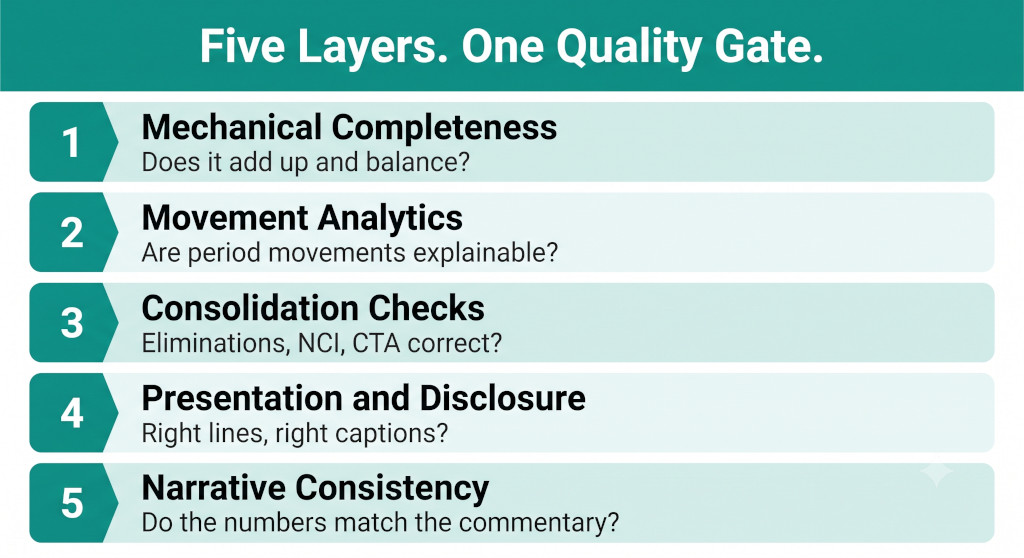
The pre-board review should work through five layers in sequence. The layers build on each other: mechanical errors caught in layer one prevent false positives in layers two and three; consolidation errors caught in layer three affect the narrative assessment in layer five. Skipping a layer to save time typically results in catching an error at a later layer in a less efficient way — or not catching it at all.
Layer 1
Mechanical Completeness
Does every statement add up arithmetically? Does the balance sheet balance? Does the income statement flow correctly from revenue to profit? Does the movement in retained earnings in the equity statement agree to the profit for the period shown in the income statement? Does the closing cash in the cash flow statement agree to the cash balance in the balance sheet? These are binary checks — pass or fail, no judgement required — and they should be the first thing verified.
Layer 2
Period-on-Period Movement Analytics
Are the movements between this period and the prior period explainable? Revenue up 8% — is that consistent with what the business did? Gross margin down 200 basis points — is there a known reason? A cost line that doubled — was there a one-off item? This layer does not require the reviewer to know the answer to every question; it requires them to identify every unexplained movement above a materiality threshold and obtain an explanation before sign-off.
Layer 3
Consolidation-Specific Checks
Have all intercompany transactions been eliminated — sales, purchases, loans, dividends, and unrealised profits? Is the NCI calculation correct — applied to the right profit figure at the right percentage? Is the cumulative translation adjustment in OCI and not in P&L? Has goodwill been tested for impairment? Are any new subsidiaries acquired during the period treated correctly? These checks are specific to consolidated accounts and are invisible to reviewers who approach the pack as if it were a single entity’s accounts.
Layer 4
Presentation and Disclosure
Are items classified correctly — operating costs vs. finance costs, current vs. non-current, exceptional vs. underlying? Are material items that require separate disclosure on the face of the statements or in the notes appropriately presented? For groups reporting under IFRS, are the disclosure requirements for business combinations, segment reporting, and related party transactions met? Are comparative figures presented consistently with the current period?
Layer 5
Narrative Consistency
Do the numbers in the financial statements agree to every figure quoted in the CEO’s report, the CFO’s commentary, and every other section of the board pack? Revenue, EBITDA, net debt, headcount, capital expenditure, and any other metric cited in narrative sections must be traced back to the financial statements or reconciled explicitly. The narrative consistency check is what catches the class of error that trapped Elena — not an arithmetic mistake in the statements themselves, but a disconnect between the statements and the surrounding commentary.
Worked Example: Three Errors Caught Before the Board
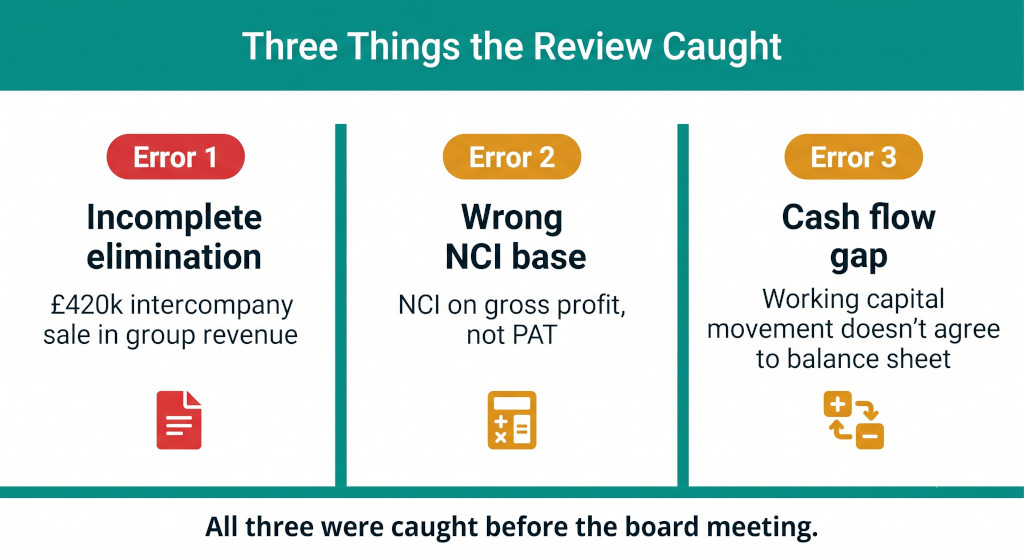
The following example shows three errors that would typically be caught at different layers of the review framework, using an illustrative six-entity group with GBP as the presentation currency.
Error 1 (Layer 3): Incomplete Intercompany Elimination — £420k in Group Revenue
The consolidation model shows group revenue of £12,840,000. The reviewer pulls the intercompany elimination schedule and checks that every intercompany sale has a corresponding elimination entry.
| Selling Entity | Buying Entity | Intercompany Sale £’000 | Elimination Posted? | Status |
|---|---|---|---|---|
| UK Parent | Germany GmbH | 1,200 | Yes | PASS |
| UK Parent | Singapore Pte | 480 | Yes | PASS |
| Germany GmbH | France OpCo | 420 | No | FAIL |
| Singapore Pte | UK Parent | 310 | Yes | PASS |
The Germany-to-France intercompany sale of £420k was captured in the consolidation workings list but the elimination journal was never posted — the corresponding Dr Revenue / Cr Cost of Sales entry was missed. Group revenue is overstated by £420k and group cost of sales is understated by £420k; gross profit is correctly stated but revenue and cost of sales are both wrong. The review catches this before the pack is issued. For the full intercompany elimination methodology, see Intercompany Elimination: The Foundation of Group Consolidation.
Error 2 (Layer 3): NCI Calculated on the Wrong Profit Figure
The group has a 70% owned subsidiary, Apex Services Ltd, with the following income statement contribution to the group:
| Line Item | Apex Services £’000 |
|---|---|
| Revenue | 2,400 |
| Cost of sales | (1,440) |
| Gross profit | 960 |
| Operating expenses | (360) |
| Finance costs | (48) |
| Tax charge | (138) |
| Profit after tax | 414 |
The NCI (30% interest) should be attributed 30% of profit after tax: 30% × £414k = £124k. The consolidation model shows NCI of £288k. The reviewer traces this back to the NCI calculation cell: it is applying 30% to gross profit (£960k × 30% = £288k) rather than profit after tax. The error overstates NCI by £164k and correspondingly overstates the profit attributable to parent shareholders by the same amount.
Correct NCI calculation: PAT attributable to Apex Services Ltd: £414,000 NCI percentage: 30% ───────────────────────────────────────────────── Correct NCI charge: £124,200 Model NCI charge (wrong): £288,000 Overstatement of NCI: £163,800
Error 3 (Layer 1): Cash Flow Working Capital Movement Doesn’t Agree to Balance Sheet
The consolidated cash flow statement shows an increase in trade receivables of £340k as a working capital outflow in the reconciliation from operating profit to cash from operations. The reviewer compares this to the balance sheet movement:
| Item | Opening £’000 | Closing £’000 | Movement £’000 |
|---|---|---|---|
| Trade receivables (consolidated BS) | 3,860 | 4,320 | 460 increase |
| Cash flow statement — receivables movement | 340 increase | ||
| Unexplained difference | 120 |
The £120k gap is investigated and traced to the newly acquired subsidiary, Meridian Holdings, which was acquired during the period. On acquisition, Meridian’s trade receivables of £120k were added to the consolidated balance sheet as part of the acquisition (and included in the investing activities section as part of the net assets acquired), but the working capital movement in the operating section was calculated using the full opening-to-closing balance sheet movement without stripping out the acquisition-related receivables. The two entries are not duplicates — both are correct — but the cash flow statement has double-counted the Meridian receivables in the operating section. Removing the £120k from the operating working capital movement and leaving it in the investing section corrects the reconciliation.
The acquisition-related working capital error is one of the most common mechanical errors in consolidated cash flow statements. Any period in which a subsidiary was acquired or disposed of requires the cash flow preparer to strip the acquired or disposed entity’s assets and liabilities from the working capital movement calculation and present them within investing activities instead. A standard check — comparing the working capital movement in the cash flow to the balance sheet movement for every significant line, with reconciling items noted — catches this class of error consistently.
Who Should Perform the Review and When
The most effective pre-board review structure has two stages. The group financial controller performs the first stage — a self-review using the full five-layer checklist — immediately after the consolidation is completed. This catches the mechanical errors (layer one) and the consolidation-specific checks (layer three) that the preparer is best placed to verify. The CFO or finance director then performs the second stage — a focused review of the analytical movements (layer two) and the narrative consistency (layer five), supported by a written summary of any items that required explanation during the first-stage review.
The timing matters as much as the structure. A review performed two hours before the board meeting cannot be corrected if it finds an error — the options are to issue the pack with a known error, to pull the pack and issue a corrected version under time pressure, or to present orally and acknowledge the discrepancy. None of these is comfortable. A review completed the day before the board meeting gives time to correct errors, re-run the model, and reissue the pack with sufficient lead time for directors to read it before the meeting.
Building the review into the close timetable — not as an afterthought after the pack is formatted, but as a scheduled step with its own deadline — is the structural fix that prevents the Saturday morning phone call.
The Consolidation-Specific Checks in Detail
Layer three of the review — the consolidation-specific checks — deserves additional attention because it covers the class of errors that are invisible to reviewers who approach consolidated accounts as if they were single-entity accounts. The following items should be on the consolidation check list for every period.
Intercompany Elimination Completeness
The elimination schedule should list every intercompany flow: sales and purchases, intercompany loans and interest, management fees, dividends, and any unrealised profit in inventory or fixed assets. For each flow, the schedule should confirm that both the revenue/asset elimination and the corresponding cost/liability elimination have been posted. A common gap is the partial elimination — the revenue side is eliminated but the cost of sales entry is missed, or the loan balance is eliminated but the interest is not. For the full mechanics of each type of intercompany elimination, see Intercompany Elimination: The Foundation of Group Consolidation.
Intercompany Balance Agreement
Before eliminations are posted, the intercompany balances in the consolidation model should agree between the two counterpart entities. A receivable in Entity A should equal a payable in Entity B, expressed in the same currency. In a multi-currency group, the agreement check needs to account for translation differences — balances denominated in different currencies will translate to different amounts at the closing rate even when the underlying commercial amount is agreed. The check is whether the foreign-currency amounts agree, not whether the translated amounts agree. For a detailed explanation of why intercompany balances fail to agree in translated terms, see Why Your Intercompany Balances Never Match Even When Both Companies Agree.
NCI Calculation and Balance
Verify that the NCI is calculated on profit after tax at the correct ownership percentage. Verify that the NCI closing balance in the balance sheet equals the opening NCI balance plus the NCI’s share of the current year’s profit less the NCI’s share of any dividends paid. If the subsidiary has a different functional currency, verify that the NCI balance also reflects the NCI’s share of the currency translation adjustment for the period.
CTA Positioning
The currency translation adjustment must sit in other comprehensive income (OCI), not in the income statement. The review should confirm that no CTA amounts have been inadvertently posted to finance costs or other P&L lines — a common error when journal entries are constructed manually rather than derived from the translation mechanics.
Goodwill Impairment
For each reporting period, confirm that the impairment test for each cash-generating unit carrying goodwill has been performed and documented. If the recoverable amount is greater than the carrying amount, no impairment is required and the goodwill balance is unchanged. If the recoverable amount is lower, an impairment charge must be recognised. The review should confirm that the goodwill balance on the consolidated balance sheet is consistent with the impairment test output — not simply rolled forward from the prior period without a current-period test.
New Acquisitions and Disposals
If any subsidiary was acquired or disposed of during the period, confirm that the acquisition accounting is complete (consideration measured, fair value of net assets assessed, goodwill and NCI calculated, purchase price allocation performed) or that the disposal accounting is complete (net assets and goodwill derecognised, consideration booked, gain or loss on disposal recognised, and any cumulative CTA recycled to the income statement). These are high-complexity, high-materiality items that are disproportionately error-prone.
Making the Review Repeatable
A pre-board review that depends on the group controller remembering what to check is not a review process — it is a memory exercise. The review should be codified into a standing checklist that is completed and signed off each period, with the reviewer’s name, the date of the review, and the outcome of each check (pass, flag for investigation, or not applicable) recorded in the close file.
The checklist serves two purposes beyond catching errors. First, it creates an audit trail demonstrating that a quality review was performed — a question that auditors regularly ask and that the close file should be able to answer with documentary evidence. Second, it makes the review transferable: if the group controller is absent, a capable deputy can run the same structured check with the same level of coverage, rather than performing an ad hoc review whose scope depends on what they happen to think of.
Built-in review checks — before the pack leaves the building
BrizoConsol flags incomplete eliminations, NCI mismatches, and cash flow reconciliation gaps automatically as part of the close process — so the review catches genuine judgment calls rather than mechanical errors your platform should have prevented.See It In Action
Pre-Board Review Checklist: Consolidated Financial Statements
- Income statement arithmetic. Revenue minus all cost lines equals stated profit figures at each level (gross profit, EBIT, PBT, PAT). NCI deducted from PAT equals profit attributable to parent shareholders. No formula errors in the consolidation model.
- Balance sheet balances. Total assets equal total liabilities plus total equity. Equity reconciles from opening balance: opening equity + profit for the year + OCI items (CTA, fair value movements) − dividends paid = closing equity.
- Cash flow reconciles to balance sheet cash. Opening cash + net cash flows from operating, investing, and financing activities + effect of exchange rates on cash = closing cash, and closing cash agrees to the cash balance on the consolidated balance sheet.
- Working capital movements agree to balance sheet movements. For each working capital line in the cash flow (receivables, payables, inventory, etc.), the movement in the cash flow reconciliation agrees to the opening-to-closing balance sheet movement — after stripping out any movements from acquisitions or disposals in the period, which belong in investing activities.
- Period-on-period movements are explained. Every revenue, cost, and balance sheet line with a movement above the analytical review threshold has a documented explanation. Unexplained movements above threshold are chased and resolved before sign-off.
- All intercompany flows are on the elimination schedule. Sales/purchases, loans/interest, management fees, dividends — all listed. Both sides of every elimination entry are confirmed as posted.
- Intercompany balances agree in functional currency terms. Before translation, the functional-currency amounts for each intercompany pair agree. Translation differences are noted and treated correctly (P&L or OCI depending on the nature of the balance).
- NCI is calculated on PAT at the correct percentage. NCI closing balance reconciles from opening: opening NCI + NCI share of PAT − NCI share of dividends ± NCI share of CTA = closing NCI.
- CTA is in OCI, not in P&L. Confirm no CTA has been posted to finance costs, other income, or any income statement line.
- Goodwill impairment test completed and documented for the period. Goodwill balance on the balance sheet is consistent with the impairment test output.
- Acquisition and disposal accounting complete. For any subsidiary acquired or disposed of in the period, confirm the full accounting treatment has been applied and the purchase price allocation or derecognition workings are in the close file.
- Presentation and classification correct. Finance costs not mixed with operating costs. Current and non-current items correctly split. Exceptional or non-underlying items disclosed separately if applicable under group policy.
- Every number in the narrative matches the financial statements. Every revenue, profit, EBITDA, net debt, capex, and other metric cited in the CEO report, CFO commentary, or board presentation is traced to the financial statements and agrees — or is explicitly reconciled with the difference explained.
- Review sign-off documented. Reviewer name, date, and outcome of each check recorded in the close file. Items flagged during review and the resolution of each flag noted.
The pre-board review is the step that converts a technically complete consolidation into a board-ready pack. The close process ensures the numbers are built correctly; the review ensures they are right. Both are necessary, and the review that is skipped to save an hour before the board meeting is the one most likely to generate a Saturday morning phone call.
Close faster. Review with confidence.
BrizoConsol automates the consolidation mechanics — eliminations, NCI, CTA — so your pre-board review focuses on business insight, not arithmetic. Start free today. Start Free Trial