IFRS 18: The Income Statement Has Changed — BrizoConsol Is Ready
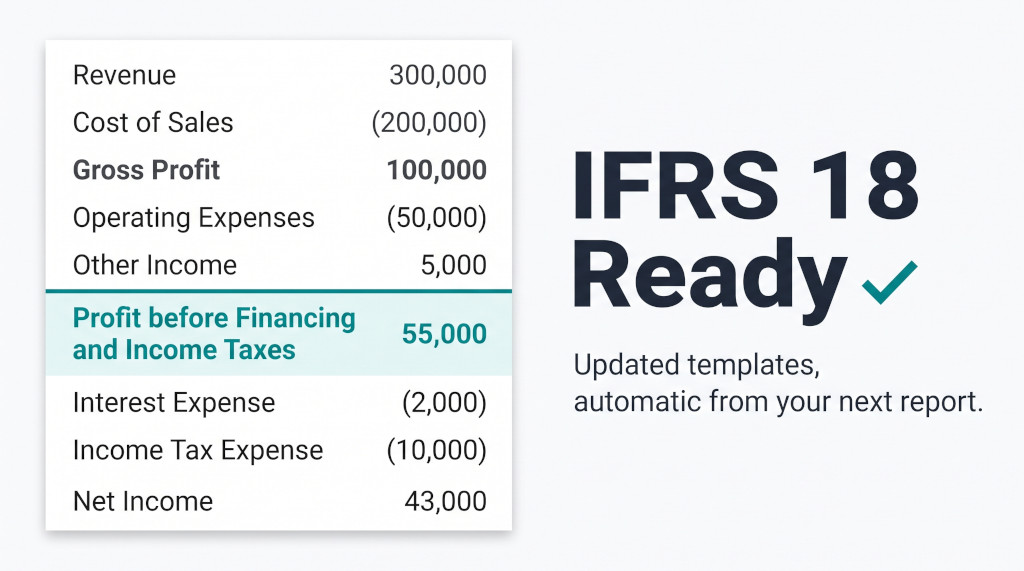
Finance teams preparing IFRS-compliant consolidated accounts have spent years building income statement templates around IAS 1. They know the structure: gross profit, operating profit, a block of financing items, profit before tax. It is well understood, widely adopted, and — effective for periods beginning on or after 1 January 2027 — no longer sufficient on its own.
IFRS 18 Presentation and Disclosure in Financial Statements replaces IAS 1 and introduces a structural requirement that changes how the section between operating profit and profit before tax is presented. Specifically, it mandates a new intermediate subtotal — Profit before Financing and Income Taxes — and requires income statement items to be classified into three distinct categories: operating, investing, and financing. The bottom-line profit figure does not change. The path to it does.
BrizoConsol’s IFRS consolidated P&L template has been updated to reflect this structure. If your group prepares IFRS-compliant consolidated accounts in BrizoConsol, the revised income statement layout is available now, ahead of the mandatory effective date. This post explains what changed in the standard, what changed in the template, and how BrizoConsol’s reporting engine gives you the flexibility to adapt the layout further for any group structure.
Stop building consolidations in spreadsheets.
BrizoConsol automates multi-entity consolidation — setup in minutes, reports the same day.
What IFRS 18 actually changes
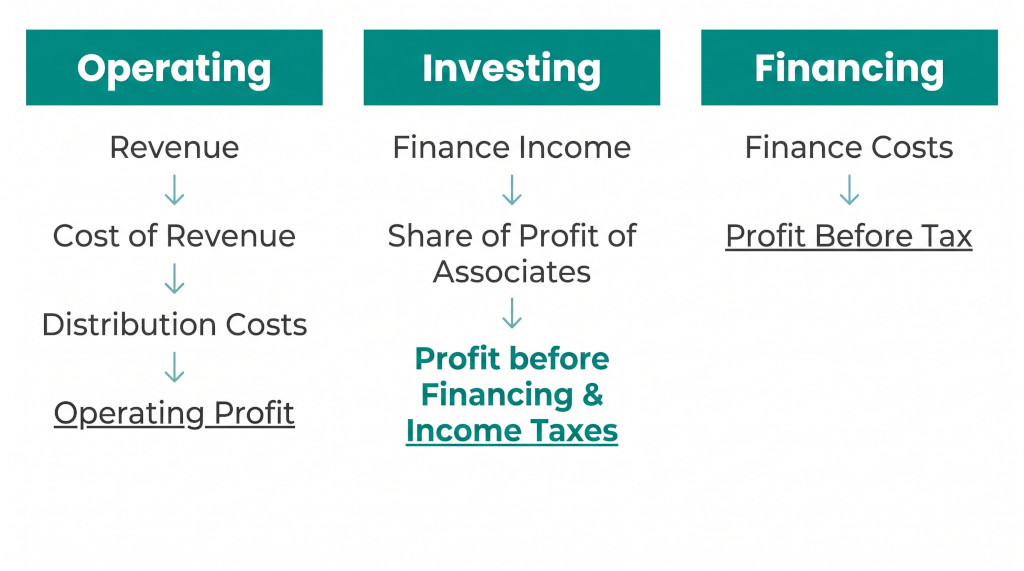
IFRS 18 introduces a classification framework for every line item in the income statement. For most non-financial entities, the framework divides items into three categories:
- Operating — income and expenses from the entity’s main business activities: revenue, cost of revenue, distribution costs, administrative expenses, and any other income or expense arising from the core business.
- Investing — income and expenses from assets that generate returns independently of the main business: interest earned on cash deposits and short-term investments, dividends received from non-controlled investments, and the share of profit from associates and joint ventures accounted for under the equity method.
- Financing — income and expenses from financial liabilities and certain equity instruments: primarily interest expense on borrowings and lease liabilities.
The standard then requires a mandatory subtotal at the boundary between the investing and financing sections: Profit before Financing and Income Taxes. This subtotal equals operating profit plus all items in the investing category. Finance costs (the financing category) are deducted below it to arrive at profit before tax.
IFRS 18 is effective for annual periods beginning on or after 1 January 2027. Early adoption is permitted. Comparative periods presented alongside IFRS 18 statements must be restated to conform to the new structure.
The practical significance of this is that interest income can no longer sit inside an operating “Other Income” bucket for presentation purposes, and it cannot be offset against finance costs in a single financing line. Under IFRS 18, interest income on investments is an investing item — it must appear above the new mandatory subtotal, separated from the finance costs that fall below it.
Three categories, one new subtotal
The most direct way to see what changes is to compare the structure of a consolidated income statement before and after IFRS 18.
Consider a group with the following figures (SGD ‘000):
Under IAS 1 (before IFRS 18)
Revenue 5,000
Cost of Revenue (3,000)
Gross Profit 2,000
Distribution Costs (400)
Administrative Exp (600)
Operating Profit 1,000
Finance Income 50
Finance Costs (120)
Share of Associates 80
Profit Before Tax 1,010
Income Tax (253)
Profit for the Year 757
Under IFRS 18 (from 2027)
Revenue 5,000
Cost of Revenue (3,000)
Gross Profit 2,000
Distribution Costs (400)
Administrative Exp (600)
Operating Profit 1,000
Finance Income 50
Share of Associates 80
▶ Profit bef. Fin. & Tax 1,130
Finance Costs (120)
Profit Before Tax 1,010
Income Tax (253)
Profit for the Year 757
Profit for the Year is identical in both columns: SGD 757k. What changes is the visibility of the investing category. In the IAS 1 layout, Finance Income (which included interest on deposits) sat on the same level as Finance Costs, with no structural signal distinguishing income from investments from the cost of debt. IFRS 18 separates them explicitly: investing items — finance income and share of profit of associates — sit above the new subtotal, and financing items — finance costs — sit below it.
The new subtotal, 1,130, tells readers something the old layout did not: the group’s earnings power before the cost of its debt structure is taken into account. It makes the financing drag on performance explicit, rather than netting it silently against investment returns.
What changed in BrizoConsol
BrizoConsol’s Consolidated Profit and Loss (IFRS) template — report 29 in the IFRS report suite — has been updated with four specific changes:
- Interest Income reclassified to the investing section. Previously, accounts in the Interest Income account type were presented within the operating Other Income bucket. They are now excluded from operating income and combined with Finance Income below Operating Profit, reflecting their correct IFRS 18 classification as investing items.
- Finance Income expanded to include Interest Income. The visible Finance Income line now captures both the Finance Income account type and the Interest Income account type — the full investing income of the group in a single line.
- Share of Profit of Associates repositioned. It was already shown separately from Finance Costs. It is now explicitly presented above the new subtotal, alongside Finance Income, as a fellow investing-category item.
- Profit before Financing and Income Taxes added as a mandatory subtotal. The formula is: Operating Profit + Finance Income + Share of Profit of Associates. Finance Costs are deducted below it, and the remaining path to Profit Before Tax and Profit for the Year is unchanged.
The result in the report engine looks like this:
| Operating Profit | 1,000,000 |
| Finance Income (investing category) | 50,000 |
| Share of Profit of Associates (investing category) | 80,000 |
| Profit before Financing and Income Taxes | 1,130,000 |
| Finance Costs (financing category) | (120,000) |
| Profit Before Tax | 1,010,000 |
| Income Tax Expense | (253,000) |
| Profit for the Year | 757,000 |
The IFRS tagging system that already existed in BrizoConsol — which assigns accounts to tags like distribution_costs, administrative_expenses, and share_of_profit_of_associates — required no changes. The account tag vocabulary is unchanged. Only the presentation structure of the income statement template was updated.
See the updated IFRS 18 statement in action
Run the Consolidated Profit and Loss (IFRS) report on your group data and see the new subtotal structure immediately — no configuration needed. See It In Action
The full IFRS reporting suite
The income statement update sits within a complete set of IFRS-tagged consolidated financial statements in BrizoConsol. The suite covers all five primary statements required under IFRS for a consolidated group:
| Statement | Report in BrizoConsol |
|---|---|
| Consolidated Statement of Financial Position | Report 22 |
| Consolidated Profit and Loss (now IFRS 18-compliant) | Report 29 |
| Consolidated Cash Flow Statement | Report 34 |
| Consolidated Statement of Profit or Loss and OCI | Report 37 |
| Consolidated Statement of Changes in Equity | Report 42 |
Each statement reads directly from the same trial-balance and consolidation engine that drives the rest of BrizoConsol. When intercompany eliminations are processed, when CTA postings are calculated for a multi-currency group, or when NCI allocations are booked, every IFRS statement updates automatically. There is no separate export or manual re-entry step.
Build your own layout with the custom report builder
The system IFRS template covers the standard presentation. Real-world groups frequently need more than that — sector-specific line items, management-defined performance measures, presentations oriented to a particular regulator or board format. BrizoConsol’s custom report builder handles these cases without touching the system templates.
The builder works on an Excel-like grid. Each row is one of four types:
- Account row — pulls figures directly from account types (e.g. REVENUE, DIRECT COSTS) or from IFRS-tagged account subsets (e.g.
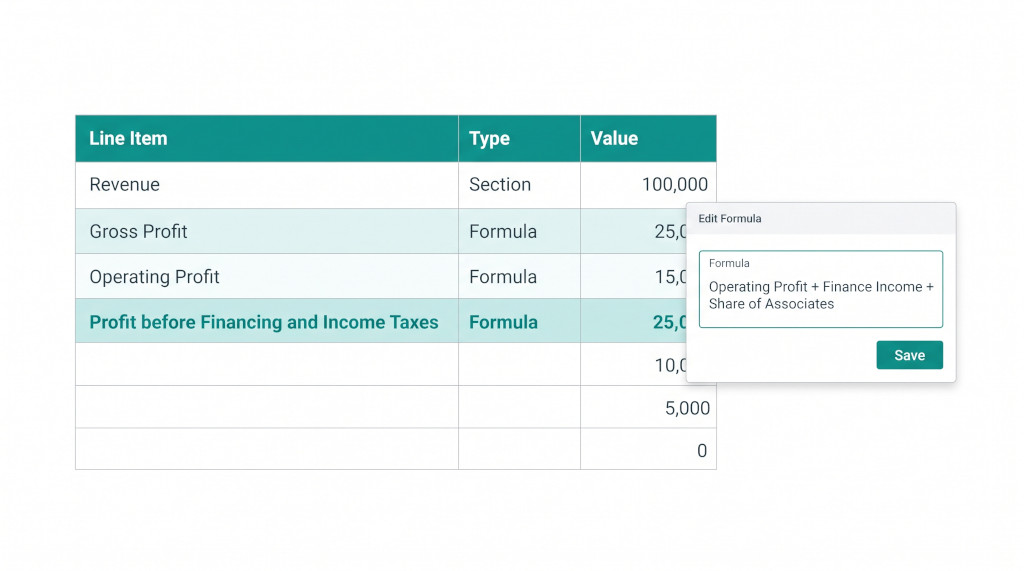
ifrs_tag:distribution_costs). - Formula row — references any other row by label using arithmetic. The IFRS 18 subtotal is simply:
Operating Profit + Finance Income + Share of Profit of Associates. - Section row — groups accounts under a heading without hard-coding which accounts belong there; the mapping is driven by the group’s chart of accounts.
- Label row — a blank separator or a non-numeric heading for visual structure.
This means that if your group needs to present investing income split across two separate lines — say, interest income on deposits as one line and share of profit of associates as another, with the IFRS 18 subtotal beneath both — you define it exactly that way in the builder. If your board pack uses a different label for the subtotal, you change the label. If your group operates under multiple standards simultaneously (IFRS for the consolidated group and SFRS for the Singapore holding entity, for example), you run separate system reports for each standard from the same underlying data.
BrizoConsol supports six reporting standards out of the box: IFRS, SFRS, AASB, US GAAP, UK GAAP (FRS 102), and Local GAAP. Each standard has its own tag column on the chart of accounts. Accounts are tagged once during setup; every standard-specific report reads the appropriate tags from that point forward.
Comparative period restatement: IFRS 18 requires that comparative periods presented alongside IFRS 18 statements are restated to the new structure. In BrizoConsol, historical periods are stored in full — running the updated IFRS P&L template against any prior fiscal year will automatically apply the new structure to that period’s data. No manual restatement work is needed in the system.
What this means for groups preparing early
The 1 January 2027 effective date is closer than it appears. Groups with a December year-end face a 2027 annual report deadline; those with a June year-end face a 2026 comparative period that will need restating. Audit committee presentations, interim management accounts, and external investor communications between now and the mandatory date may all benefit from early adoption — particularly where analysts or lenders have requested visibility into the investing versus financing split.
BrizoConsol’s updated template requires nothing from users to activate. The Consolidated Profit and Loss (IFRS) report will present the IFRS 18 structure automatically. Groups that have already configured their IFRS account tags — distribution costs, administrative expenses, share of profit of associates — will see the correct layout immediately. Groups that have not yet tagged their accounts can do so through the Accounting Standards page in BrizoConsol’s settings, where each account is assigned to the relevant standard tag with AI-assisted suggestions to reduce the manual workload.
Practical checklist: verify your IFRS 18 output
- Open Accounting Standards in BrizoConsol settings and confirm that any accounts representing interest income on investments are mapped to the Interest Income account type (not to Other Income or Revenue).
- Confirm that accounts representing income from associates are tagged
ifrs_tag: share_of_profit_of_associates. This tag controls which accounts appear in the Share of Profit of Associates line and, by extension, above the new IFRS 18 mandatory subtotal. - Confirm that finance cost accounts — interest on borrowings, lease liability interest — are mapped to the Finance Costs or Interest Expense account types. These feed the financing-category line below the new subtotal.
- Run Report 29 — Consolidated Profit and Loss (IFRS) for the current period and verify that the Profit before Financing and Income Taxes line appears between Share of Profit of Associates and Finance Costs.
- Run the same report for a prior comparative period. The historical data will automatically apply the new structure — verify that the comparative column also shows the new subtotal.
- If your group uses a custom IFRS report built in the report builder, update it by adding a formula row:
Operating Profit + Finance Income + Share of Profit of Associatesand label it Profit before Financing and Income Taxes, positioned above the Finance Costs line.
Prepare your group for IFRS 18 today
BrizoConsol’s IFRS 18-compliant income statement template is live and available on all plans. Start a free trial and run the updated consolidated P&L on your group data. Start Free Trial