IFRS vs US GAAP: How NCI Measurement Differences Change Your Consolidated Balance Sheet
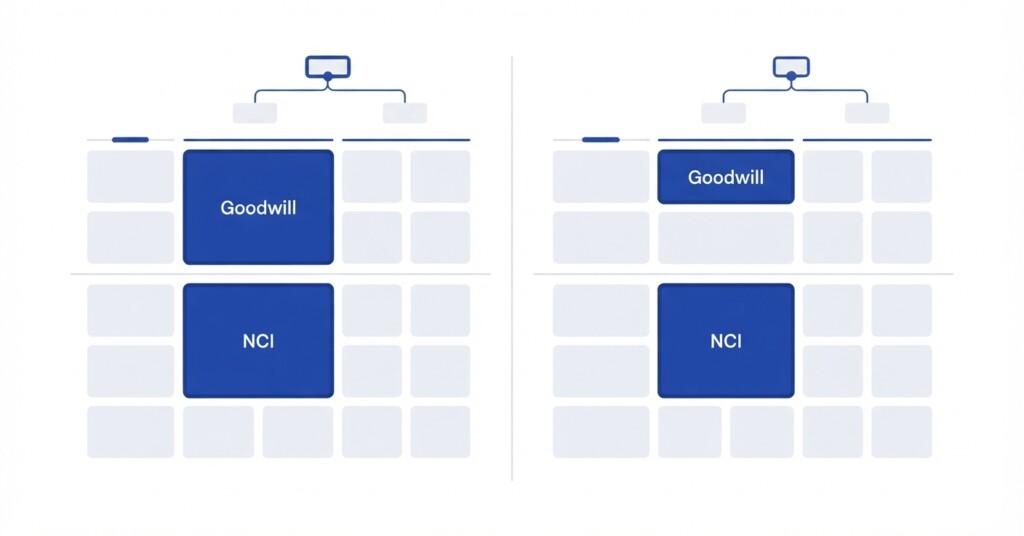
When a parent company acquires a controlling interest in a subsidiary, the question of how to measure and present the remaining ownership — the non-controlling interest, or NCI — sits at the heart of consolidation accounting. For finance teams preparing group financial statements, the answer depends almost entirely on whether you are working under IFRS or US GAAP. These two frameworks take fundamentally different approaches to NCI measurement at acquisition date, and those differences ripple through your consolidated balance sheet, goodwill calculation, and equity section in ways that matter far beyond technical compliance.
This article breaks down exactly how the two frameworks diverge, what the numbers look like in practice, and why finance teams managing multi-entity consolidations — especially those handling the process in spreadsheets — need to understand the downstream effects before they finalise their group accounts.
The Core Difference: Full Goodwill vs Partial Goodwill
Under US GAAP (ASC 805), NCI is measured at fair value on the acquisition date. This means you recognise the full fair value of the subsidiary — including the portion attributable to minority shareholders — when calculating goodwill. The result is often called the ‘full goodwill’ method because goodwill is grossed up to reflect 100% of the entity, not just the parent’s share.
Automate NCI calculations across all your entities.
BrizoConsol handles non-controlling interest automatically — no manual adjustments required.
Under IFRS 3, acquirers have a choice for present ownership instruments (such as ordinary shares) that entitle holders to a proportionate share of net assets on liquidation. NCI can be measured either at fair value (producing the same full goodwill result as US GAAP), or at the NCI’s proportionate share of the acquiree’s identifiable net assets. The second option is sometimes called the ‘partial goodwill’ method. This choice is made on a transaction-by-transaction basis, meaning different acquisitions within the same group could use different methods — adding complexity to group consolidation processes.
IFRS 3 gives acquirers an acquisition-by-acquisition choice between fair value NCI and proportionate share NCI for eligible present ownership instruments. US GAAP mandates fair value only. This single policy decision can change your consolidated goodwill balance by millions, and the effect persists on the balance sheet until the subsidiary is disposed of or goodwill is impaired.
A Worked Example: Same Acquisition, Two Different Balance Sheets
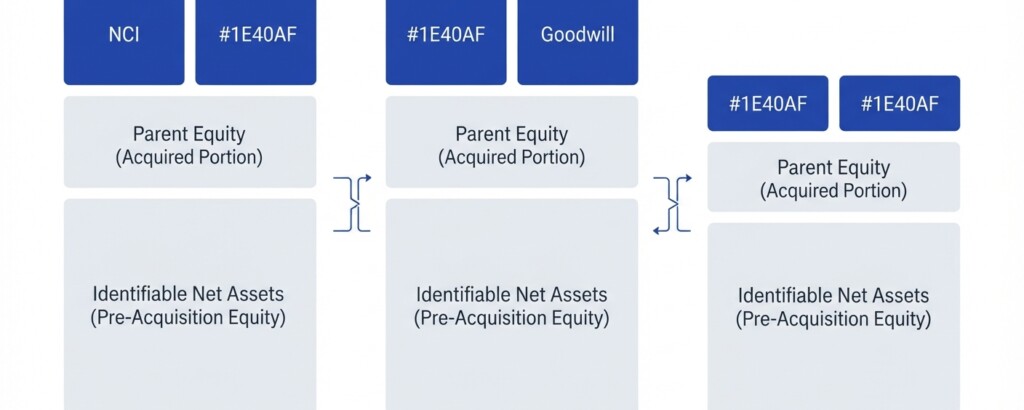
To make this concrete, consider a parent company acquiring 80% of a subsidiary. The purchase price is £8,000,000 for the 80% stake. The fair value of the subsidiary’s identifiable net assets at acquisition is £7,500,000. The fair value of the 20% NCI stake is assessed at £2,100,000 (not simply 20% of the purchase price — minority stakes often trade at a slight discount).
| Component | US GAAP (Full Goodwill) | IFRS — Fair Value NCI | IFRS — Proportionate NCI |
|---|---|---|---|
| Consideration paid (80%) | £8,000,000 | £8,000,000 | £8,000,000 |
| NCI at acquisition date | £2,100,000 (fair value) | £2,100,000 (fair value) | £1,500,000 (20% × £7.5m) |
| Total consideration + NCI | £10,100,000 | £10,100,000 | £9,500,000 |
| Less: fair value of net assets | £7,500,000 | £7,500,000 | £7,500,000 |
| Goodwill recognised | £2,600,000 | £2,600,000 | £2,000,000 |
| NCI on consolidated balance sheet | £2,100,000 | £2,100,000 | £1,500,000 |
The difference in goodwill — £600,000 in this example — is entirely attributable to how the NCI is measured. The group’s own share of goodwill is identical under all three approaches (£2,000,000, being £8,000,000 minus 80% of £7,500,000). The extra £600,000 under full goodwill represents the NCI’s share of goodwill attributable to the subsidiary as a whole.
Journal Entries at Acquisition: What the Books Actually Show
At acquisition date, the consolidation entries look different depending on the method chosen. Below is the elimination and NCI recognition entry under both approaches, recorded in the consolidated working papers.
| Account | Dr | Cr |
|---|---|---|
| Net identifiable assets of subsidiary (fair value) | 7,500,000 | |
| Goodwill (full goodwill — US GAAP or IFRS fair value option) | 2,600,000 | |
| Investment in subsidiary (eliminated) | 8,000,000 | |
| Non-controlling interest (fair value) | 2,100,000 |
Acquisition-date consolidation entry under full goodwill method — used under US GAAP and permitted under IFRS 3. NCI is recognised at fair value of £2,100,000; total goodwill grossed up to £2,600,000.
| Account | Dr | Cr |
|---|---|---|
| Net identifiable assets of subsidiary (fair value) | 7,500,000 | |
| Goodwill (partial goodwill — IFRS proportionate option) | 2,000,000 | |
| Investment in subsidiary (eliminated) | 8,000,000 | |
| Non-controlling interest (proportionate share) | 1,500,000 |
Acquisition-date consolidation entry under IFRS 3 proportionate NCI option. NCI is recognised at 20% of net identifiable assets (£1,500,000); goodwill is lower at £2,000,000 because NCI goodwill is not recognised.
Subsequent Periods: How NCI Moves After Acquisition
The choice of NCI measurement method does not just affect the opening balance sheet — it affects how equity is presented in every subsequent period. NCI on the consolidated balance sheet is updated each reporting period to reflect the minority shareholders’ share of post-acquisition profits, dividends paid to minority shareholders, and any other comprehensive income or loss allocated to NCI.
Under both frameworks, NCI absorbs its share of subsidiary profits and losses. However, when goodwill impairment arises, the mechanics diverge. Under US GAAP full goodwill, an impairment loss is allocated between controlling and non-controlling interests on a rational basis (typically reflecting their relative shares of recognised goodwill, which may not match ownership percentages if a control premium was paid). Under IFRS proportionate goodwill, the impairment test requires notionally grossing up goodwill for the cash-generating unit, but only the parent’s share of the goodwill impairment loss is recognised in profit or loss and charged against goodwill — NCI equity is unaffected because NCI goodwill was never recognised on the balance sheet.
Finance teams switching between IFRS and US GAAP reporting — for example when a privately held IFRS group seeks US capital markets access — must not assume NCI balances can be simply restated by adjusting for the goodwill difference. Impairment history, step acquisitions, and OCI movements all interact with the opening NCI balance in ways that require a full restatement analysis.
The Equity Section: Presentation and Calculation
Under both IFRS (IAS 1 and IFRS 10) and US GAAP (ASC 810), NCI must generally be presented within equity on the consolidated balance sheet, separately from the equity attributable to owners of the parent. This was a significant change from earlier practice where minority interest was sometimes shown as a liability or mezzanine item (though redeemable NCI under US GAAP SEC rules may still require temporary equity presentation). The following calculation illustrates how the NCI equity balance develops over the first two years after acquisition.
| NCI at acquisition date (proportionate method) | £1,500,000 |
| NCI share of Year 1 profit (20% × £400,000) | £80,000 |
| Less: dividends paid to NCI in Year 1 (20% × £100,000) | −£20,000 |
| NCI equity at end of Year 1 | £1,560,000 |
| NCI share of Year 2 profit (20% × £350,000) | £70,000 |
| NCI share of Year 2 OCI — FX translation loss (20% × −£50,000) | −£10,000 |
| Less: dividends paid to NCI in Year 2 (20% × £80,000) | −£16,000 |
| NCI equity at end of Year 2 | £1,604,000 |
Note that foreign exchange translation differences — arising when a foreign subsidiary’s financial statements are translated into the group’s presentation currency — flow into other comprehensive income and are allocated between the parent and NCI in proportion to ownership. This interaction between FX translation and NCI is one of the more error-prone areas in Excel-based consolidations, particularly when subsidiaries operate in multiple currencies and exchange rates move significantly during the year.
Step Acquisitions and NCI: Where Things Get Complicated
Multi-entity groups frequently increase their ownership stake in a subsidiary over time — buying 40% initially, then acquiring a further 45% to achieve control. These step acquisitions follow largely converged principles under both IFRS 3 and ASC 805, though NCI measurement differences remain central.
Under both frameworks, obtaining control is treated as a significant economic event: the previously held equity interest is remeasured at fair value at the acquisition date, with any resulting gain or loss recognised in profit or loss. Where they diverge is in measuring the remaining NCI: under IFRS 3, acquirers retain the policy choice between fair value and proportionate share of net identifiable assets (for eligible instruments), whereas ASC 805 mandates fair value for NCI. For groups with complex ownership histories — partial stakes, joint ventures converting to subsidiaries — the NCI opening balance can be difficult to reconstruct if the workpapers were not maintained carefully from the original acquisition date.
- Identify the date on which control was obtained — this is the acquisition date for IFRS 3 and ASC 805 purposes.
- Remeasure the previously held interest at fair value at the acquisition date and recognise any resulting gain or loss.
- Measure NCI at the acquisition date using the chosen method (IFRS choice; US GAAP fair value only).
- Calculate goodwill using the full formula: consideration transferred plus NCI plus fair value of prior interest, less fair value of identifiable net assets.
- Update your consolidation workpapers to carry forward the correct NCI opening balance into subsequent periods.
- Ensure any intercompany transactions between the group and the entity prior to achieving control are reviewed — some may now require elimination treatment going forward.
Practical Implications for Group Finance Teams
For finance teams maintaining group consolidations — whether in Excel, a dedicated tool, or a combination of both — the NCI measurement choice under IFRS is a policy decision that should be documented in the group accounting policy manual and applied consistently for each individual transaction. Using different methods across the same group is permitted under IFRS but creates disclosure obligations and adds to the complexity of managing NCI balances over time.
In practice, one of the most common pain points is maintaining an accurate NCI roll-forward schedule. Every period, the NCI balance must be updated for profit and loss allocation, OCI movements (including FX translation), dividends, and any changes in ownership percentage that do not result in loss of control. Under both IFRS 10 and US GAAP (ASC 810), transactions that change the parent’s ownership stake without losing control are treated as equity transactions — no goodwill adjustment, no gain or loss in earnings — with the difference between consideration paid and the change in NCI recognised directly in parent equity. However, the exact adjustment to parent equity differs because the carrying amount of NCI depends on whether full or partial goodwill was recognised at acquisition.
Finance teams that manage these calculations in spreadsheets often find that the NCI roll-forward is the first place errors accumulate. A formula that hard-codes last period’s opening balance, a tab that does not pick up the FX translation adjustment correctly, or a dividend that was processed in the subsidiary ledger but not reflected in the group workings — these are common and consequential mistakes. When the auditors ask for a reconciliation of the NCI balance from prior year to current year, being unable to trace every movement cleanly is a significant problem.
Disclosure Requirements: What Your Financial Statements Must Show
Disclosure requirements for subsidiaries with non-controlling interests differ substantially between the two frameworks. IFRS 12 requires detailed disclosures for each subsidiary with material NCI, including its name, principal place of business, NCI ownership percentage, dividends paid to NCI, and summarised financial information for the subsidiary as a whole (assets, liabilities, profit or loss, total comprehensive income, and cash flows before intercompany eliminations), as well as significant restrictions on accessing subsidiary assets. In contrast, US GAAP (ASC 810) focuses primarily on attributing net income and comprehensive income on the face of the financial statements and providing an equity reconciliation; it does not mandate full summarised financial statements (such as cash flows) for each subsidiary with material voting NCI.
For groups reporting under IFRS with several subsidiaries where NCI is material, assembling these summarised disclosures manually from subsidiary trial balances before intercompany eliminations is time-consuming and prone to error. This is an area where having a consolidation process that captures entity-level data systematically, rather than through ad hoc spreadsheet consolidation, makes the disclosure preparation significantly more manageable.
Choosing and Applying the Right Framework Consistently
For most SME groups, the choice of IFRS or US GAAP is determined by regulatory requirements, investor expectations, or the jurisdiction of the parent entity. What is within the finance team’s control — under IFRS — is the NCI measurement method chosen at each acquisition. The proportionate method produces lower goodwill and a lower NCI balance, which can be appealing because it avoids recognising goodwill that the group has not economically paid for. The fair value method gives a more complete picture of the subsidiary’s full economic value but introduces estimation uncertainty in valuing the minority stake.
Whichever approach is used, the consolidation process benefits enormously from having clean, structured data at the subsidiary level — consistent chart of accounts, documented intercompany balances, and a reliable month-end close process at each entity. The NCI calculation is only as accurate as the underlying subsidiary financials it is built on. Groups that struggle with entity-level data quality will find NCI accuracy to be a persistent problem regardless of which measurement method they adopt.
See How Consolidation Works Across Multi-Entity Groups
BrizoConsol helps finance teams manage entity-level data, intercompany eliminations, NCI calculations, and group reporting in one connected workflow — reducing the manual reconciliation work that makes month-end consolidation difficult to scale.