Xero Consolidation for Groups With a Holding Company and Multiple Operating Subsidiaries: What to Set Up Before Your First Close
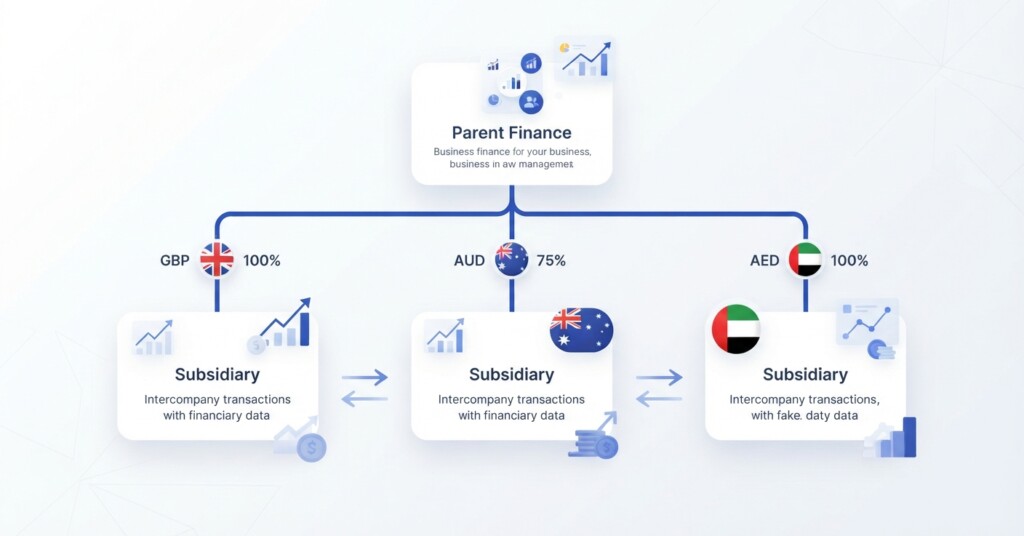
Running a group structure through Xero is common among growing SMEs. A holding company sits at the top, two or three operating subsidiaries sit underneath, and at some point a CFO or controller realises the board needs consolidated financials — a single profit and loss, balance sheet, and cash flow that rolls everything together and strips out the transactions flowing between entities. That first consolidated close is often where things get messy, fast. Intercompany loans appear on both sides of the ledger without matching amounts, FX translation creates unexplained differences, and minority shareholders have never been properly accounted for. This article walks through what you need to have in place before you attempt your first group close — so that the numbers actually make sense when they come out.
Understanding the Group Structure Before You Touch Any Numbers
Before any consolidation work begins, document the legal and economic structure clearly. Who owns what percentage of each subsidiary? Are there any non-controlling interests (NCI) — third-party shareholders who own a slice of one of your operating entities? Which entities transact with each other regularly, and in which currencies? The answers to these questions determine your consolidation methodology, your elimination entries, and your FX translation approach. A group with a UK holding company, an Australian operating subsidiary, and a UAE subsidiary faces three different functional currencies, two different minority interest calculations if both operating subsidiaries are partially owned, and a set of intercompany payables and receivables that must net to zero in the consolidated view.
Sketch a simple ownership diagram. Note the percentage owned by the holding company for each subsidiary. Any subsidiary where the group owns less than 100% needs an NCI calculation. Any entity with a functional currency different from your group presentation currency needs an FX translation policy. Get this documented before you open a single Xero file.
Consolidate your Xero entities — automatically.
BrizoConsol pulls from all your Xero organisations and delivers group reports in minutes.
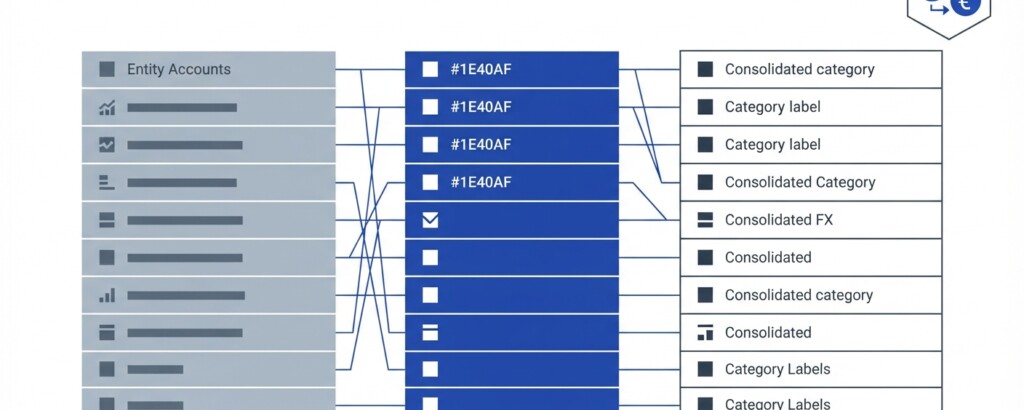
Chart of Accounts Alignment Across Entities
Xero allows each organisation to have its own chart of accounts, which is fine for standalone bookkeeping but becomes a significant problem for consolidation. If HoldCo UK books management fees to account 6100 ‘Management Charges’ and Subsidiary A receives them into account 4050 ‘Group Recharges’, your consolidation tool — or your Excel model — needs a mapping layer to understand that these are the same economic event viewed from opposite sides.
Before your first close, map every entity’s chart of accounts to a single group chart. This does not mean forcing all subsidiaries to use identical account codes — it means creating a mapping table that tells your consolidation process which accounts in each entity correspond to which group-level line. This mapping is the foundation of every automated or manual consolidation process.
A practical approach is to export each entity’s Xero chart of accounts into a spreadsheet and assign a group account code and category to every line. Common mismatches to watch for include depreciation codes split differently across entities, loan interest coded to different expense categories, and intercompany accounts that exist in one entity but have no counterpart in another. Fix these mappings on paper first — changing live Xero account codes mid-year creates historical reconciliation problems.
| Entity | Local Account Code | Local Account Name | Group Account Code | Group Account Name |
|---|---|---|---|---|
| HoldCo UK | 2100 | Intercompany Loan — Sub A | IC-L-001 | Intercompany Loan — Subsidiary A |
| Sub A AUS | 1850 | Loan from Parent | IC-L-001 | Intercompany Loan — Subsidiary A |
| Sub A AUS | 4050 | Group Recharges | IC-REV-001 | Intercompany Management Fee Income |
| HoldCo UK | 6100 | Management Charges | IC-EXP-001 | Intercompany Management Fee Expense |
| Sub B UAE | 5500 | Intra-group Sales | IC-REV-002 | Intercompany Sales — Subsidiary B |
Setting Up Intercompany Accounts and Reconciliation Discipline
The most common source of consolidation pain is unmatched intercompany balances. Entity A shows a receivable of £50,000 from Entity B. Entity B shows a payable of £48,500 to Entity A. The £1,500 difference might be timing (an invoice raised but not yet posted in Xero by B), a currency rounding issue, or an outright error. Multiplied across a five-entity group with monthly recharges, loans, and intercompany sales, you can end up with dozens of reconciling items that take days to clear.
Before your first close, establish a clear intercompany reconciliation process. This means: dedicated intercompany accounts in every Xero entity (not generic debtors or creditors), a monthly confirmation process where each entity confirms its balances with counterparties, and a defined cut-off policy for when intercompany invoices must be posted.
If intercompany balances are not matched and agreed before you attempt elimination entries, your consolidated balance sheet will not balance. Do not skip the intercompany reconciliation step and hope the consolidation tool will fix it — unmatched intercompany balances are an input problem, not an output problem.
A simple intercompany confirmation matrix — a table showing what each entity thinks it owes and is owed by every other entity — is the minimum viable reconciliation control. Run it at least monthly. Agree that the entity issuing a recharge invoice is the ‘source of truth’ for the amount, and the receiving entity must match it within the same month.
FX Translation: Getting the Policy Right Before You Close
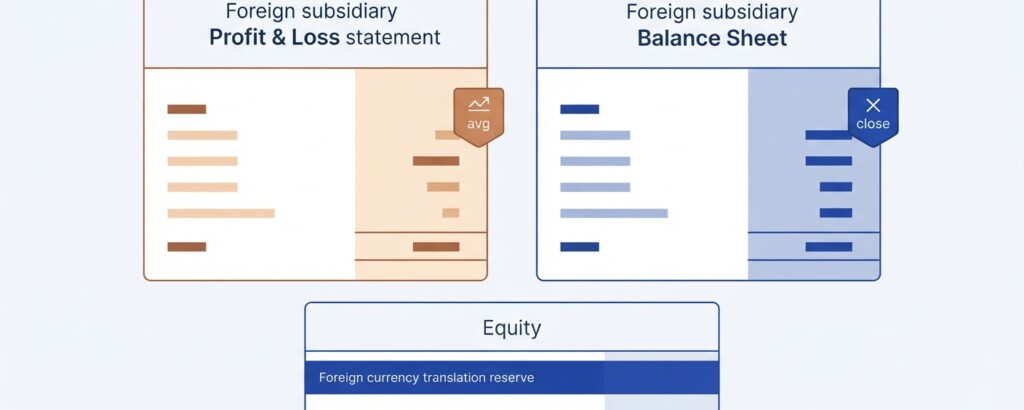
If any subsidiary operates in a currency different from your group presentation currency, you need a documented FX translation policy before you start. Under IFRS and most national GAAP frameworks, the standard approach for translating a foreign subsidiary is: translate income statement items at the average rate for the period, translate balance sheet items at the closing rate, and take the resulting translation difference to a separate component of equity — the foreign currency translation reserve (FCTR).
Xero holds each organisation in its own base currency and allows reports to be viewed in other currencies, but it does not produce a translated set of financials ready for group consolidation under standards like IAS 21 automatically. You need to define which exchange rates you will use — average for P&L, closing for balance sheet — and apply them consistently every period. Inconsistency in rate selection is one of the most common causes of unexplained movements in group equity.
| AUS Sub P&L (AUD) — translated at average rate 0.54 GBP/AUD | AUD 1,200,000 × 0.54 = £648,000 |
| AUS Sub Opening Net Assets (AUD) — translated at current closing rate 0.52 GBP/AUD | AUD 800,000 × 0.52 = £416,000 |
| AUS Sub Opening Net Assets (AUD) — translated at prior closing rate 0.55 GBP/AUD | AUD 800,000 × 0.55 = £440,000 |
| FX Translation Reserve movement on opening net assets (difference) | £416,000 − £440,000 = −£24,000 |
That £24,000 negative translation reserve movement is not a loss — it is a currency effect that belongs in other comprehensive income, not in the profit and loss. If you do not model this correctly, your consolidated retained earnings will be wrong, and your equity reconciliation will not close. Document the rate source (many groups use the central bank rate or a published rate service) and the date you observe the closing rate. Apply these rules identically every month.
Non-Controlling Interests: The Calculation You Cannot Skip
If the group owns 75% of Subsidiary B and an external investor owns 25%, that 25% minority share must be presented separately in the consolidated balance sheet (as an NCI component of equity) and in the consolidated income statement (as profit attributable to NCI). Getting this right requires knowing the subsidiary’s net assets and profit at each reporting date.
The NCI calculation at consolidation is straightforward in principle. Take the subsidiary’s net assets at the reporting date, multiply by the NCI percentage, and present that amount in group equity. Take the subsidiary’s profit after tax, multiply by the NCI percentage, and show that in the income statement as profit attributable to NCI. The rest flows to equity attributable to the parent’s shareholders.
| Account | Dr | Cr |
|---|---|---|
| Share Capital — Subsidiary B (elimination) | 1,000,000 | |
| Investment in Subsidiary B (HoldCo balance sheet) | 750,000 | |
| Non-Controlling Interest (group equity) | 250,000 |
Elimination of HoldCo investment against Subsidiary B share capital on consolidation, with NCI recognised at 25% of Subsidiary B’s share capital of £1,000,000. This entry is posted in the consolidation workings only, not in any entity’s Xero file.
| Account | Dr | Cr |
|---|---|---|
| Consolidated profit after tax | 80,000 | |
| Profit attributable to parent shareholders | 60,000 | |
| Profit attributable to NCI | 20,000 |
Allocation of Subsidiary B’s £80,000 profit after tax: 75% (£60,000) to parent, 25% (£20,000) to NCI. Presented in the consolidated income statement below profit after tax.
The Intercompany Elimination Entries You Need on Day One
Consolidation eliminates all transactions and balances between group entities — because from a group perspective, a sale from Entity A to Entity B is not a sale at all; it is an internal transfer. The most common eliminations for an SME group are: intercompany receivables and payables, intercompany revenue and cost of sales (or expenses), intercompany loan balances and related interest, and management fee income and expense.
- Eliminate intercompany receivables against intercompany payables — these must net to zero in the consolidated balance sheet.
- Eliminate intercompany revenue in one entity against the corresponding intercompany expense in the other, so group turnover reflects only third-party sales.
- Eliminate intercompany loan balances — the parent’s loan asset cancels the subsidiary’s loan liability.
- Eliminate intercompany interest income in the lender entity against interest expense in the borrowing entity.
- Eliminate any unrealised profit on intercompany stock transfers — if Subsidiary A sold goods to Subsidiary B at a mark-up and B still holds those goods, the mark-up is not yet realised and must be eliminated from group inventory and retained earnings.
Each of these eliminations needs to be tracked, documented, and repeated every period. In a manual Excel consolidation, this typically means a set of journal entry tabs in the workbook — one per elimination type — that reference the source balances from each entity’s trial balance export. The risk is that someone changes the elimination logic in one month, the model drifts, and six months later no one can explain why the group retained earnings reconciliation does not agree.
Financial Close Workflow: Sequencing Matters
Even with perfect account mapping and elimination logic, a group close will fail if the entities do not close in the right order. The correct sequence is: subsidiaries close and lock their management accounts first; intercompany reconciliations are confirmed and any differences resolved; FX rates for the period are agreed and applied; elimination entries are prepared and reviewed; the consolidated trial balance is assembled; NCI calculations are applied; and finally the group financial statements are prepared. Attempting to consolidate while some entities are still posting transactions is one of the most reliable ways to produce incorrect group numbers.
Establish a close calendar before your first period end. Define a hard cut-off date for each entity’s Xero books — ideally three to five working days after month end to allow for bank reconciliations and coding corrections. Set a separate date by which intercompany confirmations must be agreed. Set a date by which the consolidation workings must be complete and reviewed. This calendar discipline separates groups that close in five days from those that close in three weeks.
Where Automation Changes the Effort Calculation
A two-entity group with simple intercompany transactions can be consolidated manually in Excel with reasonable effort — perhaps a day of work per month if the setup is clean. A five-entity group with multiple currencies, partial ownership, monthly intercompany recharges, and a board that wants consolidated reporting by the fourth working day is a different proposition. The manual Excel approach requires someone to export trial balances from five Xero organisations, paste them into a consolidation model, apply FX rates, run elimination entries, compute NCI, and check everything before the CFO’s report is due. That process is fragile, slow, and dependent on a single person who understands the model.
Consolidation tools that connect directly to Xero via API can pull trial balance data automatically each period, apply your account mappings, run standard elimination entries, and produce a consolidated trial balance ready for review. The finance team’s job shifts from data assembly to data review — checking that the numbers make sense rather than building the model from scratch each month. The setup investment is front-loaded (the account mapping, elimination rules, and FX policy all need to be configured), but the ongoing monthly effort drops substantially.
The goal of any consolidation setup — whether manual or automated — is that the process is repeatable, documented, and survivable if the person who built it leaves the business. If your current consolidation process lives entirely in the head of one person or in an unlabelled Excel file, that is a risk worth addressing before your next close.
A Pre-Close Checklist for SME Groups Using Xero
- Document the group ownership structure including NCI percentages for each subsidiary.
- Map every entity’s Xero chart of accounts to a group chart of accounts.
- Identify all intercompany relationships — loans, management fees, intercompany sales, shared costs.
- Create dedicated intercompany accounts in each Xero entity and agree the naming convention.
- Establish a monthly intercompany confirmation process with a hard cut-off date.
- Document the FX translation policy — which rates for P&L, which for balance sheet, and the source of those rates.
- Prepare standard elimination journal templates and document the logic behind each one.
- Build or configure the NCI calculation for any partially-owned subsidiaries.
- Set a close calendar with hard dates for each entity, intercompany sign-off, and consolidated reporting.
- Test the full consolidation process with one historical period before relying on it for live reporting.
Running through this checklist with a historical month’s data — before the pressure of a live close — will surface the account mapping gaps, intercompany mismatches, and FX questions that are much easier to fix outside of a month-end deadline. The first consolidated close is almost always harder than every subsequent one. Investing in setup quality before that first close is where the real time saving happens.
See How BrizoConsol Connects to Xero for Group Consolidation
If you are setting up consolidation for a Xero group and want to see how automated consolidation handles intercompany eliminations, FX translation, and NCI without rebuilding your Excel model every month, take a look at how BrizoConsol works in practice.