Selling a Retail Chain: Why the Consolidated Disposal Gain Is Not What the Parent’s Books Show
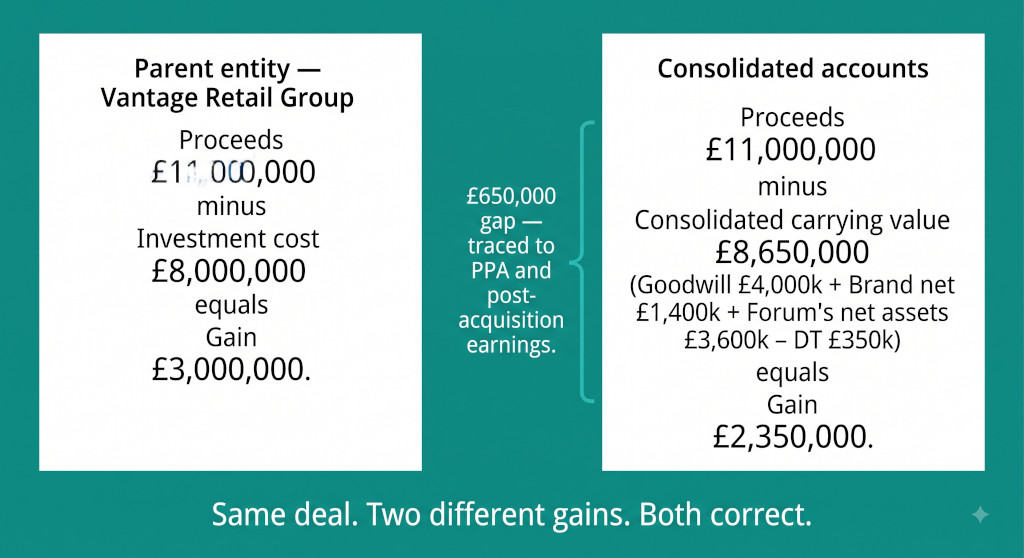
When Vantage Retail Group completed the sale of Forum Apparel — a fashion chain it had owned for three years — the CFO reviewed the transaction summary from the deal team and expected to see a £3,000,000 gain in the year-end accounts. The consolidated income statement showed £2,350,000. The parent entity accounts showed £3,000,000. Both were correct. The £650,000 difference was not a mistake.
This is the disposal version of a problem that is the mirror image of the acquisition problem: when a retail group acquires a brand, the consolidated accounts carry more than just the investment cost — they carry goodwill, PPA intangibles, and the ongoing post-acquisition trading results. When the group sells, all of those items need to come off the consolidated balance sheet as part of the disposal. The result is a consolidated carrying value that is almost always different from the parent’s investment cost — and therefore a consolidated disposal gain that is almost always different from the parent’s standalone gain.
This post works through the Vantage/Forum Apparel disposal step by step: the consolidated carrying value at the date of sale, the disposal journal, the reconciliation from parent gain to consolidated gain, and what changes if goodwill was impaired during the holding period.
Stop building consolidations in spreadsheets.
BrizoConsol automates multi-entity consolidation — setup in minutes, reports the same day.
The Transaction History
Three years ago, Vantage Retail Group Ltd acquired 100% of Forum Apparel Ltd, a sixteen-store fashion chain, for £8,000,000. The purchase price allocation at acquisition identified a brand intangible with a ten-year useful life (fair value £2,000,000), recognised a deferred tax liability of £500,000 on the brand uplift, and left goodwill of £4,000,000 after accounting for Forum’s net assets at fair value.
| PPA at acquisition (3 years ago) | £ |
|---|---|
| Forum Apparel net assets at book value | 2,500,000 |
| Brand intangible (10-year life) | 2,000,000 |
| Deferred tax liability on brand (25%) | (500,000) |
| Net assets at fair value | 4,000,000 |
| Acquisition price | 8,000,000 |
| Goodwill on acquisition | 4,000,000 |
Over the three years of ownership, Vantage consolidated 100% of Forum’s results. The brand intangible was amortised at £200,000 per year (£600,000 in total over three years). Goodwill was tested for impairment annually and no impairment was required. Forum traded profitably: its own retained earnings grew from £2,500,000 at acquisition to £3,600,000 at the disposal date — a £1,100,000 increase — as Forum’s standalone profits were retained in the subsidiary rather than paid up as dividends.
The DT liability on the brand unwound as the brand amortised: at £50,000 per year (25% × £200,000 amortisation), it reduced from £500,000 at acquisition to £350,000 at the disposal date.
The Consolidated Carrying Value at the Disposal Date
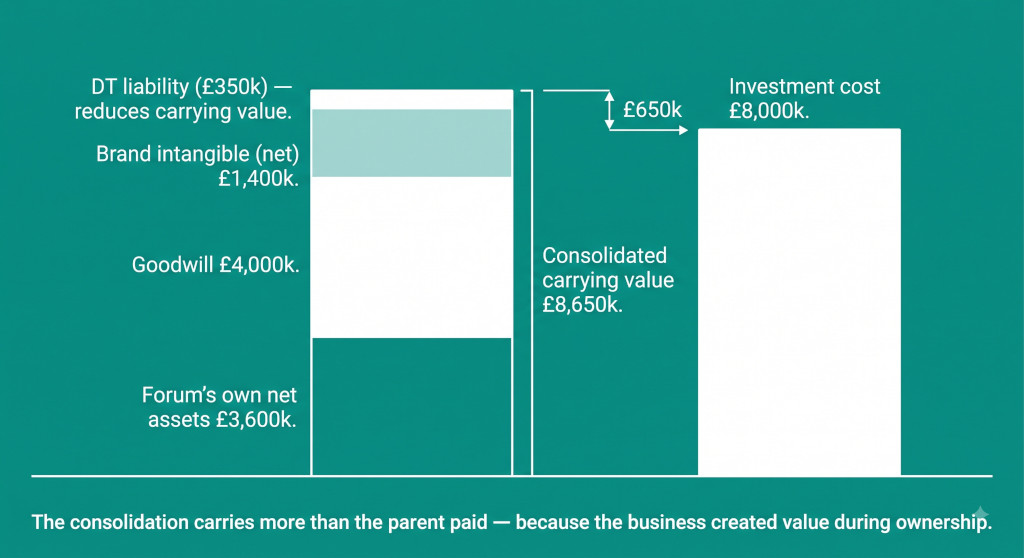
When Vantage sells Forum, it needs to derecognise everything that appears in the consolidated balance sheet in relation to Forum. This is not just Forum’s own net assets — it is the full stack of acquisition accounting items that have been sitting in the consolidated workbook since the deal closed three years ago:
| Forum Apparel own net assets at disposal date | £3,600,000 |
| Goodwill (no impairment taken) | £4,000,000 |
| Brand intangible — net of 3 years’ amortisation (£2,000k − £600k) | £1,400,000 |
| Deferred tax liability on brand (remaining after 3yr unwind) | (£350,000) |
| Total consolidated carrying value of Forum Apparel | £8,650,000 |
The consolidated carrying value of £8,650,000 is £650,000 more than the original acquisition price of £8,000,000. This reflects two opposing forces: the business created £1,100,000 of value during the holding period (Forum’s net assets grew), but the brand intangible has been amortising (£600,000 net of £150,000 DT relief = £450,000 net reduction). The net effect is that the consolidated carrying value exceeds the original price paid by £650,000.
The Disposal: Two Gain Calculations
Vantage sells Forum Apparel for £11,000,000 cash. The buyer acquires the shares and assumes all of Forum’s existing assets and liabilities.
| Disposal gain calculation | Parent entity (£) | Consolidated (£) |
|---|---|---|
| Proceeds received | 11,000,000 | 11,000,000 |
| Carrying value derecognised | (8,000,000) | (8,650,000) |
| Gain on disposal | 3,000,000 | 2,350,000 |
The parent’s carrying value is simply the cost of investment — £8,000,000. The parent entity never recorded goodwill, the brand intangible, or Forum’s post-acquisition retained earnings in its own accounts. It simply holds a £8,000,000 investment on its balance sheet, unchanged from the day of acquisition (assuming no impairment at parent entity level and no dividends received that reduced the cost basis).
The consolidated accounts carry everything — goodwill, brand, accumulated post-acquisition profits flowing through consolidated retained earnings — and the disposal removes all of it. The higher consolidated carrying value means a lower consolidated gain.
The Disposal Journal on Consolidation
At the disposal date, the consolidated accounts derecognise Forum’s full contribution — all assets and liabilities at their consolidated carrying values — and recognise the cash proceeds and the resulting gain:
| Account | Dr | Cr |
|---|---|---|
| Cash received | £11,000,000 | |
| Deferred tax liability — brand (remaining balance relieved) | £350,000 | |
| Goodwill (derecognised in full) | £4,000,000 | |
| Brand intangible (net carrying value) | £1,400,000 | |
| Forum Apparel net assets (own book value) | £3,600,000 | |
| Gain on disposal of subsidiary | £2,350,000 |
The “Forum Apparel net assets” credit of £3,600,000 represents the aggregate of Forum’s own assets and liabilities at their book values — cash, inventory, PP&E, lease assets and liabilities, trade receivables and payables. In practice the individual line items would be listed, but the net figure is used here for clarity. The debit to the DT liability removes the remaining deferred tax balance that existed because the brand’s consolidated carrying value exceeded its tax base; at disposal, this difference disappears and the DTL is no longer required.
The Reconciliation Bridge: From Parent Gain to Consolidated Gain
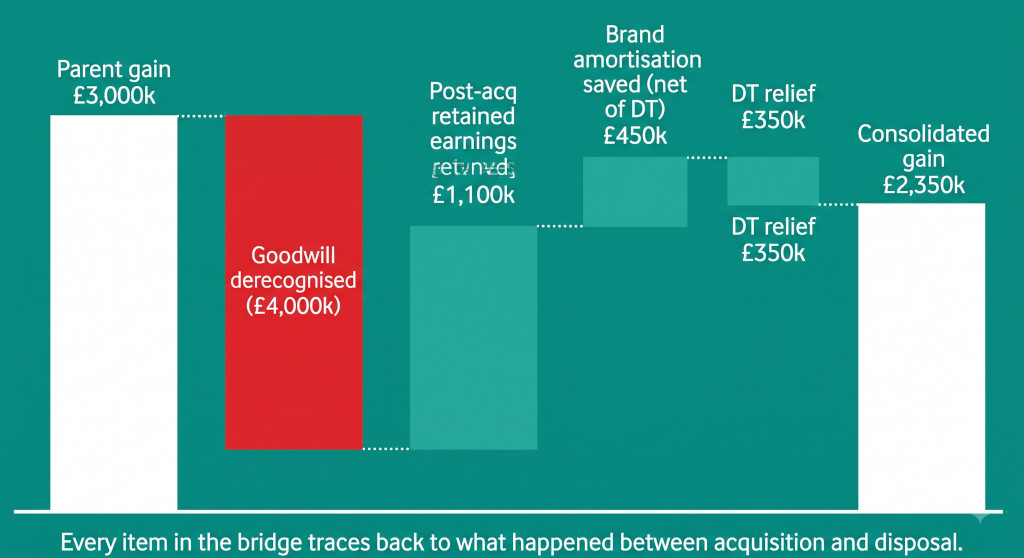
The £650,000 difference between the parent’s £3,000,000 gain and the consolidated £2,350,000 gain can be explained in full by the items that appear in the consolidated balance sheet but not in the parent’s investment account:
| Parent entity disposal gain | £3,000,000 |
| Adjustments to arrive at consolidated gain: | |
| Goodwill derecognised (not in parent’s investment account) | (£4,000,000) |
| Post-acquisition retained earnings recognised in consolidation (Forum’s net assets grew from £2,500k to £3,600k) | £1,100,000 |
| Brand amortisation charged to consolidated P&L over 3 years (net of DT) | £450,000 |
| Remaining DT liability relieved on disposal | £350,000 |
| Consolidated disposal gain | £2,350,000 ✓ |
Reading the bridge in plain terms: the parent’s gain overstates the consolidated gain because goodwill (£4,000,000) must be derecognised against the proceeds — the parent’s investment cost never included goodwill as a separate line item, but the consolidated accounts carried it throughout the holding period. The other adjustments partially offset this: Forum’s own retained earnings grew during ownership (reducing the net gap), and brand amortisation that was charged against consolidated profits in prior periods reduced the brand’s carrying value (and therefore reduces the amount derecognised at disposal, improving the gain relative to what would otherwise have been the case).
The consolidated disposal gain is always computed as proceeds minus consolidated carrying value — not proceeds minus the acquisition price. The consolidated carrying value evolves throughout the holding period as the subsidiary trades, as PPA intangibles amortise, and as goodwill impairments are (or are not) taken. The controller who prepared the acquisition consolidation three years ago holds the source data the disposal calculation needs. A disposal processed without reference to the original PPA workbook is almost guaranteed to be wrong.
What Changes If Goodwill Was Impaired During the Holding Period
Suppose that in year two of the holding period, Vantage had identified indicators of impairment in Forum Apparel — a difficult trading year, store closures, market share loss — and had recognised a £1,200,000 goodwill impairment charge in the consolidated accounts. The goodwill carrying value would have been reduced from £4,000,000 to £2,800,000.
At disposal, the consolidated carrying value of Forum would now be:
| Forum own net assets (same) | £3,600,000 |
| Goodwill (after £1,200k impairment) | £2,800,000 |
| Brand intangible net (same) | £1,400,000 |
| DT liability (same) | (£350,000) |
| Revised consolidated carrying value | £7,450,000 |
The revised consolidated disposal gain: £11,000,000 − £7,450,000 = £3,550,000.
The impairment taken in year two reduced the consolidated carrying value by £1,200,000, which in turn increases the disposal gain by £1,200,000. This is correct and expected: the £1,200,000 impairment was recognised as a loss in year two’s consolidated P&L. At disposal, the group recovers £1,200,000 more gain because the carrying value is lower. Economically, the total profit recognised over the full ownership period (impairment loss in year two plus disposal gain at exit) is the same whether or not the impairment was taken — but the timing and presentation differ significantly.
Common error at disposal: failing to use the goodwill balance net of any impairments taken during the holding period. If the consolidation workbook correctly recorded a goodwill impairment in a prior year but the disposal calculation is run using the original acquisition-date goodwill, the disposal gain will be understated by the full impairment amount. The disposal calculation must use closing carrying values as at the disposal date — which means going back into every prior year’s consolidation workbook to confirm what adjustments have been made to goodwill, intangibles, and DT.
The Parent Entity: Impairment at Entity Level vs. the Consolidated Position
Vantage’s parent entity accounts carry Forum at cost (£8,000,000) unless an impairment indicator has required a write-down. At entity level, Vantage assesses the investment against the recoverable amount of Forum — typically its value in use or fair value less costs of disposal. If Forum’s trading deteriorated significantly, Vantage might have recognised an entity-level impairment of the investment (reducing it below £8,000,000) in an earlier period.
If a parent-level impairment was taken — say the investment was written down to £7,000,000 in year two — the parent entity’s disposal gain in year three would be £11,000,000 − £7,000,000 = £4,000,000, not £3,000,000. Meanwhile, the consolidated accounts would carry the impaired goodwill (as described above) and compute the consolidated gain on that basis. The parent entity impairment and the consolidated goodwill impairment are separate calculations that may or may not be identical in amount — they assess the same economic question (is the investment carrying value recoverable?) from two different perspectives using two different accounting models.
Clearing Intercompany Balances at the Disposal Date
Before the disposal journal is posted, all outstanding intercompany balances between Vantage and Forum must be settled or reclassified. If Forum owed management fees to the parent entity (payable at the disposal date), those payables do not eliminate at consolidation after the disposal — they become genuine third-party balances once Forum leaves the group. Similarly, if Forum was receiving goods from the group’s central buying entity and there was unrealised profit in Forum’s closing inventory at the disposal date, the intercompany stock elimination that would normally apply in the current year is relevant up to the disposal date, and the unrealised profit should be cleared before derecognising Forum’s net assets.
In practice, this means confirming at the disposal date:
- All intercompany receivables and payables between Forum and remaining group entities are settled in cash (or specifically identified and reclassified as third-party balances in the sale agreement)
- Any intragroup loans from the parent to Forum are either repaid by Forum or novated to the buyer as part of the sale consideration structure
- The unrealised profit elimination on any Forum inventory sourced from the group buying entity is calculated as at the disposal date and included in the derecognised net assets
- Any IFRS 16 sublease from the group PropCo to Forum’s stores (if such a structure existed) is transferred or terminated as part of the transaction
Failing to settle or reclassify these balances before posting the disposal journal will leave orphaned intercompany entries in the consolidated workbook — balances that used to eliminate against Forum but now have no matching counterpart within the remaining group. These require individual investigation and write-off, creating reconciliation work that is significantly more complex than settling them cleanly at the transaction date.
A Practical Checklist for Retail Group Disposals
- Retrieve the original PPA workbook from the acquisition. The disposal calculation requires every PPA item at its closing carrying value on the disposal date. Brand intangibles, DT liabilities, and PP&E step-ups that were set up at acquisition must be tracked through to disposal. If the original PPA workbook cannot be located, the disposal gain cannot be correctly calculated.
- Confirm the goodwill carrying value net of all impairments. Check every year’s consolidation workbook since acquisition for goodwill impairment charges. The disposal uses the closing goodwill balance — which may be significantly below the acquisition-date goodwill if impairments have been taken.
- Confirm the net assets of the disposed entity at the disposal date. Use the subsidiary’s own balance sheet at the transaction date. Ensure it reflects all year-to-date trading, any dividends paid to the parent before completion, and any pre-completion adjustments specified in the sale agreement.
- Calculate the residual DT liability on PPA and include the relief in the disposal journal. At disposal, any remaining deferred tax liability on PPA uplifts is reversed — the temporary difference ceases to exist once the subsidiary leaves the group. Include this as a credit to the DT liability and effectively a component of the disposal proceeds (it reduces the consolidated carrying value and improves the gain).
- Settle all intercompany balances at or before the disposal date. Identify all IC receivables, payables, loans, and accruals between the disposed entity and the remaining group. Settle in cash or confirm third-party treatment in the sale agreement. Identify any unrealised profit in the disposed entity’s inventory sourced from group buying entities and include it in the pre-disposal clearing entries.
- Prepare the reconciliation from parent gain to consolidated gain. Build the bridge explicitly — start with the parent’s gain, then adjust for goodwill derecognised, post-acquisition retained earnings, net PPA amortisation, and DT relief. The bridge should reconcile to zero; any residual is a calculation error. Present this bridge to the audit team alongside the disposal journal.
- Confirm post-disposal accounting for residual items. If any portion of the proceeds is deferred (earn-out, escrow holdback), recognise it as a financial asset at fair value and reassess at each subsequent reporting date. If transition service agreements exist post-disposal (Vantage continues to provide services to the buyer for a transition period), identify whether these represent related-party transactions requiring disclosure.
Disposing of a retail subsidiary and need to get the consolidated gain right?
BrizoConsol tracks PPA schedules, goodwill impairments, and intercompany balances from acquisition through disposal — so the disposal journal builds itself from the consolidation history. See It In Action