Intercompany Reconciliation for Multi-Entity Groups: How to Match Balances and Close Faster
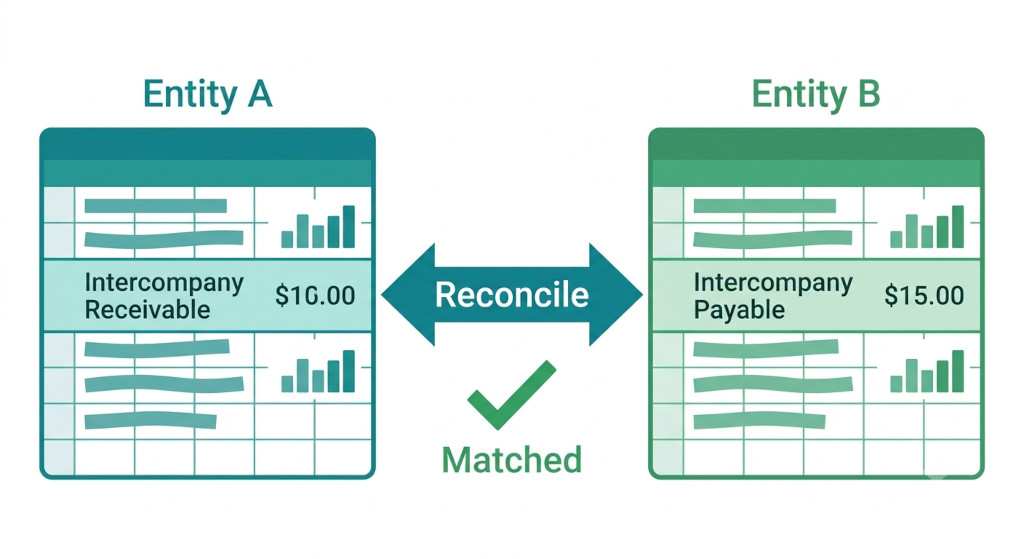
At almost every multi-entity group, the same conversation happens on day four or five of the month-end close. The consolidation is nearly done, but the balance sheet does not balance. The difference sits in the intercompany accounts. Someone posted the management fee invoice in the parent but forgot to accrue it in the subsidiary. Or the intercompany loan interest was calculated differently in the two entities. Or a payment crossed the period end and one entity has processed it while the other has not.
Intercompany reconciliation — the process of confirming that every intercompany balance recorded in one entity has a matching and equal balance in the counterpart entity — is the most common bottleneck at group month-end close. It is also one of the most preventable. Groups that build a structured intercompany reconciliation process, and run it continuously rather than only at period end, typically cut two to three days from their close cycle. Those that leave it until the consolidation spreadsheet refuses to balance spend those same days tracking down differences that should never have accumulated.
This guide explains what intercompany reconciliation involves, where mismatches come from, and how to build a process that resolves them systematically.
Automate NCI calculations across all your entities.
BrizoConsol handles non-controlling interest automatically — no manual adjustments required.
What Intercompany Reconciliation Actually Means
Every transaction between two entities in the same group creates a mirror image in the accounting records of both. When Entity A invoices Entity B for a management fee, Entity A records a receivable and fee income; Entity B records a payable and fee expense. At consolidation, both sides are eliminated — but the elimination can only work if the two balances match exactly.
Intercompany reconciliation is the process of systematically comparing the intercompany receivables and payables recorded by each entity and confirming that they agree. Where they do not agree, the difference must be investigated and resolved before the consolidated balance sheet can balance.
The reconciliation covers both the balance sheet (intercompany receivables, payables, and loan balances) and, where relevant, the P&L (intercompany income and expense flows such as management fees, rent, and recharges). A balance sheet difference that cannot be explained will prevent the consolidated balance sheet from balancing. A P&L difference will cause the consolidated profit to be misstated even if the balance sheet balances — because the income elimination and the expense elimination will not cancel exactly.
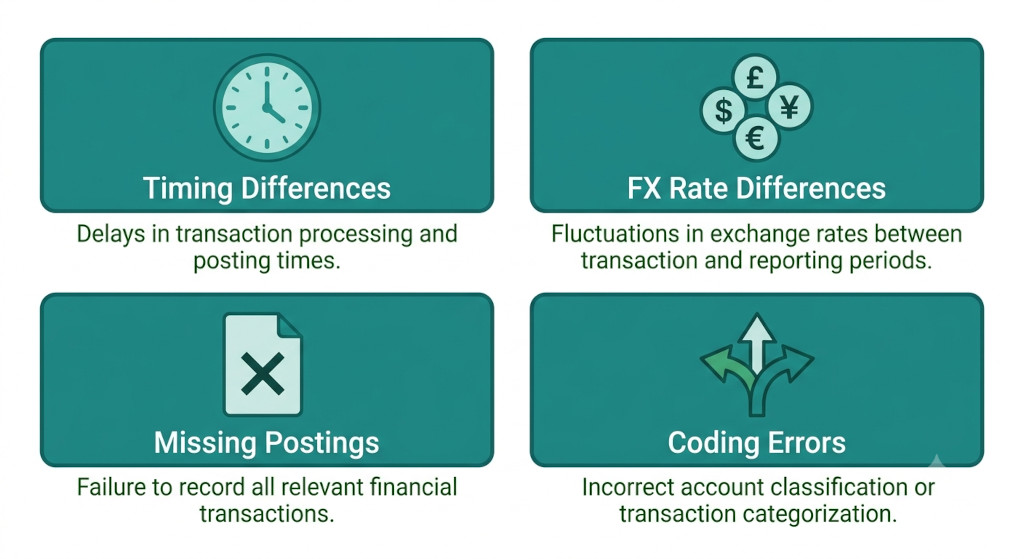
The Four Most Common Causes of Intercompany Mismatches
1. Timing differences
The most frequent mismatch is a timing difference: one entity has processed a transaction before the period end, while the counterpart entity has not yet posted the matching entry. A management fee invoice raised on 28 March may be recorded by the parent in March, but the subsidiary’s local bookkeeper may not process it until 2 April. At the 31 March consolidation, the parent shows a receivable that has no matching payable in the subsidiary. The difference is real and explainable — but it must be identified, and an accrual must be posted in the subsidiary before the period close is finalised.
2. Foreign currency differences
When a transaction between two entities crosses a currency boundary, each entity records the transaction in its own functional currency at the exchange rate applicable on the transaction date. If the transaction is settled later at a different rate, one or both entities will record a foreign exchange gain or loss. At the time of reconciliation, the translated balance in the receivable entity may differ from the balance in the payable entity simply because they applied different rates. This is not an error — but it must be identified, quantified, and treated correctly at consolidation (either eliminated or routed to the CTA reserve, depending on the nature of the balance).
3. Missing postings
In groups where intercompany invoices are raised manually, it is common for one entity to post a transaction that the counterpart entity never receives or records. A recharge for shared IT costs may be raised by the shared services centre but never accrued by the recipient entity because nobody told them it was coming. Identifying missing postings requires comparing a complete list of intercompany transactions raised by each entity against what the counterpart has recorded — not just comparing closing balances.
4. Coding errors
An intercompany transaction coded to the wrong account in either entity will appear in the reconciliation as a difference even if the amounts match. If Entity A records a management fee receivable under the correct intercompany account code but Entity B codes the matching payable to a general creditor account, the intercompany accounts will show a difference equal to the full amount of the fee. The consolidated balance sheet will balance only if both sides are coded to accounts designated as intercompany — and eliminated together.
A Step-by-Step Intercompany Reconciliation Process
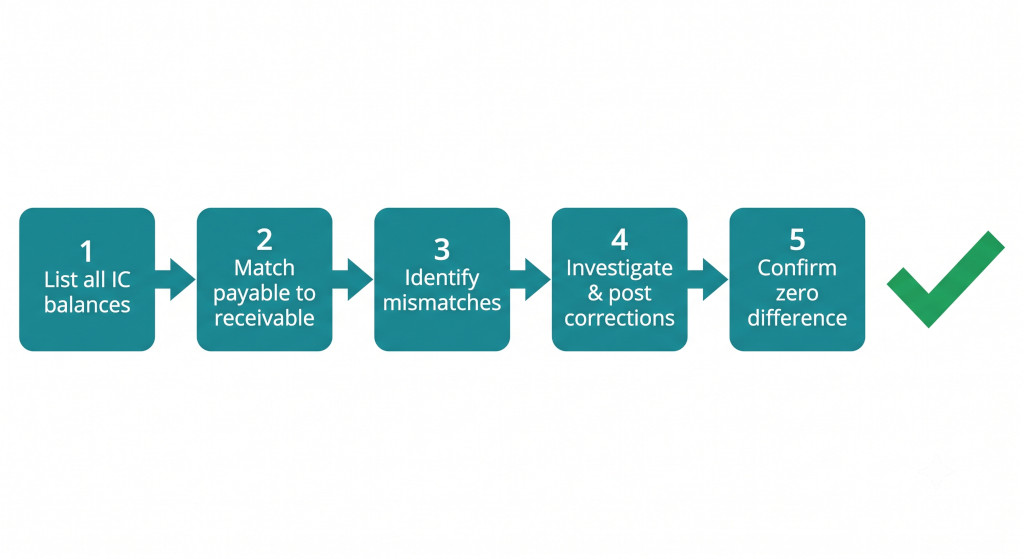
A reliable intercompany reconciliation follows the same sequence every period. Building this into the standard month-end close checklist — rather than treating it as an ad hoc task triggered by a balance sheet that refuses to balance — is what separates groups that close in five days from those that take ten.
Step 1 — Extract the intercompany balance schedule for every entity
At the start of the reconciliation, extract a complete list of intercompany balances from every entity in the group. This should include intercompany receivables and payables (balance sheet), intercompany income and expense (P&L), and the opening balance carried from the prior period. The schedule should identify the counterpart entity for every balance — not just the account code.
Step 2 — Match each receivable to its counterpart payable
For every intercompany receivable recorded by Entity A, there should be an equal and opposite payable recorded by the counterpart entity. Lay the two schedules side by side and match each balance pair. Any item that appears on one side without a match on the other is immediately flagged as a difference requiring investigation.
Step 3 — Quantify and categorise all differences
List every unmatched or partially matched balance, along with the difference amount and the entity pair involved. Categorise each difference by likely cause: timing (one entity has posted, the other has not), FX (same transaction, different rates), missing posting (one side does not exist), or coding error (wrong account code in one entity). The category determines the resolution approach.
Step 4 — Post corrections before the period closes
Timing differences require an accrual in the entity that has not yet posted the transaction. Missing postings require a journal in the entity where the entry is absent. Coding errors require a reclassification journal in the entity that used the wrong account. FX differences may require an adjustment or may simply be noted and treated correctly at consolidation — depending on whether the balance is a trading balance (difference goes to P&L) or a net investment loan (difference goes to CTA reserve).
All corrections should be posted before the period is closed in each entity’s accounting system. Posting corrections as consolidation-only journals — outside the entity books — means the mismatch will recur in the next period’s opening balances, compounding the problem over time.
Step 5 — Confirm zero net difference before eliminating
Once all corrections are posted, re-extract the intercompany balance schedule and confirm that every matched pair nets to zero. Only when the intercompany reconciliation is clean should the intercompany elimination journals be posted. Eliminating unreconciled balances produces a consolidated balance sheet that appears to balance but contains hidden errors — errors that typically surface at year-end audit in the most inconvenient way possible.
A Worked Example: Crestwood Group
Crestwood Group has three entities: Crestwood Holdings Ltd (parent), Crestwood Trading Ltd (main operating entity), and Crestwood Services Ltd (shared services centre). At 31 March, the intercompany balance schedule before reconciliation shows the following:
| Entity | Account | Balance (£) | Counterpart |
|---|---|---|---|
| Crestwood Holdings | IC Receivable — Trading | 60,000 | Trading Ltd |
| Crestwood Trading | IC Payable — Holdings | (54,000) | Holdings Ltd |
| Crestwood Services | IC Receivable — Trading | 36,000 | Trading Ltd |
| Crestwood Trading | IC Payable — Services | (36,000) | Services Ltd |
The Holdings/Trading pair shows a difference of £6,000 — Holdings records a receivable of £60,000, but Trading only shows a payable of £54,000. Investigation reveals that a March management fee invoice of £6,000 was raised by Holdings on 30 March but not yet accrued by Trading’s bookkeeper. The correction is a £6,000 accrual in Trading, posted before the period closes.
The Services/Trading pair matches exactly at £36,000 — no action required.
After the £6,000 accrual is posted in Trading, the reconciliation is clean:
| Entity pair | Receivable (£) | Payable (£) | Difference (£) |
|---|---|---|---|
| Holdings ↔ Trading | 60,000 | (60,000) | — |
| Services ↔ Trading | 36,000 | (36,000) | — |
| Total | 96,000 | (96,000) | — |
The elimination journals can now be posted with confidence. The consolidated balance sheet will balance, and the consolidated P&L will correctly show only the income earned from external customers.
The single most effective change a multi-entity finance team can make to its close process is moving the intercompany reconciliation from the end of the close to the beginning. If entity books are reconciled before anyone starts building the consolidation, the elimination step is clean from the outset — and the days spent hunting balance sheet differences simply disappear.
Building a Continuous Intercompany Reconciliation Policy
Groups that wait until month-end to reconcile intercompany balances are always firefighting. The better approach is a continuous reconciliation policy: every intercompany transaction is confirmed with the counterpart entity at the time it is raised, not three weeks later when the close is under pressure.
In practice, this means establishing a clear protocol for intercompany invoicing: every invoice raised by one entity to another is accompanied by a notification to the counterpart entity’s finance team, with a agreed posting deadline before period end. Management fee schedules are agreed at the start of the year and posted automatically each month rather than raised manually. Intercompany loan interest is calculated from a shared schedule maintained by the group finance team and distributed to each entity for posting.
These are not complicated controls — but they require consistent application across every entity in the group, which in turn requires the group finance team to have visibility of what each entity has and has not posted. In a manual process, that visibility depends on email chains and spreadsheet submissions. In a platform like BrizoConsol, it is available in real time from the intercompany balance dashboard.
How BrizoConsol Automates Intercompany Reconciliation
BrizoConsol pulls trial balance data from every connected entity — whether on Xero, QuickBooks, MYOB, or Zoho Books — and automatically builds the intercompany balance schedule each period. Every intercompany receivable is matched against its counterpart payable across entities, and any difference is flagged immediately with the amount, the entity pair, and the account involved.
The matching is done at the account level, not just the total level. If Entity A has three separate intercompany payables to Entity B — a management fee, a loan balance, and a recharge — BrizoConsol matches each one individually and flags any that do not have a corresponding entry, rather than netting the balances and masking individual differences within the total.
Once the reconciliation is confirmed clean, intercompany elimination journals run automatically. There are no manual elimination journals to post, no risk of posting the wrong amount, and no possibility of forgetting an elimination line. The consolidated balance sheet is produced from clean, reconciled data — and it balances first time.
For Crestwood Group, the reconciliation process that previously involved emailing balance schedules between three entities’ finance teams, comparing them in a spreadsheet, and chasing missing accruals via phone takes under ten minutes in BrizoConsol. The close that previously ran to day nine is consistently finished by day four.
Stop hunting intercompany differences at month-end.
BrizoConsol automatically matches intercompany balances across all your entities, flags mismatches instantly, and runs elimination journals the moment the reconciliation is clean. Start Free Trial