Selling a Property SPV: Why the Consolidated Disposal Gain Is Never What the Parent Expects
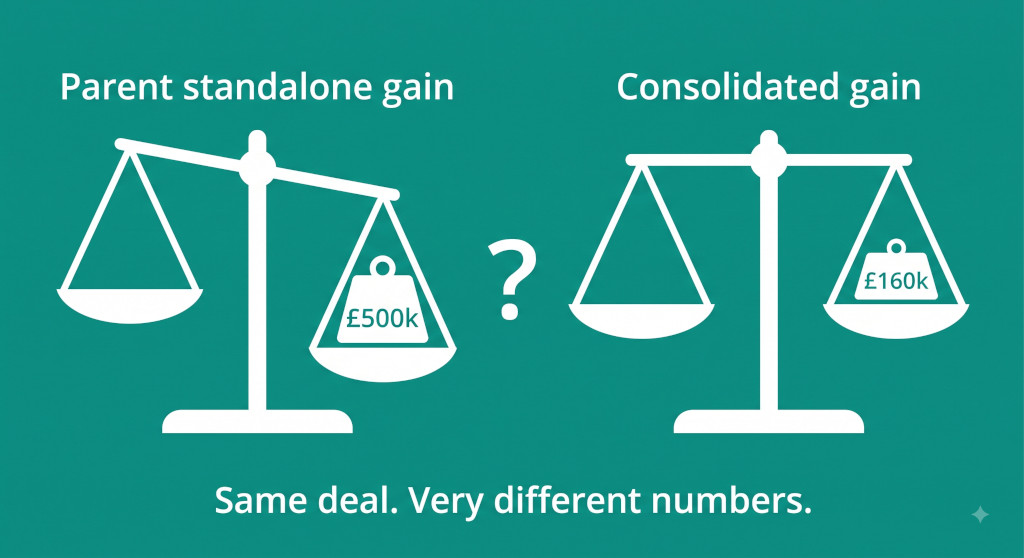
The board of Crestwood Property Holdings had been waiting five years for this. Merlin Court SPV Ltd — a commercial property held in a dedicated SPV since 2020 — had finally found a buyer. The deal was agreed at £1,100,000 for the shares, representing a clean exit at a solid premium. When the group’s finance director, Sarah, ran the number through the parent company’s accounts, the gain looked excellent: £500,000 on a £600,000 original investment. She expected to report a similar figure at group level.
When she prepared the consolidated disposal calculation, the gain was £160,000.
No one had made an error. The deal was correctly documented, the valuations were accurate, and both sets of accounts would pass audit without difficulty. The difference — £340,000 — was not a mistake. It was the correct accounting outcome, and it followed directly from how property fair values move through a group’s consolidated accounts over time. But explaining it to the board required understanding something that is invisible at entity level and only surfaces when you look at the full consolidation history of the SPV being sold.
Stop building consolidations in spreadsheets.
BrizoConsol automates multi-entity consolidation — setup in minutes, reports the same day.
Why the Parent’s Gain Looks Nothing Like the Group’s
In the parent company’s standalone accounts, Merlin Court SPV Ltd is carried as an investment in subsidiary. The parent originally paid £600,000 to acquire it in 2020 and has not adjusted that carrying value since — it sits at cost, unchanged. When the buyer pays £1,100,000 for the shares, the parent’s gain is simply the proceeds minus the cost of the investment:
| Disposal proceeds (shares sold to external buyer) | £1,100,000 |
| Less: carrying value of investment in subsidiary (cost) | (£600,000) |
| Gain on disposal — parent standalone accounts | £500,000 |
In the consolidated accounts, the investment in subsidiary line does not exist. Instead, the group holds all of Merlin Court SPV’s underlying assets and liabilities directly: the investment property, cash, bank loan, and the original goodwill that arose on acquisition. To calculate the consolidated disposal gain, you derecognise all of those assets and liabilities and compare the proceeds against the consolidated carrying amount of what you gave away.
At the date of disposal, Merlin Court SPV’s balance sheet looks like this — and these are the figures that flow through the group:
| Asset / Liability | Carrying value (£) |
|---|---|
| Investment property (FV model) | 2,800,000 |
| Cash and cash equivalents | 100,000 |
| Third-party bank loan | (2,000,000) |
| Net assets of Merlin Court SPV at disposal | 900,000 |
| Goodwill carried in consolidated accounts | 40,000 |
| Total consolidated carrying amount | 940,000 |
The consolidated disposal gain is therefore:
| Disposal proceeds | £1,100,000 |
| Less: consolidated carrying amount | (£940,000) |
| Gain on disposal — consolidated accounts | £160,000 |
The parent reports £500,000. The group reports £160,000. The difference is £340,000, and that number needs a clear explanation.
Where the £340,000 Difference Comes From
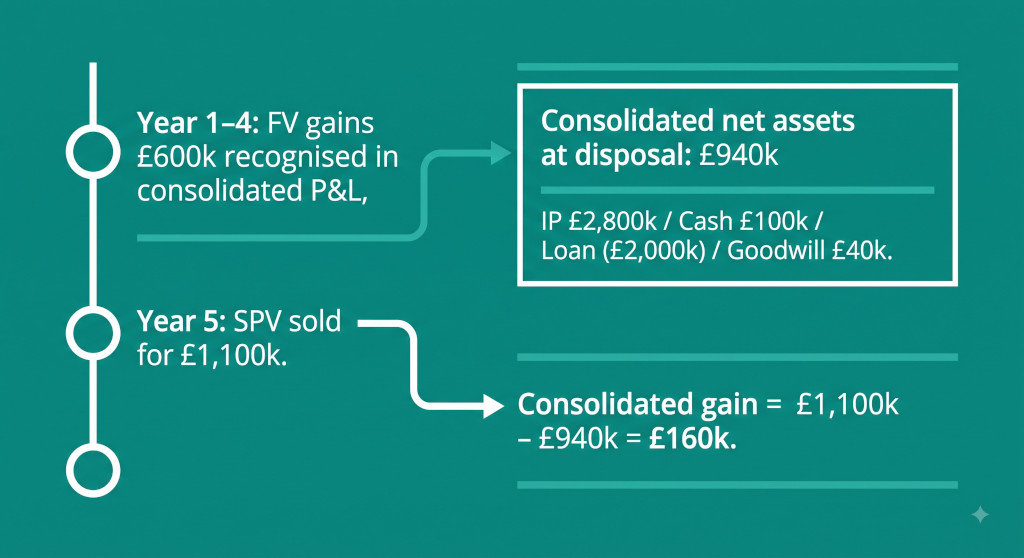
When Crestwood acquired Merlin Court SPV in 2020, the SPV held an investment property with a fair value of £2,200,000. The acquisition gave rise to £40,000 of goodwill (the £600,000 price exceeded the £560,000 of net assets at the time). The bank loan was £2,000,000 and cash was £360,000 — net assets of £560,000.
Over the following five years, the investment property appreciated from £2,200,000 to £2,800,000 under the fair value model. Each year, the fair value gain flowed through the consolidated P&L — £600,000 in total across the holding period. That £600,000 was already recognised as income in the group’s prior-year consolidated accounts. It was distributed to shareholders, reinvested, or simply accumulated in the group’s retained earnings. Either way, it was gone from future P&L — it could not be recognised again at the point of disposal.
Meanwhile, the SPV’s cash reduced from £360,000 to £100,000 as it serviced debt costs and absorbed operational expenses over five years — a net cash reduction of £260,000.
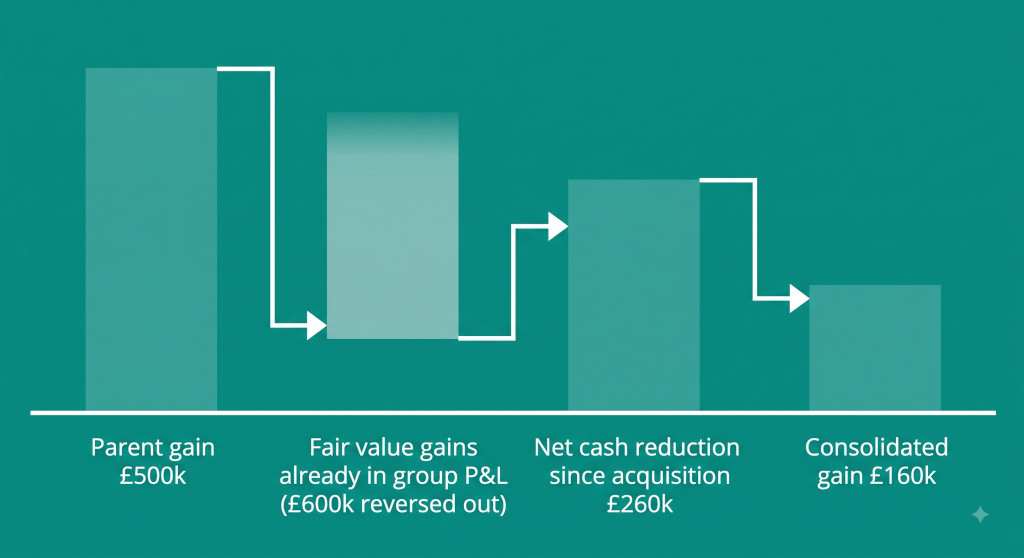
These two movements — the £600,000 already recognised as FV gains, and the £260,000 net cash reduction — together explain the £340,000 gap between parent gain and consolidated gain:
| Reconciling item | £ |
|---|---|
| Parent standalone gain on disposal | 500,000 |
| Less: fair value gains on IP already recognised in prior consolidated P&Ls | (600,000) |
| Add back: net cash reduction in SPV during holding period | 260,000 |
| Consolidated gain on disposal | 160,000 |
The fundamental rule: the consolidated accounts never recognise the same economic gain twice. If fair value movements on the investment property were recognised each year in the consolidated P&L, those gains are already in the group’s retained earnings. At disposal, only the incremental gain above the most recent consolidated carrying value is newly recognised.
The Disposal Journal in the Consolidated Accounts
The mechanics of derecognising a subsidiary at group level require removing every asset and liability that was consolidated from the SPV, and recording the difference as the disposal gain or loss. For Merlin Court SPV, the journal is:
| Account | Dr | Cr |
|---|---|---|
| Cash (proceeds received from buyer) | £1,100,000 | |
| Bank loan (derecognised — buyer inherits) | £2,000,000 | |
| Investment property | £2,800,000 | |
| Cash in SPV (derecognised) | £100,000 | |
| Goodwill | £40,000 | |
| Gain on disposal of subsidiary | £160,000 |
The bank loan is debited (derecognised as a liability — Cr bank loan in the SPV, Dr to close it out at group level) because the buyer takes on the debt when they acquire the shares. The proceeds of £1,100,000 represent the equity value paid by the buyer after adjusting for the debt the buyer inherits. Both the cash received and the debt transferred out are part of the disposal transaction.
After this journal, all balances relating to Merlin Court SPV — investment property, cash, goodwill, bank loan — are removed from the consolidated balance sheet. The consolidated P&L shows a gain of £160,000 on disposal.
What Happens to Goodwill at Disposal
Any goodwill carried in the consolidated accounts that relates to the SPV being sold must be derecognised at the point of disposal and included in the calculation of the gain or loss. In this example, the £40,000 goodwill that arose on the original acquisition of Merlin Court SPV has been carried on the group’s consolidated balance sheet throughout the holding period (with no impairment, for simplicity).
At disposal, it is removed — credited in the journal above — and its derecognition reduces the consolidated gain compared to what it would have been without goodwill. Logically, this makes sense: the buyer is paying for the goodwill as part of the share price. The group received value for it (embedded in the £1,100,000 proceeds), and the derecognition of the goodwill on the balance sheet reflects that value flowing out of the group.
Goodwill that has been impaired changes the calculation. If the goodwill had been impaired to, say, £15,000 in a prior period, the disposal journal would credit only £15,000 — and the prior impairment charge would already have flowed through a prior-year consolidated P&L. The disposal gain would be £25,000 higher than in the unimpaired scenario, reflecting that the group had already absorbed the write-down in an earlier period. Always use the closing goodwill balance, not the original amount.
Explaining the Difference to the Board
The most common challenge after calculating the consolidated disposal gain is explaining to non-accountants — board members, the MD, external shareholders — why the group is only reporting £160,000 of gain when the sale clearly generated £500,000 of value over cost. The key is to show that the group did not “miss” £340,000 of profit. That money was reported — it was reported every year across the holding period as the investment property appreciated in value.
A useful framing: the consolidated accounts act as a running total of the group’s economic performance. Every fair value gain that the investment property generated between 2020 and 2025 was recognised in the consolidated P&L as it happened. By the time the SPV is sold, the group has already reported £600,000 of gains from this asset. The disposal adds only the incremental gain above the most recent FV-based carrying amount — in this case, £160,000.
If the group had used the cost model rather than the fair value model for investment property, the picture would look entirely different. Under the cost model, no fair value gains would have been recognised during the holding period. The consolidated carrying amount at disposal would be much lower, and the consolidated gain at disposal would be much higher — and much closer to the parent’s standalone gain. The fair value model effectively smooths the gain recognition across the holding period rather than bunching it at disposal.
Over the full five-year holding period, the group recognised £600,000 in fair value gains through the consolidated P&L and a further £160,000 on disposal — £760,000 in total from its original £600,000 investment. The fair value model simply spread that recognition across the holding period rather than concentrating it at disposal. The disposal gain is the final instalment, not the full story.
Deferred Tax on the Disposal
If the group has been carrying a deferred tax liability on the investment property’s fair value gains — which is common where the entity-level tax base is historic cost — that deferred tax liability must also be derecognised at disposal. The buyer acquires the SPV taking on the tax history of the entity, including any inherent capital gains tax liability measured from the SPV’s original tax base.
In practice, this deferred tax reversal often partially offsets the disposal gain in the consolidated P&L, or it may be settled differently depending on whether the sale is structured as a share sale or an asset sale. For a share sale (which is the scenario modelled above), the SPV’s deferred tax balances transfer to the buyer along with everything else — the group simply derecognises the deferred tax liability as part of the disposal journal, which increases the net gain at group level.
Where a deferred tax liability of, say, £72,000 has been carried on the investment property fair value gains (£600,000 × 12% effective rate), the disposal journal would include an additional debit of £72,000 to derecognise that liability, increasing the consolidated gain from £160,000 to £232,000. Always check the deferred tax schedule for the SPV before finalising the disposal calculation.
When There Is a Non-Controlling Interest
If the SPV was not 100% owned — for instance, if a 20% minority partner held shares in Merlin Court SPV — the disposal calculation at group level adjusts for the NCI. The proceeds attributable to the group are only 80% of the total deal (£880,000 in this example). The net assets derecognised include the full 100% of assets and liabilities, and the NCI carrying amount at disposal is also derecognised. The gain is calculated as proceeds attributable to the group plus the NCI derecognised, minus the total consolidated carrying amount.
For wholly owned SPVs — which is the norm in most property group structures — the calculation is as shown above, with no NCI adjustment required.
A Practical Checklist for SPV Disposals
- Obtain the SPV’s balance sheet at the exact date of disposal. The disposal journal uses carrying values at the disposal date, not at the previous period end. If the disposal falls mid-year, you need to roll forward the balance sheet to the transaction date including any FV movements, accrued interest, and cash movements up to the day of completion.
- Confirm the goodwill balance attributable to the SPV. Pull the goodwill opening balance, add any subsequent additions, and deduct any impairment charges recognised since acquisition. Use the closing balance — not the original amount — in the disposal journal.
- Check for intercompany balances to be settled. Any intercompany loans or receivables between the parent (or other group entities) and the SPV must be settled before the disposal completes, or explicitly excluded from the sale. Balances still in place at completion will be derecognised as part of the disposal rather than eliminated as intercompany items.
- Calculate the consolidated gain using net assets, not investment cost. The parent’s investment in subsidiary figure is irrelevant for the consolidated gain calculation. Use the actual underlying assets and liabilities of the SPV, plus goodwill.
- Adjust for any deferred tax liabilities on the SPV’s balance sheet. Identify whether the SPV carries a deferred tax liability on investment property fair value gains. Determine whether this transfers to the buyer (share sale) or crystallises on disposal (asset sale), and adjust the disposal journal accordingly.
- Prepare the reconciliation of parent gain to consolidated gain. Document the cumulative FV gains already recognised in consolidated P&Ls, the net cash movements during the holding period, and any goodwill or deferred tax adjustments. This reconciliation is essential for board reporting and for responding to auditor queries.
- Remove all accumulated consolidation adjustments relating to the SPV. If there were standing adjustments in your consolidation workings — for example, prior-year intercompany loan eliminations or intragroup lease adjustments — confirm these are all reversed as part of the disposal. The SPV leaves the group completely; no trace of it should remain in the consolidation workings after the disposal period.
- Update group reporting to reflect the disposal from the transaction date. The SPV’s income and expenses are included in the consolidated P&L only up to the date of disposal. From that date forward, nothing from the SPV appears in any consolidated line item.
Preparing for an SPV disposal and need your consolidation in order first?
BrizoConsol gives you a clean, auditable consolidation across all your SPVs — so when you come to sell one, the numbers are already right. Start Free Trial