Disposing of a Professional Services Subsidiary: Why the Consolidated Gain and the Entity Gain Are Completely Different Numbers
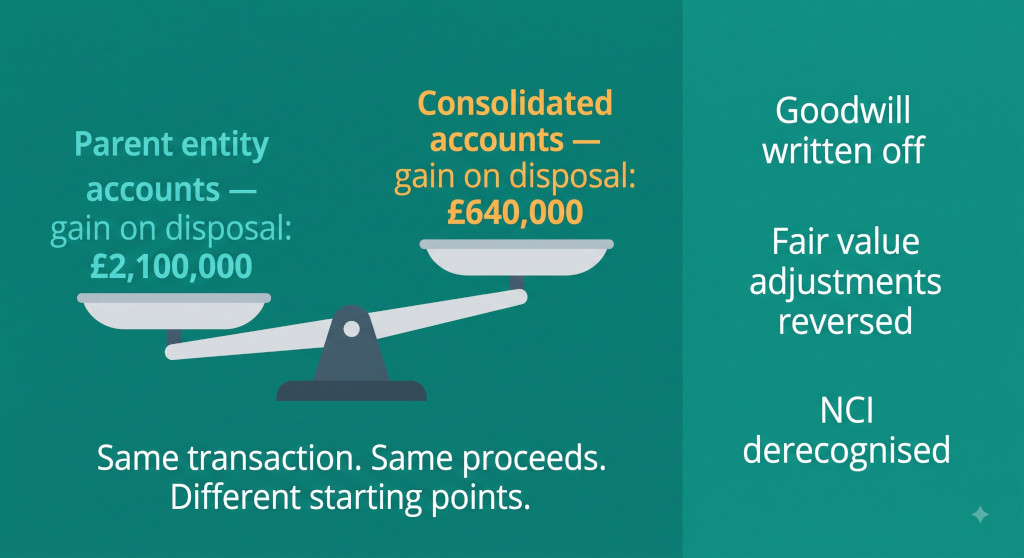
When a professional services group sells a subsidiary — a regional practice division, a specialist consulting arm, or a standalone advisory firm — the finance director will typically see two figures emerge from the transaction. The first appears in the parent holding company’s own accounts: proceeds minus the original cost of the investment in the subsidiary. It is usually large, because the original cost of investment was recorded years ago and the business has grown substantially since. The second figure appears in the consolidated accounts: a different calculation entirely, starting from the subsidiary’s carrying value of net assets as recognised in the group consolidation — including goodwill, fair value adjustments, and NCI balances that exist nowhere in any entity’s books.
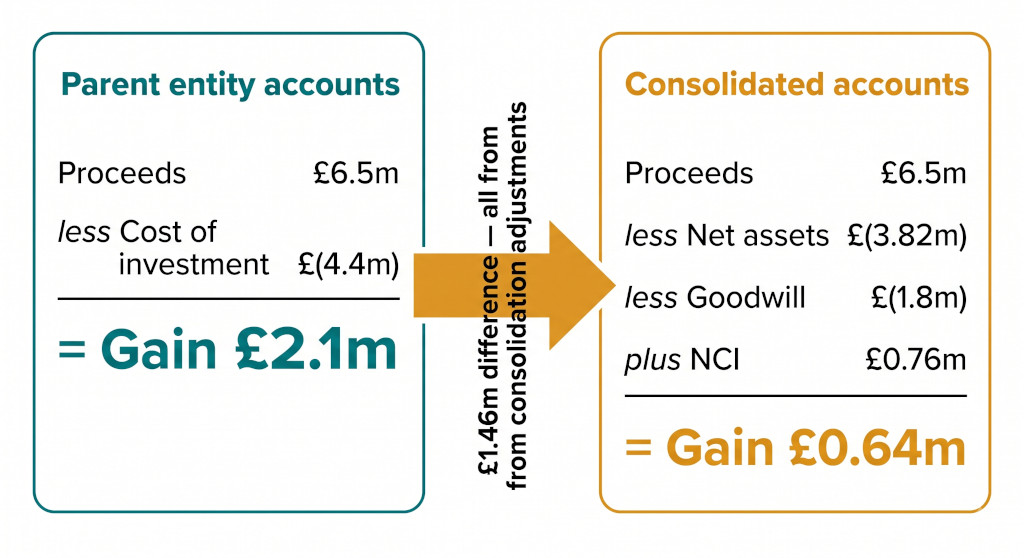
In a recent sale of a professional services subsidiary, the parent entity recorded a profit on disposal of £2,100,000. The consolidated accounts showed a gain of £640,000. The board was surprised. The auditors were not. The difference of £1,460,000 was entirely explained by items that exist only in the group consolidation workings: goodwill recognised at acquisition, fair value uplift on customer relationships that has been amortising in the group accounts, and the NCI balance that must be derecognised when control is lost.
None of these items appears in the parent’s balance sheet or the subsidiary’s balance sheet. All of them affect the consolidated gain on disposal — and all of them are the reason the consolidated P&L almost always shows a materially different gain from the parent entity P&L on the same transaction.
Stop building consolidations in spreadsheets.
BrizoConsol automates multi-entity consolidation — setup in minutes, reports the same day.
IFRS 10 — What Happens When Control Is Lost
Under IFRS 10, when a group loses control of a subsidiary, the consolidated accounts must:
- Derecognise 100% of the subsidiary’s assets and liabilities at their carrying values in the consolidated accounts at the date of disposal
- Derecognise goodwill attributable to the subsidiary
- Derecognise the NCI balance attributable to the subsidiary
- Recognise the fair value of any proceeds received
- Recognise any retained interest at its fair value at the date of disposal (if the group retains a minority stake)
- Recycle any cumulative translation adjustment (CTA) previously recognised in OCI to the consolidated P&L (if the subsidiary operated in a foreign currency)
- Recognise the resulting gain or loss in the consolidated P&L
The gain or loss is therefore a residual — proceeds plus retained interest plus NCI derecognised, minus the carrying value of all net assets and goodwill. Every one of those inputs is drawn from the group’s own consolidation workings. The parent’s entity accounts are irrelevant to this calculation.
The Scenario: Apex Advisory Sells Its Digital Practice
Apex Advisory Group acquired Digital Insights Ltd five years ago for £4,400,000. At the time of acquisition, Apex recognised goodwill of £1,800,000 and a customer relationships intangible of £1,400,000 (amortised over 7 years — £200,000 per year — so £1,000,000 accumulated amortisation by disposal date, leaving £400,000 net). Apex owned 80% of Digital Insights; the remaining 20% was held by an external founder who is classified as NCI.
Apex now sells its entire 80% stake to an external acquirer for £6,500,000 in cash. At the disposal date, the relevant figures from the consolidated workings are:
| Item from consolidated workings | Amount |
|---|---|
| Net assets of Digital Insights at disposal date (100%) | £3,820,000 |
| Goodwill — net of any impairment | £1,800,000 |
| Customer relationships intangible (net of amortisation) | £400,000 |
| NCI balance at disposal date (20%) | £760,000 |
| CTA balance (Digital Insights — sterling-denominated) | £nil |
| Cost of investment in parent entity accounts | £4,400,000 |
The net assets figure (£3,820,000) includes the customer relationships intangible net carrying value (£400,000) — because that intangible exists in the consolidated balance sheet, even though it appears nowhere in Digital Insights’ own accounts. When the subsidiary is disposed of, the group derecognises everything in the consolidated balance sheet attributable to it, including consolidation-only assets and liabilities.
The Parent Entity Gain — What Apex’s Own Accounts Show
In Apex Advisory Group’s entity financial statements (the parent company’s standalone accounts), the gain on disposal is straightforward:
| Proceeds from disposal of 80% stake | £6,500,000 |
| Cost of investment in Digital Insights | £(4,400,000) |
| Gain on disposal — parent entity P&L | £2,100,000 |
This is the only calculation the parent’s own accounts need. The cost of investment (£4,400,000) was what Apex paid for the 80% stake at acquisition and has sat on the parent’s balance sheet ever since. The parent’s accounts know nothing about goodwill, customer relationship intangibles, or NCI — those are consolidation constructs.
The Consolidated Gain — What the Group Accounts Show
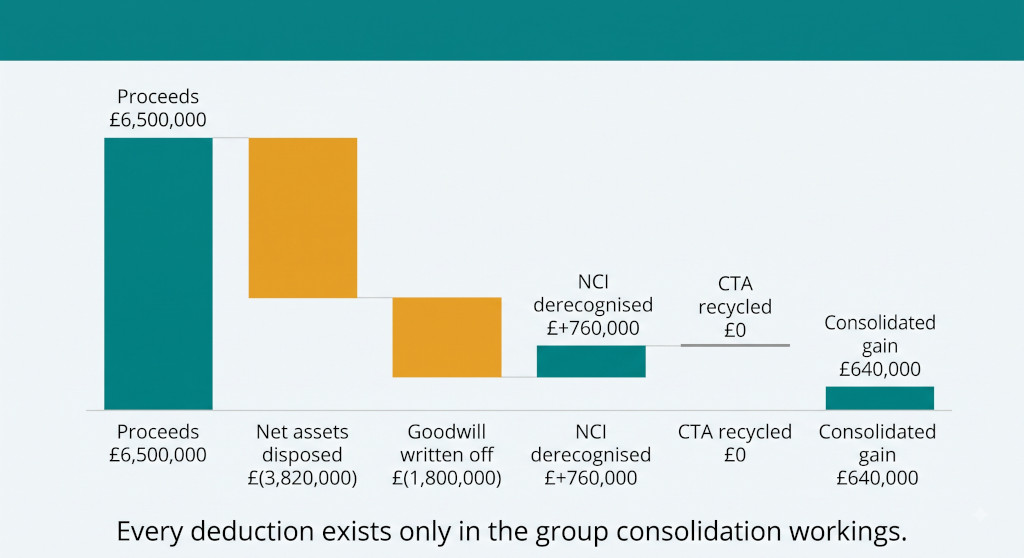
The consolidated gain is calculated from the group’s workings, not from the parent’s cost of investment:
| Proceeds from disposal of 80% stake | £6,500,000 |
| Net assets of Digital Insights — derecognised (100%) | £(3,820,000) |
| Goodwill — derecognised | £(1,800,000) |
| NCI balance — derecognised (effectively returned to buyer) | £760,000 |
| CTA recycled to P&L | £nil |
| Gain on disposal — consolidated P&L | £640,000 |
The consolidated gain is £640,000 — not £2,100,000. The difference is £1,460,000 and is entirely explained by:
- Goodwill written off (£1,800,000) — recognised at acquisition in the consolidated accounts, never recorded in the parent’s entity accounts. On disposal, the group must derecognise it. This reduces the consolidated gain dollar-for-dollar compared to the entity gain.
- Customer relationships intangible (already partially absorbed) — the net carrying value (£400,000) is included in the £3,820,000 net assets derecognised. Had there been no amortisation, this would further reduce the consolidated gain; the five years of amortisation (£1,000,000) have already been charged through the consolidated P&L each year.
- NCI derecognised (adds back £760,000) — the group derecognises the NCI’s 20% share of Digital Insights’ net assets. This partially offsets the reduction from goodwill, because the NCI balance represents a liability the group no longer carries.
The deconsolidation journal:
| Account | Dr | Cr |
|---|---|---|
| Cash — proceeds received | £6,500,000 | |
| NCI balance — derecognised | £760,000 | |
| Net assets of Digital Insights — derecognised (100%) | £3,820,000 | |
| Goodwill — derecognised | £1,800,000 | |
| Gain on disposal of subsidiary — consolidated P&L | £640,000 |
Deconsolidation journal — consolidated workings only. 100% of Digital Insights’ net assets (including the customer relationships intangible) and the full goodwill balance are derecognised. The NCI balance is derecognised and offsets the deduction. Proceeds of £6,500,000 are the full sale proceeds for the 80% stake — the buyer acquires 100% of the business; the seller receives proceeds for 80% and the existing NCI holder receives proceeds for their 20% separately (or the NCI is bought out as part of the deal — see below). The consolidated gain (£640,000) is recognised in the group P&L. No entry in Digital Insights’ entity accounts; no corresponding entry in Apex’s entity accounts (Apex’s own books record the full £6.5m proceeds and the cost of investment elimination separately).
When the NCI Is Also Bought Out
In many professional services disposals, the acquirer buys 100% of the subsidiary — purchasing both the parent’s 80% and the external founder’s 20% in the same transaction. In that case, the total proceeds from the buyer are shared between Apex (for 80%) and the founder (for 20%). The consolidated accounts present only Apex’s 80% proceeds as the disposal consideration; the founder’s 20% proceeds flow directly to the NCI and do not pass through Apex’s books at all.
If the deal is structured as a single price for 100% of the equity (say £8,125,000 total), split proportionately, Apex receives £6,500,000 (80%) and the founder receives £1,625,000 (20%). The consolidated deconsolidation calculation uses only Apex’s £6,500,000 in the proceeds line. The NCI’s £1,625,000 is outside the group and is not part of the consolidated gain calculation.
If the deal terms give Apex proceeds that do not reflect a simple 80% share of the total business value — for example if Apex negotiated a control premium — the NCI’s implied exit value may differ from the NCI carrying amount in the group’s books. The deconsolidation still derecognises the NCI at its carrying amount. Any difference between the NCI’s implied exit value and its carrying amount is not a separate consolidated gain or loss; IFRS 10 treats the NCI derecognition at carrying amount as part of the disposal mechanics, not as a separately measurable item.
The CTA Recycling — When It Applies
If Digital Insights had operated in a foreign currency — say it was a US dollar-denominated business — the group would have accumulated a cumulative translation adjustment (CTA) in other comprehensive income (OCI) over the years of ownership, representing the effect of exchange rate movements on the translation of Digital Insights’ results and net assets into sterling.
Under IAS 21, when the subsidiary is disposed of and control is lost, the CTA accumulated in OCI is recycled — reclassified from OCI to the consolidated P&L — as part of the gain or loss on disposal. The CTA can be positive (if sterling weakened against the dollar over the holding period, increasing the translated value of net assets) or negative (if sterling strengthened).
| Consolidated gain before CTA recycling | £640,000 |
| CTA accumulated in OCI (example — if applicable) | £(95,000) |
| Consolidated gain after CTA recycling | £545,000 |
In this example Digital Insights is sterling-denominated so CTA is nil. But for any professional services group with international subsidiaries — overseas offices, foreign-currency LLPs, or cross-border practice divisions — the CTA recycling can be material and must be tracked through the group’s OCI reserve for each subsidiary.
| Account | Dr | Cr |
|---|---|---|
| CTA reserve — OCI (recycled on disposal) | £95,000 | |
| Gain on disposal — consolidated P&L (CTA element) | £95,000 |
CTA recycling journal (illustrative — not applicable in this example where Digital Insights is sterling-denominated). Where a foreign currency subsidiary is disposed of, the CTA accumulated in OCI since acquisition is reclassified to the consolidated P&L. A negative CTA (where the subsidiary’s translated value has decreased over the holding period) would be debited to P&L and credited to the OCI reserve — reducing the consolidated gain on disposal. The CTA balance exists only in the group’s OCI; it does not appear in either entity’s accounts.
Partial Disposal — Losing Control but Retaining a Stake
If Apex had sold only 50% of Digital Insights (reducing its stake from 80% to 30%), it would lose control — dropping below 50% — but retain a significant minority interest. The deconsolidation mechanics are the same: all of Digital Insights’ net assets, goodwill, and NCI are derecognised at the disposal date. But instead of receiving only cash, Apex also retains a 30% equity stake that must be recognised at fair value at the disposal date.
| Cash proceeds for 50% sold | £4,062,500 |
| Fair value of 30% retained stake at disposal date | £2,437,500 |
| NCI derecognised (20%) | £760,000 |
| Net assets derecognised (100%) | £(3,820,000) |
| Goodwill derecognised | £(1,800,000) |
| Consolidated gain on partial disposal | £1,639,500 |
The retained 30% stake is then reclassified as an associate and accounted for under the equity method going forward — at the fair value (£2,437,500) established at the disposal date, which becomes the new cost of the associate investment for IAS 28 purposes. Again, this reclassification exists only in the group workings; Apex’s entity accounts continue to hold the original cost of investment for the shares it retains.
What the Consolidated P&L Presents
The consolidated P&L for the year of disposal will include:
- Digital Insights’ revenue and costs up to the disposal date (included in full, with NCI deduction)
- The gain on disposal (£640,000) — typically presented as a separate line, either within operating profit or below operating profit depending on materiality and the group’s presentation policy
- No further P&L contribution from Digital Insights after the disposal date
The prior year comparative will show Digital Insights’ full-year contribution. The notes must explain that the current year includes only a partial-year contribution and disclose the gain on disposal, the proceeds, and the carrying value of net assets disposed. IFRS 5 may require presentation of the disposed operation as a discontinued operation if it constitutes a separate major line of business — in that case the pre-disposal results are shown separately from continuing operations.
Practical Checklist for Deconsolidating a Subsidiary
- Confirm the disposal date — the date control is lost. For a share sale this is typically legal completion; for a staged sale it may differ. Only results up to this date are consolidated.
- Extract the consolidated carrying values at the disposal date — net assets (100%), goodwill, and any consolidation-only intangibles (customer relationships, order backlog) net of accumulated amortisation. These come from the group workings, not from the subsidiary’s entity accounts.
- Derecognise the NCI balance at its carrying value in the consolidated accounts at the disposal date. Accumulate the NCI’s share of current-year profit up to disposal before derecognising.
- Check for CTA — if the subsidiary operated in a foreign currency, identify the cumulative CTA in OCI and recycle it to the consolidated P&L as part of the disposal gain or loss.
- Value any retained interest at fair value at the disposal date and recognise it as an investment in associate (IAS 28) or financial asset (IFRS 9), depending on the level of remaining influence.
- Reconcile the consolidated gain to the entity gain — document the bridge between the two figures so the board understands the difference and the notes disclosure is accurate.
- Assess IFRS 5 discontinued operations — if the disposed subsidiary constitutes a separate major line of business, present it as a discontinued operation with prior-period comparatives restated.
- Classify the cash flow correctly — proceeds from disposal are an investing activity in the consolidated cash flow statement; any deferred consideration is also investing.
The consolidated gain on disposal of a subsidiary is one of the most visible examples of consolidation-only accounting: a number that appears in the group’s P&L, is reported to shareholders and analysts as the financial outcome of a major strategic transaction, and yet cannot be derived from any individual entity’s accounts. It is built entirely from items — goodwill, fair value adjustments, NCI balances, CTA reserves — that the consolidation created at acquisition and has maintained through every period since. Getting it right requires the group’s acquisition schedule to have been kept current from day one.
For the acquisition-date accounting that creates these consolidation workings in the first place, the guide on earn-out contingent consideration in professional services acquisitions covers the goodwill, intangibles, and NCI that must be recognised and maintained from acquisition through to eventual disposal.
Selling a subsidiary and need the group gain calculated correctly?
BrizoConsol maintains your acquisition schedules — goodwill, intangibles, NCI, CTA — so that when a disposal happens, the deconsolidation calculation pulls directly from your running group workings rather than starting from scratch under pressure at year end. See It In Action