Management Fees in a Restaurant Group: What the Consolidated Accounts Actually Show — and Why the Real Cost Is Not the Fee
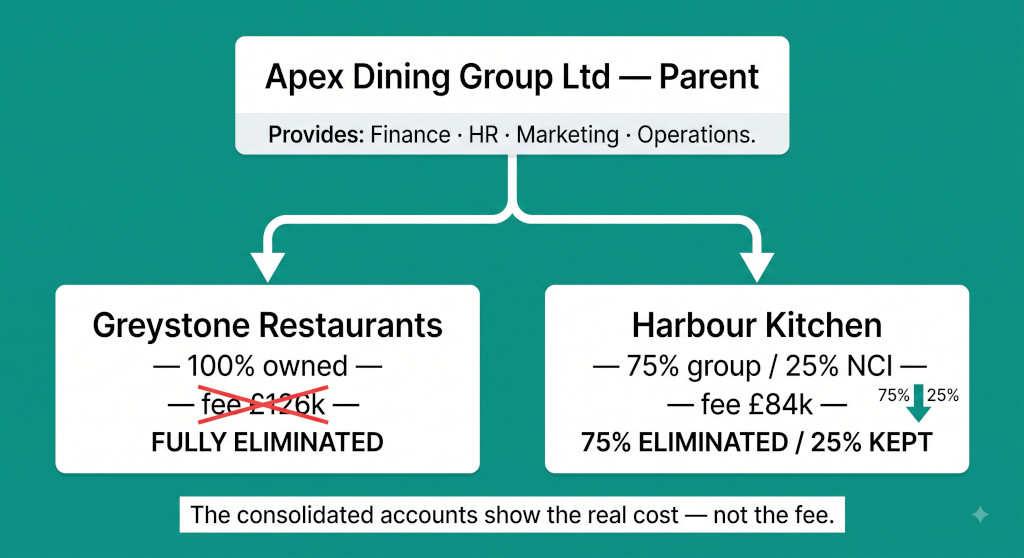
When Apex Dining Group Ltd prepared its year-end consolidation, the group financial controller faced a question she had not properly answered before: the parent entity had charged £210,000 of management fees to its restaurant subsidiaries during the year. The restaurant entities showed those fees as costs in their own accounts. The parent showed them as income. At consolidation, both sides should disappear — but how much disappears, and what does the consolidated P&L actually show in their place?
The management fee is one of the most common intercompany transactions in any multi-entity F&B business. It is also one of the most frequently prepared incorrectly in a consolidation workbook — particularly when one of the restaurant entities has an external joint venture partner whose economic stake changes what should and should not be eliminated. This post works through both scenarios using Apex Dining Group as the worked example.
Why F&B Groups Use Centralised Management Fees
A restaurant group with three, five, or fifteen operating entities cannot efficiently replicate specialist capabilities in every site. Finance, payroll, HR, brand and marketing, technology, and operational support are almost always centralised in a group parent or a dedicated shared services entity. Those central resources cost money — staff costs, software licences, premises — and the group must decide how to recover those costs across the operating restaurants.
Stop building consolidations in spreadsheets.
BrizoConsol automates multi-entity consolidation — setup in minutes, reports the same day.
A management fee is the mechanism: the parent charges each operating subsidiary a periodic fee (monthly, quarterly, or annually) that represents its share of the central cost base. The fee is typically calculated either as a fixed amount per entity, as a percentage of the subsidiary’s revenue, or as a cost-plus allocation — the parent’s actual identifiable costs for the service, plus sometimes a margin to compensate for risk and coordination.
From a management reporting perspective, the fee makes each restaurant carry a fair share of the group’s central overhead. It prevents the parent entity from absorbing all the central costs while the restaurants look artificially profitable at entity level. It also creates a documented transfer price between entities, which matters if the group ever has subsidiaries in different tax jurisdictions.
From a consolidation perspective, however, the management fee is a circular transaction — the group is paying itself. This is the tension that has to be resolved at every year-end consolidation.
The Apex Dining Group Structure
Apex Dining Group Ltd is the parent and also the entity that provides all central shared services. It has two restaurant subsidiaries in the consolidation perimeter:
| Entity | Group ownership | Annual revenue (£) | Management fee at 3% of revenue (£) |
|---|---|---|---|
| Greystone Restaurants Ltd (full-service dining) | 100% | 4,200,000 | 126,000 |
| Harbour Kitchen Ltd (waterfront casual dining) | 75% group / 25% NCI | 2,800,000 | 84,000 |
| Total management fee income in Apex Dining Group Ltd | 210,000 |
Apex’s actual cost to provide the shared services — finance team salaries, HR software, marketing headcount, the allocated office overhead — is £160,000 for the year. The £210,000 in management fees therefore includes a £50,000 margin above cost. This markup matters at consolidation, as we will see.
Case 1: The 100% Owned Subsidiary — Full Elimination
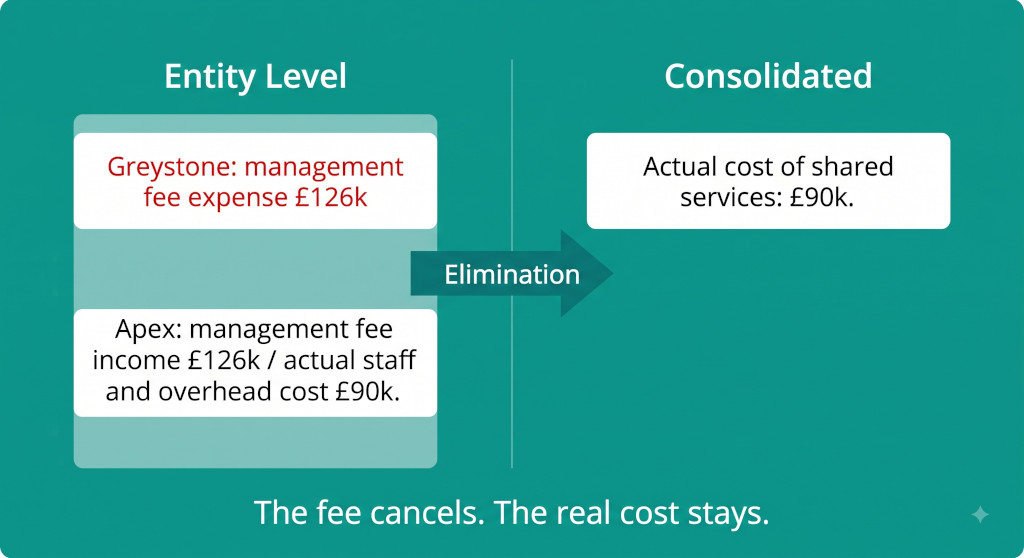
Greystone Restaurants Ltd pays £126,000 of management fees to Apex Dining Group Ltd. Both entries are correct at entity level — Greystone has a genuine expense for services received, and Apex has genuine income for services provided. At consolidation, both disappear.
| Account | Dr | Cr |
|---|---|---|
| Management fee income (Apex Dining Group Ltd) | £126,000 | |
| Management fee expense (Greystone Restaurants Ltd) | £126,000 |
Income and expense eliminate symmetrically. Net effect on consolidated profit: zero. Greystone’s entity-level EBITDA is suppressed by £126,000 relative to its consolidated contribution — the restoration of this fee is one of the most material reconciling items between entity and consolidated restaurant performance.
Case 2: The Partly Owned JV Restaurant — Partial Elimination
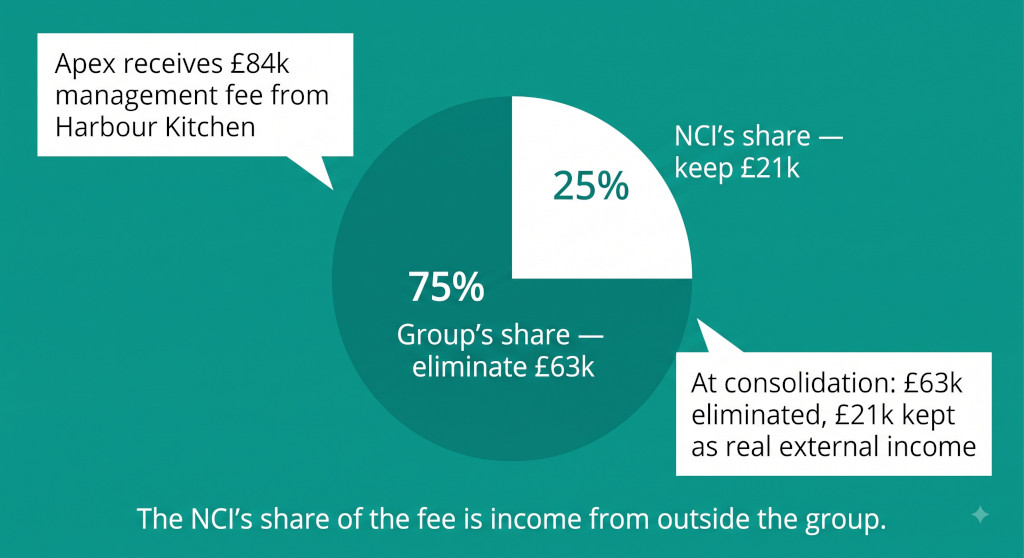
Harbour Kitchen Ltd is 75% owned by Apex Dining Group. The remaining 25% is held by an external hospitality investor — a non-controlling interest. Harbour Kitchen pays £84,000 of management fees to Apex.
The elimination is partial, for the same reason the royalty elimination is partial where there is an NCI: the group owns 75% of Harbour Kitchen. The group’s 75% share of the £84,000 management fee is effectively the group paying itself — eliminate it. The NCI’s 25% share is a fee paid by an external economic party. That £21,000 is genuine income earned by Apex from the minority investor’s stake, and it stays in the consolidated P&L.
| Account | Dr | Cr |
|---|---|---|
| Management fee income (Apex — group’s 75% share of Harbour Kitchen fee) | £63,000 | |
| Management fee expense (Harbour Kitchen — group’s 75% share) | £63,000 |
The remaining £21,000 (the NCI’s 25% of the £84,000 fee) stays as management fee income in the consolidated P&L. Harbour Kitchen’s full £84,000 fee expense appears in the consolidated P&L (as a 100%-owned subsidiary’s P&L is consolidated in full before NCI allocation). The net consolidated management fee expense from Harbour Kitchen is £84,000 − £63,000 eliminated = £21,000 — exactly matched by the £21,000 income kept from the NCI’s share. The net group P&L effect from the Harbour Kitchen management fee is zero, as expected. The only income that survives is the NCI’s genuine external contribution.
The Consolidated Management Fee Position After All Eliminations
| Management fee income from Greystone (fully eliminated) | — |
| Management fee income from Harbour Kitchen — group’s 75% share (eliminated) | — |
| Management fee income from Harbour Kitchen — NCI’s 25% share (kept) | £21,000 |
| Consolidated management fee income | £21,000 |
The £21,000 of surviving management fee income is the only amount the group actually earned from a party economically outside the group. It is funded by the external minority investor’s 25% stake in Harbour Kitchen bearing its share of the central cost recharge.
What the Consolidated P&L Actually Shows — The Real Cost of Shared Services
This is the question the Apex controller could not initially answer: if the management fees eliminate, what appears in the consolidated P&L in their place?
The answer is the actual cost that Apex incurred to provide the shared services — the £160,000 of staff costs, software, and allocated overhead. Those costs sit in Apex’s own P&L as operating expenses regardless of the management fees it charged. The fees are income in Apex’s accounts; the underlying costs are expenses in Apex’s accounts. When the fee income eliminates, the costs remain. So in the consolidated P&L:
| Apex’s actual cost of providing shared services | £160,000 |
| Management fee income kept (NCI portion from Harbour Kitchen) | (£21,000) |
| Net consolidated shared services cost | £139,000 |
The fee itself — the £210,000 intercompany charge — is entirely absent from the consolidated P&L. The consolidated P&L shows the cost of the service. The management fee was always just a mechanism for allocating that cost across entities. Once you consolidate, you no longer need the allocation mechanism — you can see the total cost directly.
A useful check: after eliminations, consolidated overhead costs should reflect what the group would show if every restaurant were one legal entity with a shared back office. The management fee would not exist. The staff costs, software, and overheads running the back office would appear directly — which is exactly what the consolidated accounts show.
When the Parent Marks Up the Management Fee
Apex charges £210,000 in fees but its underlying cost is £160,000. The £50,000 difference is a margin that Apex earns on the shared service — a common arrangement in groups where the parent entity bears risk, coordinates complexity, or simply prices the service above cost to ensure the central entity is commercially self-sustaining.
Does this markup survive at consolidation? No. At consolidation, both the management fee income and the management fee expense eliminate in full. The markup is part of the fee — it eliminates with the rest. What remains is the underlying cost of £160,000 (less the NCI offset of £21,000).
This has an important practical consequence: the consolidated EBITDA is always higher than the sum of the entity-level EBITDAs when the parent marks up the shared service. The restaurant entities are charged a fee that exceeds actual cost; at consolidation, the fee disappears and only the actual cost loads into the group accounts.
| P&L impact | Entity level aggregate (£) | Consolidated (£) | Difference (£) |
|---|---|---|---|
| Management fee income (Apex) | 210,000 | 21,000 | (189,000) |
| Management fee expense (restaurants) | (210,000) | (21,000) | 189,000 |
| Apex actual shared services cost | (160,000) | (160,000) | — |
| Net P&L impact from shared services | (160,000) | (160,000) | — |
The net P&L impact is the same in both cases — £160,000 of cost. The route is different: entity-level accounts show £210,000 of income in the parent offset by £210,000 of expense in the restaurants plus £160,000 of cost in the parent; consolidated accounts show only £160,000 of cost (net of the £21,000 NCI income). The markup that looked like a commercial margin in the parent’s entity accounts is not a group-level profit — it is a reallocation of how cost is presented, not additional economic value generated by the group.
Watch point for board reporting: If the board reviews restaurant profitability using entity-level EBITDA figures, each restaurant’s margin is suppressed by the management fee charge. The consolidated EBITDA will always be higher — by an amount equal to the management fees eliminated — than the sum of the individual entity EBITDAs. Make this reconciliation explicit to the board so the two bases of reporting are not inadvertently compared as if they were equivalent.
Revenue-Linked Fees vs. Cost-Plus Allocation — and Why the Difference Matters for Tax
Apex charges management fees as a percentage of each restaurant’s revenue — 3% in the worked example. This is a common commercial approach: it scales the fee automatically with the restaurant’s size without requiring annual renegotiation, and it aligns the central entity’s income with the group’s commercial performance.
From a transfer pricing perspective, however, revenue-linked management fees attract more scrutiny than cost-plus allocations. The question a tax authority asks is whether the fee is arm’s length — i.e., whether an independent restaurant operating outside the group would pay 3% of its revenue for the same package of services from an independent provider. The answer depends on what the services actually cover, how well the benefit can be demonstrated, and how the 3% rate compares to market benchmarks for equivalent outsourced services.
A cost-plus approach — Apex allocates its actual £160,000 of shared services cost across the restaurants, typically weighted by revenue, headcount, or floor area, and charges without a markup — is more defensible to a tax authority because it is anchored to a verifiable cost base. The fee cannot be set above cost, so the opportunity to shift profit to a lower-tax entity via an excessive management fee is structurally absent.
For UK restaurant groups operating entirely within a single tax jurisdiction, the transfer pricing risk may be low. For groups with overseas subsidiaries — a franchise restaurant in a different country, an owned site in Ireland or Europe — a documented transfer pricing policy for the management fee, aligned to the OECD’s arm’s length principle, becomes a material compliance requirement rather than an optional best practice.
At consolidation, the accounting treatment is identical regardless of the transfer pricing method: the fee eliminates. But the tax risk — and the audit exposure if HMRC or an overseas authority challenges the fee on transfer pricing grounds — varies significantly between a well-documented cost-plus allocation and an undocumented revenue-linked charge.
The Intercompany Receivable and Payable
The management fee also creates intercompany balance sheet entries during the period: a receivable in Apex’s balance sheet (management fee outstanding from subsidiaries) and matching payables in each restaurant entity’s balance sheet. These eliminate against each other as part of the same consolidation adjustment — they are the balance sheet counterpart of the P&L elimination.
| Account | Dr | Cr |
|---|---|---|
| Intercompany payable (Greystone Restaurants — management fee owed to Apex) | £126,000 | |
| Intercompany receivable (Apex Dining Group — management fee owed from Greystone) | £126,000 |
This balance sheet elimination is separate from the P&L elimination above. Both are required. A consolidation that eliminates the P&L entries but not the balance sheet entries will show inflated receivables and payables in the consolidated balance sheet — a common error in manual workbooks where P&L and balance sheet adjustment schedules are maintained separately without a cross-check.
In practice, well-run F&B groups settle management fees monthly to avoid large year-end intercompany balances. Where fees are accrued but not settled, the year-end balance is the full annual accrual; where settled monthly, the year-end balance may be only one month’s fee outstanding. The elimination amount is always whatever balance remains on the intercompany receivable/payable at the balance sheet date — not the full annual fee.
Tired of building management fee eliminations by hand?
BrizoConsol automates intercompany eliminations across every entity in your group — P&L and balance sheet — including partial eliminations where a subsidiary has a minority partner.See It In Action
A Practical Checklist for F&B Groups With Management Fee Structures
- Identify every intragroup management fee agreement. For each agreement, document: the charging entity, the receiving entity, the fee basis (fixed, percentage of revenue, cost-plus), and the annual amount. Confirm whether any fees are charged to entities outside the consolidation perimeter — such as associate companies or external joint ventures — which would not be eliminated.
- Separate the management fee income by counterparty type. In the charging entity’s accounts, maintain a clear split between fees received from 100% owned subsidiaries, fees from partly-owned subsidiaries (noting the NCI percentage), and any fees from external parties. Only the intragroup portion is eliminated.
- For 100% owned subsidiaries: eliminate the full fee on both P&L and balance sheet. Debit management fee income in the parent, credit management fee expense in the subsidiary. Separately, debit the intercompany payable in the subsidiary, credit the intercompany receivable in the parent. Both adjustments are required.
- For partly-owned subsidiaries: eliminate the group’s proportionate share only. Multiply the management fee by the group’s ownership percentage. Eliminate that amount on P&L and balance sheet. The NCI’s share of the fee remains as income in the consolidated P&L — it is funded by an external economic party and represents genuine group income.
- Verify that the underlying costs of the shared service remain in the consolidated P&L. After eliminations, the consolidated P&L should show the actual staff costs, software, and overhead of the shared services function — not the management fee. If the management fees eliminate cleanly but the underlying costs are not visible in the consolidated accounts, there is an error in the workbook structure.
- Reconcile entity EBITDA to consolidated EBITDA. Prepare a bridge showing each restaurant’s entity-level EBITDA, the management fee add-back (since the fee eliminates), and the allocation of actual shared services cost. The board should understand that entity-level margins are management-fee-burdened and that consolidated margins reflect the real economic performance of the restaurant portfolio.
- Review the transfer pricing basis annually. For multi-jurisdictional groups, document the arm’s length basis for the management fee rate, maintain a transfer pricing file, and update the analysis whenever the services provided or the group structure changes materially. For UK-only groups, document the fee basis and the cost allocation methodology as a minimum — HMRC management fee challenges, though less common in single-jurisdiction groups, do occur.
- Check NCI profit allocation reflects the full management fee expense. The NCI’s share of a partly-owned subsidiary’s profit is calculated after the management fee charge in that subsidiary’s P&L. Do not adjust the NCI calculation to exclude the fee — the NCI bears their proportionate share of it, which is the economic basis for keeping their share of the fee as consolidated income.
Ready to consolidate your F&B group without a manual workbook?
BrizoConsol handles the full consolidation cycle — management fees, royalties, inventory profits, and everything in between — with complete audit trails at every step. Start Free Trial