How to Consolidate a Subsidiary When Ownership Is Less Than 100%
For three years, every entity in Daniel’s group was 100% owned. The consolidation was straightforward: add the trial balances together, eliminate intercompany transactions, and you were done. The group’s equity was entirely attributable to the parent’s shareholders. There was no NCI line on the balance sheet, no minority interest deduction at the bottom of the P&L, and no second equity column in the statement of changes in equity.
Then the group acquired a 70% stake in a new technology business. The acquisition was processed correctly — goodwill was calculated, the investment elimination journal was posted — but when Daniel ran the first consolidated accounts after the acquisition, several things confused him. He had included 100% of the new subsidiary’s revenue, costs, and assets. Was that right, even though the group only owned 70%? Where exactly did the minority’s 30% appear, and why wasn’t it simply deducting 30% from every line? And the equity section of the balance sheet had a new NCI line that he wasn’t sure he’d calculated correctly.
These are the right questions. The consolidation of a partially-owned subsidiary follows the same fundamental mechanics as a 100% consolidation — but with five specific changes that affect the balance sheet, the P&L, the equity statement, and the goodwill calculation. This post explains those five changes from first principles, then works through a complete three-statement example to show how they interact.
Automate NCI calculations across all your entities.
BrizoConsol handles non-controlling interest automatically — no manual adjustments required.
Why You Consolidate 100% Even When You Own 70%
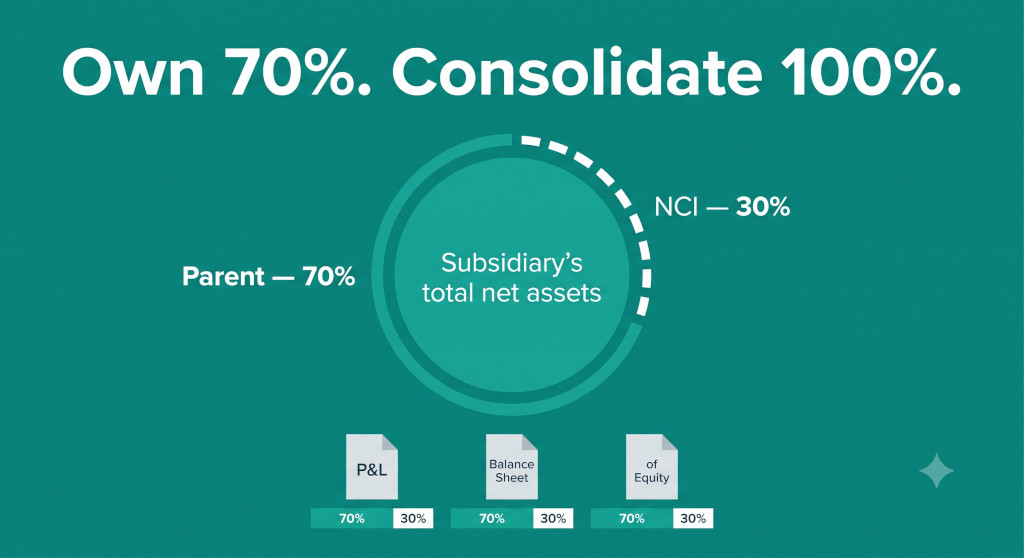
The most counterintuitive feature of partially-owned subsidiary consolidation is that the group includes 100% of the subsidiary’s assets, liabilities, revenue, and costs — not 70%. This is not an error. It is a direct consequence of the control principle that underpins group accounting.
Consolidation is not about economic ownership. It is about control. When the group holds 70% of a subsidiary, it controls 100% of that entity’s resources — it can direct all of its activities, deploy all of its assets, and commit all of its workforce. The 30% minority shareholder has an economic interest in the returns but does not control anything. Presenting only 70% of the subsidiary’s assets in the group balance sheet would misrepresent the economic reality: the group commands those assets in their entirety.
Instead, the 100% assets and liabilities are included, and the minority’s economic interest is represented separately — as the non-controlling interest (NCI), a component of equity that shows the minority shareholder’s claim on the net assets. This is the key distinction: the NCI does not reduce the assets shown. It adjusts the equity attribution. The group’s balance sheet total is higher because it includes 100% of the subsidiary; the equity section then splits that total between the parent’s shareholders and the minority.
An easy way to remember the principle: control determines what goes into the consolidation; ownership percentage determines how the results are attributed. The group controls 100% of the subsidiary, so 100% goes in. The group owns 70%, so 70% of the results are attributed to the parent’s shareholders and 30% to the NCI.
The Five Things That Change in Your Consolidation Procedure
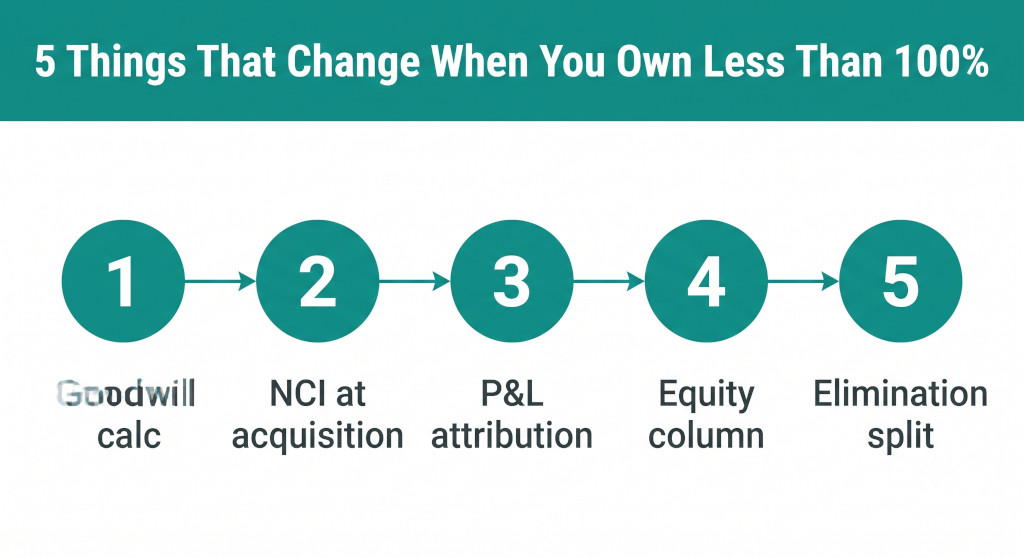
1. The goodwill calculation uses the group’s ownership percentage
Goodwill is calculated as the difference between the consideration paid by the group and the group’s share of the fair value of the subsidiary’s net identifiable assets. Under the proportionate share method — the simpler of the two methods permitted under IFRS 3 — only the parent’s goodwill is recognised. If the group paid £2,800,000 for its 70% stake and the fair value of net assets was £3,000,000:
Goodwill — proportionate share method: Consideration paid £2,800,000 Less: 70% × £3,000,000 net assets (£2,100,000) ───────────────────────────────────────────── Goodwill £ 700,000
Under the full goodwill method (the alternative under IFRS 3), the NCI is measured at its fair value on the acquisition date rather than its proportionate share of net assets. This produces higher goodwill and a higher NCI opening balance, but the same total equity. The choice of method is an accounting policy decision and should be applied consistently. For a detailed comparison of both methods, see Goodwill in Group Consolidation: How to Calculate and Account for It.
2. The NCI is recognised as a separate equity component at acquisition
Alongside the goodwill calculation, the NCI’s opening balance is established at acquisition date. Under the proportionate share method:
NCI at acquisition: 30% × £3,000,000 fair value of net assets = £900,000
This £900,000 is credited in the investment elimination journal as a component of consolidated equity — not as a liability. The NCI has an economic interest in the subsidiary’s net assets, but no contractual right to demand repayment from the group. It sits in equity, separately disclosed from the equity attributable to the parent’s shareholders.
3. The P&L includes 100% of the subsidiary, then deducts the NCI’s share at the bottom
Every revenue and cost line in the consolidated income statement includes 100% of the subsidiary’s figures. The NCI’s share does not reduce individual line items — it appears as a single deduction near the bottom of the statement, after profit for the year has been calculated in full. The structure is:
Revenue (100% of group incl. subsidiary) £X Cost of sales (100%) (£X) Operating expenses (100%) (£X) ────────────────────────────────────────────── Profit for the year £X Attributable to: Equity holders of the parent £X (70% of subsidiary profit) Non-controlling interests £X (30% of subsidiary profit)
This presentation matters because the group’s revenue, EBITDA, and operating profit figures include 100% of the subsidiary. Only the bottom attribution line separates the minority’s economic share. Readers of the accounts who focus on revenue or EBITDA will see the full consolidated figures; only those who trace through to the earnings-per-share calculation will encounter the NCI deduction.
4. The equity statement has a second column for the NCI
The consolidated statement of changes in equity has two equity columns: one for the equity attributable to the parent’s shareholders (comprising share capital, share premium, retained earnings, and any reserves) and one for the NCI. Each column moves independently each period: the NCI column increases by the NCI’s share of post-acquisition profit, decreases by the NCI’s share of any dividends declared by the subsidiary, and is adjusted for the NCI’s share of any other comprehensive income. The mechanics of building this column correctly are covered in detail in NCI in the Consolidated Statement of Changes in Equity.
5. Upstream intercompany eliminations are split between the group and the NCI
When the subsidiary sells goods to the parent (an upstream intercompany sale) and some of those goods remain in the parent’s closing inventory, the unrealised profit elimination reduces the subsidiary’s retained earnings. Because the NCI owns 30% of the subsidiary, 30% of that profit elimination reduces the NCI’s equity rather than the parent’s equity. This contrasts with downstream sales (parent selling to subsidiary), where 100% of the unrealised profit elimination falls on the parent’s equity because the profit originated in a 100%-owned entity. The NCI is only affected by eliminations that reduce the subsidiary’s own retained earnings.
Worked Example: Three Statements for a 70%-Owned Subsidiary
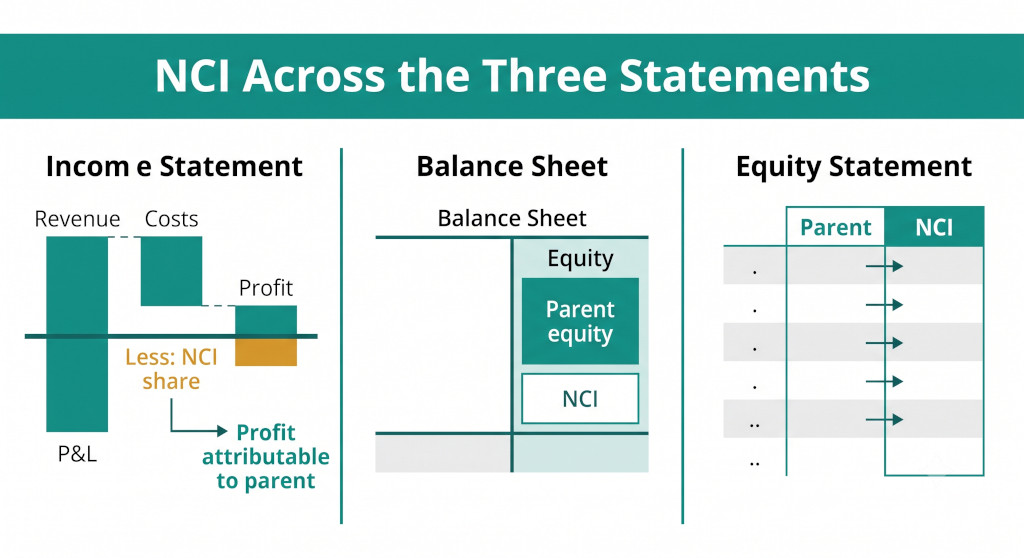
The following example shows the complete consolidation for a group consisting of a parent company and a single 70%-owned subsidiary, Apex Services Ltd. The group acquired its 70% stake at the beginning of the year. All figures are in thousands of pounds. Intercompany trading: the parent sold £200k of services to Apex during the year; Apex has paid in full, so no intercompany balance remains on the balance sheet. No unrealised profit in inventory.
Step 1: Consolidated Income Statement
| Line Item | Parent £’000 | Apex (100%) £’000 | Elimination £’000 | Consolidated £’000 |
|---|---|---|---|---|
| Revenue | 4,800 | 1,620 | (200) | 6,220 |
| Cost of sales | (2,900) | (860) | 200 | (3,560) |
| Gross profit | 1,900 | 760 | — | 2,660 |
| Operating expenses | (980) | (410) | — | (1,390) |
| Finance costs | (60) | (30) | — | (90) |
| Profit before tax | 860 | 320 | — | 1,180 |
| Income tax | (215) | (80) | — | (295) |
| Profit for the year | 645 | 240 | — | 885 |
| Attributable to: | ||||
| Equity holders of the parent | 813 | |||
| Non-controlling interests (30% × £240k) | 72 | |||
| Profit for the year | 885 | |||
The parent’s own profit of £645k plus the group’s 70% share of Apex’s profit (70% × £240k = £168k) = £813k attributable to the parent’s shareholders. The NCI receives 30% × £240k = £72k. The revenue and gross profit lines include 100% of Apex — the NCI share does not reduce individual line items anywhere above the attribution footnote.
Step 2: Consolidated Balance Sheet
| Line Item | Parent £’000 | Apex (100%) £’000 | Elimination £’000 | Consolidated £’000 |
|---|---|---|---|---|
| Non-current assets | ||||
| Goodwill | — | — | 700 | 700 |
| Property, plant and equipment | 3,200 | 1,140 | — | 4,340 |
| Investment in Apex (cost) | 2,800 | — | (2,800) | — |
| Current assets | ||||
| Trade receivables | 960 | 380 | — | 1,340 |
| Cash and cash equivalents | 420 | 190 | — | 610 |
| Total assets | 7,380 | 1,710 | (2,100) | 6,990 |
| Liabilities | ||||
| Bank borrowings | (800) | (300) | — | (1,100) |
| Trade payables | (540) | (210) | — | (750) |
| Total liabilities | (1,340) | (510) | — | (1,850) |
| Net assets | 6,040 | 1,200 | (2,100) | 5,140 |
| Equity | ||||
| Share capital and reserves (parent) | 6,040 | — | (813) | 4,327 |
| Retained earnings (parent — incl. 70% of Apex profit) | — | — | 813 | 813 |
| Non-controlling interest | — | — | — | 972 |
| Total equity | 5,112 | |||
The NCI balance of £972k is the opening NCI at acquisition (£900k) plus the NCI’s share of the current year profit (£72k). Note that 100% of Apex’s assets (£1,710k) and liabilities (£510k) appear in the consolidated balance sheet. The investment in Apex on the parent’s balance sheet (£2,800k) is eliminated and replaced by Apex’s underlying net assets at fair value plus the goodwill arising on acquisition.
Common mistake: Including only 70% of the subsidiary’s assets and liabilities in the consolidated balance sheet. This understates the group’s total assets and total liabilities and misrepresents the group’s actual scale of operations. The correct treatment is always 100% of the subsidiary’s assets and liabilities, with the minority’s economic interest shown separately within equity — not as a reduction in individual asset or liability lines.
Step 3: NCI Movement in the Equity Statement
The NCI column in the consolidated statement of changes in equity for the year looks like this:
| NCI Movement | £’000 |
|---|---|
| NCI at acquisition date (30% × £3,000k fair value of net assets) | 900 |
| NCI share of profit for the year (30% × £240k) | 72 |
| NCI share of dividends declared by Apex (none this year) | — |
| NCI at year end | 972 |
In future years the NCI column will also absorb the NCI’s share of any other comprehensive income items — most commonly the currency translation adjustment if Apex is a foreign entity. For groups with foreign partially-owned subsidiaries, the CTA split between the parent’s equity and the NCI is a specific calculation covered in detail in NCI and Currency Translation Adjustments.
Consolidating a partially-owned subsidiary for the first time?
BrizoConsol handles NCI attribution across the P&L, balance sheet, and equity statement automatically — so your first partial-ownership consolidation doesn’t have to be your most stressful close.See It In Action
When Does an Interest Become an Associate Instead of a Subsidiary?
Not every ownership stake below 100% results in full consolidation. The threshold is control, not a specific percentage. If the group owns 35% of an entity and does not have the power to direct its relevant activities, that entity is an associate — accounted for under the equity method — not a subsidiary subject to full consolidation.
The equity method is fundamentally different from consolidation: it does not bring any of the associate’s individual assets or liabilities into the group balance sheet. Instead, the group’s share of the associate’s net assets is represented as a single investment line, and the group’s share of the associate’s annual profit or loss appears as a single line in the consolidated P&L. No NCI is recognised for associates, because control is absent. For the full mechanics of equity method accounting, see Equity Method Accounting in Group Consolidation.
The practical question for groups with ownership stakes between roughly 20% and 50% is: is this entity controlled (and therefore consolidated with NCI) or significantly influenced (and therefore equity-accounted)? IFRS 10 and IAS 28 provide the framework, but the answer depends on the specific contractual and governance arrangements in place — board representation, veto rights, shareholder agreements — rather than on the percentage alone. Getting this classification wrong affects every financial statement: a controlled entity treated as an associate will show far lower revenue and assets (only the group’s share of net assets as a single line), while an associate treated as a subsidiary will inflate revenue and assets by including 100% of the entity’s figures.
Common Errors in the First Partially-Owned Consolidation
Beyond the 70%-vs-100% error already described, three further mistakes appear consistently in the first consolidation of a partially-owned entity.
The first is calculating the NCI’s share of profit on the wrong base. The NCI takes 30% of the subsidiary’s own profit after tax — not 30% of the consolidated group profit, and not 30% of the subsidiary’s profit before intercompany eliminations. If the parent sold services to the subsidiary and those services are eliminated from the consolidation, the subsidiary’s profit used for the NCI calculation must be the post-elimination figure. Using the pre-elimination profit overstates the NCI charge by the NCI’s share of the eliminated intercompany profit. For the precise calculation methodology, see How to Calculate Non-Controlling Interest in Financial Consolidation.
The second error is treating the NCI as a liability rather than as equity. Under both IFRS and UK GAAP, the NCI is a component of equity — it is not a debt of the group to the minority shareholder. Presenting it as a liability (sometimes done on the grounds that the minority might eventually sell their shares back) overstates the group’s financial obligations and understates its equity. An NCI only converts to a liability if there is a put option or other contractual obligation requiring the group to purchase the minority’s shares at a fixed or determinable price — and even then, the accounting is specific and must be applied carefully.
The third error is failing to update the NCI roll-forward when the subsidiary pays dividends. A dividend paid by the subsidiary to the NCI is cash that leaves the group. It reduces the NCI balance in equity (the NCI has taken cash out of the entity they part-own) and appears as a financing outflow in the consolidated cash flow statement. Omitting this reduces the NCI balance and overstates group equity, because the cash is also gone from the consolidated balance sheet — the two sides of the error are in different places, which means they may not immediately surface in a balance sheet check.
Practical Checklist: Consolidating a Partially-Owned Subsidiary
- Confirm control exists. Before applying full consolidation, document the basis for the control conclusion — majority voting rights, board appointment rights, or other power mechanisms. If control is absent, equity method applies instead.
- Calculate goodwill using the group’s ownership percentage. Under the proportionate share method: consideration paid less the group’s percentage share of fair value of net identifiable assets. Do not calculate goodwill on 100% of net assets.
- Establish the NCI opening balance. Under the proportionate share method: the minority’s percentage share of fair value of net identifiable assets. Record this as a credit in the investment elimination journal.
- Include 100% of the subsidiary’s assets, liabilities, revenue, and costs in the consolidation. Do not scale any line item by the ownership percentage. The ownership percentage affects attribution only, not inclusion.
- Attribute the subsidiary’s profit between the parent and the NCI. The NCI’s share of profit (minority percentage × subsidiary’s post-elimination profit after tax) is disclosed at the foot of the consolidated income statement. It does not reduce any individual income or expense line.
- Set up the NCI column in the equity statement. The NCI balance moves each period for: its share of profit, its share of dividends declared by the subsidiary, and its share of any OCI items (including the CTA if the subsidiary is a foreign entity).
- Apply the upstream/downstream distinction in intercompany eliminations. Downstream sales (parent → subsidiary): unrealised profit elimination reduces parent equity only. Upstream sales (subsidiary → parent): unrealised profit elimination is split between parent equity (majority %) and NCI equity (minority %).
- Treat dividends paid to the NCI correctly. The NCI’s share of any subsidiary dividend is a financing outflow in the cash flow statement and a reduction of the NCI balance in equity. It is not an expense in the P&L.
- Verify the NCI balance reconciles from acquisition date. The closing NCI balance should be derivable from first principles: opening NCI plus NCI’s share of cumulative post-acquisition profit, less NCI’s share of cumulative dividends, plus or minus NCI’s share of OCI movements. If it doesn’t reconcile, the error is in the roll-forward, not in the current period.
- Check that total equity on the balance sheet equals parent equity plus NCI. This is the most basic integrity check for a partially-owned consolidation. If the two sides of the equity section don’t add to the balance sheet net assets total, there is an error in either the NCI calculation or the investment elimination.
The partially-owned consolidation is mechanically more involved than a 100% consolidation, but once the five changes are understood as a system — goodwill on the group’s share, NCI in equity, 100% assets and liabilities, P&L attribution at the foot, equity column for the NCI — the logic is consistent and reproducible period after period. The complexity compounds when the subsidiary is also a foreign entity (requiring the CTA split covered in NCI and Currency Translation Adjustments) or when the ownership percentage changes during the year (covered in our guide to acquisition accounting under IFRS 3). But the foundation — control means 100% in, ownership means attribution — holds in every scenario.
NCI handled automatically across every close
BrizoConsol calculates and tracks NCI across the P&L, balance sheet, equity statement, and cash flow — with full drill-down from the NCI line to the underlying subsidiary transactions. Start free today. Start Free Trial