SFRS vs US GAAP: Key Differences in Financial Reporting
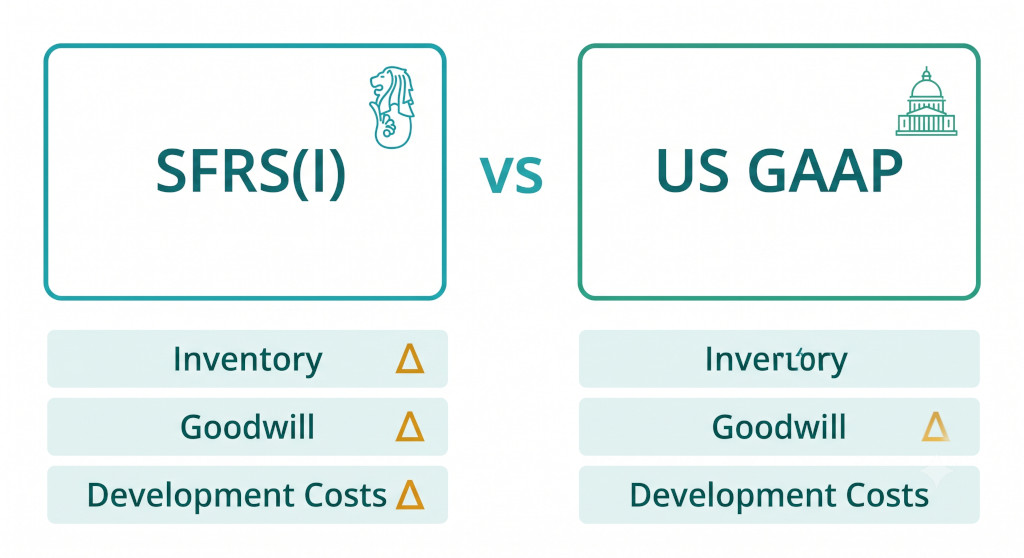
For finance teams at Singapore-based subsidiaries of US-listed companies, the need to report under two frameworks is a regular reality. The Singapore entity prepares statutory accounts under SFRS(I) for local compliance; the parent group requires a US GAAP reporting package for SEC filing purposes. Reconciling the two — understanding where the numbers will differ and why — is a practical skill that matters every quarter-end.
More broadly, any Singapore finance professional working with US investors, US joint venture partners, or US-domiciled holding companies will encounter US GAAP. Understanding where it diverges from SFRS(I) — and the underlying philosophy that drives those differences — is essential context for producing reliable group accounts and clear management commentary.
This guide covers the most significant differences between SFRS(I) and US GAAP, with particular attention to the areas that affect group consolidation and multi-entity financial reporting.
Automate NCI calculations across all your entities.
BrizoConsol handles non-controlling interest automatically — no manual adjustments required.
The Fundamental Divide: Principles-Based vs Rules-Based
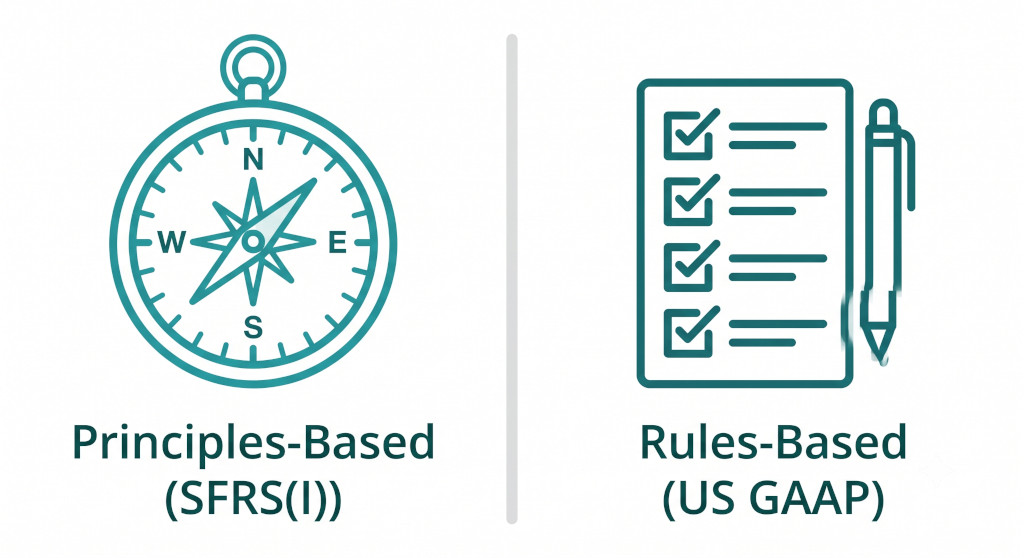
The single most important difference between SFRS(I) and US GAAP is not a specific accounting treatment — it is the underlying philosophy of each framework.
SFRS(I), like the IFRS on which it is based, is a principles-based framework. It establishes broad objectives and principles and requires preparers to exercise professional judgement in applying them to their specific circumstances. Where a transaction or arrangement is unusual or not explicitly addressed, the preparer looks to the framework’s principles and applies them in good faith.
US GAAP, issued by the Financial Accounting Standards Board (FASB) and overseen by the Securities and Exchange Commission (SEC), is predominantly a rules-based framework. It contains extensive, detailed, industry-specific guidance — the Accounting Standards Codification (ASC) runs to thousands of pages. Where SFRS(I) might give a preparer a principle and trust their judgement, US GAAP is more likely to prescribe the exact treatment with bright-line tests and numerical thresholds.
In practice, this means that the same economic transaction can produce different reported numbers under the two frameworks — not because the underlying reality differs, but because the accounting model each framework uses to capture that reality is different.
The principles-vs-rules distinction matters most when a transaction is novel or sits at the edge of an existing standard. Under SFRS(I), the preparer applies their judgement guided by the framework’s objectives. Under US GAAP, they look for specific codification guidance — and if it does not exist, the answer is less clear.
Key Accounting Differences: A Comparison
| Area | SFRS(I) | US GAAP |
|---|---|---|
| Framework type | Principles-based; issued by ASC Singapore, aligned with IASB | Rules-based; issued by FASB, codified in ASC |
| Inventory valuation | FIFO or weighted average only. LIFO is prohibited. | FIFO, weighted average, or LIFO permitted. LIFO is widely used in the US for tax reasons. |
| Development costs | Capitalise if criteria met (technical feasibility, intention to complete, ability to use/sell, future economic benefits, resources available, ability to measure). Capitalised amounts amortised over useful life. | Both research and development costs are generally expensed as incurred. Only certain software development costs may be capitalised under ASC 350-40. |
| Revaluation of PP&E | Revaluation model permitted — assets can be carried at fair value with revaluation surplus recognised in OCI. | Only the cost model is permitted. Revaluation of PP&E to fair value is not allowed. |
| Investment property | Fair value model or cost model permitted under SFRS(I) 1-40. | Only the cost model (with depreciation). Fair value model for investment property is not available. |
| Goodwill | Not amortised; subject to annual impairment test (or more frequently if indicators exist). Impairment is irreversible. | Public companies: not amortised; annual impairment test. Private companies: may elect to amortise over up to 10 years. Impairment test simplified to one-step approach. |
| Impairment of assets | Recoverable amount = higher of fair value less costs of disposal and value in use. Reversals of impairment permitted (except goodwill). | Two-step impairment test (recoverability then measurement). Reversals of impairment not permitted for long-lived assets. |
| Leases (lessee) | SFRS(I) 16: almost all leases recognised on balance sheet as right-of-use asset and lease liability. Limited exemptions for short-term and low-value leases. | ASC 842: similar on-balance-sheet model, but distinguishes between finance and operating leases on the income statement — operating leases show a straight-line expense rather than front-loaded interest + depreciation. |
| Biological assets | SFRS(I) 1-41: measured at fair value less costs to sell. | No equivalent standard. Generally measured at cost. Relevant for agriculture, aquaculture, and F&B groups. |
| Provisions | Recognised when probable (>50%) and can be reliably estimated. | Recognised when probable and reasonably estimable. “Probable” interpreted similarly, but guidance is more detailed on specific types of contingencies. |
| Extraordinary items | Not permitted as a separate line item — unusual items disclosed in notes. | Eliminated by FASB in 2015 (ASU 2015-01) — no longer permitted. |
Inventory: The LIFO Difference
The prohibition on LIFO (Last In, First Out) inventory costing under SFRS(I) is one of the most practically significant differences for groups with US operations. Many US companies use LIFO for tax purposes — in an inflationary environment, LIFO produces a higher cost of goods and therefore lower taxable income. This makes LIFO an attractive choice for US tax planning.
Because SFRS(I) prohibits LIFO, a Singapore entity that is part of a US group using LIFO will need to maintain a separate FIFO or weighted average inventory calculation for its SFRS(I) statutory accounts. The LIFO reserve — the cumulative difference between LIFO and FIFO inventory values — must be understood and tracked to produce accurate SFRS(I) numbers. For groups with significant inventory, this reconciliation can be material.
Development Costs: Capitalise or Expense?
The treatment of development costs represents one of the starker philosophical differences between the two frameworks. Under SFRS(I) 1-38, development costs that meet specific criteria — including technical feasibility, intention to complete, ability to generate future economic benefits, and the availability of adequate resources — must be capitalised and amortised over the asset’s useful life.
Under US GAAP, research and development expenditure is generally expensed as incurred under ASC 730. The only significant exception is internal-use software development, where certain costs in the application development stage may be capitalised under ASC 350-40.
For Singapore technology groups or pharmaceutical companies with significant development programmes, this difference can produce a material divergence in reported profit and asset values between SFRS(I) and US GAAP reporting packages. Under SFRS(I), a successful development project will show capitalised development costs on the balance sheet, amortising over time. Under US GAAP, those same costs hit the income statement immediately.
Goodwill and Impairment
Both SFRS(I) and US GAAP prohibit the amortisation of goodwill for public companies, instead requiring an annual impairment test. However, the mechanics differ in two respects.
First, US GAAP (ASC 350) allows private companies to elect to amortise goodwill on a straight-line basis over a period not exceeding ten years under the Private Company Council alternative. No equivalent simplification exists under SFRS(I) for private entities — goodwill is tested for impairment regardless of entity size.
Second, the impairment test methodology differs. Under SFRS(I) 1-36, the recoverable amount is the higher of fair value less costs of disposal and value in use (discounted cash flows). Under US GAAP, following ASU 2017-04, the impairment test compares the carrying amount of a reporting unit — including goodwill — to its fair value. If the carrying amount exceeds fair value, the excess is the impairment charge. The older two-step test (which involved calculating implied goodwill) was eliminated for most entities.
Importantly, under SFRS(I), impairment losses on assets other than goodwill may be reversed in subsequent periods if the recoverable amount recovers. Under US GAAP, impairment of long-lived assets is not reversible.
Consolidation: Control Model vs Variable Interest Entity Model
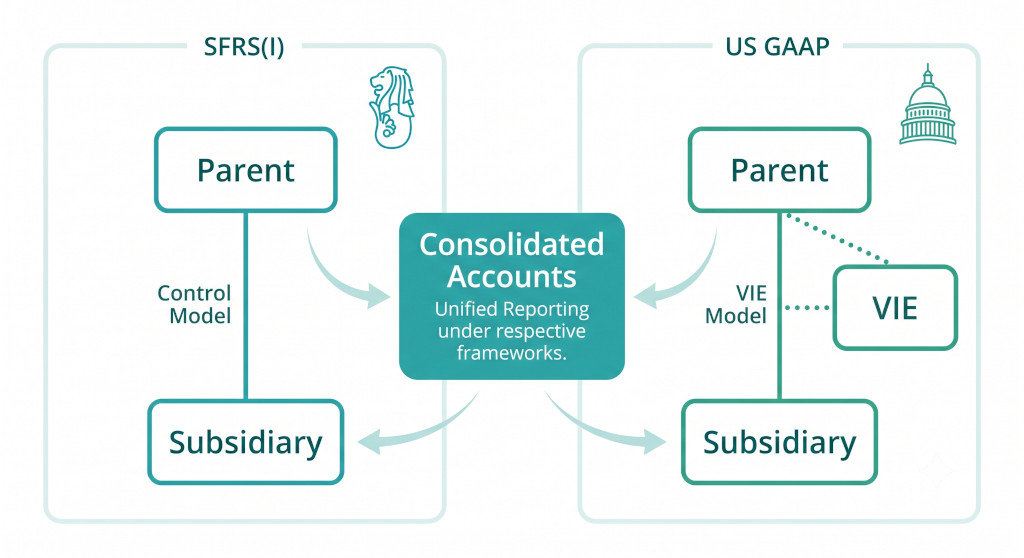
The consolidation frameworks under SFRS(I) and US GAAP share the same objective — to present the financial results of a group as if it were a single economic entity — but they reach that objective through different models.
SFRS(I) 10: The Control Model
SFRS(I) 10 (equivalent to IFRS 10) uses a single control model. An investor consolidates an entity when it has power over the investee, exposure to variable returns from the investee, and the ability to use its power to affect those returns. Control is assessed holistically, using professional judgement. The same model applies to all types of entities, whether structured or otherwise.
US GAAP ASC 810: The VIE Model
US GAAP under ASC 810 has a more complex structure. It retains the voting interest model for conventional subsidiaries (similar to the control model), but adds a separate Variable Interest Entity (VIE) framework for entities that lack sufficient equity at risk to finance their activities without additional financial support, or where equity investors lack the typical characteristics of a controlling financial interest.
The VIE model requires entities to assess whether they are the “primary beneficiary” of a VIE — defined as the entity with the power to direct the activities that most significantly affect the VIE’s economic performance, and the obligation to absorb losses or receive benefits. Primary beneficiaries must consolidate VIEs even if they hold no equity interest. This framework was strengthened significantly following the Enron collapse and again after the 2008 financial crisis.
For Singapore groups with structured financing arrangements, special purpose vehicles, or entities where the equity structure is complex, the VIE assessment under US GAAP can produce a different consolidation scope than the SFRS(I) 10 control assessment. Structures that are clearly non-consolidated under SFRS(I)’s principles may fall within scope under the more prescriptive VIE rules.
Singapore subsidiaries of US-listed parents frequently encounter the VIE question when the group has structured entities — joint ventures with complex profit-sharing arrangements, securitisation vehicles, or entities with non-standard governance. The consolidation conclusion may genuinely differ between the SFRS(I) statutory accounts and the US GAAP group report.
Foreign Currency Translation
Both SFRS(I) 1-21 and ASC 830 use the functional currency concept and broadly the same translation approach: assets and liabilities translated at the closing rate, income and expenses at the average rate for the period, with cumulative translation differences recognised in other comprehensive income (the cumulative translation adjustment, or CTA). For most groups, the foreign currency translation mechanics will produce the same result under both frameworks.
Differences can arise in edge cases — for example, in highly inflationary economies, ASC 830 requires the use of the temporal method (translating at historical rates for non-monetary items) rather than the current rate method. SFRS(I) 1-21 and SFRS(I) 1-29 address hyper-inflation through a different mechanism, restating local currency financial statements before translation. For Singapore groups with subsidiaries in hyper-inflationary economies, this treatment difference requires careful attention.
Practical Implications for Singapore Groups With US Connections
For a Singapore entity that is a subsidiary of a US-listed parent, the most common practical challenge is maintaining two sets of accounting records — or at minimum, a clear reconciliation between SFRS(I) statutory accounts and the US GAAP reporting package. The areas most likely to produce material reconciling items are development costs (if significant R&D is undertaken), inventory (if LIFO is used by the US parent), PP&E revaluation (if the Singapore entity uses the revaluation model), and lease classification on the income statement.
For a Singapore-listed group that has US joint venture partners or US investors requiring US GAAP financials for their own reporting, the VIE assessment and the development cost treatment are typically the first areas to review.
Note: This guide provides a general overview of the key differences between SFRS(I) and US GAAP. The accounting treatment for specific transactions can be complex and depends on the facts and circumstances of each case. Always consult a qualified accountant or auditor when preparing financial statements under either framework.
Consolidation Software and Dual-Framework Reporting
Where a group needs to produce consolidated accounts under both SFRS(I) and US GAAP, the most efficient approach is to maintain a single consolidation model and apply adjustments for the framework-specific differences — the LIFO reserve, the development cost capitalisation reversal, the VIE inclusion or exclusion — as top-side journals at the consolidation level.
Cloud consolidation software that supports multiple scenarios and adjustment journals makes this significantly more manageable. Rather than maintaining two entirely separate consolidation workbooks, the group can run a single consolidation and apply a small number of well-documented adjustments to move from the SFRS(I) result to the US GAAP result, with a clear reconciliation between the two.
Consolidating a Singapore group under SFRS(I)?
BrizoConsol connects to Xero, QuickBooks, MYOB, and Zoho Books — automate your intercompany eliminations, currency translation, and consolidated reporting from one platform. Start Free Trial