NCI and Currency Translation Adjustments: How to Split the CTA in Partly-Owned Foreign Subsidiaries
Most finance teams understand the mechanics of currency translation well enough: income statement items are translated at the average rate for the period, balance sheet items at the closing rate, and the resulting difference lands in other comprehensive income as the currency translation adjustment — the CTA. When the parent wholly-owns the foreign subsidiary, that’s the end of the story. The entire CTA belongs to the parent’s shareholders.
But what happens when the foreign subsidiary is only 75% owned? Or 60%? The CTA doesn’t belong entirely to the parent. Part of it belongs to the non-controlling interest. And most finance teams either get this wrong, handle it through guesswork, or don’t realise the error exists until an auditor or a disposal surfaces it.
This article explains why the CTA must be split when there is an NCI, how to do it correctly under IFRS, and where the common mistakes appear in practice — with a worked numerical example so you can trace the logic through to the final balance sheet.
Automate NCI calculations across all your entities.
BrizoConsol handles non-controlling interest automatically — no manual adjustments required.
Why the CTA Must Be Allocated to NCI
Under IAS 21 (The Effects of Changes in Foreign Exchange Rates), when a group consolidates a foreign subsidiary, it translates that subsidiary’s financial statements into the group’s presentation currency using three different rates:
- Income and expenses are translated at the exchange rate at the date of each transaction, or the average rate as a practical approximation
- Assets and liabilities are translated at the closing rate at the reporting date
- Equity items are translated at historical rates — the rate at the date equity was contributed, or the rate at which retained earnings were earned
Because three different rates apply to different line items, the translated balance sheet will not arithmetically close without a balancing figure. That figure is the CTA — recognised in other comprehensive income and accumulated in equity as the Foreign Currency Translation Reserve (FCTR).
Now consider a foreign subsidiary with a non-controlling interest. The NCI holds a genuine economic stake in that subsidiary’s net assets. If those net assets increase in translated value because the subsidiary’s functional currency has strengthened, the NCI benefits from that increase just as much as the parent does — proportionally. It follows that the CTA, which represents the translation gain or loss on those net assets, belongs partly to the NCI and not entirely to the parent’s shareholders.
Failing to make this split means the NCI line on your consolidated balance sheet is understated, and the parent’s FCTR is overstated by the same cumulative amount. The error compounds with each reporting period and becomes particularly visible at disposal: when the accumulated FCTR is recycled to the income statement on sale of the subsidiary, the wrong amount will be recycled if the reserve was never correctly allocated.
The Two NCI Measurement Methods and What They Mean for CTA
Before working through the calculation, it’s worth clarifying how your choice of NCI measurement method — made at the date of acquisition under IFRS 3 — affects how the CTA is handled.
Proportionate method (share of identifiable net assets)
Under the proportionate method, NCI at acquisition is measured at the NCI’s share of the fair value of the subsidiary’s identifiable net assets. No goodwill is attributed to the NCI. CTA is then split proportionately: if NCI holds 25%, it receives 25% of the CTA on the net assets each period. This is the simpler approach and the one most SME groups and accounting firms use in practice.
Full goodwill method (fair value)
Under the full goodwill method, NCI at acquisition is measured at its fair value, which means the NCI carries a portion of goodwill. Because goodwill is denominated in the subsidiary’s functional currency under IAS 21, it is treated as an asset of the foreign operation and translated at the closing rate each period. A CTA therefore arises on the goodwill balance as well, and that goodwill CTA must be calculated separately and allocated between parent and NCI in proportion to how goodwill was split at acquisition.
The full goodwill method meaningfully increases the complexity of the CTA calculation. The worked example below uses the proportionate method, which reflects the approach taken by most groups in practice.
Worked Example: Calculating and Splitting the CTA
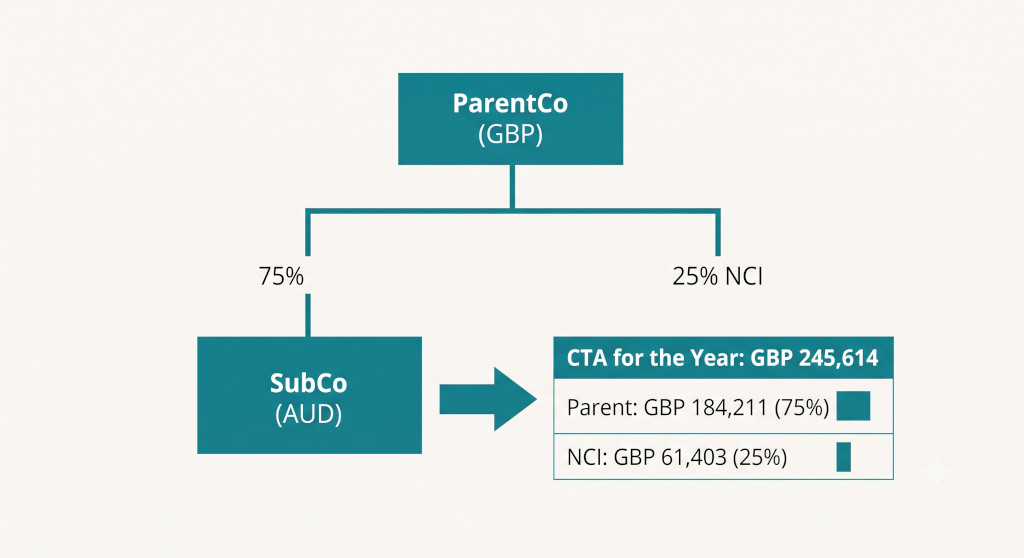
The scenario: ParentCo is a UK company with GBP as its presentation currency. It owns 75% of SubCo, an Australian company whose functional currency is AUD. The remaining 25% is held by a non-controlling interest. NCI is measured using the proportionate method.
At the start of the year, SubCo’s net assets are AUD 4,000,000. During the year, SubCo earns a profit of AUD 800,000. No dividends are paid and there are no other equity movements.
Exchange rates:
- Opening rate: 1 GBP = 2.00 AUD
- Average rate for the year: 1 GBP = 1.90 AUD
- Closing rate: 1 GBP = 1.80 AUD
AUD has strengthened against GBP during the year. The group therefore expects a translation gain — its Australian net assets are worth more in GBP at the closing rate than at the opening rate.
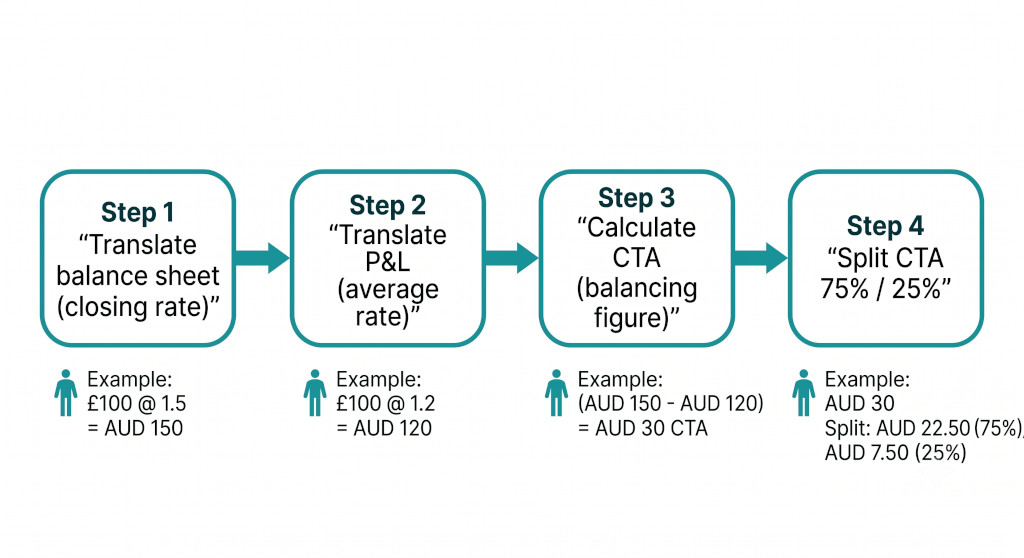
Step 1 — Translate SubCo’s financial position
| Item | AUD | Rate applied | GBP |
|---|---|---|---|
| Opening net assets | 4,000,000 | Opening (÷ 2.00) | 2,000,000 |
| Profit for the year | 800,000 | Average (÷ 1.90) | 421,053 |
| Closing net assets | 4,800,000 | Closing (÷ 1.80) | 2,666,667 |
Step 2 — Calculate the CTA as the balancing figure
The CTA is the difference between the closing net assets translated at the closing rate, and what you would expect from simply adding translated profit to opening net assets.
Closing net assets at closing rate GBP 2,666,667
Less: Opening net assets at opening rate (GBP 2,000,000)
Less: Profit at average rate (GBP 421,053)
CTA for the year (translation gain) GBP 245,614
Step 3 — Split the CTA between parent and NCI
Under the proportionate method, the CTA is split in proportion to the ownership percentages:
CTA attributable to parent (75%) = GBP 245,614 × 75% = GBP 184,211
CTA attributable to NCI (25%) = GBP 245,614 × 25% = GBP 61,403
Step 4 — Split profit between parent and NCI
Profit attributable to parent (75%) = GBP 421,053 × 75% = GBP 315,789
Profit attributable to NCI (25%) = GBP 421,053 × 25% = GBP 105,263
How this appears in the consolidated financial statements
| Line item | Parent shareholders | NCI | Total |
|---|---|---|---|
| Profit for the year | GBP 315,789 | GBP 105,263 | GBP 421,053 |
| OCI — CTA (translation gain) | GBP 184,211 | GBP 61,403 | GBP 245,614 |
| Total comprehensive income | GBP 500,000 | GBP 166,667 | GBP 666,667 |
As a cross-check: SubCo’s closing net assets are AUD 4,800,000. At the closing rate, this is GBP 2,666,667. The parent’s 75% share is GBP 2,000,000 and the NCI’s 25% is GBP 666,667. The opening position for each was GBP 1,500,000 (parent) and GBP 500,000 (NCI). Adding comprehensive income of GBP 500,000 (parent) and GBP 166,667 (NCI) reconciles exactly to the closing translated values. The numbers close.
The NCI’s total comprehensive income of GBP 166,667 reflects both what it earned (profit of GBP 105,263) and how its share of the subsidiary’s net assets changed in translated value (CTA of GBP 61,403). Both components belong to the NCI. Only the profit component is reflected if the CTA split is omitted.
The Equity Section: What It Looks Like
In the consolidated balance sheet, the equity section should reflect these allocations clearly. The movement for the year from SubCo’s contribution would appear as:
| Equity component | Movement | Driver |
|---|---|---|
| Retained earnings (parent share) | + GBP 315,789 | Profit attributable to parent shareholders |
| FCTR / translation reserve (parent share) | + GBP 184,211 | CTA attributable to parent shareholders |
| Non-controlling interest | + GBP 166,667 | NCI profit (GBP 105,263) + NCI CTA (GBP 61,403) |
Under IFRS, the NCI is presented as a single line within equity. The breakdown between the NCI’s retained earnings and its share of the FCTR is shown in the consolidated statement of changes in equity, where the NCI column should display both the profit allocation and the OCI (CTA) allocation separately for each period.
The Cumulative Position and Why It Compounds
The example above covers one period. In practice, the FCTR accumulates across years. Each period’s CTA movement is added to the reserve, with the split applied each time. If AUD continues to strengthen over several years, the NCI’s embedded share of the FCTR grows alongside the parent’s — and must be tracked consistently.
This matters most at disposal. When the group sells the foreign subsidiary, IAS 21 requires the cumulative FCTR to be reclassified from equity to profit or loss (recycled). If the FCTR has been correctly split from the outset, the parent’s share is recycled through the parent’s income statement and the NCI’s share is derecognised from the NCI line in equity. If the split was never applied, the entire FCTR sits under the parent’s reserve — and the full amount gets recycled on disposal, overstating the parent’s gain or loss on sale and misrepresenting what the NCI earned from currency movements over the life of the investment.
Even a “small” NCI of 15% in a foreign subsidiary with a cumulative FCTR of GBP 600,000 represents GBP 90,000 of NCI equity sitting in the wrong place. At disposal, that GBP 90,000 is recycled through the wrong line — a material misstatement of the disposal gain.
Where This Goes Wrong in Practice
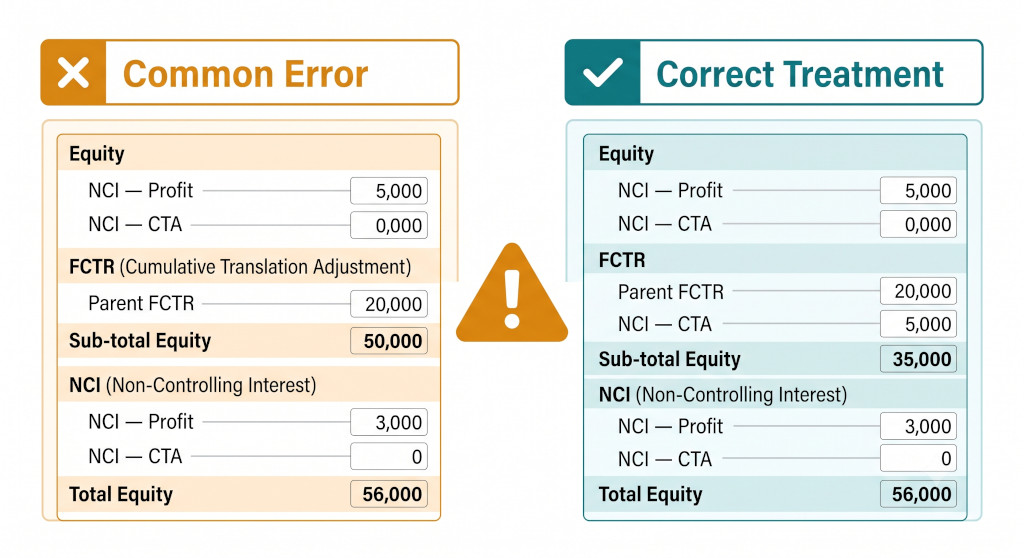
Not splitting the CTA at all
The most common error. The entire CTA is credited to the parent’s FCTR; the NCI line on the balance sheet reflects only the NCI’s share of retained earnings plus the original acquisition value. The NCI balance is understated by the cumulative unallocated CTA — often a material figure for groups with years of currency movement. Neither number looks obviously wrong until someone asks what the NCI balance represents if the subsidiary were sold.
Splitting the closing balance instead of the movement
A team correctly intends to split the CTA but applies the NCI percentage to the total closing FCTR balance each year rather than the movement for the period. In year one, this produces the same result. From year two onwards it misallocates: the movement is correctly identified, but applying the percentage to the cumulative balance double-counts the prior years’ allocation. The error is small in year two and can be significant by year five.
Profit and CTA treated inconsistently
The income statement correctly shows profit attributable to NCI and profit attributable to parent shareholders. But in the equity section, the CTA is not split — so the NCI column in the statement of changes in equity shows only profit, not total comprehensive income. The statement of comprehensive income and the equity section do not reconcile through total comprehensive income attributable to NCI. Auditors reviewing the equity movements will flag this; the harder problem is that it has often been accumulating for multiple years before anyone checks.
Watch out: If your consolidation workpapers show NCI comprehensive income equal to NCI profit, and there is a foreign subsidiary in the group with material currency movements, the CTA has almost certainly not been split correctly. The difference between the two figures is the NCI’s share of the FCTR movement for the period.
The Full Goodwill Method: The Additional Complication
If your group measures NCI using the full goodwill method, a goodwill balance attributable to the NCI exists in the subsidiary’s functional currency. Under IAS 21, goodwill arising on acquisition of a foreign operation is treated as an asset of that operation and is expressed in its functional currency. It is therefore translated at the closing rate at each reporting date, and a CTA arises on the goodwill balance.
This goodwill CTA must be calculated separately from the CTA on the identifiable net assets:
Goodwill (NCI portion) at closing rate
Less: Goodwill (NCI portion) at historical rate (acquisition date rate)
= CTA on NCI goodwill → allocated entirely to NCI
The total CTA movement for a period then comprises three components: CTA on identifiable net assets (split proportionately between parent and NCI), CTA on parent goodwill (entirely to parent), and CTA on NCI goodwill (entirely to NCI). Each is calculated and allocated separately. For groups using the proportionate NCI method — which excludes goodwill from the NCI altogether — this additional layer does not arise.
Disclosure Requirements Under IAS 21
IAS 21.52 requires groups to disclose the amount of exchange differences recognised in OCI during the period and the cumulative amount of exchange differences accumulated in a separate component of equity at the end of the period. For groups with significant NCI, the allocation between parent and NCI should be transparent in the statement of changes in equity.
The NCI column in the statement of changes in equity should show, as a minimum:
- Opening NCI balance
- Share of profit for the period
- OCI attributable to NCI (the CTA allocation for the period)
- Dividends paid to NCI holders
- Any transactions with NCI (acquisitions of additional shares, partial disposals)
- Closing NCI balance
If the CTA has not been allocated, the OCI row in the NCI column will be nil or missing, and total comprehensive income attributable to NCI will match profit attributable to NCI exactly. This is the tell. In a group with foreign subsidiaries and an NCI, those two figures should never be equal unless exchange rates were perfectly flat for the entire year.
How BrizoConsol Handles CTA Allocation for Partly-Owned Foreign Subsidiaries
When you set up a foreign subsidiary in BrizoConsol, you configure the ownership percentage as part of the entity setup. The platform applies the IAS 21 translation rules automatically — average rate for the income statement, closing rate for the balance sheet — and calculates the CTA as the balancing figure. The CTA is then allocated to the parent’s FCTR and the NCI’s equity line in proportion to the ownership split, without any manual journal entries required.
This means:
- Your consolidated balance sheet equity section shows the FCTR correctly allocated between shareholders and NCI each period
- The OCI section of your consolidated statement of comprehensive income presents the CTA split between parent and NCI transparently
- The NCI balance accumulates correctly over time, incorporating both profit and CTA movements
- For groups with multiple foreign subsidiaries, each with different NCI percentages, BrizoConsol performs the calculation independently for each entity
You can read more about how BrizoConsol handles currency translation and the CTA/FCTR and non-controlling interest across the consolidation workflow. If you’re working through the mechanics of how to calculate the cumulative CTA or how NCI is calculated in the first place, those articles cover the foundations in full.
Summary
When a foreign subsidiary has a non-controlling interest, the currency translation adjustment must be split between the parent’s shareholders and the NCI. Under the proportionate NCI method — the most common approach for SME groups under IFRS — the split mirrors the ownership percentages and is applied to the CTA movement for each reporting period.
The steps in practice:
- Translate the subsidiary’s income statement at the average rate and balance sheet at the closing rate
- Calculate the CTA as the balancing figure
- Allocate the CTA to parent and NCI in proportion to their ownership percentages
- Present both allocations in OCI and in the equity section of the consolidated balance sheet
- Accumulate both allocations in the FCTR and NCI equity line consistently across periods
Errors in this area compound silently over time and emerge most painfully at disposal or audit. If your consolidation process does not allocate the CTA to NCI automatically, you are carrying that risk manually — and it grows with every reporting period that passes.
Automate Your CTA and NCI Calculations
BrizoConsol handles currency translation and NCI allocation automatically — no manual journals, no spreadsheet risk. Connect your accounting data and produce a correctly calculated consolidated report on the same day. Start Free Trial