SFRS vs IFRS: Key Differences in Financial Reporting for Singapore Groups
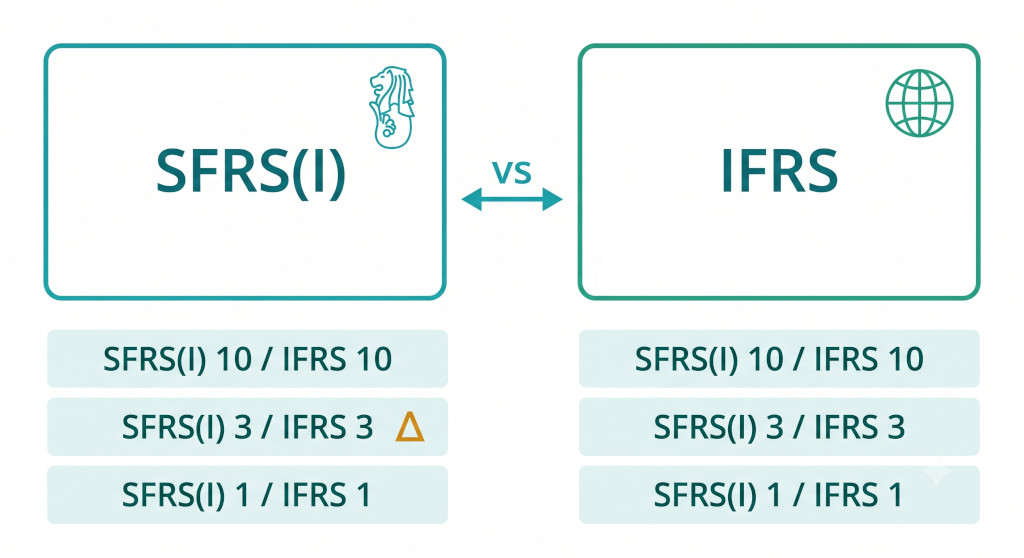
Singapore has one of the most internationally aligned accounting frameworks in Asia. Since 2018, listed companies in Singapore have applied Singapore Financial Reporting Standards (International) — commonly written as SFRS(I) — which is substantively identical to IFRS as issued by the International Accounting Standards Board. For most practical purposes, a consolidated set of accounts prepared under SFRS(I) will look very similar to one prepared under full IFRS.
But “substantively identical” does not mean identical. There are meaningful differences in scope, who issues the standards, how first-time adoption works, and how the framework applies to smaller entities. For finance teams at Singapore-based groups — particularly those with overseas subsidiaries or a mix of listed and unlisted entities — understanding where SFRS diverges from IFRS matters for both compliance and consolidation.
This guide sets out the key differences between SFRS(I) and IFRS, what each framework requires for group consolidation, and how Singapore entities should think about the two frameworks when structuring their group accounts.
Automate NCI calculations across all your entities.
BrizoConsol handles non-controlling interest automatically — no manual adjustments required.
What Is SFRS(I)?
SFRS(I) stands for Singapore Financial Reporting Standards (International). It was introduced by the Accounting Standards Council (ASC) of Singapore and became mandatory for Singapore-listed companies from financial years beginning on or after 1 January 2018.
The SFRS(I) framework was created to bring Singapore listed companies onto a common footing with IFRS, which is the dominant global standard used by listed companies in over 140 jurisdictions. Singapore’s Accounting Standards Council adopts IFRS pronouncements issued by the IASB and, in most cases, issues them as the equivalent SFRS(I) standard with minimal or no modification. SFRS(I) 10, for example, mirrors IFRS 10; SFRS(I) 3 mirrors IFRS 3; and so on.
Before 2018, Singapore had its own Financial Reporting Standards (FRS), which were broadly aligned with IFRS but maintained as a separate local framework. SFRS(I) replaced FRS for listed entities, while a separate framework — SFRS for Small Entities — was retained for non-publicly accountable companies.
The ASC’s stated policy is to adopt IFRS Standards without modification wherever possible. In practice, this means the vast majority of SFRS(I) content is identical to its IFRS counterpart — word for word, in most cases.
Which Entities Apply SFRS(I) vs SFRS for Small Entities?
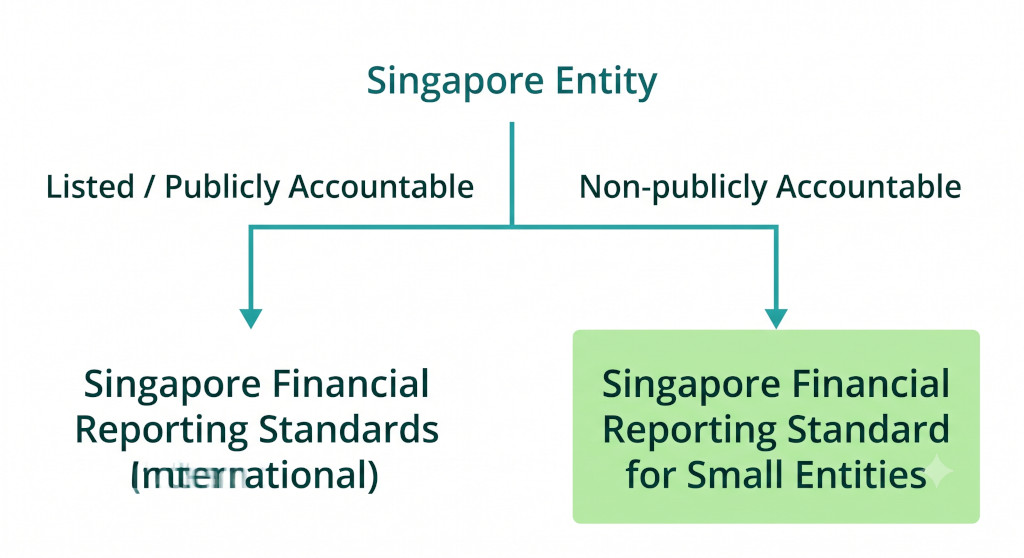
Not all Singapore companies apply SFRS(I). The framework that applies depends on whether an entity is publicly accountable.
SFRS(I) is required for entities listed on the Singapore Exchange (SGX) and other publicly accountable entities — those whose debt or equity instruments are traded in a public market, or that hold assets in a fiduciary capacity for a broad group of outsiders (such as banks and insurers). These entities must prepare full SFRS(I) financial statements, including consolidated accounts where they have subsidiaries.
SFRS for Small Entities is available to entities that are not publicly accountable and that meet the size criteria set by the ASC. It is a simplified framework, broadly comparable in structure to the IFRS for SMEs standard issued by the IASB, but adapted for Singapore. It reduces disclosure requirements and simplifies measurement for certain items, making it more practical for smaller businesses without the resources to maintain full SFRS(I) compliance.
For a Singapore group with a listed holding company, the consolidated financial statements will be prepared under SFRS(I). Individual subsidiaries — even unlisted ones — will typically also apply SFRS(I) for their standalone accounts if they are part of a group that consolidates under SFRS(I), to ensure consistency in the consolidation process.
SFRS(I) vs IFRS: The Key Differences
| Area | SFRS(I) | IFRS |
|---|---|---|
| Issuing body | Accounting Standards Council (ASC), Singapore | International Accounting Standards Board (IASB) |
| Jurisdiction | Singapore (mandatory for SGX-listed entities) | 140+ jurisdictions globally |
| First-time adoption | SFRS(I) 1 — includes specific relief for entities transitioning from old Singapore FRS to SFRS(I) | IFRS 1 — applies to entities adopting IFRS for the first time from any prior framework |
| Effective dates | Generally aligned with IASB, but ASC may adopt with a lag or issue Singapore-specific guidance on transition | Set by the IASB; applied globally on a consistent effective date |
| Small entity framework | SFRS for Small Entities — a Singapore-specific simplified framework | IFRS for SMEs — an internationally issued simplified framework |
| Numbering | SFRS(I) follows IFRS numbering — e.g. SFRS(I) 10, SFRS(I) 3, SFRS(I) 1-7 | IFRS and IAS numbering — e.g. IFRS 10, IFRS 3, IAS 7 |
| Content | Substantively identical to IFRS in almost all cases; Singapore-specific modifications are rare | Source standard; any differences from SFRS(I) originate here |
| Regulatory oversight | ASC; entities regulated by MAS (banks, insurers) may have additional requirements | No single global regulator; jurisdictions enforce locally |
First-Time Adoption: Where SFRS(I) 1 Differs from IFRS 1
The most operationally significant difference between SFRS(I) and IFRS is in first-time adoption. IFRS 1 governs how an entity prepares its first set of IFRS financial statements when transitioning from a non-IFRS framework. SFRS(I) 1 performs the same function but was specifically designed for the 2018 transition, when Singapore listed companies moved from old FRS to SFRS(I).
SFRS(I) 1 includes optional exemptions and mandatory exceptions that do not exist in IFRS 1, because they were tailored to the specific circumstances of entities that had previously applied Singapore FRS rather than another GAAP. For example, SFRS(I) 1 allowed entities to use deemed cost elections for property, plant and equipment where the old FRS carrying amount at the transition date was used as a proxy for cost — a relief that had practical relevance given the differences between old FRS and SFRS(I) measurement bases in certain areas.
For a company adopting IFRS from scratch today — for example, a Singapore subsidiary preparing a standalone IFRS report for an overseas parent — IFRS 1 rather than SFRS(I) 1 would be the applicable standard. Understanding which first-time adoption standard applies is important when a group’s Singapore entity needs to produce both SFRS(I) statutory accounts and IFRS-compliant reporting packages.
Consolidation Under SFRS(I): How It Compares to IFRS
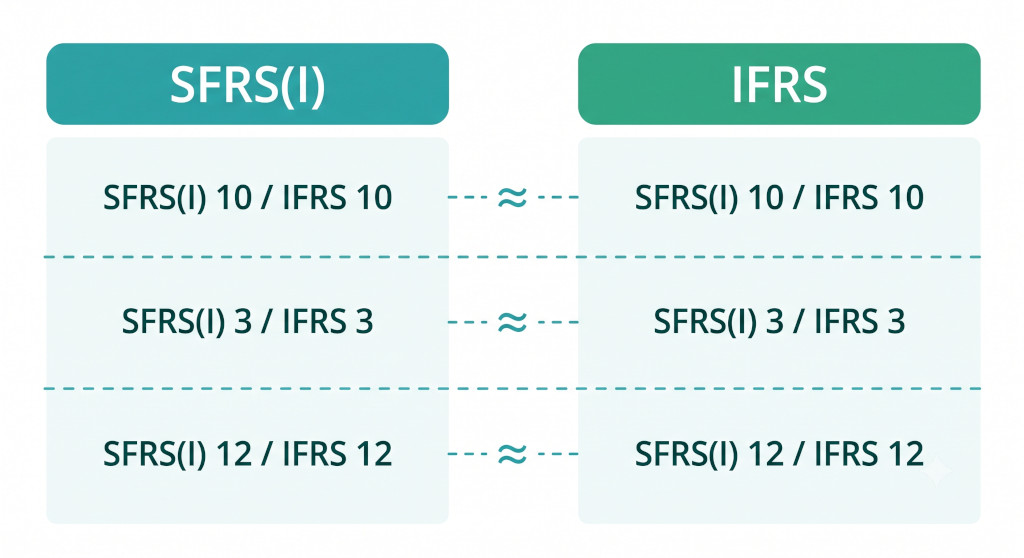
For groups producing consolidated financial statements, the good news is that the consolidation standards under SFRS(I) and IFRS are, for practical purposes, identical. The table below maps the key SFRS(I) consolidation standards to their IFRS equivalents.
| Topic | SFRS(I) Standard | IFRS Equivalent | Key Requirement |
|---|---|---|---|
| Consolidated Financial Statements | SFRS(I) 10 | IFRS 10 | Control-based consolidation; parent consolidates all subsidiaries it controls |
| Business Combinations | SFRS(I) 3 | IFRS 3 | Acquisition method; goodwill recognised at acquisition date |
| Interests in Other Entities — Disclosure | SFRS(I) 12 | IFRS 12 | Disclosures about subsidiaries, associates, joint arrangements, and structured entities |
| Investments in Associates & JVs | SFRS(I) 1-28 | IAS 28 | Equity method for associates and joint ventures |
| Joint Arrangements | SFRS(I) 11 | IFRS 11 | Classification of joint operations vs joint ventures; proportionate vs equity method |
| Foreign Currency Translation | SFRS(I) 1-21 | IAS 21 | Functional and presentation currency; translation of foreign operations |
| Non-controlling Interests | SFRS(I) 10 / SFRS(I) 3 | IFRS 10 / IFRS 3 | NCI measured at fair value or proportionate share of net assets at acquisition |
Because these standards are substantively identical, a Singapore group preparing consolidated accounts under SFRS(I) will follow the same consolidation process as a group preparing under full IFRS: combine all controlled entities line by line, eliminate intercompany transactions, translate foreign subsidiaries at the closing rate, and calculate goodwill and non-controlling interest on acquisition.
For multi-entity Singapore groups using cloud accounting software such as Xero, QuickBooks, or MYOB for their individual entities, the consolidation process is the same whether the group reports under SFRS(I) or full IFRS. The standards that govern what must be eliminated and how foreign currency subsidiaries are translated are functionally the same in both frameworks.
Effective Dates and Adoption Timing
One area where Singapore groups occasionally encounter a practical difference is effective dates. The IASB issues new standards and amendments with a specified mandatory effective date — typically one to two years after publication. The ASC generally adopts these on the same date, but there are occasions where Singapore-specific guidance on transition, or a short lag in formal adoption, means the effective date for SFRS(I) differs slightly from the IASB’s date.
For finance teams at Singapore groups with offshore entities reporting under full IFRS, it is worth monitoring ASC announcements alongside IASB publications, particularly for major new standards. In most cycles this makes no material difference, but for standards with complex transition requirements — such as IFRS 17 on insurance contracts — local adoption timing can affect planning.
Practical Implications for Singapore Group Finance Teams
For the majority of Singapore groups preparing consolidated financial statements, the choice between SFRS(I) and IFRS is not a free choice — it is determined by whether the group is listed on the SGX. Listed groups apply SFRS(I); unlisted groups have more flexibility.
Where the distinction matters most in practice is in cross-border groups: a Singapore holding company consolidating overseas subsidiaries that report under full IFRS will need to ensure its group reporting pack aligns with SFRS(I) requirements, and any differences in effective dates or disclosure requirements are identified and addressed before the consolidated accounts are finalised.
For unlisted Singapore groups, the decision between SFRS(I) and SFRS for Small Entities is worth taking seriously. SFRS for Small Entities significantly reduces disclosure requirements and simplifies some measurement rules, which can reduce the time and cost of financial statement preparation for smaller entities. However, if the group is considering a future listing, or if a majority overseas parent requires IFRS-compliant reporting packages, starting with SFRS(I) avoids a potentially disruptive transition later.
Note for finance teams: This guide provides a general overview of the differences between SFRS(I) and IFRS. For specific compliance questions — particularly around first-time adoption elections, disclosure requirements, or whether SFRS for Small Entities applies to your entity — consult a qualified accountant or auditor familiar with Singapore financial reporting requirements.
Consolidation Software and SFRS(I) Compliance
Whether your Singapore group reports under SFRS(I) or full IFRS, the mechanics of group consolidation are the same: combine, eliminate, translate, and present. Consolidation software does not need to be standards-specific in most respects — the intercompany eliminations, foreign currency translation adjustments, and non-controlling interest calculations it performs are identical whether the output is labelled SFRS(I) or IFRS.
What matters is that the tool correctly applies the closing rate for balance sheet translation, the average rate for income statement translation, recognises the cumulative translation adjustment (CTA) in equity, and allows you to document your elimination entries with sufficient detail for audit purposes. These requirements are consistent across both frameworks.
Consolidating a Singapore group under SFRS(I) or IFRS?
BrizoConsol connects to Xero, QuickBooks, MYOB, and Zoho Books. Automate intercompany eliminations, currency translation, and consolidated reporting — whichever framework your group applies. Start Free Trial